What does an exchange administrator do?
An Exchange Administrator is responsible for setting up and managing an organization's Microsoft Exchange server. As an Exchange Administrator, you will assist in creating mailboxes and user accounts as well as restoring files and backup security. You will also conduct routine maintenance of the server, configure new users, and help in managing server infrastructure. Other duties include managing email-related tools and systems, assisting in server migration and disaster recovery, and handling and managing client inquiries.
Exchange administrator responsibilities
Here are examples of responsibilities from real exchange administrator resumes:
- Monitor, maintain, and manage Citrix XenApp user sessions and support their ThinClients.
- Manage IIS 6.0 and IIS 7.0 server clusters and services across multiple sites and domains.
- Save company many hours of manual testing and developing by engineering Java applications to automate tedious tasks.
- Utilize strong working knowledge of TCP/IP, DHCP, HTTP, LDAP, SNMP, SMTP, and other networking protocols.
- Subject matter expert on the Linux and UNIX servers.
- Perform multiple batch moves from on-premise exchange environment to O365.
- Experience in DNS administration, installation of DHCP, configuration of DHCP scopes.
- Configure DNS and DHCP servers to provide name resolution and IP connectivity for users.
- Team participant in infrastructure planning and implementation of the organization's disaster recovery site.
- Provide support for HTTP, POP3, IMAP, LDAP, and SMTP.
- Optimize the existing SCCM environment.
- Maintain SQL databases by updating and compiling reports.
- Deploy and configure DHCP server, print server.
- Install and configure SQL server, and Packman front-end.
- Provide LYNC to LYNC video calling to VIP users.
Exchange administrator skills and personality traits
We calculated that 8% of Exchange Administrators are proficient in PowerShell, Windows Server, and Troubleshoot. They’re also known for soft skills such as Analytical skills, Communication skills, and Problem-solving skills.
We break down the percentage of Exchange Administrators that have these skills listed on their resume here:
- PowerShell, 8%
Automated and executed Office 365 administrative tasks via PowerShell such as user account licensing and statistic reporting.
- Windows Server, 7%
Hold multifaceted responsibilities for configuring, installing and administering Windows servers and telecommunications systems that supported staff of 500 personnel.
- Troubleshoot, 7%
Blackberry and Good-mobile administration services to include: management and troubleshoot user accounts, application control policies and software configuration.
- Infrastructure, 6%
Coordinated and ensured the successful installation and configuration of critical Iraqi Command and Control Data and Voice network infrastructure.
- Microsoft Exchange, 6%
Experience in configuring and troubleshooting Blackberry Enterprise and Microsoft Exchange.
- Mobile Device Management, 4%
Trouble shoot with mail flow issue to BB Mobile Device Management.
Most exchange administrators use their skills in "powershell," "windows server," and "troubleshoot" to do their jobs. You can find more detail on essential exchange administrator responsibilities here:
Analytical skills. To carry out their duties, the most important skill for an exchange administrator to have is analytical skills. Their role and responsibilities require that "administrators need to evaluate networks and systems to make sure that they perform reliably and to anticipate new requirements as customers’ needs change." Exchange administrators often use analytical skills in their day-to-day job, as shown by this real resume: "managed site connectivity and replication throughout the organization and handled daily aspects of exchange such as database maintenance and connectivity. "
Communication skills. Another essential skill to perform exchange administrator duties is communication skills. Exchange administrators responsibilities require that "administrators must describe problems and their solutions to non-it workers." Exchange administrators also use communication skills in their role according to a real resume snippet: "consulted with hardware, communications and database experts and/or vendors to ensure viability of systems. "
Problem-solving skills. This is an important skill for exchange administrators to perform their duties. For an example of how exchange administrator responsibilities depend on this skill, consider that "administrators must quickly resolve problems that arise with computer networks." This excerpt from a resume also shows how vital it is to everyday roles and responsibilities of an exchange administrator: "implemented email encryption solution utilizing cisco's registered envelope technology. ".
The three companies that hire the most exchange administrators are:
- Leidos4 exchange administrators jobs
- PeaceHealth2 exchange administrators jobs
- Randstad North America, Inc.2 exchange administrators jobs
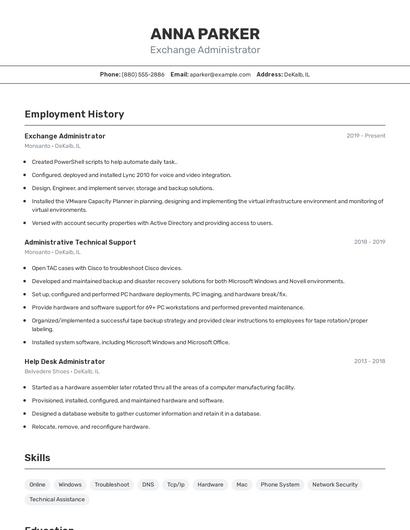
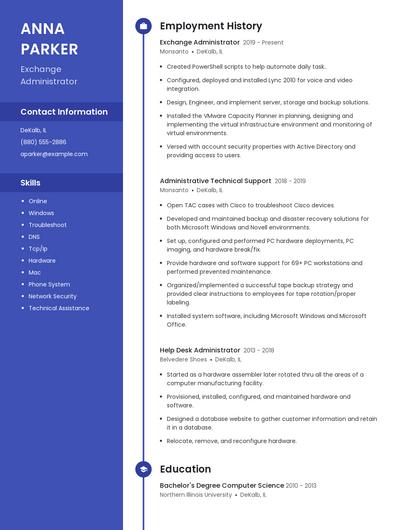
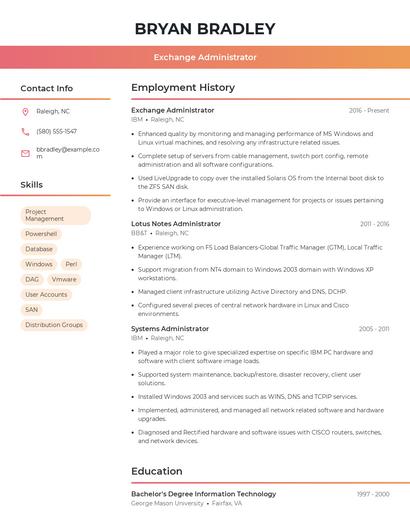
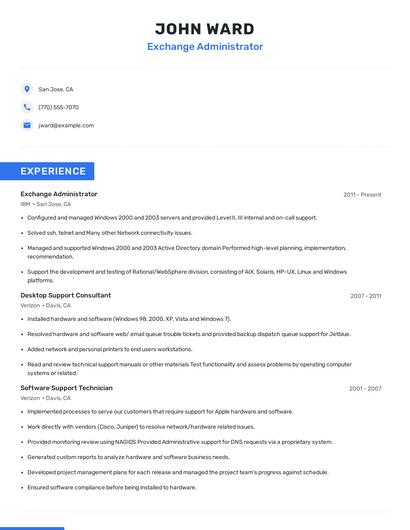
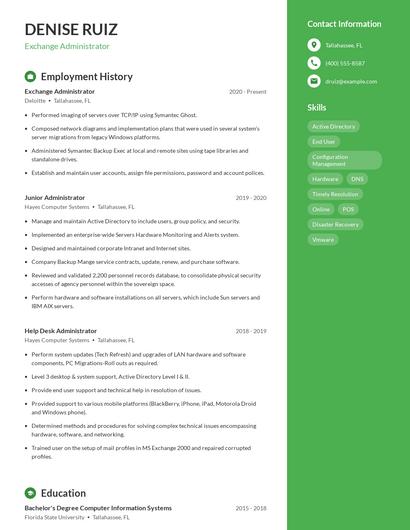
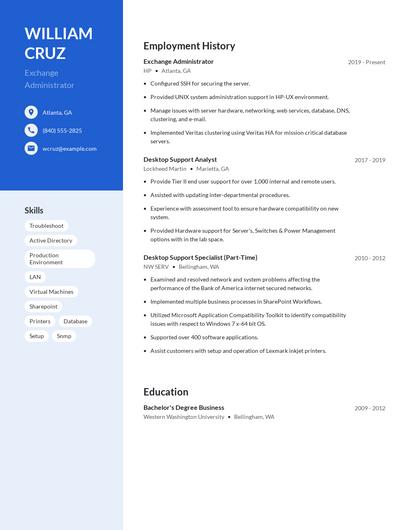
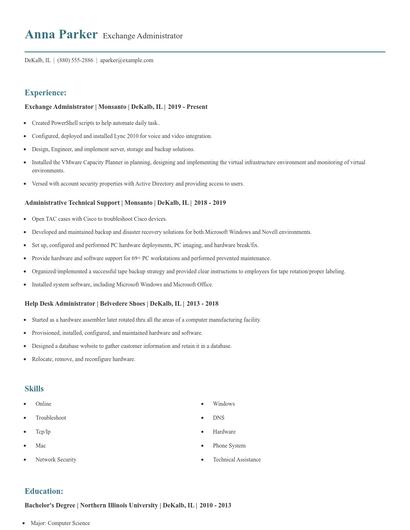
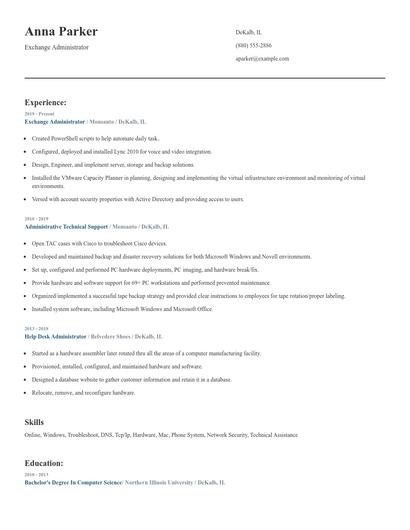
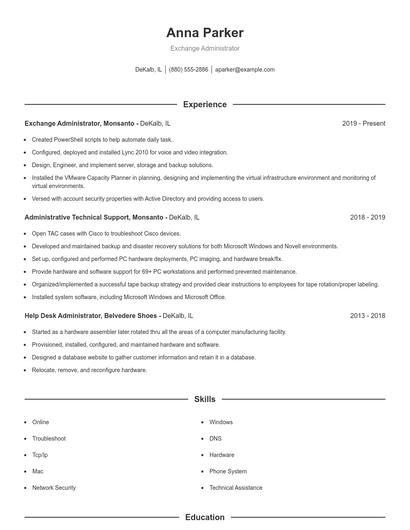
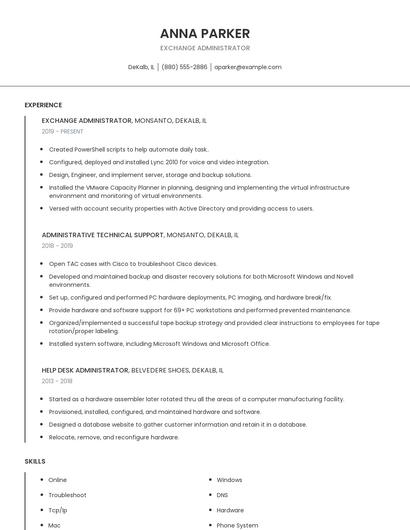
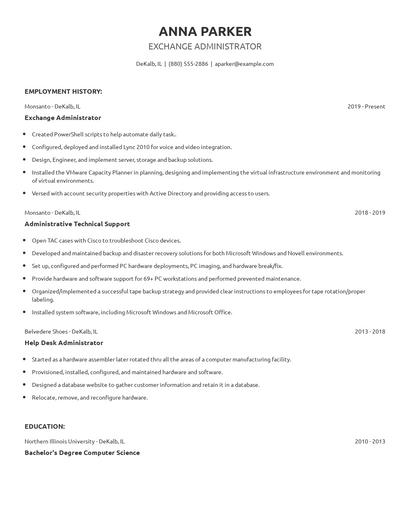
Choose from 10+ customizable exchange administrator resume templates
Build a professional exchange administrator resume in minutes. Our AI resume writing assistant will guide you through every step of the process, and you can choose from 10+ resume templates to create your exchange administrator resume.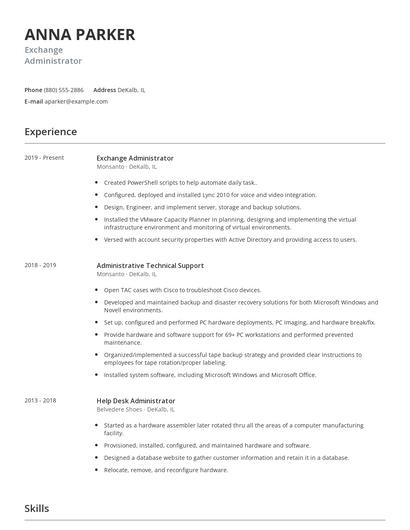
Compare different exchange administrators
Exchange administrator vs. Network/server administrator
A Network Administrator ensures an organizations' network is operational and up to date. They solve problems that arise within computer networks, maintaining computer networks, interacting with clients, and consulting with them to determine their system requirements.
There are some key differences in the responsibilities of each position. For example, exchange administrator responsibilities require skills like "infrastructure," "mobile device management," "exchange server," and "cloud." Meanwhile a typical network/server administrator has skills in areas such as "customer service," "linux," "server administration," and "sql server." This difference in skills reveals the differences in what each career does.
Network/server administrators tend to make the most money working in the manufacturing industry, where they earn an average salary of $84,609. In contrast, exchange administrators make the biggest average salary, $100,088, in the finance industry.network/server administrators tend to reach similar levels of education than exchange administrators. In fact, network/server administrators are 2.4% less likely to graduate with a Master's Degree and 0.1% more likely to have a Doctoral Degree.Exchange administrator vs. Information technology administrator
An Information Technology (IT) administrator is an individual responsible for managing the day-to-day operation of an organization's IT systems and ensuring that the systems are running effectively. IT administrators must conduct consistent analyses of the computer system and install updates when needed. They are required to assess the organization's security programs and run the system for viruses and spyware. IT administrators also extend support to the organization's end-users and train them on desktop applications.
In addition to the difference in salary, there are some other key differences worth noting. For example, exchange administrator responsibilities are more likely to require skills like "powershell," "infrastructure," "cloud," and "sql." Meanwhile, an information technology administrator has duties that require skills in areas such as "customer service," "linux," "switches," and "sql server." These differences highlight just how different the day-to-day in each role looks.
Information technology administrators earn a lower average salary than exchange administrators. But information technology administrators earn the highest pay in the finance industry, with an average salary of $93,678. Additionally, exchange administrators earn the highest salaries in the finance with average pay of $100,088 annually.In general, information technology administrators achieve similar levels of education than exchange administrators. They're 0.8% less likely to obtain a Master's Degree while being 0.1% more likely to earn a Doctoral Degree.What technology do you think will become more important and prevalent for exchange administrators in the next 3-5 years?
David Groshoff
Exchange administrator vs. Systems administrator lead
A systems administrator lead is responsible for planning, designing, and implementing procedures for critical enterprise systems. Typical duties of systems administrators include managing the day-to-day operations of a company's computer and network systems, developing new application and system implementation plans, and establishing guidelines for installing and managing the organization's computer operating systems. In addition, you are expected to ensure the security of computer systems by preventing unauthorized use, user abuse, and acts of nature.
There are many key differences between these two careers, including some of the skills required to perform responsibilities within each role. For example, an exchange administrator is likely to be skilled in "powershell," "troubleshoot," "infrastructure," and "exchange server," while a typical systems administrator lead is skilled in "linux," "project management," "system performance," and "dod."
Systems administrator leads make a very good living in the telecommunication industry with an average annual salary of $103,205. On the other hand, exchange administrators are paid the highest salary in the finance industry, with average annual pay of $100,088.systems administrator leads typically earn similar educational levels compared to exchange administrators. Specifically, they're 2.4% more likely to graduate with a Master's Degree, and 0.7% more likely to earn a Doctoral Degree.Exchange administrator vs. Windows system administrator
A Windows System Administrator maintains the systems and servers of a Windows operating system. They evaluate and modify the system's performance.
Types of exchange administrator
Updated January 8, 2025
