
Automatically apply for jobs with Zippia
Upload your resume to get started.
Family educator skills for your resume and career
15 family educator skills for your resume and career
2. Child Development
- Conducted weekly home-visits that provided comprehensive information about pregnancy, childbirth preparation, infant care and child development.
- Case management /recruitment, Community resource referrals, Child Development Education, Ongoing child development assessments
3. CPR
Cardiopulmonary resuscitation or CPR is a medical procedure that involves chest compression to help a patient breathe. This artificial ventilation helps in keeping the brain function in place and regulates blood throughout the body. CPR is a lifesaving procedure that is used in emergencies.
- Directed and monitored hospital wide/community CPR education program which certified over 2,000 participants per year.
- Evaluate staff performance and identify necessary training and support resources (PCM, CPR, Epi-Pen and medication regimes.)
4. Childhood Education
- Created lesson plans and conducted early childhood education activities both in and out of the home.
- Provide: Domestic Violence principles help, finance strategies and childhood education.
5. Health Education
Health education refers to education concerning healthcare.
- Provided health education to families and assistance in accessing health, well-child, immunization, and dental care.
- Provide health education and experiences to families.
6. Community Resources
Community resources are a set of resources that are used in the day to day life of people which improves their lifestyle in some way. People, sites or houses, and population assistance can come under the services offered by community resources.
- Provide clients with information and assistance in accessing relevant community resources.
- Refer families to community resources; medical insurance, homelessness, education, financial, mental health, and parenting.
Choose from 10+ customizable family educator resume templates
Build a professional family educator resume in minutes. Our AI resume writing assistant will guide you through every step of the process, and you can choose from 10+ resume templates to create your family educator resume.7. Family Education
- Worked with Family Education teams to develop appropriate activities based on family needs and maintained accurate records.
- Provided family education services to pregnant teens.
8. Mental Health
Mental health is the state of wellbeing in which an individual can cope with the regular stresses and tensions of life, and can work productively without having any emotional or psychological breakdown. Mental health is essential for a person of any age and helps them make the right decisions in their life.
- Shadow a licensed mental health practitioner in individual counseling sessions.
- Assist Designated Mental Health Professionals with response to clients and community for complaints, concerns, and other issues as appropriate.
9. Educational Programs
An educational program is a program primarily concerned with the provision of education, including but not limited to early childhood education, primary and secondary education, post-secondary education, special education, vocational training, career and technical education, education for adults, and any program managed by an educational agency or institution.
- Transitioned children from family-based to center based educational programs.
- Assured attendance of families for all center-based educational programs.
10. Crisis Intervention
- Provided crisis intervention when required * Presented all documentation in a timely and accurate manner
- Provide crisis intervention and facilitate community assistance to families.
11. Parent Education
- Assisted in the development and implementation of appropriate research based parent education curriculum for immigrants and refugees.
- Provided individual parent education and coaching to residential and community clients with co-occurring disorders.
12. IEP
- Collaborated with special education teachers for implementation of IEP s for special needs children and curriculum development.
- Performed developmental screenings and participated in IEP transition meetings.
13. Early Intervention
- Refer children for Early Intervention services when appropriate.
- Work with Component Coordinators and early intervention staff to provide developmentally appropriate early intervention service; and make referrals as necessary.
14. Community Agencies
Community agencies stand for the organizations operated to provide human service in the community.
- Enrolled families after performing an initial application to determine eligibility; contacted community agencies to assist families in connecting with resources.
- Coordinated with community agencies to provide information on military programs.
5 Family Educator resume examples
Build a professional family educator resume in minutes. Browse through our resume examples to identify the best way to word your resume. Then choose from 5+ resume templates to create your family educator resume.

What skills help Family Educators find jobs?
Tell us what job you are looking for, we’ll show you what skills employers want.
What skills stand out on family educator resumes?
Dara Soljaga Ph.D.
Associate Dean of Education, King's College
What soft skills should all family educators possess?
Dara Soljaga Ph.D.
Associate Dean of Education, King's College
What hard/technical skills are most important for family educators?
Dara Soljaga Ph.D.
Associate Dean of Education, King's College
What family educator skills would you recommend for someone trying to advance their career?
Dr. Stephen Graves Ph.D
Director of Undergraduate Studies, Assistant Professor, University of Missouri
What type of skills will young family educators need?
Jamelyn Tobery-Nystrom
Coordinator of M.Ed. Special Education, Frostburg State University
List of family educator skills to add to your resume
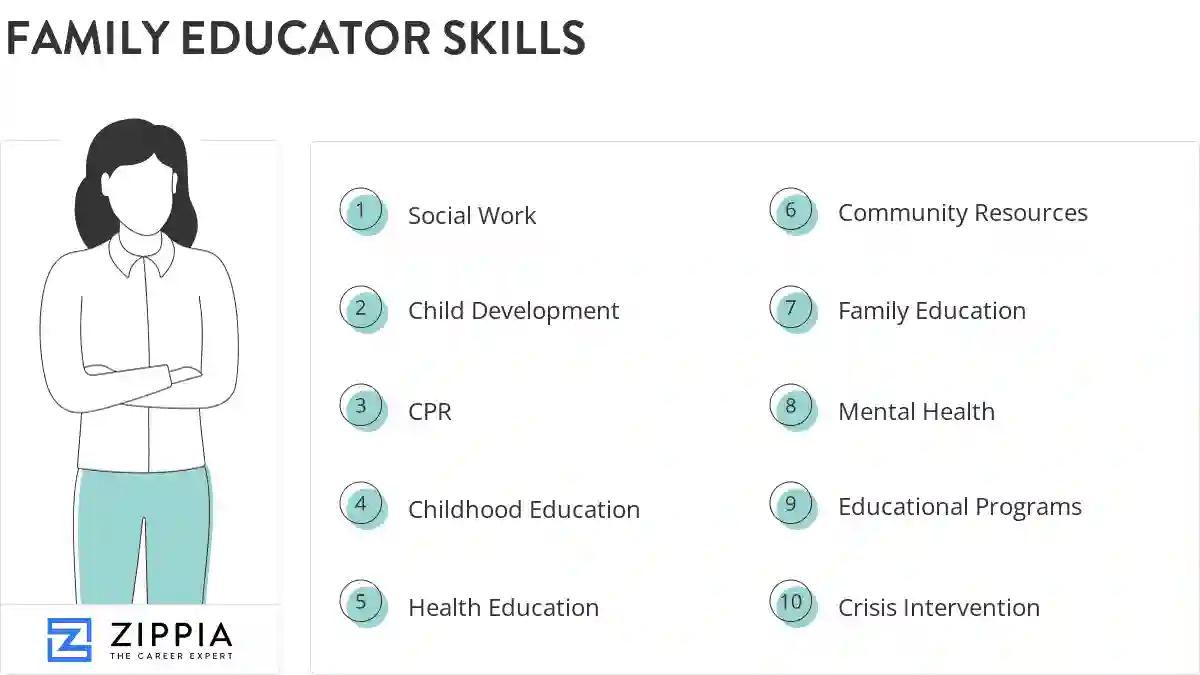
The most important skills for a family educator resume and required skills for a family educator to have include:
- Social Work
- Child Development
- CPR
- Childhood Education
- Health Education
- Community Resources
- Family Education
- Mental Health
- Educational Programs
- Crisis Intervention
- Parent Education
- IEP
- Early Intervention
- Community Agencies
- Social Services
- Comprehensive Services
- Community Outreach
- Parent Involvement
- Child Protective
- Children Birth
- Child Abuse
- Early Childhood Development
- Child Care
- Independent Living
- Domestic Violence
- Parent Support
- DCFS
- Family Teaching
- Medical Appointments
- Direct Care
- Pregnant Women
- Anger Management
- Teen
- Community Services
- Incident Reports
- Conflict Resolution
- GED
- Community Organizations
- Educational Services
- Classroom Environment
- ESL
- WIC
- Residential Facility
- Parent Conferences
- Asq-Se
- Healthy Relationships
Updated January 8, 2025

1. Social Work