What does a feeder do?
Feeders work on machines inside a factory, "feeding" or loading raw ingredients for the product they are supposed to make. They are typically also responsible for unloading the finished products. They test machines for damages, maintain them, and clean them. They may be responsible for using forklifts to deliver the ingredients to large conveyors and machines.
Feeder responsibilities
Here are examples of responsibilities from real feeder resumes:
- Fed spoons and forks into machine to be send out to different companies
- Place finish product onto conveyors or into carts, dump slings of product onto work tables.
- Rotate product first in first out (FIFO).
- Operate 5-color 40"Komori!
- Operate 6-color 26"Komori!
- Run lines that produce plastic shrink bundling.
- assist press operator, run an envelope press ,
- Push dollies of chicken to be tag and freezed.
- Measure product and record SPC data to ensure quality product.
- Coordinate the loading of materials and products on pallets to expedite shipping processes.
- Check solids and temperature of candy, pump candy in to holding tanks and extruders.
- Hand feed parts into grinders, CNC, and roll thread machines in a fast-pace environment.
- Veneer that are damp, but in first quality condition are re-fed through dryer.
- Take stacks of cartons from load pallet and place into feed machine.
- Feed all cattle, clean barns, scrape manure, maintain barns, run various equipment, and fencing.
Feeder skills and personality traits
We calculated that 27% of Feeders are proficient in Pallet Jack, Customer Specifications, and Safety Standards. They’re also known for soft skills such as Customer-service skills, Listening skills, and Physical strength.
We break down the percentage of Feeders that have these skills listed on their resume here:
- Pallet Jack, 27%
Utilized pallet jack to maneuver products around warehouse as necessary.
- Customer Specifications, 19%
Inspect finished products for quality and adherence to customer specifications.
- Safety Standards, 18%
Clean and maintain area according to company safety standards.
- Assembly Line, 11%
Served as Feeder Relief Number 4 for the 3rd shift A-Line, assembly line production (conveyor line).
- RAN, 5%
Sorted linens Folded linens Ran the linens and uniforms through an industrial iron
- Tape Measure, 4%
Learned to read a tape measure.
"pallet jack," "customer specifications," and "safety standards" are among the most common skills that feeders use at work. You can find even more feeder responsibilities below, including:
Customer-service skills. The most essential soft skill for a feeder to carry out their responsibilities is customer-service skills. This skill is important for the role because "hand laborers and material movers who work with the public, such as grocery baggers or carwash attendants, must be pleasant and courteous to customers." Additionally, a feeder resume shows how their duties depend on customer-service skills: "inspect finished products for quality and adherence to customer specifications. "
Listening skills. Many feeder duties rely on listening skills. "hand laborers and material movers follow instructions that a supervisor gives them.," so a feeder will need this skill often in their role. This resume example is just one of many ways feeder responsibilities rely on listening skills: "communicated quality issues with mixing room and seasoning room. "
Physical strength. Another skill that relates to the job responsibilities of feeders is physical strength. This skill is critical to many everyday feeder duties, as "some hand laborers and material movers must be able to lift and carry heavy objects." This example from a resume shows how this skill is used: "maintain the physical structure of the establishment by keeping the work area neat, clean, and safe. "
The three companies that hire the most feeders are:
- Sheridan38 feeders jobs
- Graphic Packaging International17 feeders jobs
- CARE15 feeders jobs
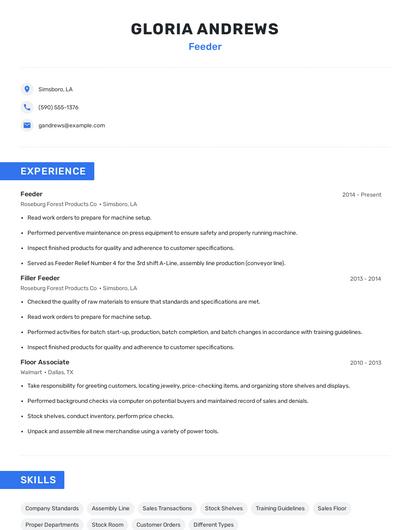
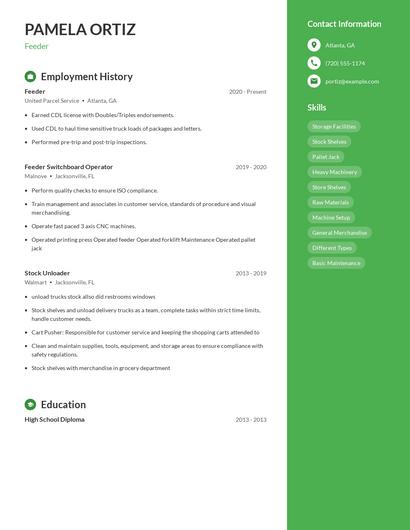
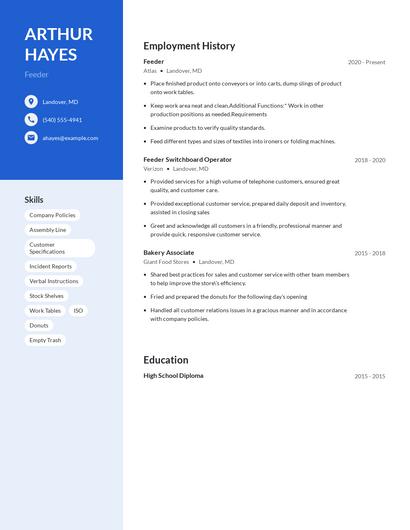
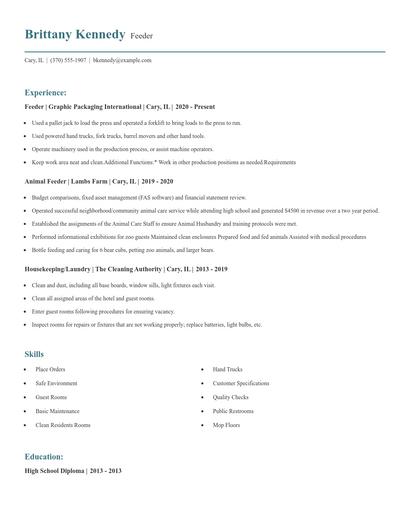
Choose from 10+ customizable feeder resume templates
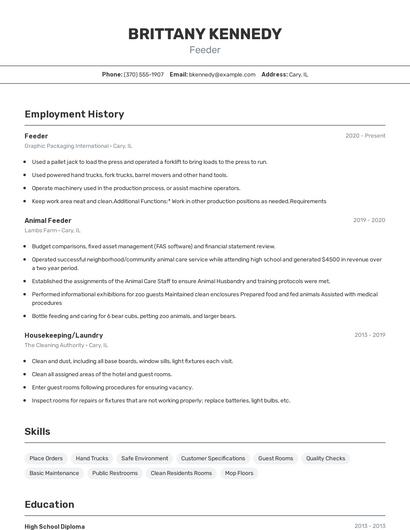
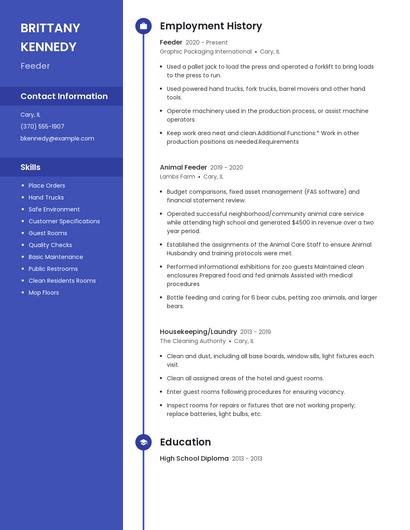
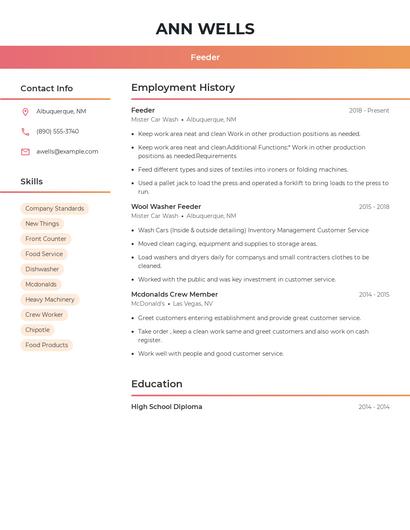
Build a professional feeder resume in minutes. Our AI resume writing assistant will guide you through every step of the process, and you can choose from 10+ resume templates to create your feeder resume.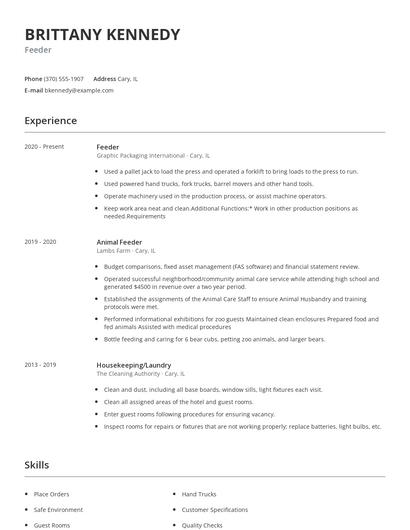
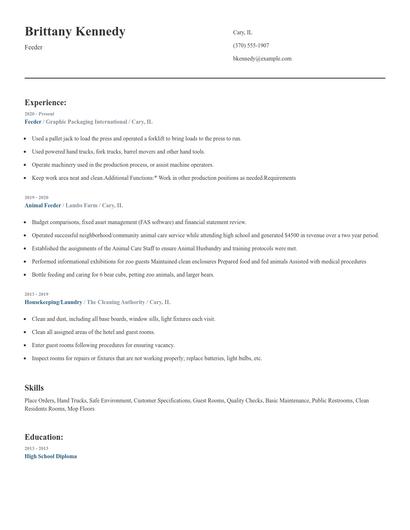
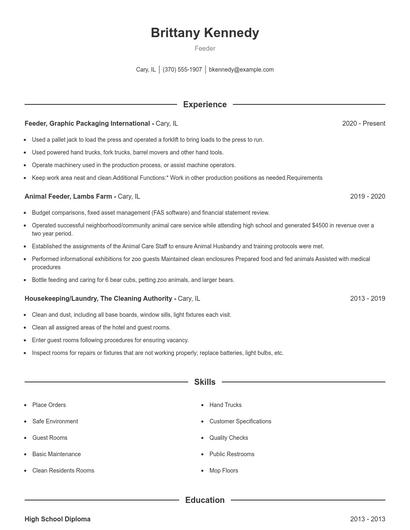
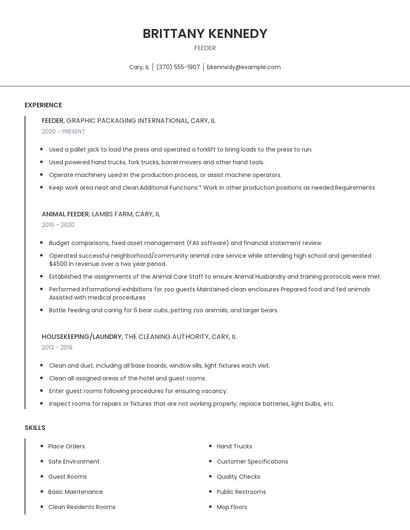
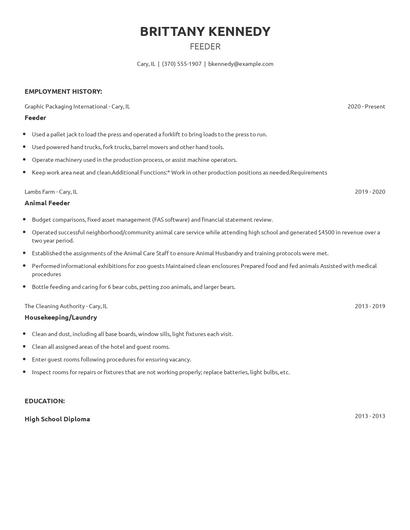
Compare different feeders
Feeder vs. Hopper filler
A stacker operates machines to fit lumber stacks. These machines include conveyer chains, mechanical hands, and rollers. They may also be required to burn off feather edges with a gas torch.
There are some key differences in the responsibilities of each position. For example, feeder responsibilities require skills like "basic math," "pallet jack," "safety standards," and "ran." Meanwhile a typical hopper filler has skills in areas such as "production equipment," "input data," "computer programs," and "jacks." This difference in skills reveals the differences in what each career does.
The education levels that hopper fillers earn slightly differ from feeders. In particular, hopper fillers are 0.9% less likely to graduate with a Master's Degree than a feeder. Additionally, they're 0.1% less likely to earn a Doctoral Degree.Feeder vs. Drying oven attendant
While some skills are similar in these professions, other skills aren't so similar. For example, resumes show us that feeder responsibilities requires skills like "basic math," "pallet jack," "customer specifications," and "safety standards." But a drying oven attendant might use other skills in their typical duties, such as, "safety guidelines," "powder coat," "quality standards," and "track system."
In general, drying oven attendants achieve similar levels of education than feeders. They're 0.9% less likely to obtain a Master's Degree while being 0.1% less likely to earn a Doctoral Degree.Feeder vs. Wave solder offbearer
The required skills of the two careers differ considerably. For example, feeders are more likely to have skills like "basic math," "pallet jack," "safety standards," and "assembly line." But a wave solder offbearer is more likely to have skills like "circuit board assembly," "wave solder," "ipc," and "pcb."
Wave solder offbearers typically earn similar educational levels compared to feeders. Specifically, they're 0.9% less likely to graduate with a Master's Degree, and 0.1% less likely to earn a Doctoral Degree.Feeder vs. Stacker
Even though a few skill sets overlap between feeders and stackers, there are some differences that are important to note. For one, a feeder might have more use for skills like "basic math," "pallet jack," "safety standards," and "ran." Meanwhile, some responsibilities of stackers require skills like "pallets," "electric pallet jack," "safety procedures," and "stack boxes. "
The manufacturing industry tends to pay the highest salaries for stackers, with average annual pay of $32,074. Comparatively, the highest feeder annual salary comes from the transportation industry.In general, stackers hold similar degree levels compared to feeders. Stackers are 0.2% less likely to earn their Master's Degree and 0.0% less likely to graduate with a Doctoral Degree.Types of feeder
Updated January 8, 2025
