
Automatically apply for jobs with Zippia
Upload your resume to get started.
Fiscal clerk skills for your resume and career
15 fiscal clerk skills for your resume and career
1. Purchase Orders
- Utilized both AS/400 and Oracle software to document and reconcile invoices, create purchase orders and process those invoices/orders for payment.
- Prepared purchase orders, cash receipts, tax requisitions, reports, counter warrants, memorandums and letters.
2. Data Entry
Data entry means entering data into a company's system with the help of a keyboard. A person responsible for entering data may also be asked to verify the authenticity of the data being entered. A person doing data entry must pay great attention to tiny details.
- Performed CRT 10 key data entry of vouchers for reimbursement; answer and direct phone calls to proper county departments.
- Receive deposits from all departments for data entry and processing.
3. Payroll
Payroll is the sum of all the compensation that an organization has to pay to employees at a specified time. Payroll is managed by the finance or HR department while small business owners may handle it themselves. Payroll isn't fixed as it varies every month due to sick leaves, overtime, etc.
- Examined employee payroll sheets for accuracy, and assisted with gathering information for Payroll Audits.
- Prepare and maintain basic budgetary, fiscal, payroll and cost accounting records and report.
4. Database Systems
- Entered the support obligation amount and made adjustments per squib/court order in the database system.
- Changed the client and the absent parents demographic information in the database system.
5. Bank Deposits
Any money that a customer chooses to leave with their bank account is a deposit. Deposits can vary in amounts and different banks have limits on the deposits their customers can have as a minimum. Banks charge customers for deposits especially when a teller is used by the customer to deposit money into their account.
- Process a large volume of daily cash receipts and bank deposits.
- Perform bank deposits and record in checkbook.
6. Defense Travel System
- Managed government travel through the Defense Travel System as a Financial Defense Travel Administrator.
- Manage over 2000 training missions through the Defense Travel System (DTS).
Choose from 10+ customizable fiscal clerk resume templates
Build a professional fiscal clerk resume in minutes. Our AI resume writing assistant will guide you through every step of the process, and you can choose from 10+ resume templates to create your fiscal clerk resume.7. Front Desk
- Performed dual roles for fiscal & front desk to eliminate need for new team member.
- Answer front desk telephone, transferred calls, and take messages.
8. Medicaid
- Prepare Medicaid Billing for Adult Home residents monthly, and follow up on claim issues.
- Prepared Medicaid billing forms for the MIC TIP Program Entered patient related data using the C.S.M.
9. Journal Entries
Journal entries can be defined as an act of keeping or making records of any transactions either economic or non-economic. The journal entries are made in the accounting systems of an organization. The entries are filled with two main fields; debit and credit. The debit and credit must be equal at the end of a journal entry else it is not considered correct. The journal entries also keep the date of transactions and the names of the accounts that were affected by the transactions.
- Maintain financial accounting records; accounts receivable, journal entries, account reconciliation and financial reports.
- Prepared and posted journal entries between agencies on FMIS.
10. Child Support Cases
- Researched child support cases to determine refund eligibility.
- Set up new court orders and made adjustments to child support cases in the database system daily per the court orders.
11. Bank Statements
- Reconcile monthly bank statements with receipt attachment to complete reconciliation process.
- Land services reconcile bank statements against bank receipts from the bank for year end.
12. Patient Accounts
Patient accounts are a part of a hospital information system that is used for storing financial data, keeping a record of healthcare costs, and providing information regarding patient billing. It deals with the financial aspects of the healthcare setting.
- Reconcile daily accounts payable and receivable for patient accounts.
- Uploaded and notated patient accounts in proprietary software with payment information.
13. Scheduling Appointments
Scheduling appointments is the practice of finding a free slot with the person(s) you want to meet. The process of scheduling appointments involves finding mutually free time, negotiating follow-ups, sending reminders, and creating new appointments. Scheduling appointments is important to ensure that the timings of consecutive meetings do not clash with each other.
- Performed patient related functions such as maintaining charts, scheduling appointments and billing insurance and public aid.
14. Financial Transactions
The type of agreement held between two parties (buyer and seller) regarding an exchange of funds for an asset, is termed as a financial transaction. The financial transaction is the exchange of products, services, cash or credit, information, and other things of value among two separate entities for a common goal.
- Monitored accounts posted data manually/electronically and processed financial transactions.
- Adjusted and balanced financial transactions.
15. Medi-Cal
- Reconcile, file, and safely secure reports generated of patients that are no longer eligible Medi-Cal.
- Generate and process Medi-Cal billing to the State of California.
5 Fiscal Clerk resume examples
Build a professional fiscal clerk resume in minutes. Browse through our resume examples to identify the best way to word your resume. Then choose from 5+ resume templates to create your fiscal clerk resume.

What skills help Fiscal Clerks find jobs?
Tell us what job you are looking for, we’ll show you what skills employers want.
List of fiscal clerk skills to add to your resume
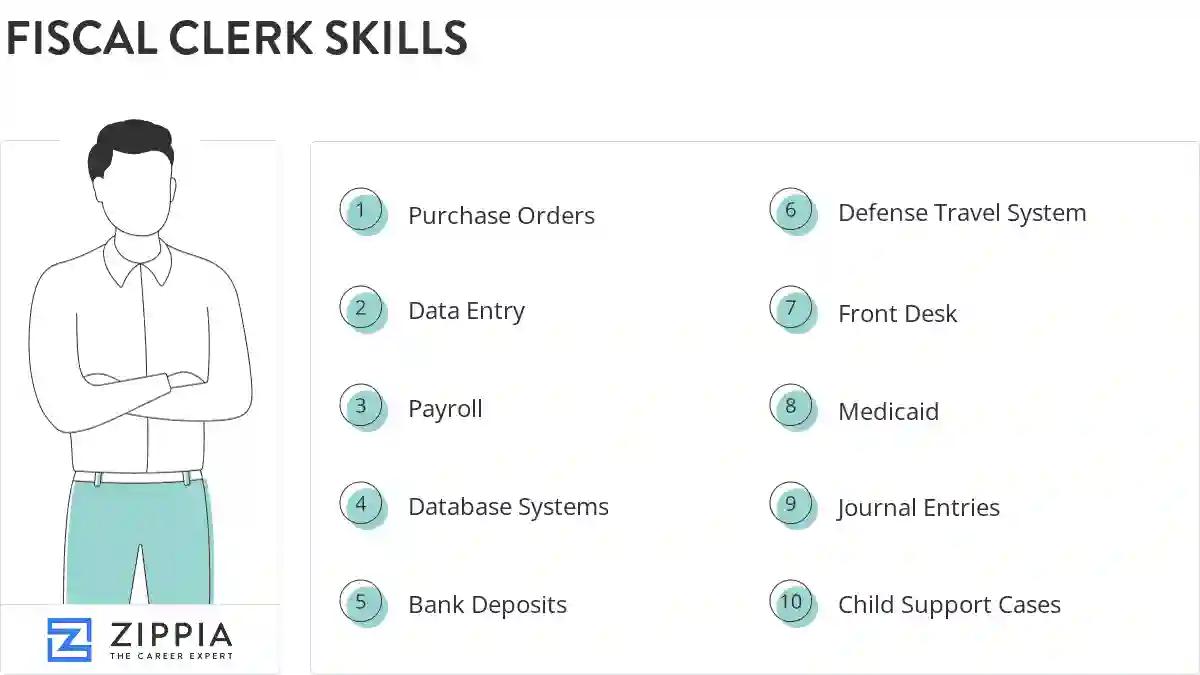
The most important skills for a fiscal clerk resume and required skills for a fiscal clerk to have include:
- Purchase Orders
- Data Entry
- Payroll
- Database Systems
- Bank Deposits
- Defense Travel System
- Front Desk
- Medicaid
- Journal Entries
- Child Support Cases
- Bank Statements
- Patient Accounts
- Scheduling Appointments
- Financial Transactions
- Medi-Cal
- Office Equipment
- PowerPoint
- Process Payments
- Copy Machines
- Inventory Control
- A/P
- Vendor Payments
- Court Orders
- Data Processing
- Patient Payments
- Financial Data
- Budget Reports
- Expense Reports
Updated January 8, 2025
