What does a freight rate analyst do?
Freight rate analyst responsibilities
Here are examples of responsibilities from real freight rate analyst resumes:
- Manage the account by performing detail cost/benefit analysis and WMS analysis.
- Devise negotiation method LTL mixer loads from multiple suppliers.
- Work on international accounts pertaining to ISO containers, TL, LTL and other modes of transportation.
- Utilize industrial logistics and strong interpersonal communication skills to develop new business, increase current business, and renew existing contracts.
- Coordinate with freight forwarders expediting international shipments.
Freight rate analyst skills and personality traits
We calculated that 17% of Freight Rate Analysts are proficient in Freight Invoices, Freight Payment, and TMS. They’re also known for soft skills such as Math skills, Organizational skills, and Communication skills.
We break down the percentage of Freight Rate Analysts that have these skills listed on their resume here:
- Freight Invoices, 17%
Led the initiative to create an automated & streamlined freight invoices analysis, approval and payment process.
- Freight Payment, 14%
Work with carriers to improve/streamline the freight payment process, carrier aging reports, and minimizing manual processes.
- TMS, 13%
Developed and maintained information and business requirements through TMS.
- Accruals, 7%
Communicated with carriers on a daily basis about invoice billing errors - Calculated accruals for upcoming shipments.
- Freight Costs, 5%
Resolved problems and implemented solutions to maximize on-time customer service while minimizing freight costs.
- Payment System, 4%
Work closely with external payment system and transportation providers to ensure timely invoice resolution.
Common skills that a freight rate analyst uses to do their job include "freight invoices," "freight payment," and "tms." You can find details on the most important freight rate analyst responsibilities below.
Math skills. One of the key soft skills for a freight rate analyst to have is math skills. You can see how this relates to what freight rate analysts do because "the job duties of financial clerks includes calculating charges and updating financial records." Additionally, a freight rate analyst resume shows how freight rate analysts use math skills: "conducted qualitative and quantitative analysis of logistics operations usingsimulation models and other tools. "
Organizational skills. Another soft skill that's essential for fulfilling freight rate analyst duties is organizational skills. The role rewards competence in this skill because "financial clerks must be able to arrange files so they can find them quickly and efficiently." According to a freight rate analyst resume, here's how freight rate analysts can utilize organizational skills in their job responsibilities: "optimize workflow within the company and between lasership and its clients to improve customer service experience and organizational efficiency. "
Communication skills. freight rate analysts are also known for communication skills, which are critical to their duties. You can see how this skill relates to freight rate analyst responsibilities, because "financial clerks should be able to explain policies and procedures to colleagues and customers." A freight rate analyst resume example shows how communication skills is used in the workplace: "acquire skills involving individual and cooperative logistics operations, freight management, and communication. "
The three companies that hire the most freight rate analysts are:
- Regal Beloit3 freight rate analysts jobs
- JPMorgan Chase & Co.2 freight rate analysts jobs
- EmployBridge2 freight rate analysts jobs
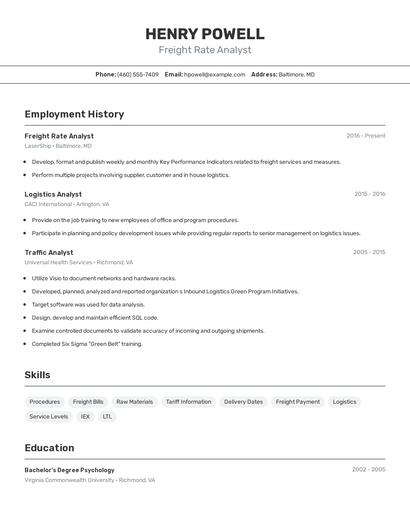
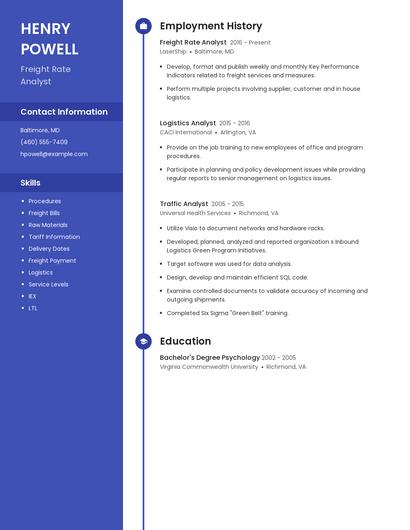
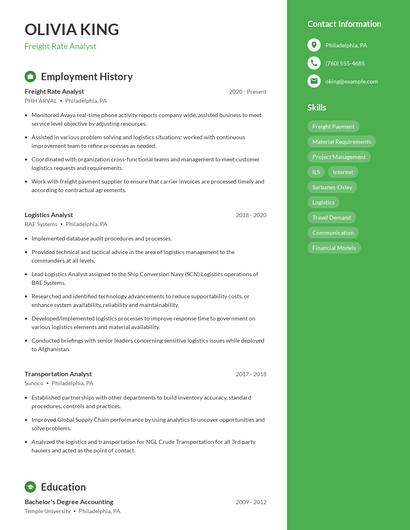
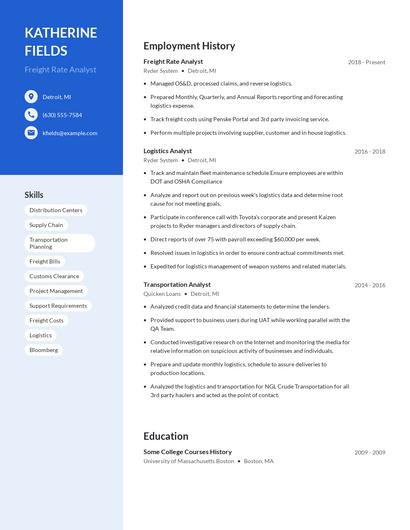
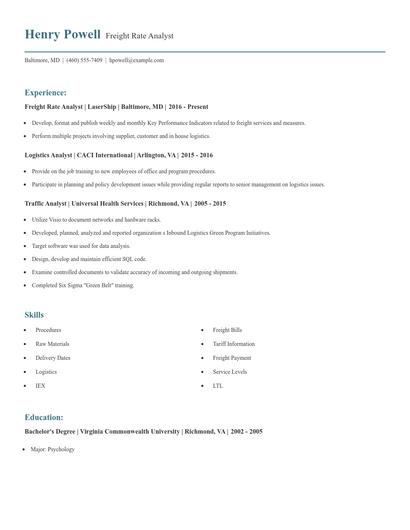
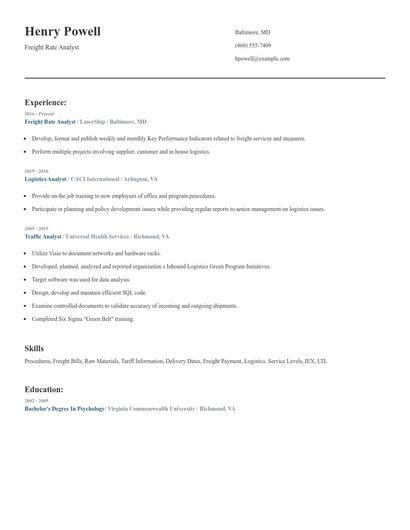
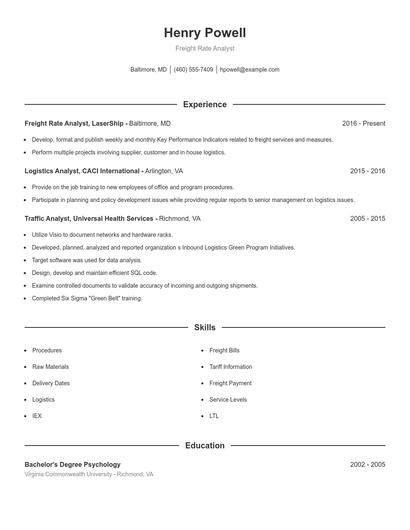
Choose from 10+ customizable freight rate analyst resume templates
Build a professional freight rate analyst resume in minutes. Our AI resume writing assistant will guide you through every step of the process, and you can choose from 10+ resume templates to create your freight rate analyst resume.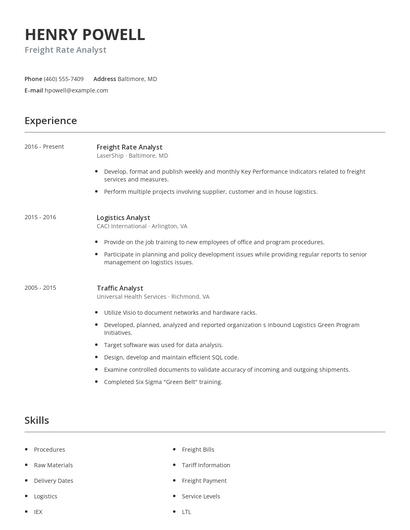



Compare different freight rate analysts
Freight rate analyst vs. Billing coder
A billing coder usually works at medical facilities where they are primarily in charge of gathering and analyzing patient information and billing data, translating them according to the special coding system for medical and insurance record purposes. They usually work in an office setting where they manage electronic health records, organize files, handle calls and correspondence, coordinate with different departments, and enter insurance claims into particular programs. Moreover, as a billing coder, it is essential to review records, keeping an eye out for any inconsistencies or missing details, performing corrective measures right away.
While similarities exist, there are also some differences between freight rate analysts and billing coder. For instance, freight rate analyst responsibilities require skills such as "freight invoices," "freight payment," "tms," and "accruals." Whereas a billing coder is skilled in "patients," "icd-10," "medical terminology," and "home health." This is part of what separates the two careers.
The education levels that billing coders earn slightly differ from freight rate analysts. In particular, billing coders are 4.4% less likely to graduate with a Master's Degree than a freight rate analyst. Additionally, they're 0.3% more likely to earn a Doctoral Degree.Freight rate analyst vs. Biller
Billers are medical professionals who are responsible for translating health care services into medical claims to be submitted to insurance companies. These billers are required to obtain patient medical records and interpret them to determine the billable units and services. They must manage all aspects of the medical billing process and make necessary contacts with insurance payers or patients to ensure maximum reimbursements. Billers must also provide services that are associated with internal and external customer billing and payment processing operations.
In addition to the difference in salary, there are some other key differences worth noting. For example, freight rate analyst responsibilities are more likely to require skills like "freight invoices," "freight payment," "tms," and "accruals." Meanwhile, a biller has duties that require skills in areas such as "patients," "customer service," "cpt," and "medicaid." These differences highlight just how different the day-to-day in each role looks.
Billers earn a lower average salary than freight rate analysts. But billers earn the highest pay in the manufacturing industry, with an average salary of $42,377. Additionally, freight rate analysts earn the highest salaries in the energy with average pay of $63,317 annually.Average education levels between the two professions vary. Billers tend to reach similar levels of education than freight rate analysts. In fact, they're 4.4% less likely to graduate with a Master's Degree and 0.3% more likely to earn a Doctoral Degree.Freight rate analyst vs. Billing administrator
A billing administrator is primarily in charge of managing the billing and collection procedures of a company. They mostly handle administrative tasks such as gathering and organizing patient information, preparing billing data and invoices, maintaining and updating databases, and keeping an eye for any errors and inconsistencies, taking corrective measures right away. In some industries, a billing administrator must coordinate and submit receipts to insurance companies, answer client inquiries, discuss products and services, and produce regular reports. Moreover, as a billing administrator, it is essential to maintain a clear line of communication with staff for an efficient workflow.
Some important key differences between the two careers include a few of the skills necessary to fulfill the responsibilities of each. Some examples from freight rate analyst resumes include skills like "freight invoices," "freight payment," "tms," and "accruals," whereas a billing administrator is more likely to list skills in "patients," "billing issues," "financial reports," and "billing system. "
Billing administrators make a very good living in the construction industry with an average annual salary of $41,089. On the other hand, freight rate analysts are paid the highest salary in the energy industry, with average annual pay of $63,317.When it comes to education, billing administrators tend to earn similar degree levels compared to freight rate analysts. In fact, they're 2.5% less likely to earn a Master's Degree, and 0.2% less likely to graduate with a Doctoral Degree.Freight rate analyst vs. Medical billing clerk
A medical billing clerk is primarily in charge of processing payments and creating billing arrangements in clinics and hospitals. Among their responsibilities include gathering and verifying patient identification, handling insurance information, coding, updating databases, and maintaining records. It is also their responsibility to assist patients by filling out forms, answering their inquiries, and referring them to other services. Moreover, a medical billing clerk must monitor patient accounts and follow-up on delinquent patient accounts, coordinating with collection agencies as needed.
Even though a few skill sets overlap between freight rate analysts and medical billing clerks, there are some differences that are important to note. For one, a freight rate analyst might have more use for skills like "freight invoices," "freight payment," "tms," and "accruals." Meanwhile, some responsibilities of medical billing clerks require skills like "patients," "medical billing," "healthcare," and "customer service. "
The health care industry tends to pay the highest salaries for medical billing clerks, with average annual pay of $34,137. Comparatively, the highest freight rate analyst annual salary comes from the energy industry.medical billing clerks reach similar levels of education compared to freight rate analysts, in general. The difference is that they're 4.9% more likely to earn a Master's Degree, and 0.2% more likely to graduate with a Doctoral Degree.Types of freight rate analyst
Updated January 8, 2025
