What does a gas engineer do?
A Gas Engineer specializes in installing, maintaining, and repairing gas systems and appliances in homes and business establishments. They typically travel to various locations, conduct inspections using detectors and other equipment, troubleshoot problems, replace or fix parts, and enforce safety protocols in case of emergencies. Moreover, a Gas Engineer may also work for gas companies where they are in charge of designing and developing extraction systems. To carry out their duties, they perform extensive research and analysis, gather and analyze samples, conduct examinations and surveys, and implement safety policies and regulations.
Gas engineer responsibilities
Here are examples of responsibilities from real gas engineer resumes:
- Manage Jenkins security by providing specific access to authorize developers/testers using project base matrix authorization strategy.
- Operate and troubleshoot machinery control systems (circuit boards, micro-switches, controls valves, electronic relays, etc).
- Conduct geotechnical and environmental subsurface investigations.
- Qualify electrical switchboard operator during drills and emergency operations.
Gas engineer skills and personality traits
We calculated that 17% of Gas Engineers are proficient in Project Management, Technical Support, and GIS. They’re also known for soft skills such as Manual dexterity, Troubleshooting skills, and Mechanical skills.
We break down the percentage of Gas Engineers that have these skills listed on their resume here:
- Project Management, 17%
Involved in development and project management activities.
- Technical Support, 17%
Provide technical support to various work centers/departmental personnel to maintain efficiency, reliability and availability of shipboard propulsion.
- GIS, 10%
Utilize internal GIS (Geographic Information System) to create detailed construction plans.
- API, 10%
Conducted risk-based technology transfer of advanced intermediates and API to external Contract Manufacturing Organizations or internal scale-up facilities.
- Engineering Support, 7%
Provided engineering support to manufacturing operation, repair shop, and customer service.
- Distribution Systems, 6%
Operated and maintained electrical generation and distribution systems, switchboards and control centers.
Most gas engineers use their skills in "project management," "technical support," and "gis" to do their jobs. You can find more detail on essential gas engineer responsibilities here:
Manual dexterity. One of the key soft skills for a gas engineer to have is manual dexterity. You can see how this relates to what gas engineers do because "industrial machinery mechanics, machinery maintenance workers, and millwrights must have a steady hand and good hand–eye coordination when handling very small parts." Additionally, a gas engineer resume shows how gas engineers use manual dexterity: "maintained a technical manual library pertaining to shipboard engineering equipment. "
Troubleshooting skills. Another essential skill to perform gas engineer duties is troubleshooting skills. Gas engineers responsibilities require that "industrial machinery mechanics, machinery maintenance workers, and millwrights must observe, diagnose, and fix problems that a machine may be having." Gas engineers also use troubleshooting skills in their role according to a real resume snippet: "assisted engine test cell operations in troubleshooting and repairing various components on gas turbine engines. "
Mechanical skills. This is an important skill for gas engineers to perform their duties. For an example of how gas engineer responsibilities depend on this skill, consider that "industrial machinery mechanics, machinery maintenance workers, and millwrights use technical manuals and sophisticated diagnostic equipment to figure out why machines are not working." This excerpt from a resume also shows how vital it is to everyday roles and responsibilities of a gas engineer: "evaluated pressure pulsation levels and mechanical natural frequencies against api 618 4th and 5th editions and made recommendations to the client. ".
The three companies that hire the most gas engineers are:
- Eversource Energy9 gas engineers jobs
- CenterPoint Energy6 gas engineers jobs
- Micron Technology5 gas engineers jobs
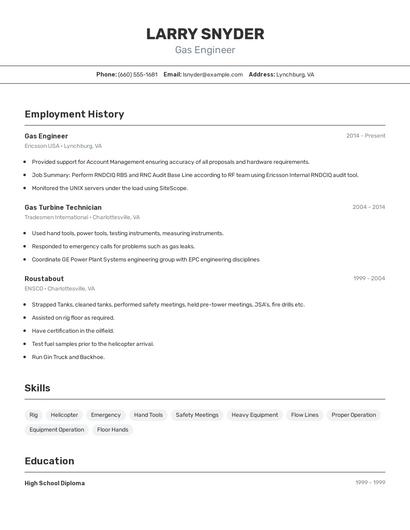
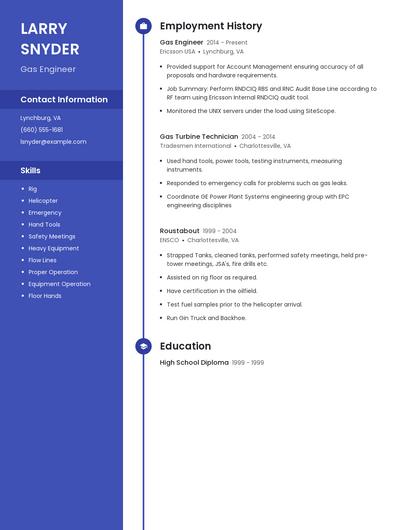
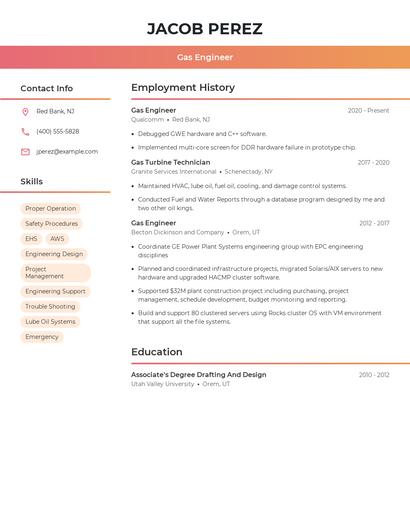
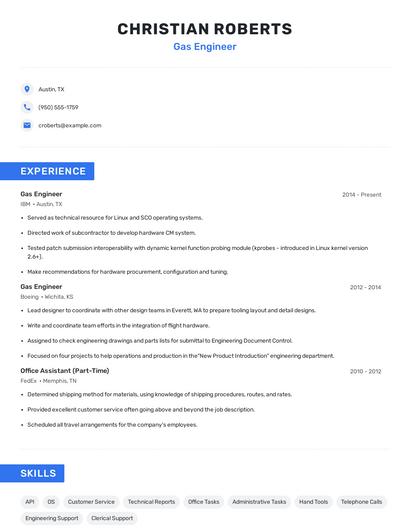
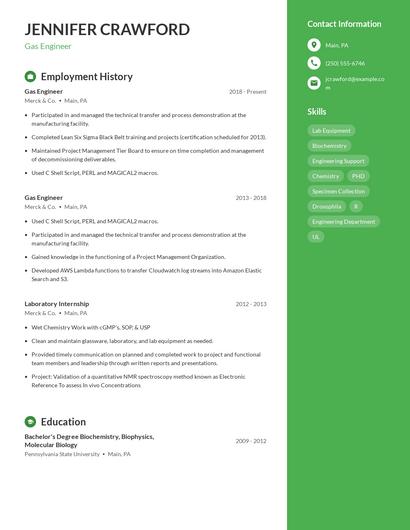
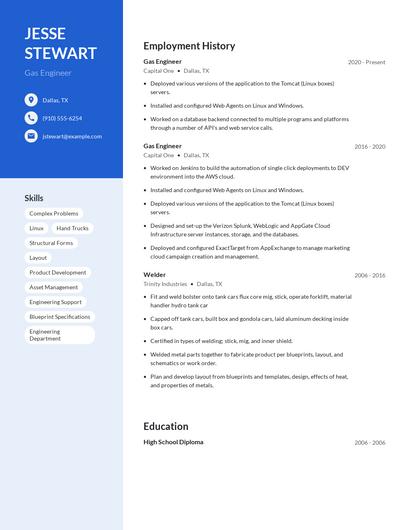
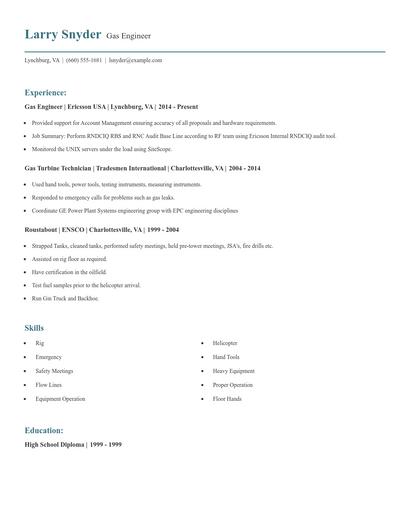
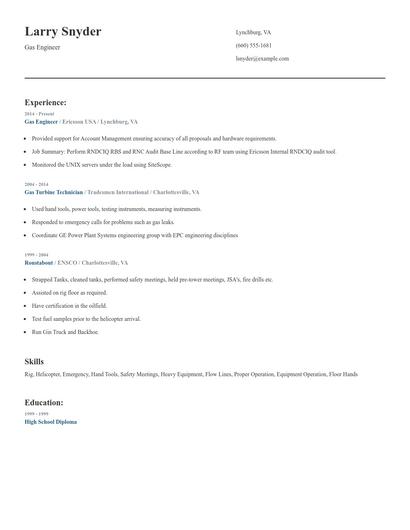
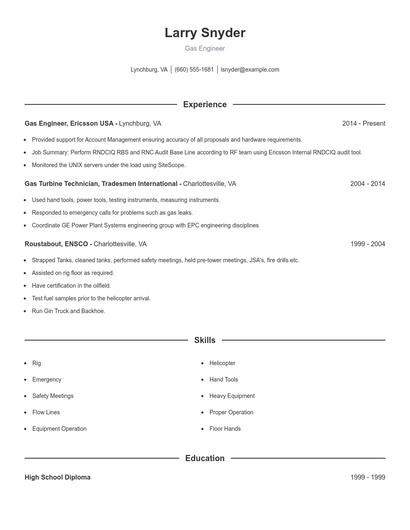
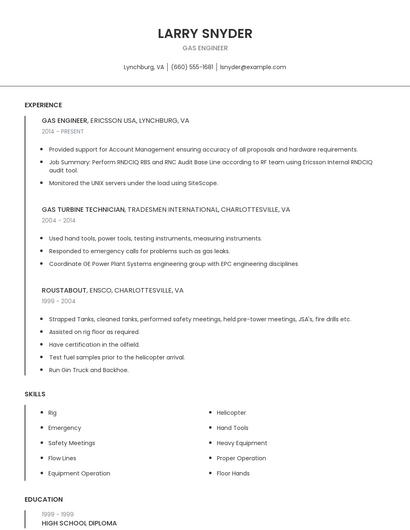
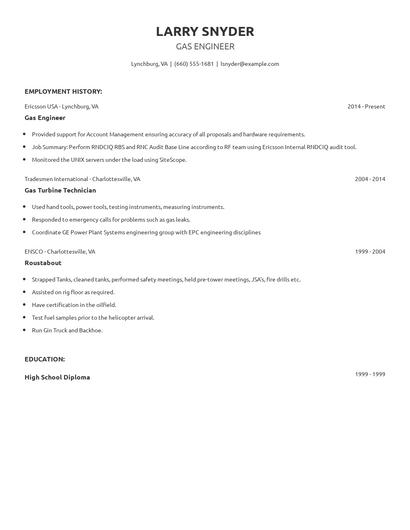
Choose from 10+ customizable gas engineer resume templates
Build a professional gas engineer resume in minutes. Our AI resume writing assistant will guide you through every step of the process, and you can choose from 10+ resume templates to create your gas engineer resume.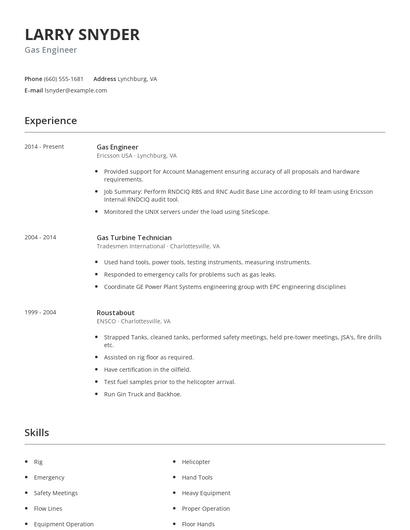
Compare different gas engineers
Gas engineer vs. Compressor station operator
While similarities exist, there are also some differences between gas engineers and compressor station operator. For instance, gas engineer responsibilities require skills such as "project management," "technical support," "gis," and "api." Whereas a compressor station operator is skilled in "station #," "pipeline operations," "safety regulations," and "minor maintenance." This is part of what separates the two careers.
On average, compressor station operators reach lower levels of education than gas engineers. Compressor station operators are 13.5% less likely to earn a Master's Degree and 2.6% less likely to graduate with a Doctoral Degree.Gas engineer vs. Pump station operator
While some skills are similar in these professions, other skills aren't so similar. For example, resumes show us that gas engineer responsibilities requires skills like "project management," "technical support," "gis," and "cfr." But a pump station operator might use other skills in their typical duties, such as, "water treatment plant," "scada," "dot," and "water samples."
Average education levels between the two professions vary. Pump station operators tend to reach lower levels of education than gas engineers. In fact, they're 13.5% less likely to graduate with a Master's Degree and 2.6% less likely to earn a Doctoral Degree.Gas engineer vs. Compressor operator
Some important key differences between the two careers include a few of the skills necessary to fulfill the responsibilities of each. Some examples from gas engineer resumes include skills like "project management," "technical support," "gis," and "api," whereas a compressor operator is more likely to list skills in "llc," "safety standards," "production equipment," and "tablet press. "
Most compressor operators achieve a lower degree level compared to gas engineers. For example, they're 11.2% less likely to graduate with a Master's Degree, and 2.6% less likely to earn a Doctoral Degree.Gas engineer vs. Central station operator
Types of gas engineer
Updated January 8, 2025
