
Automatically apply for jobs with Zippia
Upload your resume to get started.
Geotechnical engineer skills for your resume and career
15 geotechnical engineer skills for your resume and career
1. Geotechnical
- Performed geotechnical analysis and foundation design for plants housing heavy machinery that generate vibration, oil tanks and related industrial structures.
- Assisted in data management and review, coordinated laboratory testing program, and wrote final analysis for feasibility-level geotechnical design report.
2. Civil Engineering
Civil Engineering is a term referring to the branch of the engineering industry which deals with the design, creation, and keep up of public spaces such as roads, dams, parks, railways, pipelines, and various other infrastructures. It is one of the oldest branches of this field, having been born with the first larger cities and civilizations; thus "civil" engineering. It is an industry generally used to solve the problems of the public, such as a lack of sheltering or low cleanliness.
- Leveraged industry expertise in administering multiple civil engineering-related projects including shallow and deep foundation design.
- Prepared recommendations and reports for the construction or improvement of civil engineering projects.
3. Project Management
- Assisted with the project management for a variety of private, commercial public projects.
- Performed roles of project management and mentoring junior level staffs and engineers.
4. Autocad
- Designed grading, haul road, and drainage channel plans utilizing AutoCAD Civil 3D.
- Land Surveying, Drafting and Design, Soils Testing, AutoCAD
5. GINT
- Prepared soil boring logs and created soil profiles using gINT to assist structural engineers to prepare bridge plans.
- Created boring logs using gINT based on visual classification and lab test results.
6. Retaining Walls
- Inspected construction of gravity retaining walls protecting an engineered waterway;.
- Pile foundations will be required to ensure adequate stability of the retaining walls with the added benefit of improved seismic performance.
Choose from 10+ customizable geotechnical engineer resume templates
Build a professional geotechnical engineer resume in minutes. Our AI resume writing assistant will guide you through every step of the process, and you can choose from 10+ resume templates to create your geotechnical engineer resume.7. Engineering Analysis
The application of scientific analytic processes and principles to reveal the state and properties of a device, system, or mechanism under study is called engineering analysis.
- Interpreted field and laboratory test data, originated and checked engineering analysis and design calculations, and prepared investigation factual reports.
- Directed field explorations and laboratory testing programs, prepared plans and performed engineering analysis.
8. Technical Reports
Technical reports are a type of document that is used to indicate either the progress, result, or process of scientific research or the state of problems occurring within such research. A technical report may also showcase the report's overall conclusion and may also include recommendations. This kind of report does not require a peer review and isn't published officially but distributed within the organizations where it was formed.
- Slope stability analyses and Coordination of technical reports.
- Verified cross sections, contour maps, technical reports, calculations pertinent to develop geological sections.
9. Engineering Reports
An engineering report offers an engineering problem, analysis and judgment to its reader which proposes or recommends a determined solution to the given engineering problem. The structure of the reports usually contains the title page, letter of transmittal, acknowledgements, and executive summary. These reports usually contain data based on analysis and research, which is why they are considered exceptionally reliable.
- Produced proposals, memorandums, preliminary engineering reports and design recommendations, final engineering reports and design recommendations.
- Prepared geotechnical & construction engineering reports with design recommendations.
10. Business Development
Business development is the ideas or initiatives that work to make business work better. Selling, advertising, product development, supply chain management, and vendor management are only a few of the divisions involved with it. There is still a lot of networking, negotiating, forming alliances, and trying to save money. The goals set for business development guide and coordinate with all of these various operations and sectors.
- Provided business development functions including creation of marketing materials and meeting with prospective clients.
- Performed business development in infrastructure projects.
11. Geotechnical Analysis
Geotechnical analysis or surface exploration includes geophysical methods, photogrammetry, geologic mapping, and/or simple observational measures to analyze the physical condition of a location. Surface exploration can include geologic mapping, geophysical methods, and, or it can be as simple as a geotechnical professional walking around on the site to observe the physical conditions at the site.
- Evaluated feasibility of using a newly developed seismic receiver for low-cost seismic refraction analysis for seismic reflection studies and geotechnical analysis.
- Carried out various Geotechnical analysis and soil sample tests for soil identification and classification.
12. Engineering Services
- Developed multiple master service agreements with engineering service providers by leading a cross-discipline group of technical, procurement and legal specialists.
- Performed multiple subsurface investigations, on-site soils engineering services and deep foundation inspections for project managers and principals.
13. Geotechnical Design
- Review of geotechnical design of FLETs/ILTs Lianzi Project (Chevron, Angola).
14. Cost Estimates
- Developed excavation plans and cost estimates for these projects in addition to negotiating the cost and documentation of change orders.
- Participated in the projects involving water source, water pump, pipe size, channel and cost estimates.
15. Field Testing
- Executed field testing for foundation and pipe installation.
- Managed consultant design and field testing projects.
5 Geotechnical Engineer resume examples
Build a professional geotechnical engineer resume in minutes. Browse through our resume examples to identify the best way to word your resume. Then choose from 5+ resume templates to create your geotechnical engineer resume.

What skills help Geotechnical Engineers find jobs?
Tell us what job you are looking for, we’ll show you what skills employers want.
What skills stand out on geotechnical engineer resumes?
Pooja Preetha Ph.D.
Assistant Professor, Alabama A&M University
What soft skills should all geotechnical engineers possess?
James Albrecht
Professor of Criminal Justice and Homeland Security, retired NYPD Captain/Commanding Officer, Pace University
What geotechnical engineer skills would you recommend for someone trying to advance their career?
Joseph Reichenberger PE [CA AZ HI NM NV], BCEE, F.ASCE![Joseph Reichenberger PE [CA AZ HI NM NV], BCEE, F.ASCE LinkedIn profile](https://static.zippia.com/ui-router/images/linkedin-rounded-new.svg)
Professor of Civil Engineering and Environmental Science, Website
infrastructure. The federal Infrastructure Investment and Jobs Act, passed in November 2021,
authorized $1.2 trillion dollars for a variety of infrastructure projects.
From: https://home.treasury.gov/news/featured-stories/infrastructure-investment-in-the-united-states
Civil engineers are involved in most if not all of these types of projects. So the job market for
civil engineers for the near term is excellent.
Afifa Mushtaque in an article published 03102024 entitled "20 Highest Paying Countries for Civil
Engineers" https://www.insidermonkey.com/blog/20-highest-paying-countries-for-civil-engineers-
1271941/, stated the global civil engineering market is looking for major growth as $13.7 trillion
dollars is expected by 2030 and forecasts a compound annual growth rate of nearly 6% from
2023 to 2030.
Civil engineering has generally always been a good field for jobs. Civil engineering jobs tend to
follow the housing market so it is not all roses. There was a significant reduction in employment
for civil engineers, along with many others in the early 1980s and recently in the recession in
2010 or so. But the recovery has been substantial and continuing as stated above.
We are blessed with an influx of well prepared, young graduates with skills in the latest
technology replacing retiring civil engineers. Our typical class here at Loyola Marymount
University (LMU) typically has 30 to 40% women. It is a great profession for women and work
force is quite diverse.
What type of skills will young geotechnical engineers need?
Nick Hudyma PhD PE
Professor and Chair, Boise State University
In my opinion, visualization skills will begin to become very important. I can envision a coupled work environment, having technical analyses and designs working behind the scenes with visualizations being presented to clients. Civil engineers will need to present their work, not using traditional 2D blueprints and plan sets, but using 3D and 4D visualizations, which will include either virtual reality or augmented reality. This is especially important as our designs become more complex, and we continue in-fill development in dense urban areas.
List of geotechnical engineer skills to add to your resume
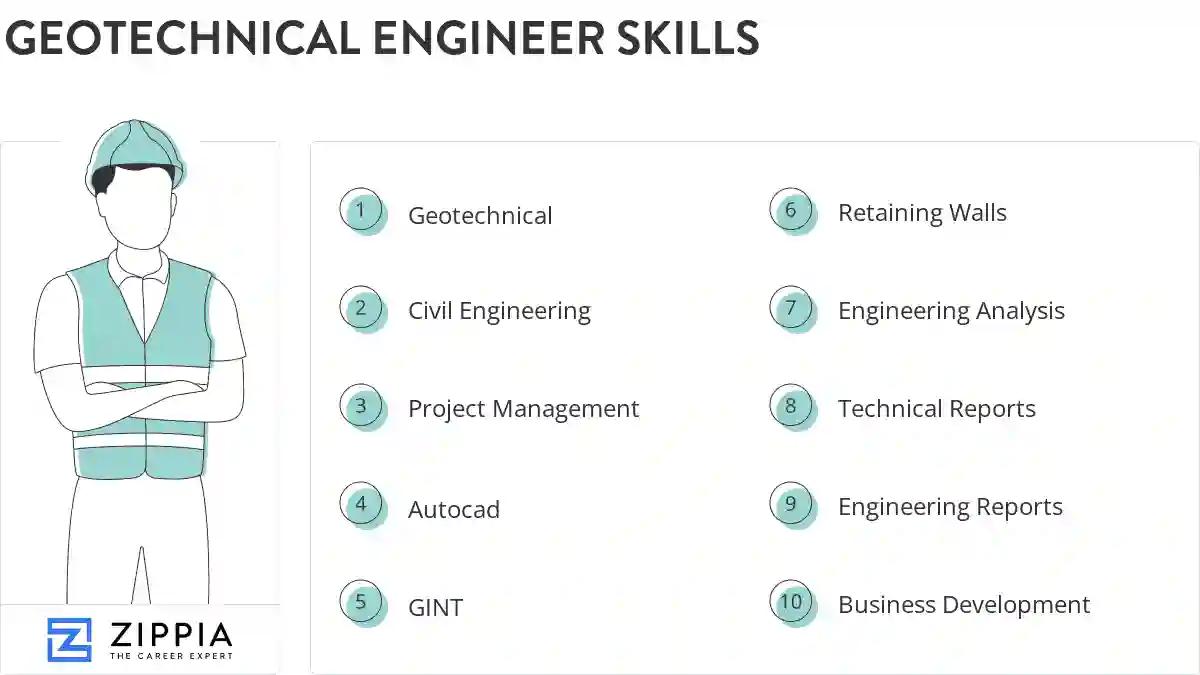
The most important skills for a geotechnical engineer resume and required skills for a geotechnical engineer to have include:
- Geotechnical
- Civil Engineering
- Project Management
- Autocad
- GINT
- Retaining Walls
- Engineering Analysis
- Technical Reports
- Engineering Reports
- Business Development
- Geotechnical Analysis
- Engineering Services
- Geotechnical Design
- Cost Estimates
- Field Testing
- Infrastructure Projects
- Oil Gas
- Construction Projects
- Engineering Design
- Excavations
- Construction Sites
- Data Collection
- Slope
- Geotechnical Investigations
- Construction Materials
- Ground Improvement
- Calculation
- Geotechnical Projects
- Technical Support
- Rehabilitation
- Design Parameters
- Design Calculations
- Engineering Calculations
- CPT
- Conveyance
- Subsurface Exploration
- Shallow Foundations
- Pavement Design
- Test Pits
- Laboratory Analysis
- Site Investigations
- Data Analysis
- Laboratory Data
- AASHTO
- Construction Inspection
- Asphalt
Updated January 8, 2025
