Explore jobs
Find specific jobs
Explore careers
Explore professions
Best companies
Explore companies
What is a gis analyst and how to become one

A GIS analyst uses geographic information systems (GIS) software to analyze and interpret spatial data. They collect, manage, and manipulate data to create maps and visual representations that aid in decision-making. GIS analysts work inenvironmental management, urban planning, and public health. They use specialized software to create and maintain databases, conduct spatial analyzes, and produce visualizations for stakeholders. In addition to technical skills, GIS analysts must communicate with clients and team members and multitask effectively.
What general advice would you give to a gis analyst?
Dr. Christopher Brown Ph.D.
Professor, New Mexico State University
Avg. Salary $63,718
Avg. Salary $59,228
Growth rate 9%
Growth rate 0.3%
American Indian and Alaska Native 0.19%
Asian 14.54%
Black or African American 10.33%
Hispanic or Latino 11.09%
Unknown 5.01%
White 58.83%
Genderfemale 27.34%
male 72.66%
Age - 42American Indian and Alaska Native 3.00%
Asian 7.00%
Black or African American 14.00%
Hispanic or Latino 19.00%
White 57.00%
Genderfemale 47.00%
male 53.00%
Age - 42Stress level is manageable
7.1 - high
Complexity level is challenging
7 - challenging
Work life balance is fair
6.4 - fair
What are the pros and cons of being a gis analyst?
Pros
Potential for career advancement and higher salaries
High demand for GIS skills in many industries
Possibility of flexible work arrangements, including remote work
Opportunity to gain experience in data management and analysis
Potential for personal and professional growth through continuous learning
Cons
Can be mentally demanding and require long periods of concentration
May require working under tight deadlines with high accuracy expectations
May require working with outdated or incompatible software
May involve frequent travel or relocation for fieldwork or project implementation
Possibility of being outsourced to other countries where labor is cheaper
Gis analyst career paths
Key steps to become a gis analyst
Explore gis analyst education requirements
Start to develop specific gis analyst skills
Skills Percentages GPS 8.21% Spatial Data 7.80% Data Collection 6.84% Esri Arcgis 4.13% Database Design 4.01% Complete relevant gis analyst training and internships
Accountants spend an average of 6-12 months on post-employment, on-the-job training. New gis analysts learn the skills and techniques required for their job and employer during this time. The chart below shows how long it takes to gain competency as a gis analyst based on U.S. Bureau of Labor Statistics data and data from real gis analyst resumes.Research gis analyst duties and responsibilities
- Manage and collect data from NGA, NATO partners, and other organizations to support military training simulations.
- Manage vector, raster, and cad data for cultural resources, public works, forestry and planning departments.
- Manage the creation and development of a GIS mapping system for a local waste management company using ArcGIS and ArcGIS Online.
- Construct, implement and manage state-wide seismic hazard and infrastructure mapping projects.
Prepare your gis analyst resume
When your background is strong enough, you can start writing your gis analyst resume.
You can use Zippia's AI resume builder to make the resume writing process easier while also making sure that you include key information that hiring managers expect to see on a gis analyst resume. You'll find resume tips and examples of skills, responsibilities, and summaries, all provided by Zippi, your career sidekick.
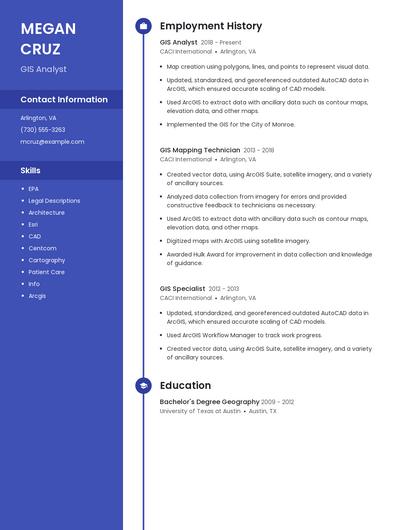
Choose from 10+ customizable gis analyst resume templates
Build a professional gis analyst resume in minutes. Browse through our resume examples to identify the best way to word your resume. Then choose from 10+ resume templates to create your gis analyst resume.



Apply for gis analyst jobs
Now it's time to start searching for a gis analyst job. Consider the tips below for a successful job search:
- Browse job boards for relevant postings
- Consult your professional network
- Reach out to companies you're interested in working for directly
- Watch out for job scams
How did you land your first gis analyst job

Are you a gis analyst?
Share your story for a free salary report.
Average gis analyst salary
The average gis analyst salary in the United States is $63,718 per year or $31 per hour. Gis analyst salaries range between $47,000 and $85,000 per year.
What am I worth?

How do gis analysts rate their job?
Gis analyst reviews

Creating maps, data sorting, spatial analysis, training, geo referencing, digitizing, creating shapefiles, map clipping/dissolving, map styling/decorating
programming
Sometimes work is light. I do not like that aspect of it.
Updated January 8, 2025
