Explore jobs
Find specific jobs
Explore careers
Explore professions
Best companies
Explore companies
Job outlook for implementation consultants in the United States
Implementation consultant job growth summary. After extensive research, interviews, and analysis, Zippia's data science team found that:
The projected implementation consultant job growth rate is 11% from 2018-2028.
About 108,400 new jobs for implementation consultants are projected over the next decade.
Implementation consultant salaries have increased 8% for implementation consultants in the last 5 years.
There are over 7,600 implementation consultants currently employed in the United States.
There are 70,450 active implementation consultant job openings in the US.
The average implementation consultant salary is $80,195.
Are implementation consultant jobs in demand?
Implementation consultant job and salary trends over time
Implementation consultant jobs over time
Implementation consultant job growth rate over time
| Year | # of jobs | % of population |
|---|---|---|
| 2021 | 7,600 | 0.00% |
| 2020 | 7,260 | 0.00% |
| 2019 | 7,020 | 0.00% |
| 2018 | 7,791 | 0.00% |
| 2017 | 7,595 | 0.00% |
Average implementation consultant salary over time
Implementation consultant salary by year
| Year | Avg. salary | Hourly rate | % Change |
|---|---|---|---|
| 2026 | $80,195 | $38.56 | +2.8% |
| 2025 | $77,999 | $37.50 | +2.0% |
| 2024 | $76,490 | $36.77 | +1.4% |
| 2023 | $75,428 | $36.26 | +1.4% |
| 2022 | $74,404 | $35.77 | +0.0% |
Implementation consultant jobs by state
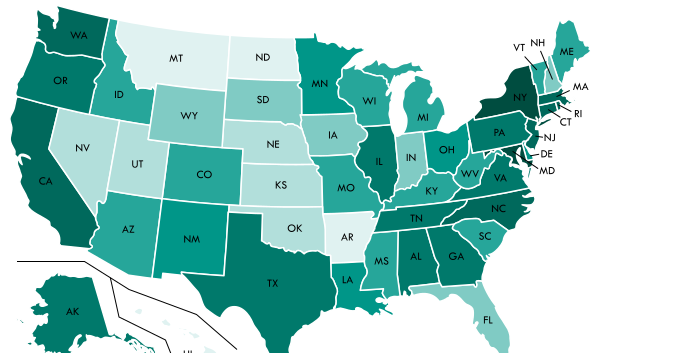
Most common states for implementation consultants
| Rank | State | Population | # of jobs | Employment/ 1000ppl |
|---|---|---|---|---|
| 1 | District of Columbia | 693,972 | 454 | 65% |
| 2 | North Dakota | 755,393 | 183 | 24% |
| 3 | Vermont | 623,657 | 126 | 20% |
| 4 | South Dakota | 869,666 | 167 | 19% |
| 5 | Rhode Island | 1,059,639 | 186 | 18% |
| 6 | Tennessee | 6,715,984 | 975 | 15% |
| 7 | New Mexico | 2,088,070 | 323 | 15% |
| 8 | Delaware | 961,939 | 144 | 15% |
| 9 | Massachusetts | 6,859,819 | 931 | 14% |
| 10 | Indiana | 6,666,818 | 920 | 14% |
| 11 | Oregon | 4,142,776 | 571 | 14% |
| 12 | Utah | 3,101,833 | 427 | 14% |
| 13 | West Virginia | 1,815,857 | 260 | 14% |
| 14 | Maine | 1,335,907 | 193 | 14% |
| 15 | New Hampshire | 1,342,795 | 188 | 14% |
| 16 | Wyoming | 579,315 | 79 | 14% |
| 17 | Virginia | 8,470,020 | 1,138 | 13% |
| 18 | Alabama | 4,874,747 | 594 | 12% |
| 19 | Kentucky | 4,454,189 | 539 | 12% |
| 20 | Connecticut | 3,588,184 | 420 | 12% |
Most common cities for implementation consultants
| Rank | City | # of jobs | Employment/ 1000ppl | Avg. salary |
|---|---|---|---|---|
| 1 | Annapolis | 11 | 28% | $90,345 |
| 2 | Frankfort | 7 | 25% | $71,301 |
| 3 | Lansing | 10 | 9% | $73,043 |
| 4 | Springfield | 8 | 7% | $80,325 |
| 5 | Hartford | 8 | 6% | $85,195 |
| 6 | Topeka | 7 | 6% | $61,977 |
| 7 | Atlanta | 18 | 4% | $82,862 |
| 8 | Baton Rouge | 8 | 4% | $74,416 |
| 9 | Tallahassee | 8 | 4% | $72,180 |
| 10 | Des Moines | 6 | 3% | $66,735 |
| 11 | Boston | 15 | 2% | $89,237 |
| 12 | Sacramento | 11 | 2% | $92,970 |
| 13 | Urban Honolulu | 7 | 2% | $57,241 |
| 14 | Indianapolis | 8 | 1% | $64,381 |
| 15 | Detroit | 7 | 1% | $73,605 |
| 16 | Denver | 6 | 1% | $71,026 |
| 17 | Chicago | 13 | 0% | $82,757 |
| 18 | Phoenix | 7 | 0% | $70,626 |
Implementation Consultant job outlook: Expert opinions
Our panel of implementation consultant experts
Davidson College

Lewis-Clark State College
Duke University
Xavier University

Coastal Carolina University

Florida State University

UMass Lowell

University of Nevada, Reno

Lasell University

Bucknell University
Clarion University of Pennsylvania

Kent State University
The University of North Carolina at Greensboro
University of Central Missouri
University of Arizona
Drexel University
Saint Peter's University

Alfred University

University of Georgia, Terry College of Business
North Carolina State University
Katie Horowitz
Associate Professor of Gender & Sexuality StudiesDavidson College
Ethnic, Cultural Minority, Gender, And Group Studies
What general advice would you give to an Implementation Consultant?
Katie Horowitz: With the rise of artificial intelligence, soft skills like interpersonal communication, conflict management, and critical thinking will become more important than ever before. These are assets that can’t be outsourced to AI, and they are fundamental to the work that Gender & Sexuality Studies majors do in college.
What Implementation Consultant skills would you recommend for someone trying to advance their career?
Katie Horowitz: Some research shows that women and members of marginalized racial groups are less likely to negotiate their salaries than their white male counterparts. When you get a job offer, don’t forgo the opportunity to advocate for a higher salary.
What will help Implementation Consultants increase their earning potential?
Katie Horowitz: Don’t limit yourself. I’ve seen Gender & Sexuality Studies students land jobs in business consulting, nonprofit, medicine, law, and more. The beauty of this interdisciplinary field is that it intersects with virtually every sphere of human existence. You can bring your GSS skills to bear on any line of work that interests you.
What skills will help Implementation Consultants earn the most?
Jenny Scott: -Emotional Intelligence
-Relevant industry experience (expertise)
-Written and oral presentation communication
-Ability to relate and connect . . .the best strategy in the world will live on paper only if the leader is not able to relate to their people (all stakeholder groups) and connect. Leadership involves three key elements: People - Influence - Goals. The most effective leaders are able to ethically influence their followers for the purpose of attaining the organization's mission and goals.
Michael Munger
Director of Undergraduate Studies, Director, PPE ProgramDuke University
Department of Political Science
What skills stand out on Implementation Consultant resumes?
Michael Munger: Political science is an ancient career synergy, one that explores the connections between ethical considerations and engineering policy that works. Someone who majors in Political Science is able to make arguments about the questions that have plagued philosophers for thousands of years while using the latest data techniques to scrape online sources of information on social media. So political science instructors have to combine ethics, knowledge of esoteric procedures and laws, and statistics!
What soft skills should all Implementation Consultants possess?
Michael Munger: Working in groups. And that's hard to teach. The best teacher is experience. Often, students learn the most when their group fails or the other members don't pull their weight. The ability to work in unstructured environments and still achieve group success is a big part of many jobs. And Political Science teaches that.
What hard/technical skills are most important for Implementation Consultants?
Michael Munger: Political Science students should take at least one Computer Science class, be able to run a spreadsheet with skill, and be able to write crisp prose that gets to the point.
What skills will help Implementation Consultants earn the most?
Michael Munger: The ability to lead a group by example and to get other people to feel that they are part of something larger than themselves. At its best, Political Science is like an entire little liberal arts curriculum. It's the perfect preparation for leadership, either in government or the private sector!
Mike Halloran
Teaching Professor, Management and Entrepreneurship, Taskforce Member, Center for InnovationXavier University
Management Department
What soft skills should all Implementation Consultants possess?
Mike Halloran: -Leadership
-Working well with others
-Oral and written communication
- Thinking analytically, creatively, and strategically
-Leadership
-Time management
- Motivation and drive
What hard/technical skills are most important for Implementation Consultants?
Mike Halloran: Excel
-Digital communication
-Budget management
Sourav Batabyal Ph.D.
Assistant Professor, Finance and EconomicsCoastal Carolina University
Finance and Economics Department
What skills stand out on Implementation Consultant resumes?
Sourav Batabyal Ph.D.: Problem-solving, Creative thinking, Data Analytics, Competitive Strategies, Communication, Leadership and Team Building, Decision making.
C. Darren Brooks Ph.D.
Assistant Department Chair and Executive Director, Center for Human Resource ManagementFlorida State University
Department of Management and the Center for Human Resource Management
What soft skills should all Implementation Consultants possess?
C. Darren Brooks Ph.D.: While advancements in technology, artificial intelligence (AI), and data analytics occupy center stage in many areas of management practice, soft skills continue to be seen as equally or even more important skills for success in the field of management. Soft skills are typically described as personal attributes, qualities, and characteristics that enable us to interact more effectively with others. In most fields of management, our ability to communicate, work with, and interact with other people constitutes a significant portion of the work we do. Consequently, employers are focused on identifying candidates who possess strong skills are areas of communication (verbal, written, and non-verbal), leadership and followership, collaboration, an ability to work in teams, intellectual curiosity, adaptability, conflict management, problem-solving, creativity.
What hard/technical skills are most important for Implementation Consultants?
C. Darren Brooks Ph.D.: As stated earlier, the field of management is broad and encompasses all industries and sectors. Consequently, the technical skills necessary to succeed will vary according to the specific knowledge and experiences required to understand the nuances of an organization. Accordingly, graduates who have business acumen and technical competency in a particular discipline or industry would be better positioned for employment opportunities. As a result, I always place emphasis on gaining internships and work experience concurrently with academic study. These experiences will provide a real-world understanding of the type of skills necessary to succeed in organizations as well as offer industry-specific knowledge. However, for many graduates, their practical skills are limited. In this case, it is important to ensure you have more generalizable skills that are applicable across industries, such as building digital fluency, analytical fluency, writing skills, and strong Excel skills. When speaking with consulting firms and industry employers, they repeatedly reference the need for graduates to demonstrate more advanced Excel skills.
Michael Ciuchta Ph.D.
Associate Professor, Program Coordinator, Masters of Science in EntrepreneurshipUMass Lowell
Department of Marketing, Entrepreneurship & Innovation
What soft skills should all Implementation Consultants possess?
Michael Ciuchta Ph.D.: In addition to the above, in today's environment, it is important that people are adept at improvising. For long-term career success in any field, sound leadership skills are critical. It is important to be able to formulate, communicate and execute a compelling vision for where you want to take your organization.
Jim McClenahan
Director of Career and Corporate OutreachUniversity of Nevada, Reno
College of Business
What skills stand out on Implementation Consultant resumes?
Jim McClenahan: Most importantly, skills that are customized for the job you are applying. Someone could work in a restaurant and have great customer management skills that would work well in a bank. The key is identifying "transferrable skills"-how what you did is relevant for the job you are applying. The applicant has to articulate that-don't expect the committee, screener, or HR Recruiter to make the connections. For business majors, the skills that differentiate applicants are technical skills when they are relevant to the job. Data analysis, coding, SQL are often looked for by employers that have a tech focus as preferred skills.
What are the biggest trends we'll see in the Implementation Consultant job market given the pandemic?
Jim McClenahan: Rethinking work locations. Companies may recruit in areas that have lots of talent, cheaper cost of living and better quality of life. As an example, Incline Village is a small community on Lake Tahoe about 40 minutes from our campus. Every store is packed and the traffic is worse than any holiday weekend. Silicon Valley companies (about 4 hours away) have seen lots of people "temporarily relocate" to Lake Tahoe from the Bay Area. Now that some companies have permanently moved to at least a portion of their workforce as "work anywhere," communities like Reno, Boise, Missoula-ones with lower cost of living and better quality of life compared to the Bay Area may experience a mini-boom. It's already happening more in Reno.
The best candidates will be "swiss army knives." They have lots of different skillsets and with the flexibility everyone has demonstrated during the pandemic knowing how to do a lot of different things allows organizations to run a little leaner. Someone told me I was the ultimate "utility infielder" last week which I took as a high compliment! I think mastering lots of different skills is a key to employability for the candidate and success for the organization.
Finally, I expect small business hiring to be a mixed bag. Some are doing very well and expanding. Many others are struggling to survive and waiting to see how quickly lockdowns end and business returns before they start hiring.
Dr. Brian Wardyga
Professor of Communication; General Manager, 109.2FM WLAS & LCTVLasell University
School of Communication and The Arts
What skills stand out on Implementation Consultant resumes?
Dr. Brian Wardyga: Today's business consultant should be able to showcase skills in project management, business strategy & outlook, and supply chain management & optimization. Evidence of collaboration & teamwork is also a big plus.
Within these constructs, one should identify key technical skills, evidence of decision making & critical thinking, verbal and written communication skills, and creative thinking or problem-solving examples. Lastly, evidence of working in focus groups and leading workshops or presentations are also standouts.
What skills will help Implementation Consultants earn the most?
Dr. Brian Wardyga: That answer is dependent on the specific market, really. Any combination of the above and the more of those skills, the better chance at negotiating higher earnings.
Neil Boyd Ph.D.
David J. & Deborah West Professor of Management; Chair, Management and Organizations DepartmentBucknell University
Management and Organizations Department
What skills will help Implementation Consultants earn the most?
Neil Boyd Ph.D.: A combination of hard and soft skills, but at the end of the day, soft skills are critical to truly helping clients. And, for sure, they can be learned. This is a challenge for management education, but places like the Freeman College of Management at Bucknell work hard to develop soft skills in students primarily through coaching, experiential and community-based pedagogies, and professional development programming.
How have salaries changed over time for Implementation Consultants?
Dr. Miguel Olivas-Luján Ph.D.: Again, there is wide variation across industries and occupations. The Bureau of Labor Statistics reported a nationwide drop (relative to the previous month) of 4 cents in average hourly earnings for workers on private payrolls, but an increase of 2 cents for private-sector production and nonsupervisory employees; little changes were observed for healthcare and information employers (https://www.bls.gov/news.release/empsit.nr0.htm). The largest gains (on a yearly basis) were reported by the Financial activities sector, and the lowest by Mining and logging (https://www.bls.gov/news.release/empsit.t19.htm). Unfortunately, the BLS does not publish regional data, but I am confident that some states have observed more gains than others.
What are the biggest trends we'll see in the Implementation Consultant job market given the pandemic?
Dr. Miguel Olivas-Luján Ph.D.: As the economy "reopens" (thanks to appeased fears of contagion driven by vaccination, herd immunity, people worn out by the lockdowns, warmer weather, etc.), we should see workforce adjustments across industries and occupations. Already in March, unemployment was returning to 6% (from a high of 14.8% in April 2020, but after a low of 3.5 in February 2020; https://data.bls.gov/timeseries/LNS14000000). Barring unexpected resistance in the virus variants or other influences, the summer and fall months should give us better job market numbers, but this recovery seems to be benefitting some population segments more than others. The unemployed rate for teenagers was at 13%, followed by Blacks (9.6%), Hispanics (7.9%), Asians (6%), adult men (5.8%), and adult women (5.7%; more detail is available at https://www.bls.gov/news.release/empsit.nr0.htm).
What technical skills for an Implementation Consultant stand out to employers?
Dr. Miguel Olivas-Luján Ph.D.: Of course, there is variation across industries, but the long lockdown months have highlighted the need for skills that make telecommuting and work from home more efficient and effective. The ability to use not just technologies but also work habits that allow collaboration mediated by information and communication tools has only become more valuable. With this, I mean that it is important to use Zoom, Teams, Skype, and similar technologies, but even more than that, scheduling, collaboration, creative, professional-grade, and timely delivery (in the absence of face-to-face interaction) is vital. If a higher proportion of work-from-home becomes predominant (as many commentators expect), these skills are likely to differentiate high-performers from their counterparts.
Will there be an enduring impact of the coronavirus pandemic on Implementation Consultants?
Michael Ellis Ph.D.: Most economics undergraduates obtain jobs as analysts, especially in the financial and non-financial business industries, because of their skills in analyzing data. The pre-coronavirus pandemic trend of increasing job opportunities for those who can analyze data will not be reversed by the pandemic and in fact may increase the growth of such job opportunities.
Dr. Dianne Welsh
Hayes Distinguished Professor, Founding Director Entrepreneurship Cross-Disciplinary ProgramThe University of North Carolina at Greensboro
Department of Marketing, Entrepreneurship, Hospitality & Tourism
Will there be an enduring impact of the coronavirus pandemic on Implementation Consultants?
Dr. Dianne Welsh: I believe all students will feel an enduring impact of the coronavirus pandemic from the perspective of knowing that one should be ready for anything, no matter when, no matter where. We teach this in entrepreneurship and it is the best degree to teach flexibility and dealing with ambiguity-the unknown. We teach how to "pivot" and look for opportunities out of any situation.
What's a day at work look like for an Implementation Consultant?
Dr. Dianne Welsh: For entrepreneurs, a day at work is going to be anything but routine. We teach how to "pivot" and look for opportunities out of any situation. That's what they'll be looking for each day while keeping up with the routine work.
What are the biggest trends we'll see in the Implementation Consultant job market given the pandemic?
Dr. Dan Jensen: There will be a combination of opportunities and losses across the next 3-5 years because of the COVID-19 pandemic. Many industries will find it difficult to recover such as hospitality (hotels, restaurants, etc.), entertainment (movie theatres, night clubs, casinos, etc.), manufacturing, and educational services. But many industries and career pathways are opening up because of the use of online technologies. Positions that include remote work that leverage technology will remain and probably increase across time. Supply chain, project management, eCommerce, computer science, data science ("big data"), digital content, and artificial intelligence specialists will continue to increasingly be in demand. The healthcare industry has been in flux because of increasing costs but will emerge on the other side of the pandemic with opportunities for nurses, healthcare support staff, and related technologies (e.g., the "electronic healthcare record"). Irrespective of the pandemic, careers in sales or customer relationship management (CRM) will continue to be a popular launching point for recent college graduates.
The recruitment/hiring process is likely to become much longer than in the past and will rely on virtual interviews instead of face-to-face. With a high unemployment rate, it will be more difficult for younger, less experienced candidates to get hired. This is not great news for recent college graduates, but all is not lost.
Networking has always been the number one way that people find work opportunities. The skill is more important than ever. My recommended approach is to: identify a list of companies where you would like to work; research job postings within the company (and apply!) while simultaneously identifying contacts at the company (LinkedIn is a great tool to do this); then reaching out to contacts by using your existing network for an introduction (identify someone you know is already connected to the person you want to meet and ask them to forward a letter of introduction on your behalf). This leads to an "informational interview" (not a job interview); a chance to speak with someone about the company and its culture.
Melody Buckner Ph.D.
Associate Vice Provost | Digital Learning and Online Initiatives, Assistant Professor of PracticeUniversity of Arizona
Digital Learning
What are the biggest trends we'll see in the Implementation Consultant job market given the pandemic?
Melody Buckner Ph.D.: More of pivot to collaborate workspaces and working virtually from home offices. This includes the educational sector where hybrid and flex models of instruction will flourish. The light has been shined into the face-to-face classroom and there are cobwebs. We can help to advance education with modern pedagogical practices that include humanized technologies and more personalized learning experiences for learners of all ages.
What's a good job out of college for Implementation Consultants?
Melody Buckner Ph.D.: Any career that you can do from your home. Jobs where physical presence is required will be difficult in the future. I think collaborative space will become more the norm in public offices and private spaces will be created in personal spaces like homes or special office environments. Business will take advantage of the cost saving and put space as the responsivity of the employee. Let's hope tax codes keep up with this trend and allow write offs.
Will there be an enduring impact of the coronavirus pandemic on Implementation Consultants?
Lauren D’Innocenzo Ph.D.: The coronavirus pandemic has certainly tightened the job market, with fewer available jobs in many sectors such as the service industry, but at the same time, has created many other opportunities for graduates in fields such as healthcare and supply chain. For new graduates, strategically considering opportunities may help to overcome some of the challenges presented in the current economy.
For example, if you are looking to gain experience in service, applying to service-oriented positions in IT or healthcare may offer more opportunities and give you more breadth of experience. I believe the potential for an enduring impact exists in a graduate's ability to adapt to changing demands and willingness to cast a wider net for available positions. Graduates who are myopically focused and unwilling to test their knowledge in different areas may not see the same opportunities, and over time, the lack of opportunities can add up. Now is a great time to work on your resilience and flexibility.
Joseph Gilkey Ph.D.
Chair Business Administration, Director, Data Science Institute, Director of MBA and MSA Masters Programs, Associate Professor Department of Business AdministrationSaint Peter's University
Department of Business Administration
What general advice would you give to an Implementation Consultant?
Joseph Gilkey Ph.D.: Continue to build skill sets and never stop learning. Look to understand and use new technologies, like AI. Stay current and relevant in the areas you want to work in. There are many ways to accomplish this, from self-study programs to colleges and universities.
What are the biggest trends we'll see in the Implementation Consultant job market given the pandemic?
Jean Ellefson: COVID has accelerated the trends for traits that the next generations expect in an employer, including flexible virtual working capability, growing virtual business models with technology, analytics usage, and most importantly, purpose beyond profit. Students entering the workforce this year have the rare opportunity of joining companies that are demonstrating flexibility in strategy and adaptability in business execution, as these tend to be hiring. There are many companies and industries that have been surviving on the previous brick-and-mortar status quo, but COVID has accelerated the demise of these and made clearer the likely future successors. Employees are starting virtually with companies, which allows them a broader range of companies to pursue when tied with short-term geographical preferences or concerns.
Ron Aubé Ph.D.
Adjunct Professor of ManagementUniversity of Georgia, Terry College of Business
Department of Management
What are the biggest trends we'll see in the Implementation Consultant job market given the pandemic?
Ron Aubé Ph.D.: Covid-19 raised awareness about the importance of trust and flexibility in the workplace. Organizations have been forced to explore options beyond traditional office solutions and learned to adapt for different tasks and projects while maintaining employee morale and productivity. Remote work and entrusting employees is not only possible, but necessary, as well as profitable. Companies found that employees can remain effective and productive, while enjoying increased job satisfaction and progressive organizations look for opportunities to arrange talent-sharing partnerships with other organizations.
Remote work has in some ways dehumanized employees and much remains to be done to prioritize the well-being of employees, treating them as people first and workers second. Personal factors promoting physical health and emotional well-being are trendy. Gartner (2020) finds that 32 percent of organizations are replacing full-time employees with contingent workers as a cost-saving measure. The workforce will be increasingly distributed requiring new forms of management and leadership at the top and ways to enhance job satisfaction. Furthermore, the cross-generational workforce curve is being reshaped as many workers aged over 65 are retiring due to infection concerns. While young workers are currently more likely to be in jobs impacted by the crisis, this exodus of older workers opens the door for them to step in.
Unlike typical recessions where the consumption of goods collapses while services remain largely stable, this pandemic has created the opposite. The service industries (entertainment, travel, lodging, full-service restaurants, elective healthcare, and childcare) have been the most adversely affected driven by the impact of social distancing (Source: U.S. Bureau of Labor Statistics). Employment opportunities in production, transportation, storage, and selling of goods (excluding retail) are therefore expected to rise. Fueled by the new realities of social distancing and the increased need for digital collaborations in the workforce, fields related to artificial intelligence are growing at an accelerated pace.
Migration away from large urban centers is becoming noticeable as fewer people come to work and spend money in the city. As a result, the most significant drop in hiring has occurred in large metropolitan areas, while outside the cities, hiring is on the rise.
What general advice would you give to an Implementation Consultant?
Ron Aubé Ph.D.: Be humble and coachable. Get several mentors and absorb all the knowledge you can from them. Learn from experienced workers and share your own knowledge. Older generations are not always as savvy with technology and reverse mentoring has proven productive whereas older experienced workers can teach the younger cohorts about how to navigate organizational and decision-making issues. Remote work has made this a bit more challenging but not impossible. Build your network. Get involved in everything and anything related to your field of expertise. Be seen. Share your knowledge. Be confident, yet humble and open to new ideas.
As the workplace is still undergoing significant behavior change forced by Covid-19, probably the best advice I could give to a graduate beginning her/his career is to be adaptable and seek to work for an organization with a culture of agility and innovation. Organizations refusing to change and adapt are doomed to fail ultimately. As a young graduate with the knowledge of technology, you have an enormous advantage over workers not possessing the ability to navigate the digital world so easily. Take advantage of it.
Steve Barr Ph.D.
Professor of Technology ManagementNorth Carolina State University
Department of Management Innovation & Entrepreneurship
What general advice would you give to an Implementation Consultant?
Steve Barr Ph.D.: You have to think about a career and not just a job. It is not all about the money. If you take a job to "chase the money" you will be disappointed later. Find something that you are passionate about and give it your best. The money will work out over time. I see too many people who can't wait to retire but have to stay "for the money" due to their lifestyle and lack of savings. This is very sad. I may never retire, I really like what I am doing. It is not for the money.
Be prepared to move to take the first job/step in your career. You also need to be prepared for "constant learning" for your job, be it technological changes, supply chain changes, industry/economic value changes, etc. Your best option is to be able to show that you can "create value for the organization" in specific ways so you need to plan your education and career in a way(s) that enable you to "create value" in different organizations.