
Automatically apply for jobs with Zippia
Upload your resume to get started.
Incident manager skills for your resume and career
15 incident manager skills for your resume and career
1. Incident Response
Incident response is defined as the process by which a company or organization handles a cyber attack or a data breach. Along with dealing with the initial attack, this also deals with the possible consequences of the breach. The goal of incident response is to limit the damage caused by the attack.
- Lead efforts to advance the maturity of the security incident response program and increase capabilities related to investigations and forensics.
- Provide critical support, incident response, and technical management to internal/external customers.
2. Infrastructure
Infrastructure includes the organizational and physical structures needed to run an area or a society smoothly. It is a group of basic facilities required for any society or firm to run sustainably and efficiently. The infrastructural system is a high investing area and helps majorly in flourishing the economy and prosperity of a country. It is an underlying system needed for ensuring the safety and comfort of the public and to run a country smoothly. All the tasks needed to be performed for a flourishing economy and a happy and healthy public are included in infrastructure.
- Defined processes for managing Critical National Infrastructure confidential organization successfully managing outages that could potentially impact human life.
- Spearheaded successful roll out of the information technology infrastructure incident management process for the entire North America region.
3. ITIL
- Reported all customer-impacting events to customers in a timely and professional manner while complying with documented ITIL processes.
- Directed engineering teams to facilitate the investigation / resolution of Pearson-based Production Major incidents using ITIL methodologies.
4. Metrics
Metrics are quantitative assessment measures that are commonly used to evaluate, compare, measure, and track results, performance, or production. Business metrics are used to evaluate performance, compare results, monitor and assess the success or failure of various business processes, and track relevant data to improve business outcomes.
- Audited major service interruption tickets for appropriate prioritization, technical and business domain accuracy, and service level metrics.
- Developed the metrics and monitoring for identifying and evaluating the impact and likelihood of incidents.
5. Problem Management
- Created, maintained and published Problem Management processes through detailed documentation that was validated regularly through a review process.
- Practice proactive problem management to prevent incidents, errors and problems through statistical analysis and identification of underlying trends.
6. Service Management
Service Management is a customer-oriented approach to delivering information technology. Service Management focuses on providing a relationship with individual customers and adding value to customer assistance.
- Fine-tuned service management processes that deals with unplanned service interruptions.
- Recognized as lead in IT service management implementation project.
Choose from 10+ customizable incident manager resume templates
Build a professional incident manager resume in minutes. Our AI resume writing assistant will guide you through every step of the process, and you can choose from 10+ resume templates to create your incident manager resume.7. Escalation Support
- Supplied escalation support, problem diagnosis, and resolution of complex customer system issues.
8. Incident Management
Incident management is a set of processes, practices, and solutions designed to restore a damaged service as quickly as possible in an event that could result in the loss or disruption of an organization's operations, services, or functions. The goal of incident management is to maintain and restore normal service operations as quickly as possible and reduce the negative impact on business operations.
- Reviewed and provided recommendations on changes to support processes to ensure continuous improvement of the incident management and outage management procedures.
- Performed management of incidents by a combination of active monitoring, incident management, and engagement of technical experts when required.
9. Database
A database is a collection of data and information which makes it easy to view, access, and manage. Databases save a lot of time and can store huge amounts of data. Databases make sorting data easier and stores it in certain fields which narrows the searching criteria. A database usually contains tables, graphs, and columns to display data.
- Conducted regular audits to validate server information was accurate within MassMutual's Component Database.
- Planned and managed population of the configuration management database accessing company assets.
10. Incident Resolution
- Escalated to appropriate domestic and international Exchange Carrier management levels to assist in expediting incident resolution.
- Ensured resolution of enterprise-level production outages for rapid incident resolution within Service Level Agreements.
11. Technical Support
Technical support or tech support are the services provided by any hardware or software company to users. They help in solving the technical difficulties the customers face with their products or services. Moreover, the tech support employees maintain, manage, and repair the IT faults. They are also responsible for resolving the network problems, installing and configuring hardware and software.
- Focused consistently on business/end-users, having worked in both Customer Technical Support and Service Delivery roles.
- Key point of escalation for operations/technical support or management during problem recovery activities.
12. Process Improvement
- Contributed to business process changes and enhancing remediation process including process improvements operationally.
- Monitored processes, developed process improvement activities and provided recommendations to contract management.
13. ITSM
- Managed ITSM and TFS cases to ensure SLA was met and provide updates twice weekly to customer.
- Keep audit of all major incident activities in ITSM tool Remedy.
14. Slas
- Facilitated troubleshooting discussions in response to high severity issues and ensured escalations procedures were followed, guaranteeing SLAs were met.
- Monitored and mitigated any SEV 1 or 2 tickets in peril of breaching SLAs due to lack of progress.
15. Continuous Improvement
Continuous improvement is an ongoing process of improvement of products, services, and processes with the help of innovative ideas. It is an organized approach that helps an organization to find its weaknesses and improve them.
- Participate in root cause analysis meetings, gathering lessons learned and managing and implement continuous improvement processes.
- Evaluate data highlighting trends and problem areas driving toward continuous improvement.
5 Incident Manager resume examples
Build a professional incident manager resume in minutes. Browse through our resume examples to identify the best way to word your resume. Then choose from 5+ resume templates to create your incident manager resume.

What skills help Incident Managers find jobs?
Tell us what job you are looking for, we’ll show you what skills employers want.
What skills stand out on incident manager resumes?
Donald Yeung
Professor and Associate Chair for Undergraduate Education, Affiliate Professor, Computer Science Department, University of Maryland - College Park
What hard/technical skills are most important for incident managers?
Donald Yeung
Professor and Associate Chair for Undergraduate Education, Affiliate Professor, Computer Science Department, University of Maryland - College Park
What technical skills for an incident manager stand out to employers?
Patrick Atkinson
Professor, Kettering University
List of incident manager skills to add to your resume
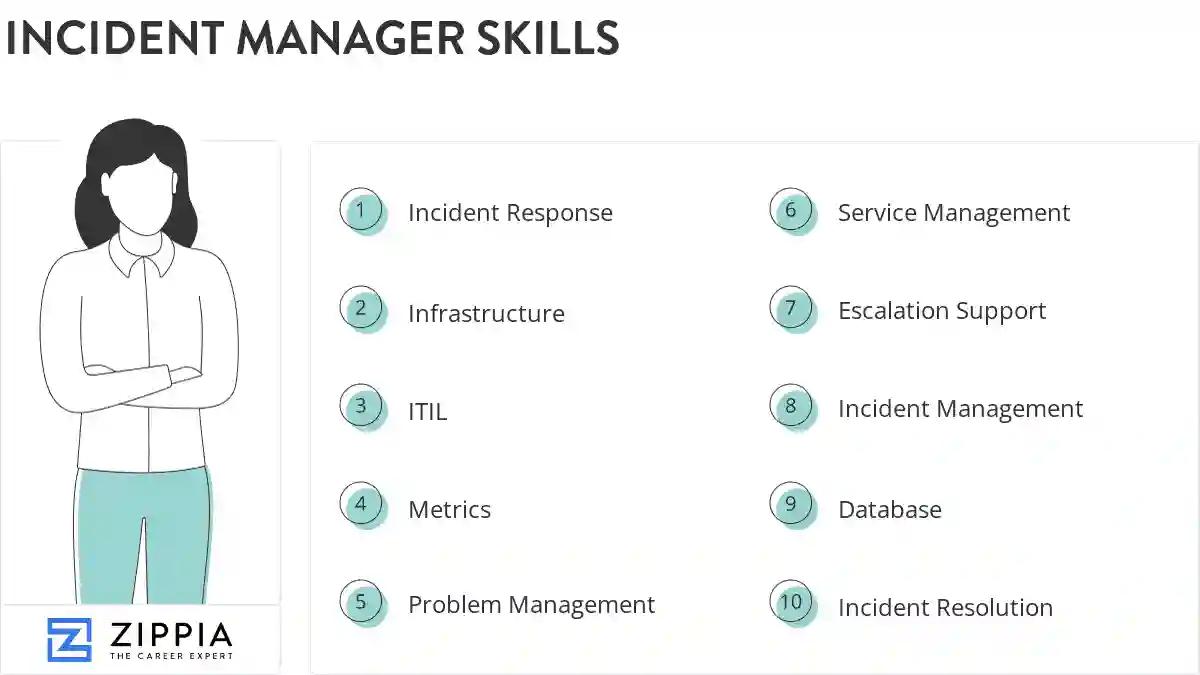
The most important skills for an incident manager resume and required skills for an incident manager to have include:
- Incident Response
- Infrastructure
- ITIL
- Metrics
- Problem Management
- Service Management
- Escalation Support
- Incident Management
- Database
- Incident Resolution
- Technical Support
- Process Improvement
- ITSM
- Slas
- Continuous Improvement
- Linux
- Level Agreements
- Critical Incidents
- Customer Satisfaction
- Remedy
- Service Desk
- Service Delivery
- SQL
- RCA
- Unix
- Business Operations
- Restore Service
- Management System
- Business Stakeholders
- Status Updates
- Windows Server
- Conference Calls
- Problem Resolution
- Azure
- Production Environment
- Incident Reports
- Technical Issues
- NOC
- Client Facing
- Network Operations
- Executive Management
- Java
- Mainframe
- SharePoint
Updated January 8, 2025
