What does an instructor/tutor do?
Instructor/tutor responsibilities
Here are examples of responsibilities from real instructor/tutor resumes:
- Used different tools to achieve student success such as the whiteboard, websites, and role playing.
- Tutor elementary children in elementary math, literacy comprehension, study skills and EOG preparation.
- Work with students both in Spanish and English if they are ESL.
- Instruct secondary-level students in a small-group setting in the fields of literature and writing.
- Experience teaching all levels (beginner, intermediate, advance intermediate, advance) ESL.
- Provide multiple math anxiety/exam workshops.
- Authore and present PowerPoint presentations for multiple weekly, quarterly lab meetings and for oral presentations at national or international meetings.
- Prepare daily lesson plans with interactive teaching tools and instruct physical therapy students participating in an intensive gross anatomy summer course.
- Proofread college students' essays and offer suggestions for improvement
Instructor/tutor skills and personality traits
We calculated that 19% of Instructor/Tutors are proficient in Basic Mathematics, Math, and Classroom Management. They’re also known for soft skills such as Communication skills, Cultural sensitivity, and Patience.
We break down the percentage of Instructor/Tutors that have these skills listed on their resume here:
- Basic Mathematics, 19%
Tutored students in mathematics ranging from basic mathematics to calculus.
- Math, 17%
Provided multiple math anxiety/exam workshops.
- Classroom Management, 10%
Oversee credit recovery for migrant students (grades 9-12) Classroom management
- Language Arts, 7%
Instruct and tutor Language Arts to elementary, middle school, and high school students using hands-on learning opportunities and alternative instruction
- Grammar, 5%
Tutor 25-36 ELL students each session in speaking, reading, writing, listening, pronunciation, and grammar.
- Chemistry, 3%
Tutor students in areas of mathematics, chemistry, biology, geography and geology.
"basic mathematics," "math," and "classroom management" are among the most common skills that instructor/tutors use at work. You can find even more instructor/tutor responsibilities below, including:
Communication skills. To carry out their duties, the most important skill for an instructor/tutor to have is communication skills. Their role and responsibilities require that "adult basic and secondary education and esl teachers must collaborate with other teachers and program administrators." Instructor/tutors often use communication skills in their day-to-day job, as shown by this real resume: "assist student-athletes with introductory communication, psychology, statistics, nutrition, and sociology courses. "
Cultural sensitivity. Another soft skill that's essential for fulfilling instructor/tutor duties is cultural sensitivity. The role rewards competence in this skill because "teachers work with students from a variety of cultural, educational, and economic backgrounds." According to an instructor/tutor resume, here's how instructor/tutors can utilize cultural sensitivity in their job responsibilities: "tutored a culturally diverse group of students in math and language arts. "
Patience. instructor/tutors are also known for patience, which are critical to their duties. You can see how this skill relates to instructor/tutor responsibilities, because "working with students of different abilities and backgrounds can be difficult." An instructor/tutor resume example shows how patience is used in the workplace: "assisted students problem proficiency to better mathematics test scores learned patience and developed skills for teaching others"
Resourcefulness. A big part of what instructor/tutors do relies on "resourcefulness." You can see how essential it is to instructor/tutor responsibilities because "teachers must be able to think on their feet and find ways to keep students engaged in learning." Here's an example of how this skill is used from a resume that represents typical instructor/tutor tasks: "showed resourcefulness and teaching effectiveness in meeting the needs of students with limited english language proficiency as well as learning disabilities. "
The three companies that hire the most instructor/tutors are:
- Delaware Systems Technology, Inc.11 instructor/tutors jobs
- Pueblo City-County Library District3 instructor/tutors jobs
- Brilla Public Charter Schools1 instructor/tutors jobs
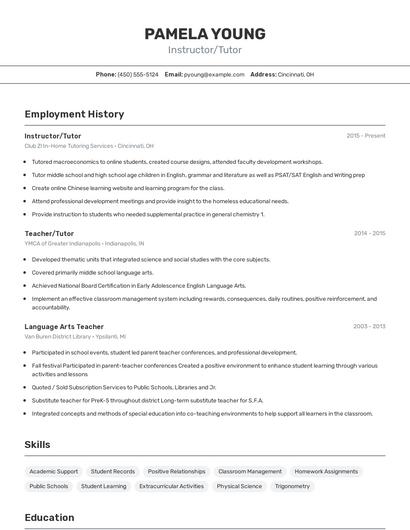
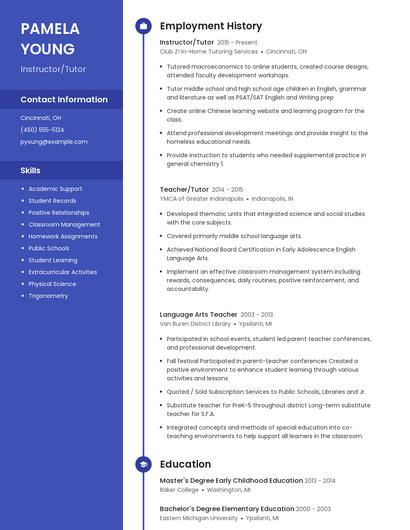
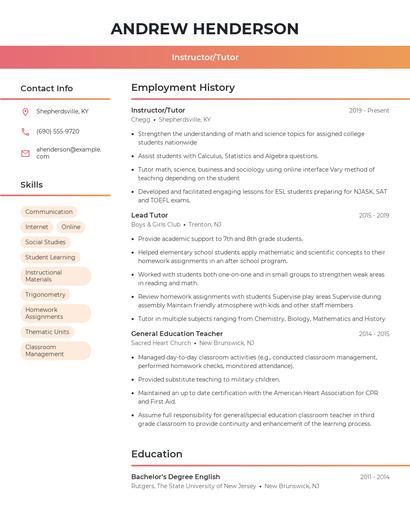
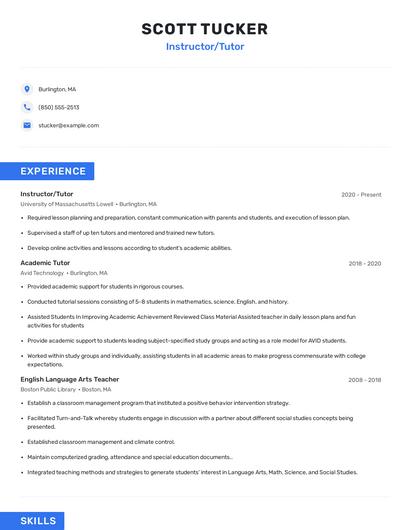
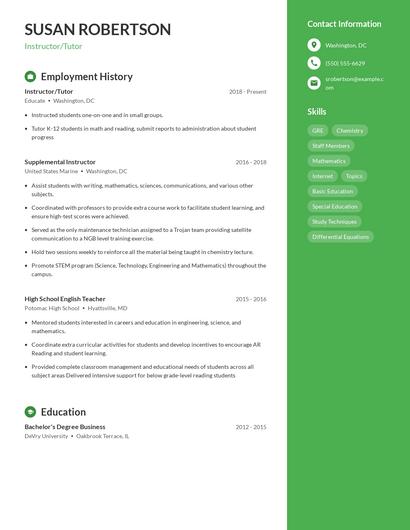
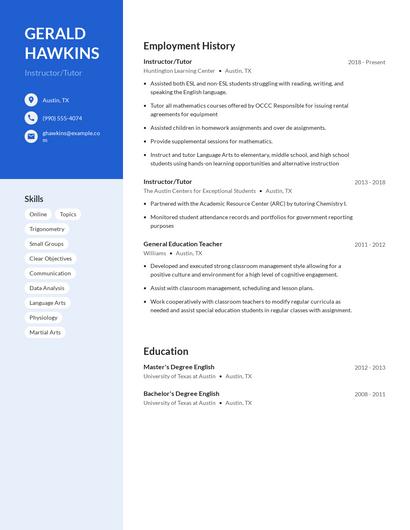
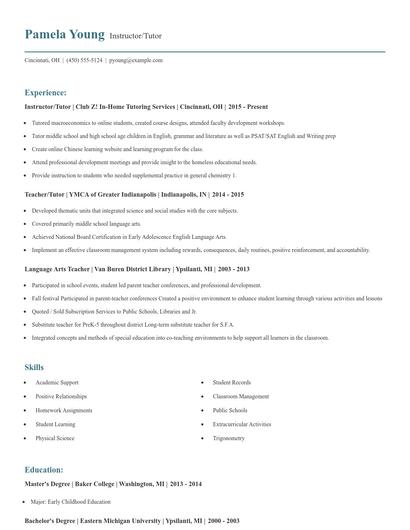
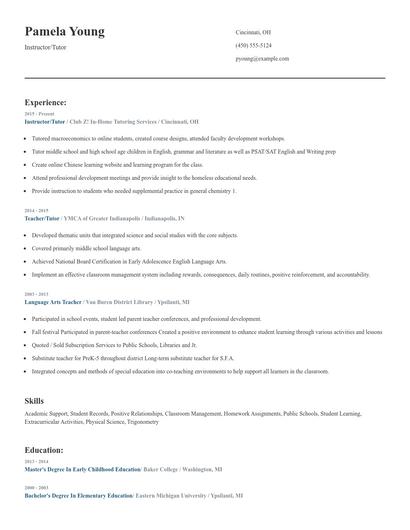
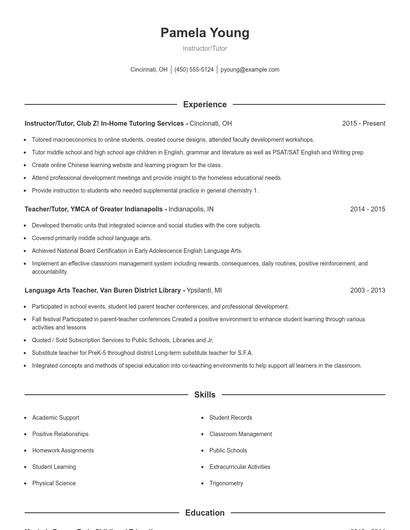
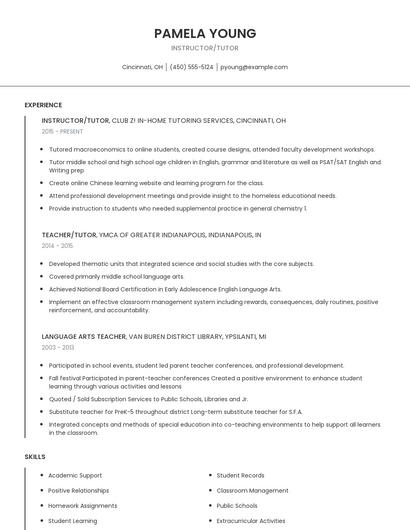
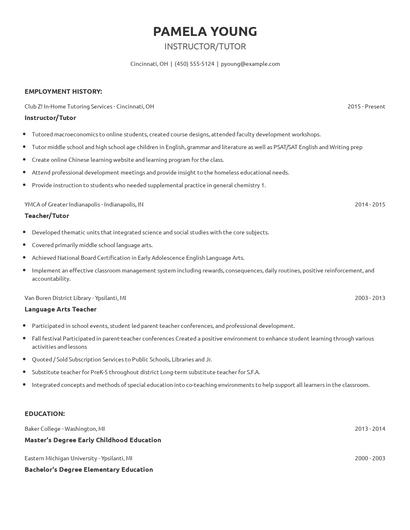
Choose from 10+ customizable instructor/tutor resume templates
Build a professional instructor/tutor resume in minutes. Our AI resume writing assistant will guide you through every step of the process, and you can choose from 10+ resume templates to create your instructor/tutor resume.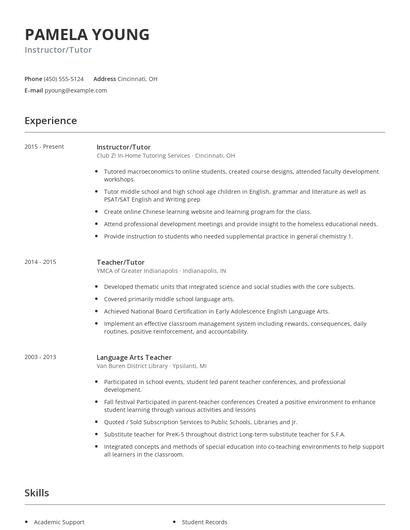
Compare different instructor/tutors
Instructor/tutor vs. Math and science teacher
Math and Science Teachers are responsible for imparting knowledge and developing a student's skills in mathematics and science. Their duties include creating lessons, producing learning materials, sourcing supplies, and grading examinations and quizzes. They develop student progress reports, provide constructive feedback, and work with parents to inform a student's educational development. Math and Science Teachers must ensure awareness of special educational needs and health and safety regulations related to subject teachings.
There are some key differences in the responsibilities of each position. For example, instructor/tutor responsibilities require skills like "basic mathematics," "language arts," "grammar," and "language." Meanwhile a typical math and science teacher has skills in areas such as "science curriculum," "learning process," "learning styles," and "instructional strategies." This difference in skills reveals the differences in what each career does.
Math and science teachers really shine in the education industry with an average salary of $49,024. Comparatively, instructor/tutors tend to make the most money in the government industry with an average salary of $41,367.The education levels that math and science teachers earn slightly differ from instructor/tutors. In particular, math and science teachers are 5.4% more likely to graduate with a Master's Degree than an instructor/tutor. Additionally, they're 2.2% less likely to earn a Doctoral Degree.Instructor/tutor vs. Avid tutor
An AVID tutor has expertise in this type of teaching and promotes the AVID teaching methodology in education. The AVID tutor intends to inspire students to improve through individual determination. The focus of each activity is the Socratic method. Students come up with answers independently by engaging questions and analyzing principles provided by various textbooks approved by an educational institution.
Each career also uses different skills, according to real instructor/tutor resumes. While instructor/tutor responsibilities can utilize skills like "basic mathematics," "grammar," "instructional materials," and "language," avid tutors use skills like "writing process," "student binders," "collaborative learning," and "brainstorming."
Avid tutors may earn a lower salary than instructor/tutors, but avid tutors earn the most pay in the education industry with an average salary of $28,853. On the other hand, instructor/tutors receive higher pay in the government industry, where they earn an average salary of $41,367.In general, avid tutors achieve lower levels of education than instructor/tutors. They're 12.5% less likely to obtain a Master's Degree while being 2.2% less likely to earn a Doctoral Degree.What technology do you think will become more important and prevalent for instructor/tutors in the next 3-5 years?
Helen Callus
Professor of Viola, Northwestern University
I imagine this might become part of the framework that we offer in the future. Students should understand how to present themselves in these situations, understanding sound and picture quality devices (what microphones and cameras are best), internet speeds, ethernet cables, router devices, lighting, etc. But it is an excellent opportunity to understand the media of film/video and how to create best a sound video recording for competitions, summer festivals, or college applications. We were already using that medium for prescreens, so this is a chance to refine that skill as, without doubt, that will be a part of our future.
Instructor/tutor vs. Academic tutor
An academic tutor is responsible for assisting the students' learning goals and development by helping them with school work and related academic tasks. Academic tutors implement effective learning strategies to improve the student's academic standing, such as identifying areas of improvement and addressing those difficulties by administering learning activities to evaluate the student's progress and adjust the learning approach as needed. They also review the school's curriculum and present educational materials adhering to the requirements, encouraging the student to set goals for learning objectives.
There are many key differences between these two careers, including some of the skills required to perform responsibilities within each role. For example, an instructor/tutor is likely to be skilled in "basic mathematics," "classroom management," "grammar," and "chemistry," while a typical academic tutor is skilled in "student athletes," "organic chemistry," "gpa," and "anatomy."
Academic tutors make a very good living in the education industry with an average annual salary of $32,838. On the other hand, instructor/tutors are paid the highest salary in the government industry, with average annual pay of $41,367.academic tutors typically earn lower educational levels compared to instructor/tutors. Specifically, they're 6.5% less likely to graduate with a Master's Degree, and 2.4% less likely to earn a Doctoral Degree.Instructor/tutor vs. Reading tutor
Typically working with children, a reading tutor facilitates activities that enhance students' reading and comprehension skills. They may provide tutoring sessions in a one-on-one or group setting, depending on their place of employment. Their responsibilities include developing lesson plans and activities in adherence to the students' needs, conducting skills assessments, preparing quizzes and tests, grading performances, and assisting students in the areas they find difficult. Moreover, as a reading tutor, it is essential to motivate students to reach goals while making them feel comfortable throughout the lessons.
Even though a few skill sets overlap between instructor/tutors and reading tutors, there are some differences that are important to note. For one, an instructor/tutor might have more use for skills like "basic mathematics," "classroom management," "grammar," and "chemistry." Meanwhile, some responsibilities of reading tutors require skills like "kids," "professional development," "americorps," and "english language. "
The education industry tends to pay the highest salaries for reading tutors, with average annual pay of $38,172. Comparatively, the highest instructor/tutor annual salary comes from the government industry.The average resume of reading tutors showed that they earn similar levels of education compared to instructor/tutors. So much so that theyacirc;euro;trade;re 4.7% less likely to earn a Master's Degree and less likely to earn a Doctoral Degree by 3.1%.Types of instructor/tutor
Updated January 8, 2025
