
Automatically apply for jobs with Zippia
Upload your resume to get started.
Intake worker skills for your resume and career
15 intake worker skills for your resume and career
2. Assistance Program
Assistance Program refers to a set of volunteer-based programs offered to help employees currently struggling with home- or work-related problems. These programs may include counseling, assessments, or referrals. Counselors address substance abuse problems, psychological disorders, and even workplace trauma or violence. Counselors may also work with the employers to determine what, if any, issues or challenges should be addressed on a large scale.
- Collect all client information to assess for eligibility for heating assistance program.
- Initiated procedures for eligibility of various assistance programs.
3. Scheduling Appointments
Scheduling appointments is the practice of finding a free slot with the person(s) you want to meet. The process of scheduling appointments involves finding mutually free time, negotiating follow-ups, sending reminders, and creating new appointments. Scheduling appointments is important to ensure that the timings of consecutive meetings do not clash with each other.
- Managed off-site location Data entry, scheduling appointments, file management Candidate assessment
4. Intake Assessments
- Conducted intake assessments in order to establish eligibility for low income heat and/or natural gas.
- Produced intake assessment report and statistical information for program.
6. Data Entry
Data entry means entering data into a company's system with the help of a keyboard. A person responsible for entering data may also be asked to verify the authenticity of the data being entered. A person doing data entry must pay great attention to tiny details.
- Process correspondence to inmates seeking program re-entering society, data entry and general filing.
- Assisted clients by opening a file, completing an application over the telephone, check for conflicts and used data entry.
Choose from 10+ customizable intake worker resume templates
Build a professional intake worker resume in minutes. Our AI resume writing assistant will guide you through every step of the process, and you can choose from 10+ resume templates to create your intake worker resume.7. Community Resources
Community resources are a set of resources that are used in the day to day life of people which improves their lifestyle in some way. People, sites or houses, and population assistance can come under the services offered by community resources.
- Counseled applicants on available community resources for applications based on the State and Federal policy.
- Referred Veterans to community resources based upon Veteran needs.
8. Child Abuse
When a child who is under 18 is mistreated by an adult, it is considered child abuse. There are many forms of intentional harm and mistreatment for example physical abuse, sexual abuse, emotional abuse, medical abuse, and neglect in providing adequate basic life necessities.
- Assess and evaluate families for various social issues including substance abuse, domestic violence, child abuse, and child neglect.
- Assess referrals of child abuse and neglect and prioritize whether and how immediate intervention is required.
9. Emergency Services
- Assisted clients with information regarding emergency services including food banks, clothing give-a-way, and housing needs.
- Perform intakes for emergency services.
10. Intake Interviews
- Conducted intake interviews to determine eligibility for program enrollments of low income families.
- Conducted Eligibility Intake Interviews for General Caseload and Chemically Dependent Populations.
11. Substance Abuse
- Processed residential applications attended to client needs and administered substance abuse tests.
- Facilitate Intensive Outpatient Treatment substance abuse groups for adolescents and adults.
12. Mental Health
Mental health is the state of wellbeing in which an individual can cope with the regular stresses and tensions of life, and can work productively without having any emotional or psychological breakdown. Mental health is essential for a person of any age and helps them make the right decisions in their life.
- Provide face-to-face assessment/intake and administrative case management services to individuals with mental health and drug and alcohol needs.
- Created intake assessment reports which included psychiatric diagnoses, clinical assessment, mental health status, and disposition about possible admissions.
13. Law Enforcement
Law enforcement is the task of certain members of the community who work together to uphold the law by identifying, preventing, rehabilitating, or prosecuting others who break society's laws and norms. The phrase refers to the police, the judiciary, and the correctional system.
- Compiled information from law enforcement and conducted interviews with juvenile offenders for the office of public defenders.
- Processed Minors into Juvenile Detention Center from local law enforcement.
14. Crisis Intervention
- Complete intake on juvenile offenders and juvenile CINC, perform crisis assessment & crisis intervention, facilitate court documentation
- Provide crisis intervention to individuals experiencing episodes of acute stress.
15. Intake Process
- Determine payment codes, clothing allowance and completing the intake process with both child and foster parent.
- Review and update patient charting through the intake process, scan and upload new documents.
5 Intake Worker resume examples
Build a professional intake worker resume in minutes. Browse through our resume examples to identify the best way to word your resume. Then choose from 5+ resume templates to create your intake worker resume.

What skills help Intake Workers find jobs?
Tell us what job you are looking for, we’ll show you what skills employers want.
What skills stand out on intake worker resumes?
Dr. Florence DiGennaro Reed Ph.D.
Associate Professor and Chairperson, Director of the Performance Management Laboratory, University of Kansas
What soft skills should all intake workers possess?
Dr. Dianna Cooper
Associate Professor, Campbellsville University
What hard/technical skills are most important for intake workers?
Dr. Dianna Cooper
Associate Professor, Campbellsville University
What intake worker skills would you recommend for someone trying to advance their career?
Abby Worland
Managing Director of People Rocky Mountain Prep Network Support Team, Rocky Mountain Prep
Many people recommend "following your passion" in your work. I would adjust that and recommend instead that you pursue work that has a purpose and mission that align with your personal values. Spend your gap year identifying what those values are. All jobs are going to have tough moments, that is the nature of work, but if the work is meaningful to you, it is far easier to be resilient.
What type of skills will young intake workers need?
Chris Hennington Ph.D.
School Counseling Program Coordinator, Lubbock Christian University
List of intake worker skills to add to your resume
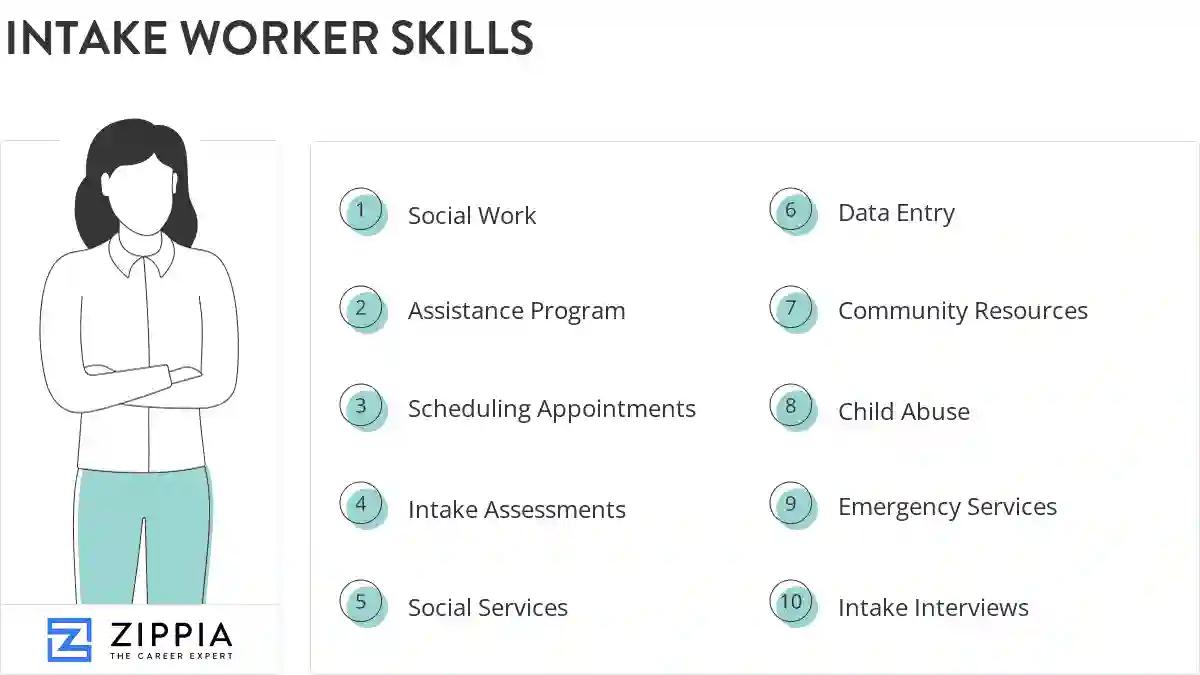
The most important skills for an intake worker resume and required skills for an intake worker to have include:
- Social Work
- Assistance Program
- Scheduling Appointments
- Intake Assessments
- Social Services
- Data Entry
- Community Resources
- Child Abuse
- Emergency Services
- Intake Interviews
- Substance Abuse
- Mental Health
- Law Enforcement
- Crisis Intervention
- Intake Process
- Program Eligibility
- Community Agencies
- Referral Services
- Process Applications
- Domestic Violence
- Financial Assistance
- Face-To-Face Interviews
- Conflict Resolution
- Front Desk
- Computer System
- Community Services
- Legal Services
- Crisis Calls
- Public Assistance
- Telephone Calls
- Child Protective
- Client Eligibility
- Child Care
- Client Data
- Utility Bills
- Court Hearings
- Court Reports
- Client Referrals
- Intake Applications
- Utility Assistance
- Crisis Situations
Updated January 8, 2025

1. Social Work