What does an intake worker do?
Intake Workers are responsible for directing new patients with their needed services in a medical facility such as hospitals, nursing homes, or crisis centers. They are responsible for coordinating appointments with clients, providing information about services and programs, and answering client inquiries on emails and phone calls. Intake Workers are responsible for vetting application eligibility, maintaining accurate client documentation, and providing assistance in checking or applying for health insurance coverage.
Intake worker responsibilities
Here are examples of responsibilities from real intake worker resumes:
- Manage assignments of paying medical bills limit in depth that include organizing and researching regulations as pertain to veterans eligibility.
- Develop effective, trusting relationships with identify veterans, with a focus on facilitating housing placement, stability, and independence.
- Provide interventions for at-risk children with emotional disabilities, including sexual/physical abuse, delay development, autism, and social impairment.
Intake worker skills and personality traits
We calculated that 18% of Intake Workers are proficient in Social Work, Assistance Program, and Scheduling Appointments. They’re also known for soft skills such as Emotional skills, Communication skills, and Interpersonal skills.
We break down the percentage of Intake Workers that have these skills listed on their resume here:
- Social Work, 18%
Monitored foster home and child's progress in the home until case is transferred to case carrying social worker.
- Assistance Program, 8%
Collect all client information to assess for eligibility for heating assistance program.
- Scheduling Appointments, 8%
Managed off-site location Data entry, scheduling appointments, file management Candidate assessment
- Intake Assessments, 7%
Conducted intake assessments in order to establish eligibility for low income heat and/or natural gas.
- Social Services, 7%
Coordinated referrals to community-based programs including medical, substance abuse and social services.
- Data Entry, 6%
Process correspondence to inmates seeking program re-entering society, data entry and general filing.
Most intake workers use their skills in "social work," "assistance program," and "scheduling appointments" to do their jobs. You can find more detail on essential intake worker responsibilities here:
Communication skills. Another essential skill to perform intake worker duties is communication skills. Intake workers responsibilities require that "clients talk to social workers about challenges in their lives." Intake workers also use communication skills in their role according to a real resume snippet: "position required regular communication and coordination with multiple agencies to include mental health, drug and alcohol, and foster care. "
Interpersonal skills. Another skill that relates to the job responsibilities of intake workers is interpersonal skills. This skill is critical to many everyday intake worker duties, as "social workers must be able to work with different groups of people." This example from a resume shows how this skill is used: "demonstrate excellent interpersonal and counseling skills. "
Organizational skills. A big part of what intake workers do relies on "organizational skills." You can see how essential it is to intake worker responsibilities because "social workers must help and manage multiple clients, often assisting with their paperwork or documenting their treatment." Here's an example of how this skill is used from a resume that represents typical intake worker tasks: "maintain patients' confidentiality adhering to hipaa rules and adhere to organizational policies. "
Problem-solving skills. A commonly-found skill in intake worker job descriptions, "problem-solving skills" is essential to what intake workers do. Intake worker responsibilities rely on this skill because "social workers must analyze their clients’ complex situations and develop practical solutions." You can also see how intake worker duties rely on problem-solving skills in this resume example: "provide 24- hour crisis intervention and conflict resolution. "
Compassion. Another skill commonly found on intake worker job descriptions is "compassion." It can come up quite often in intake worker duties, since "social workers often work with people who are in stressful and difficult situations." Here's an example from a resume of how this skill fits into day-to-day intake worker responsibilities: "dedicated to excellence and compassion to patients and their families. "
The three companies that hire the most intake workers are:
- ICF57 intake workers jobs
- The Salvation Army4 intake workers jobs
- HELP USA3 intake workers jobs
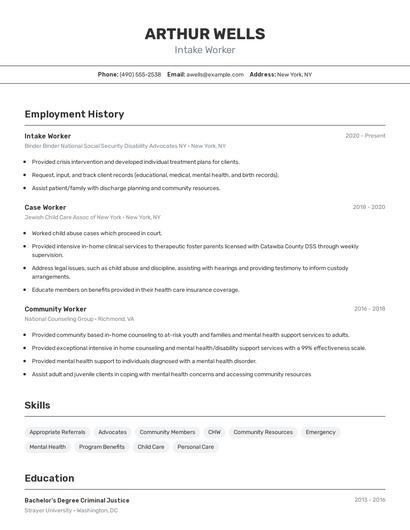
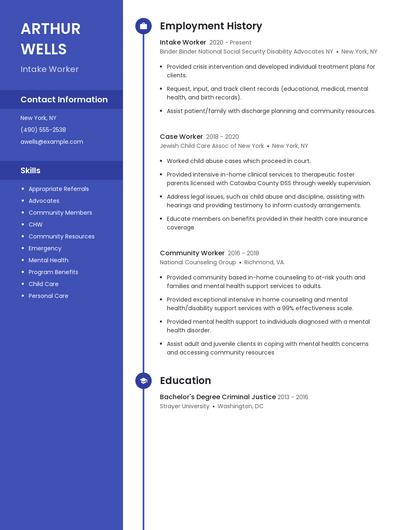
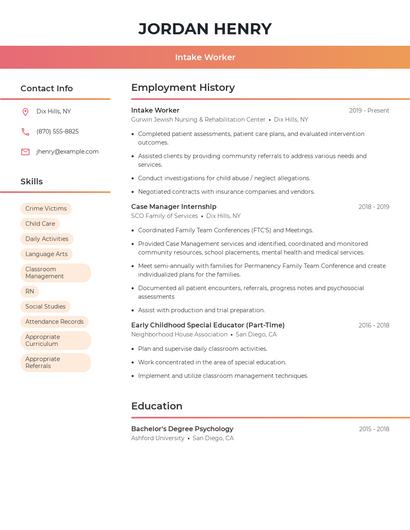
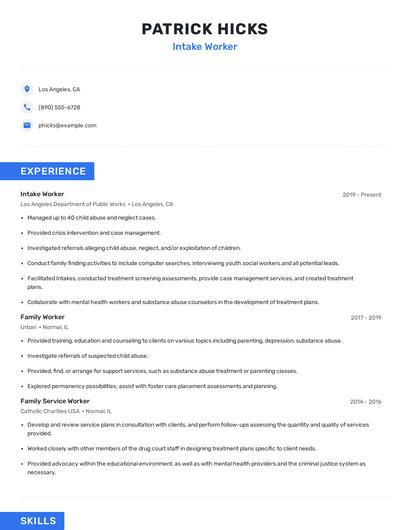
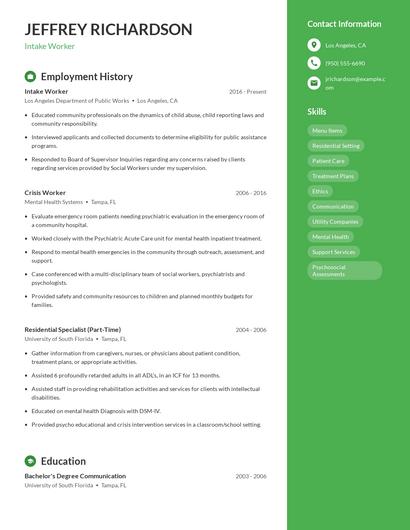
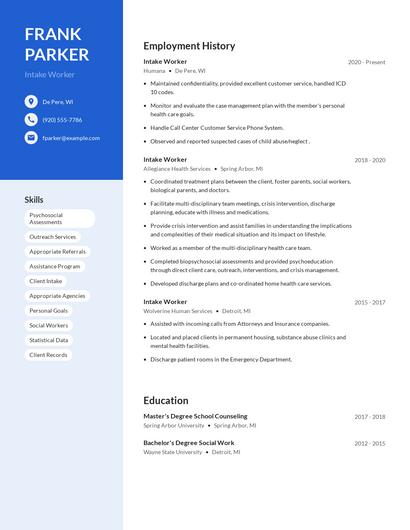
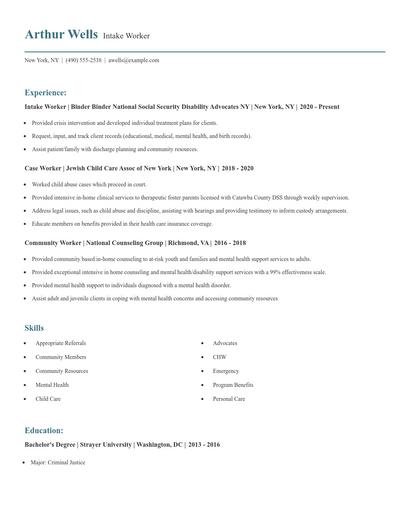
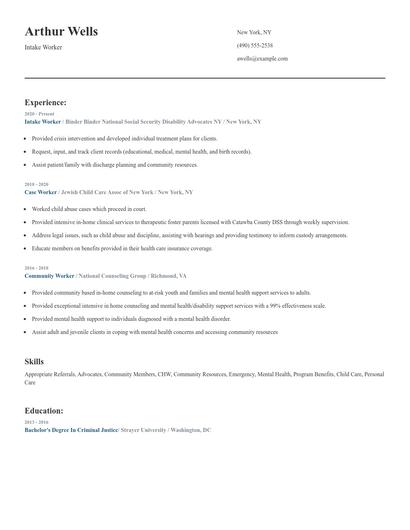
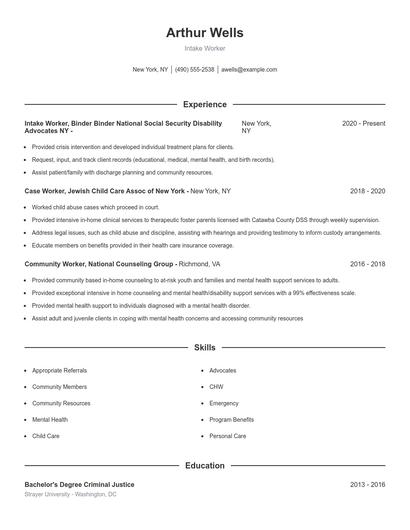
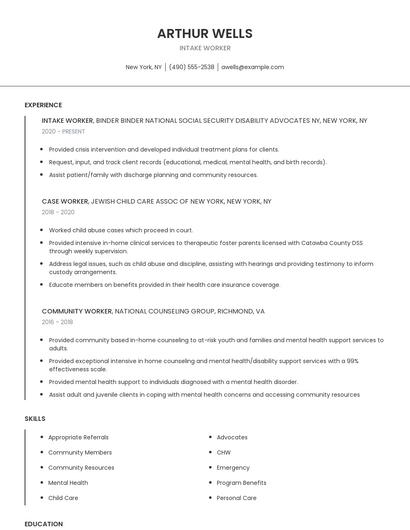
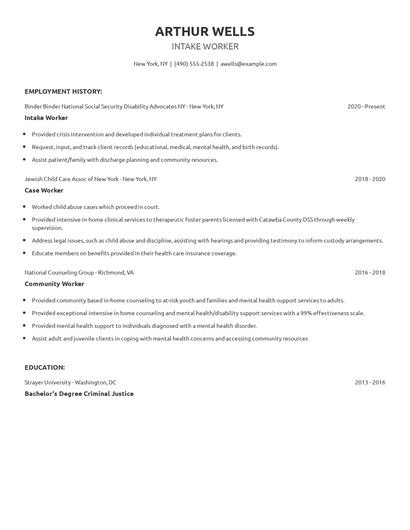
Choose from 10+ customizable intake worker resume templates
Build a professional intake worker resume in minutes. Our AI resume writing assistant will guide you through every step of the process, and you can choose from 10+ resume templates to create your intake worker resume.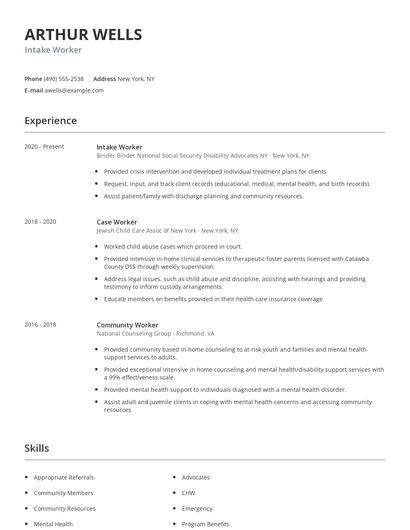
Compare different intake workers
Intake worker vs. Social services assistant
A social services assistant is responsible for supporting the social needs of citizens within society. Social services assistants work within the community office or health institutions to assist patients and their families in processing their needs and obtaining medical information. They also coordinate with other organizations to gather additional resources and financial assistance to plan community programs that will be beneficial for society. A social services assistant provides counseling to the families to identify the services and referrals they needed.
These skill sets are where the common ground ends though. The responsibilities of an intake worker are more likely to require skills like "assistance program," "intake assessments," "social services," and "data entry." On the other hand, a job as a social services assistant requires skills like "patients," "rehabilitation," "discharge planning," and "term care." As you can see, what employees do in each career varies considerably.
Social services assistants earn the highest salaries when working in the government industry, with an average yearly salary of $38,533. On the other hand, intake workers are paid more in the government industry with an average salary of $37,783.social services assistants tend to reach similar levels of education than intake workers. In fact, social services assistants are 1.4% less likely to graduate with a Master's Degree and 0.3% less likely to have a Doctoral Degree.Intake worker vs. Residence counselor
Residence counselors are professionals who are responsible for providing services such as one-to-one therapy and crisis support to clients who are living in group homes or assisted-living facilities. These counselors must assist adults with moderate intellectual disabilities to find employment while monitoring their work performance. They must facilitate and supervise daily personal care and activities for developmentally disabled adults. Residence counselors must also encourage clients to participate in community activities that can contribute to the development of skills necessary for independent living.
In addition to the difference in salary, there are some other key differences worth noting. For example, intake worker responsibilities are more likely to require skills like "assistance program," "scheduling appointments," "intake assessments," and "social services." Meanwhile, a residence counselor has duties that require skills in areas such as "developmental disabilities," "cpr," "english language," and "patients." These differences highlight just how different the day-to-day in each role looks.
Residence counselors earn a lower average salary than intake workers. But residence counselors earn the highest pay in the education industry, with an average salary of $35,988. Additionally, intake workers earn the highest salaries in the government with average pay of $37,783 annually.Average education levels between the two professions vary. Residence counselors tend to reach similar levels of education than intake workers. In fact, they're 1.6% less likely to graduate with a Master's Degree and 0.3% less likely to earn a Doctoral Degree.What technology do you think will become more important and prevalent for intake workers in the next 3-5 years?
Virginia Schwindt
MSW Field Director/Associate Professor, Union University
Intake worker vs. Youth mentor
Youth mentors are adult individuals who are responsible for creating programs to improve the well-being of young people by providing role models that can support them academically and socially. These mentors must educate the community on issues related to mental health while making regular home visits to youth and young adults. They should provide direct care and assistance to adolescents who are with substance abuse issues by creating an educational curriculum on the said topic. Youth mentors are also required to collaborate with mental health professionals and social workers to coordinate counseling efforts.
Some important key differences between the two careers include a few of the skills necessary to fulfill the responsibilities of each. Some examples from intake worker resumes include skills like "assistance program," "scheduling appointments," "intake assessments," and "social services," whereas a youth mentor is more likely to list skills in "eating disorders," "academic support," "role model," and "youth development. "
Youth mentors earn the highest salary when working in the professional industry, where they receive an average salary of $32,145. Comparatively, intake workers have the highest earning potential in the government industry, with an average salary of $37,783.youth mentors typically earn lower educational levels compared to intake workers. Specifically, they're 5.7% less likely to graduate with a Master's Degree, and 0.1% less likely to earn a Doctoral Degree.Intake worker vs. Intensive in-home counselor
An Intensive In-Home Counselor conducts individual counseling sessions for parents and deals with delicate issues like sexual addiction. They also prepare progress reports for clients.
Types of intake worker
Updated January 8, 2025
