What does a lathe operator do?
Lathe operator responsibilities
Here are examples of responsibilities from real lathe operator resumes:
- Operate and programme Mazak lathes.
- Operate dual side Okuma lathe.
- Perform SPC inpections reports for cus to meet monitoring.
- Fabricate metal parts using punch press, CNC brake press.
- Check parts using CMM, micrometers and other appropriate gauges.
- Grind and send dog food into the extrusion for cooking.
- Work on a Fanuc 5 station 2 axis vertical lathe machine.
- File material, hardware, and finish certifications and control drawings.
- Set up, operate, and working on doing programming on Mazak lathes.
- Program, setup, and operate Haas lathes for one-off and production operations.
- Check for the correct blades and angles, and used calipers to measure units.
- Design jigs, fixtures, custom tooling, and revise processes to increase production.
- Operate a turret, forklift, and electric pallet jack.
- Utilize various measuring instruments, such as micrometer, calipers, and dial bore gauge to ensure proper quality.
- Operate heavy duty lathes, boring machines, shapers, grinders, and sand blasters.
Lathe operator skills and personality traits
We calculated that 11% of Lathe Operators are proficient in CNC Lathes, Micrometers, and Manual Lathes. They’re also known for soft skills such as Computer skills, Dexterity, and Physical strength.
We break down the percentage of Lathe Operators that have these skills listed on their resume here:
- CNC Lathes, 11%
Finish Lathe Responsibilities: Prep Barrels for CNC Lathes such as: machine counter-bores and cut to length.
- Micrometers, 11%
Operate a metal lathe to machine gears and Inspect parts with micrometers and calipers to assure proper dimensions.
- Manual Lathes, 10%
Set up of manual lathe, change tooling, welding bits, machining to specified prints and specifications.
- Hand Tools, 9%
Advanced knowledge of hand tools, powered tools, and their proper uses and functions.
- Calipers, 8%
Used Mics Calipers and Bore Gauges.
- Math, 6%
Ensured machinery parts met specification requirements using machine shop math.
Most lathe operators use their skills in "cnc lathes," "micrometers," and "manual lathes" to do their jobs. You can find more detail on essential lathe operator responsibilities here:
Computer skills. The most essential soft skill for a lathe operator to carry out their responsibilities is computer skills. This skill is important for the role because "metal and plastic machine workers must be able to use programmable devices, computers, and robots on the factory floor." Additionally, a lathe operator resume shows how their duties depend on computer skills: "light maintenance and computer set up.skills / experience:* proficient with hand tools, power tools. "
Physical strength. This is an important skill for lathe operators to perform their duties. For an example of how lathe operator responsibilities depend on this skill, consider that "metal and plastic machine workers must be able to secure and tighten heavy fixtures into place." This excerpt from a resume also shows how vital it is to everyday roles and responsibilities of a lathe operator: "lead repair technician skills used math, physical, geometry, electrical, driving, forklift".
Mechanical skills. A big part of what lathe operators do relies on "mechanical skills." You can see how essential it is to lathe operator responsibilities because "these workers must be comfortable with machines and have a good understanding of how all the parts work." Here's an example of how this skill is used from a resume that represents typical lathe operator tasks: "adjusted, cleaned and lubricated mechanical parts of machines, using hand tools and grepse guns. "
The three companies that hire the most lathe operators are:
- Award Staffing
16 lathe operators jobs
- AAR2 lathe operators jobs
- Caterpillar2 lathe operators jobs
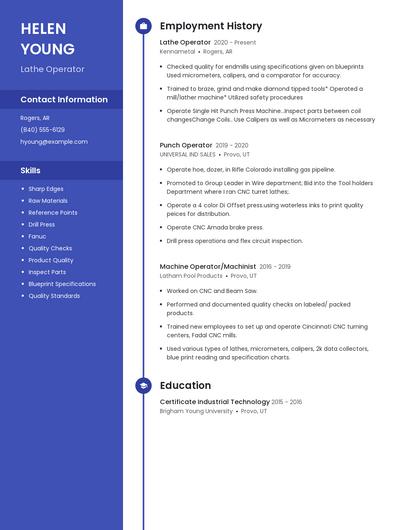
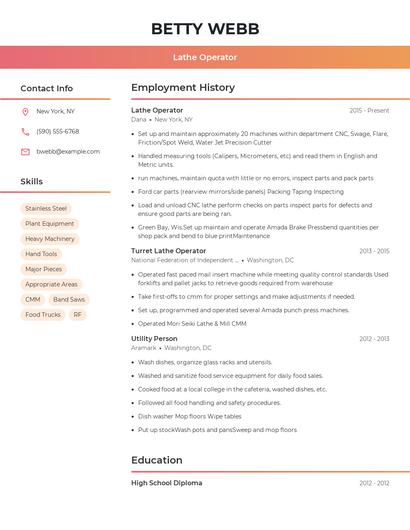
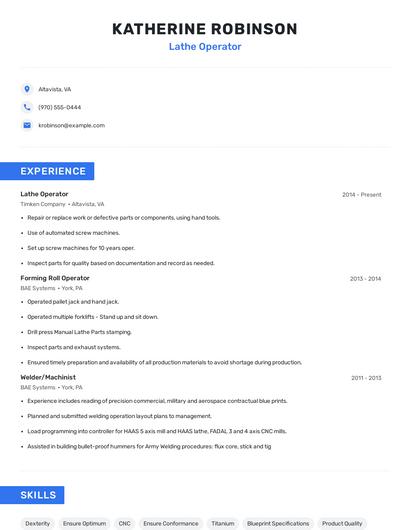
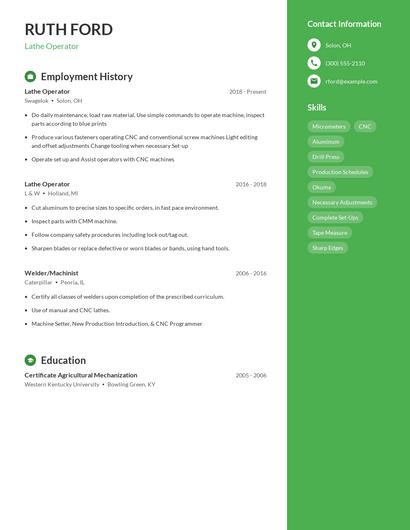
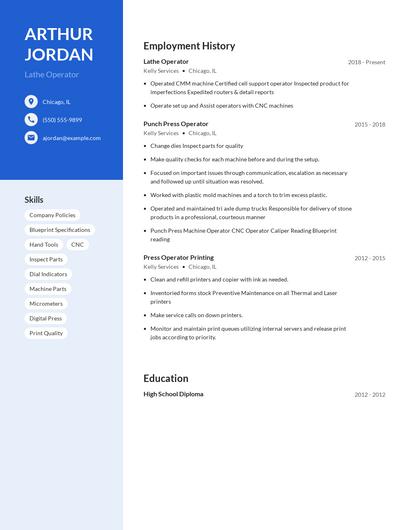
Choose from 10+ customizable lathe operator resume templates
Build a professional lathe operator resume in minutes. Our AI resume writing assistant will guide you through every step of the process, and you can choose from 10+ resume templates to create your lathe operator resume.



Compare different lathe operators
Lathe operator vs. Numerical control operator
A numerical control operator is responsible for monitoring machinery and managing computer-generated equipment to produce tools and components from various mechanical resources. Numerical control operators must have extensive knowledge with the technology and mechanical industry to perform basic troubleshooting and detect malfunctions during operations. A numerical control operator duties' also include inspecting equipment setup and finished products, ensuring high-quality parts, reviewing blueprints, following client's specifications for making adjustments, and adhering to the safety guidelines and procedures required by the business.
These skill sets are where the common ground ends though. The responsibilities of a lathe operator are more likely to require skills like "cnc lathes," "print specifications," "routine maintenance," and "machine operation." On the other hand, a job as a numerical control operator requires skills like "safety standards," "basic math," "preventative maintenance," and "safety procedures." As you can see, what employees do in each career varies considerably.
Numerical control operators earn the highest salaries when working in the automotive industry, with an average yearly salary of $41,888. On the other hand, lathe operators are paid more in the technology industry with an average salary of $39,317.The education levels that numerical control operators earn slightly differ from lathe operators. In particular, numerical control operators are 0.7% more likely to graduate with a Master's Degree than a lathe operator. Additionally, they're 0.1% more likely to earn a Doctoral Degree.Lathe operator vs. Machine set up operator
An extrusion operator is also sometimes called a drawing machine operator. They control and monitor machines that shape thermoplastic materials for industries such as aerospace manufacturing, general plastics manufacturing, and automobile and auto parts manufacturing. An extrusion operator sets up and operates a machine following established procedures, guidelines, and customer requirement. Mechanical skills are the very foundation of being an extrusion operator. An extrusion operator also needs physical strength, stamina, computer skills, and critical thinking skills.
Each career also uses different skills, according to real lathe operator resumes. While lathe operator responsibilities can utilize skills like "hand tools," "print specifications," "lathe machines," and "perform routine maintenance," machine set up operators use skills like "cnc machines," "dexterity," "basic math," and "quality products."
Machine set up operators earn a lower average salary than lathe operators. But machine set up operators earn the highest pay in the automotive industry, with an average salary of $39,440. Additionally, lathe operators earn the highest salaries in the technology with average pay of $39,317 annually.In general, machine set up operators achieve similar levels of education than lathe operators. They're 0.6% more likely to obtain a Master's Degree while being 0.1% more likely to earn a Doctoral Degree.Lathe operator vs. Machine operator/machinist
The required skills of the two careers differ considerably. For example, lathe operators are more likely to have skills like "hand tools," "print specifications," "perform routine maintenance," and "lathe operation." But a machine operator/machinist is more likely to have skills like "grinders," "cnc machines," "safety procedures," and "machine shop."
Most machine operators/machinist achieve a similar degree level compared to lathe operators. For example, they're 1.4% more likely to graduate with a Master's Degree, and 0.0% more likely to earn a Doctoral Degree.Lathe operator vs. Extrusion operator
Even though a few skill sets overlap between lathe operators and extrusion operators, there are some differences that are important to note. For one, a lathe operator might have more use for skills like "cnc lathes," "micrometers," "manual lathes," and "print specifications." Meanwhile, some responsibilities of extrusion operators require skills like "extrusion machine," "safety procedures," "extrusion equipment," and "basic math. "
Extrusion operators enjoy the best pay in the automotive industry, with an average salary of $40,020. For comparison, lathe operators earn the highest salary in the technology industry.In general, extrusion operators hold similar degree levels compared to lathe operators. Extrusion operators are 0.0% less likely to earn their Master's Degree and 0.0% less likely to graduate with a Doctoral Degree.Types of lathe operator
Updated January 8, 2025
