What does a lead system technician do?
A lead technician is a person who is responsible for assisting clients that has legal concerns. For most countries, this job description is a unique position that allows individuals that are practicing law but do not have a license. They have to advise and give proper assistance to clients dealing with legal issues like child labor, divorce, annulment, and other family issues. Also, this person prepares all the needed documents when beginning a legal battle. They also accompany the lawyer and client to a court hearing and further proceedings.
Lead system technician responsibilities
Here are examples of responsibilities from real lead system technician resumes:
- Lead the development of LTE RF optimization projects for Verizon, and Vodafone.
- Recommend, engineer and manage office systems, including centralize productivity and communication systems such as e-mail and centralize desktop environments.
- Create project plans for PC and software programs upgrades.
- Assist in the development of training materials for the Linux cluster solutions product line.
- Update all javascript, plugins, workflows and solutions to support integration with non IE browsers and existing code changes.
- Participate in LAN implementation projects.
- Develop and implement imaging QA program increasing organizations quality and workflow.
- Point person for restructuring hierarchical mainframe data into relational SQL format.
- Monitor, troubleshoot and coordinate contractor personnel for repair, additions and modifications of building HVAC mechanical and automation systems.
- Operate industrial-sized air conditioners and high-powered diesel generators to provide necessary HVAC and electrical power to the mobile grind system.
- Present performance enhancement over current technology for potential investment benefit and status update briefings to the IC stakeholders on architecture design/installation/test.
- Image and install software on new PCs and deliver to Toyota employees.
- Maintain VAX computer system, install network hubs, connect company PCs to network.
- Provide field maintenance and communications support under several OS platforms using remote access.
Lead system technician skills and personality traits
We calculated that 13% of Lead System Technicians are proficient in Java, Troubleshoot, and Hand Tools. They’re also known for soft skills such as Analytical skills, Communication skills, and Multitasking skills.
We break down the percentage of Lead System Technicians that have these skills listed on their resume here:
- Java, 13%
Maintained LPS System Website using Java and Web sphere deployment of jar files.
- Troubleshoot, 12%
Pull backbone and Station cables, Terminate Test and Troubleshoot also install station cables in (ZDB) zone data box.
- Hand Tools, 10%
Removed/installed line-replaceable units and circuit card assemblies using hand tools and soldering devices in compliance with technical data.
- Linux, 6%
Assisted in the development of training materials for the Linux cluster solutions product line.
- Technical Support, 5%
Provided staff-level technical support to program managers and system engineers in areas of software and hardware development.
- CCTV, 4%
Collaborated in organizing and operating audio and video setup and CCTV broadcast for corporate events and exhibitions.
Most lead system technicians use their skills in "java," "troubleshoot," and "hand tools" to do their jobs. You can find more detail on essential lead system technician responsibilities here:
Analytical skills. To carry out their duties, the most important skill for a lead system technician to have is analytical skills. Their role and responsibilities require that "administrators need to evaluate networks and systems to make sure that they perform reliably and to anticipate new requirements as customers’ needs change." Lead system technicians often use analytical skills in their day-to-day job, as shown by this real resume: "populated of sample data into the db2 database for testing purposes. "
Communication skills. Many lead system technician duties rely on communication skills. "administrators must describe problems and their solutions to non-it workers.," so a lead system technician will need this skill often in their role. This resume example is just one of many ways lead system technician responsibilities rely on communication skills: "provided 24/7 satellite communications technical support for oif/oef armed forces combatants utilizing shf/uhf and vhf assets. "
Multitasking skills. lead system technicians are also known for multitasking skills, which are critical to their duties. You can see how this skill relates to lead system technician responsibilities, because "administrators may have to work on many problems and tasks at the same time." A lead system technician resume example shows how multitasking skills is used in the workplace: "exhibit strong communication, critical thinking, multitasking, troubleshooting, and customer service skills"
Problem-solving skills. A big part of what lead system technicians do relies on "problem-solving skills." You can see how essential it is to lead system technician responsibilities because "administrators must quickly resolve problems that arise with computer networks." Here's an example of how this skill is used from a resume that represents typical lead system technician tasks: "updated all javascript, plugins, workflows and solutions to support integration with non ie browsers and existing code changes. "
The three companies that hire the most lead system technicians are:
- General Dynamics Mission Systems
211 lead system technicians jobs
- General Dynamics112 lead system technicians jobs
- Deloitte40 lead system technicians jobs
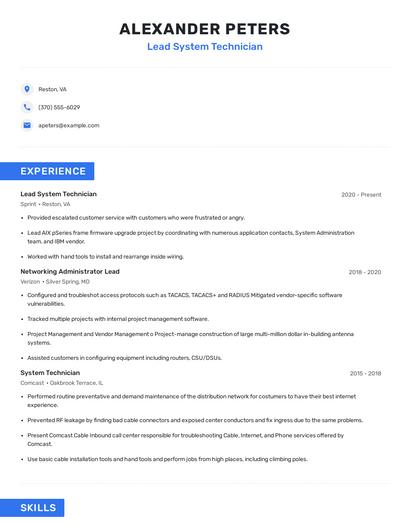
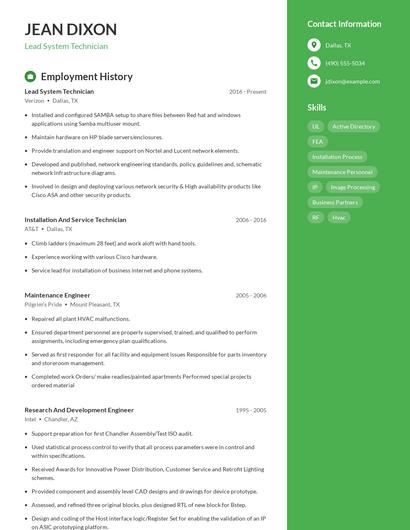
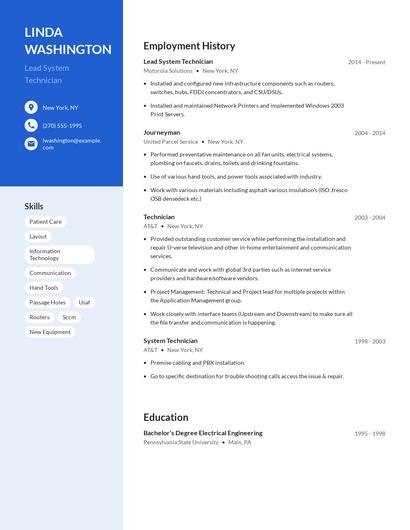
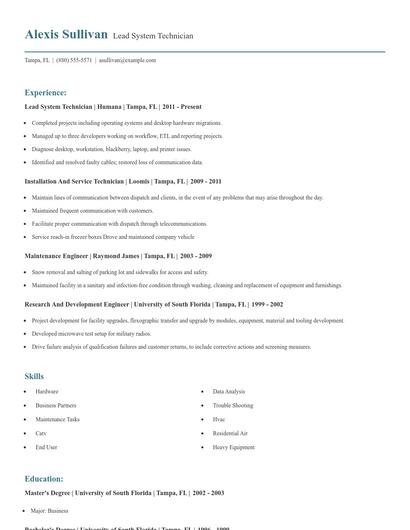
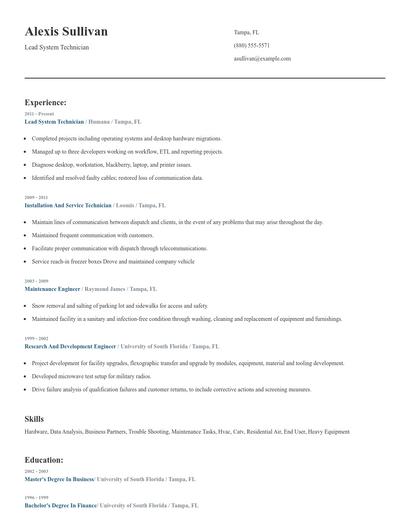
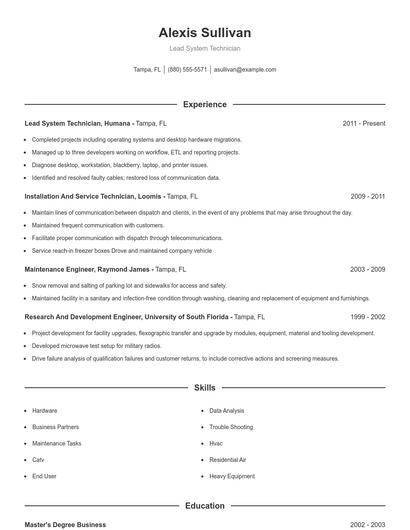
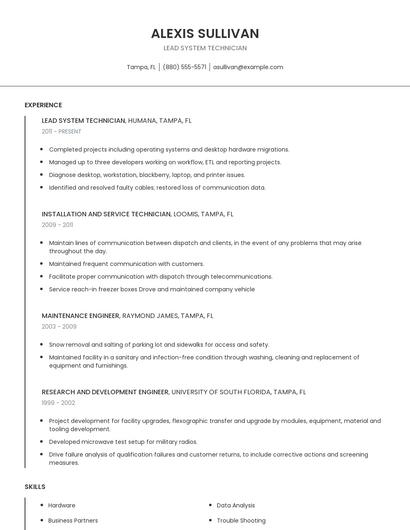
Choose from 10+ customizable lead system technician resume templates
Build a professional lead system technician resume in minutes. Our AI resume writing assistant will guide you through every step of the process, and you can choose from 10+ resume templates to create your lead system technician resume.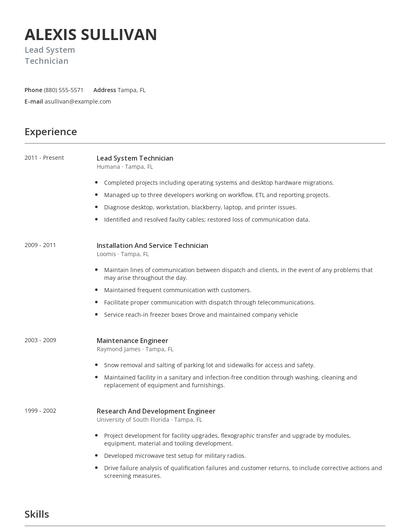
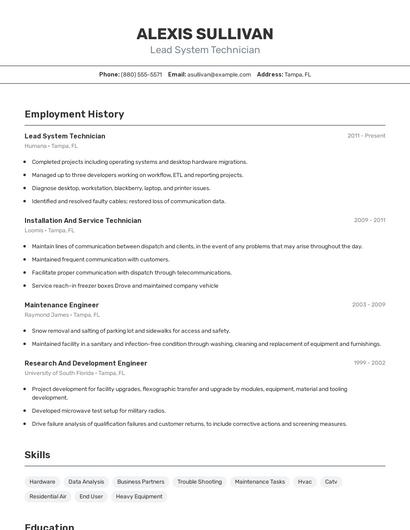
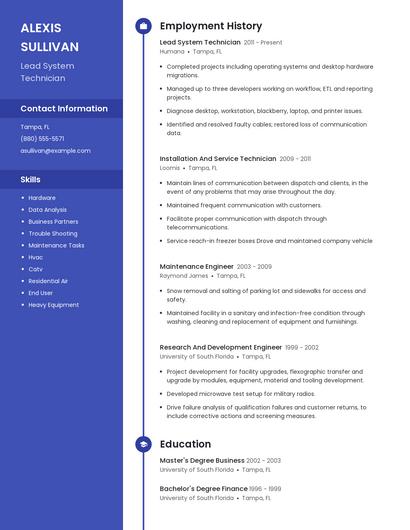
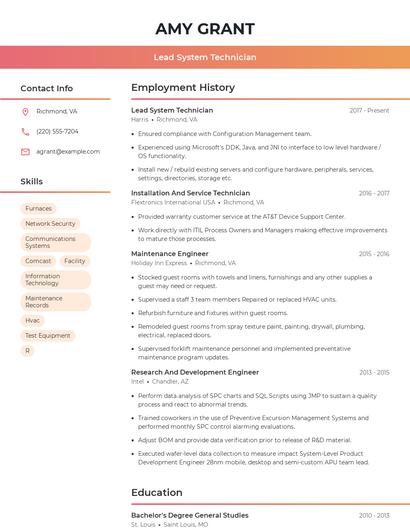

Compare different lead system technicians
Lead system technician vs. Technician support team leader
The Technician Support Team Leader is tasked with leading and training the technical support team. As a team leader, you will be required to organize scheduled staff reviews and communicate new procedures and policies with them. Your key role is to ensure that all goals are met. For all that you'll do, you'll have to ensure that the staff under you are highly productive, and you'd have to come up with ways to increase their productivity.
While similarities exist, there are also some differences between lead system technicians and technician support team leader. For instance, lead system technician responsibilities require skills such as "java," "troubleshoot," "hand tools," and "technical support." Whereas a technician support team leader is skilled in "printers," "customer support," "technical issues," and "sql." This is part of what separates the two careers.
Technician support team leaders tend to make the most money working in the technology industry, where they earn an average salary of $91,502. In contrast, lead system technicians make the biggest average salary, $110,364, in the manufacturing industry.technician support team leaders tend to reach similar levels of education than lead system technicians. In fact, technician support team leaders are 4.5% less likely to graduate with a Master's Degree and 1.0% less likely to have a Doctoral Degree.Lead system technician vs. Technical systems engineer
Technical Systems Engineers are responsible for maintaining the integrity of the infrastructure or systems network. They build, maintain, and repair all the systems and network infrastructure of the organization. They troubleshoot problems and find the best possible solution to address such problems. They also ensure that those problems will be resolved and would never be encountered again. Technical Systems Engineers also help out in information technology or network infrastructure projects of other departments. They provide expertise on the systems-related aspects of the project. They help guide project teams on the feasibility and the success factors of the project.
In addition to the difference in salary, there are some other key differences worth noting. For example, lead system technician responsibilities are more likely to require skills like "hand tools," "cctv," "preventative maintenance," and "customer service." Meanwhile, a technical systems engineer has duties that require skills in areas such as "cloud," "windows server," "powershell," and "project management." These differences highlight just how different the day-to-day in each role looks.
Technical systems engineers earn a lower average salary than lead system technicians. But technical systems engineers earn the highest pay in the finance industry, with an average salary of $116,420. Additionally, lead system technicians earn the highest salaries in the manufacturing with average pay of $110,364 annually.Average education levels between the two professions vary. Technical systems engineers tend to reach similar levels of education than lead system technicians. In fact, they're 0.2% more likely to graduate with a Master's Degree and 1.0% less likely to earn a Doctoral Degree.Lead system technician vs. Information technology technician
An information technology technician, also known as an IT technician, is responsible for ensuring that all computer systems in a company or organization are running smoothly and efficiently. Their duties primarily revolve around installing and maintaining systems, including software and hardware, and resolving any issues. They also provide technical support such as troubleshooting, navigation, and even system upgrades. Furthermore, an information technology technician can choose whether to work for a company or independently.
The required skills of the two careers differ considerably. For example, lead system technicians are more likely to have skills like "hand tools," "cctv," "preventative maintenance," and "emerging technologies." But a information technology technician is more likely to have skills like "desk support," "network printers," "sql," and "remote desktop."
Information technology technicians earn the highest salary when working in the finance industry, where they receive an average salary of $66,881. Comparatively, lead system technicians have the highest earning potential in the manufacturing industry, with an average salary of $110,364.When it comes to education, information technology technicians tend to earn lower degree levels compared to lead system technicians. In fact, they're 7.0% less likely to earn a Master's Degree, and 1.0% less likely to graduate with a Doctoral Degree.Lead system technician vs. Technical system analyst
Technical Systems Analysts are employees who are adept in information technology (IT). They work in the IT department, where they oversee the different networks and systems that exist in the company. They manage the technical systems and ensure that these systems are working properly at all times. They generate reports related to the networks and systems. They then study and analyze these reports to identify existing problems or anticipate challenges that may come their way. These reports help them craft solutions to problems and invest in infrastructure that will address challenges.
Types of lead system technician
Updated January 8, 2025
