What does a lecturer/instructor do?
Lecturer/instructor responsibilities
Here are examples of responsibilities from real lecturer/instructor resumes:
- Assist classmates with developing positive study habits and strategies for managing classroom material.
- Work closely with department principal to outline student learning, design syllabus, teaching methods, and student learning assessment.
- Create PowerPoint presentations used for teaching.
- Develop syllabus and overall course structure, including lab experiments, and administer grades
- Utilize core knowledge and extensive computer skills to delivery timely and relevant materials in PowerPoint and other formats.
- Guide students through management of labor and safe delivery of normal spontaneous vaginal deliveries and postpartum coordination of patients plan of care
- Lecture and laboratory intro to video production concepts and non-linear editing.
Lecturer/instructor skills and personality traits
We calculated that 15% of Lecturer/Instructors are proficient in Semester, Social Work, and Graduate Courses. They’re also known for soft skills such as Interpersonal skills, Speaking skills, and Writing skills.
We break down the percentage of Lecturer/Instructors that have these skills listed on their resume here:
- Semester, 15%
Managed Minority Introduction To Engineering involving 25 students from different states during the Summer Semester, 2004.
- Social Work, 10%
Field instructor for students completing their advance seminar class in preparation of graduation with a Master of Social Work degree.
- Graduate Courses, 10%
Conceptualized undergraduate courses in a wide range of mathematical subjects to cultivate students' mathematical skills and theoretical knowledge.
- Mathematics, 9%
Course instructor for Mathematics and Business Administration departments, primarily teaching Probability and Statistics, but also Corporate Finance courses as needed
- Syllabus, 7%
Developed syllabus and overall course structure, including lab experiments, and administered grades
- Classroom Curriculum, 6%
Created and implemented classroom curriculum for both Law and Speech and Debate classes.
Most lecturer/instructors use their skills in "semester," "social work," and "graduate courses" to do their jobs. You can find more detail on essential lecturer/instructor responsibilities here:
Interpersonal skills. To carry out their duties, the most important skill for a lecturer/instructor to have is interpersonal skills. Their role and responsibilities require that "postsecondary teachers need to work well with others for tasks such as instructing students and serving on committees." Lecturer/instructors often use interpersonal skills in their day-to-day job, as shown by this real resume: "course curriculum highlights increasing emotional intelligence, improving interpersonal communications and presentations skills and conflict resolution. "
Speaking skills. Another essential skill to perform lecturer/instructor duties is speaking skills. Lecturer/instructors responsibilities require that "postsecondary teachers need good communication skills to present lectures and provide feedback to students." Lecturer/instructors also use speaking skills in their role according to a real resume snippet: "developed and presented lectures and class projects, 2 semester exams and the final exam for this course. "
Writing skills. lecturer/instructors are also known for writing skills, which are critical to their duties. You can see how this skill relates to lecturer/instructor responsibilities, because "postsecondary teachers need strong writing ability to publish original research and analysis." A lecturer/instructor resume example shows how writing skills is used in the workplace: "developed curriculum in humanities, literature, writing, critical reasoning, mythology, and ethics as full-time faculty member. "
The three companies that hire the most lecturer/instructors are:
- Sam Houston State University2 lecturer/instructors jobs
- University of South Carolina2 lecturer/instructors jobs
- South Dakota Board Of Regents1 lecturer/instructors jobs
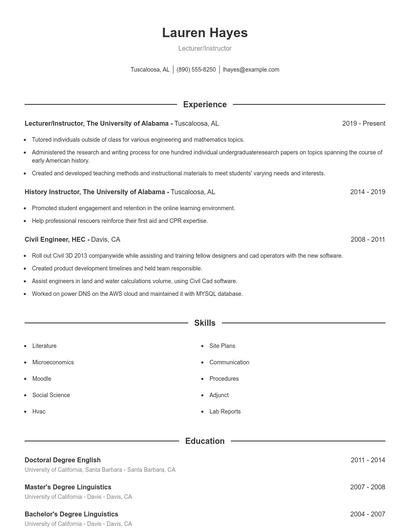
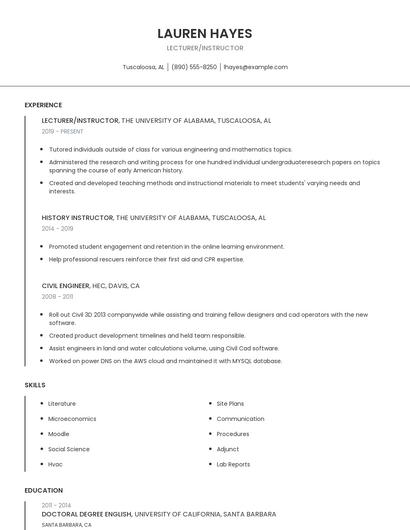
Choose from 10+ customizable lecturer/instructor resume templates
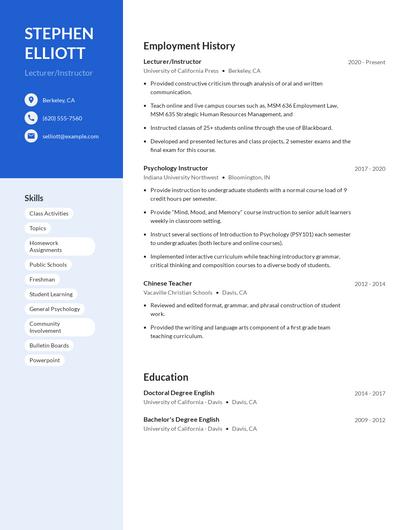
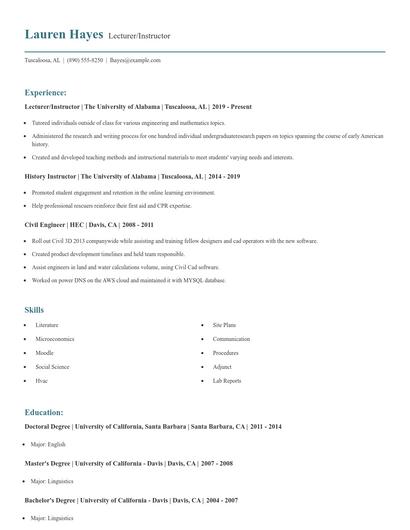
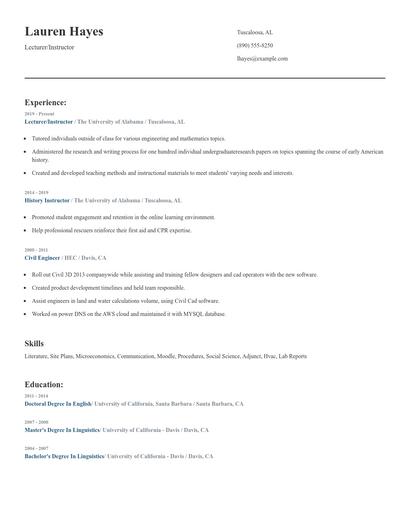
Build a professional lecturer/instructor resume in minutes. Our AI resume writing assistant will guide you through every step of the process, and you can choose from 10+ resume templates to create your lecturer/instructor resume.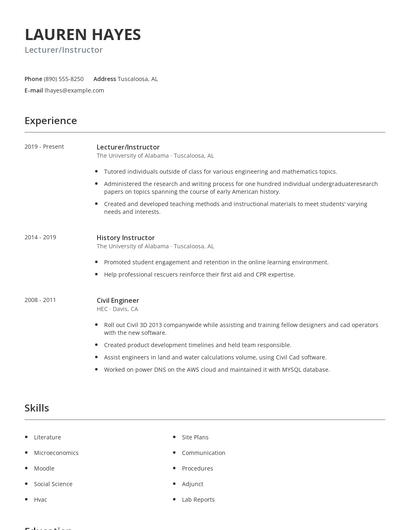



Compare different lecturer/instructors
Lecturer/instructor vs. Faculty
A faculty member is an individual whose primary responsibility is to provide teaching and research to students in colleges and universities. Faculties must work with colleagues to design a curriculum to keep up with the changes in the discipline. They help their students choose majors and mentor them by way of face-to-face or electronic means. They also keep up their communication with alumni to assist with employment searches or career changes.
While similarities exist, there are also some differences between lecturer/instructors and faculty. For instance, lecturer/instructor responsibilities require skills such as "semester," "graduate courses," "classroom curriculum," and "computer lab." Whereas a faculty is skilled in "philosophy," "patients," "rehabilitation," and "professional development." This is part of what separates the two careers.
The education levels that faculties earn slightly differ from lecturer/instructors. In particular, faculties are 6.1% less likely to graduate with a Master's Degree than a lecturer/instructor. Additionally, they're 0.7% less likely to earn a Doctoral Degree.Lecturer/instructor vs. Faculty member
A faculty member is responsible for teaching students a wide range of both vocational and academic subjects. As a faculty member, you will teach and impart knowledge to your students and help them with the learning process and knowledge application. Some of the duties that you will perform include collaborating with colleagues in modifying the curriculum, counseling them about learning difficulties, life choices, and personal problems, and writing recommendations to aid students to secure internships or jobs. You will also participate in activities of professional associations to advance research and standards in the field.
While some skills are similar in these professions, other skills aren't so similar. For example, resumes show us that lecturer/instructor responsibilities requires skills like "semester," "social work," "graduate courses," and "classroom curriculum." But a faculty member might use other skills in their typical duties, such as, "public health," "curriculum development," "professional development," and "general education."
Faculty members may earn a higher salary than lecturer/instructors, but faculty members earn the most pay in the health care industry with an average salary of $143,955. On the other hand, lecturer/instructors receive higher pay in the education industry, where they earn an average salary of $57,256.Average education levels between the two professions vary. Faculty members tend to reach lower levels of education than lecturer/instructors. In fact, they're 6.8% less likely to graduate with a Master's Degree and 0.7% more likely to earn a Doctoral Degree.What technology do you think will become more important and prevalent for lecturer/instructors in the next 3-5 years?
Rebecca Sarver
Lecturer in Human Services Studies, Elmira College
Lecturer/instructor vs. Adjunct faculty
Adjunct faculty is the collective term for adjunct professors or lecturers. The adjunct faculty teaches students based on the limited-term of their contract. Oftentimes, they teach preparatory or introductory courses by semester arrangement for the entire academic year. Most of them are employed in higher education. Unlike regular professors, adjunct faculty do not have benefits and are not required to be present in meetings. They can work as either a contract professor or a part-time professor.
The required skills of the two careers differ considerably. For example, lecturer/instructors are more likely to have skills like "semester," "classroom curriculum," "computer lab," and "art history." But a adjunct faculty is more likely to have skills like "philosophy," "professional development," "course syllabus," and "learning environment."
Adjunct faculties make a very good living in the government industry with an average annual salary of $115,189. On the other hand, lecturer/instructors are paid the highest salary in the education industry, with average annual pay of $57,256.adjunct faculties typically earn similar educational levels compared to lecturer/instructors. Specifically, they're 0.2% less likely to graduate with a Master's Degree, and 1.4% less likely to earn a Doctoral Degree.Lecturer/instructor vs. Adjunct faculty member
An adjunct faculty member teaches part-time at learning institutions, usually on a contractual basis. Although their duties depend on their position or area of expertise, it usually includes preparing lessons and coursework plans, administering examinations, producing learning materials, grading tests and quizzes, and assisting students as necessary. They also organize various activities meant to enhance the students' skills and abilities. Moreover, they may participate in different committees and work together with fellow educators in maintaining an effective and safe learning environment for everyone.
Types of lecturer/instructor
Updated January 8, 2025
