What does a machine setter do?
Machine setter responsibilities
Here are examples of responsibilities from real machine setter resumes:
- Control hoists to remove parts and products from work stations.
- Change nozzle, nozzle tip, and/or any broken heater bands if need.
- Complete assembly, inspect, install on test units and run to ensure proper operation in photocopy equipment.
- Used Zoller precision measuring and computer programming.
- Crew leader for dryer and wet feel changes.
- Inspect and maintain weapons and ammunition parts machine.
Machine setter skills and personality traits
We calculated that 17% of Machine Setters are proficient in Production Schedules, CMM, and Oiling. They’re also known for soft skills such as Computer skills, Dexterity, and Mechanical skills.
We break down the percentage of Machine Setters that have these skills listed on their resume here:
- Production Schedules, 17%
Team Leader: Plan and lay out work to meet production schedule requirements.
- CMM, 14%
Check quality at two-hour intervals by using Coordinate Measuring Machine (CMM), hard gauge, and visual inspection.
- Oiling, 13%
Perform maintenance work such as cleaning and oiling machines.
- Cranes, 13%
Lift work pieces to machines manually, or with hoists or cranes.
- Hand Tools, 7%
Changed alignment and adjustment of cutting machine guides in order to prevent defects in finished products, using hand tools.
- TPM, 7%
Perform daily, weekly and monthly TPM on assigned machines.
"production schedules," "cmm," and "oiling" are among the most common skills that machine setters use at work. You can find even more machine setter responsibilities below, including:
Computer skills. To carry out their duties, the most important skill for a machine setter to have is computer skills. Their role and responsibilities require that "metal and plastic machine workers must be able to use programmable devices, computers, and robots on the factory floor." Machine setters often use computer skills in their day-to-day job, as shown by this real resume: "set up, programmed, and controlled computer-aided design (cad) and computer numerical control (cnc) machines. "
Mechanical skills. machine setters are also known for mechanical skills, which are critical to their duties. You can see how this skill relates to machine setter responsibilities, because "these workers must be comfortable with machines and have a good understanding of how all the parts work." A machine setter resume example shows how mechanical skills is used in the workplace: "completed plant repair breakdown preventive mechanical maintenance on equipment. "
The three companies that hire the most machine setters are:
- Staffing Resources1 machine setters jobs
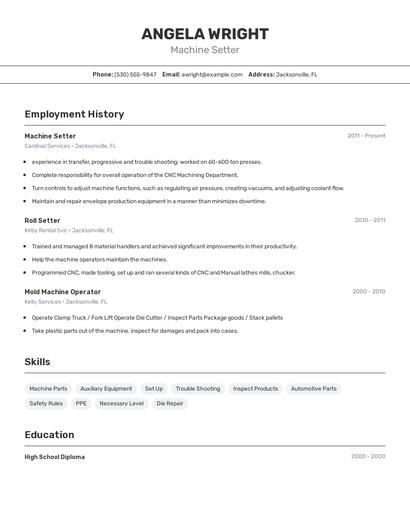
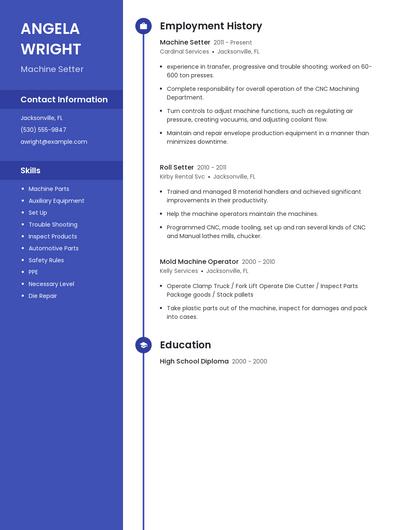
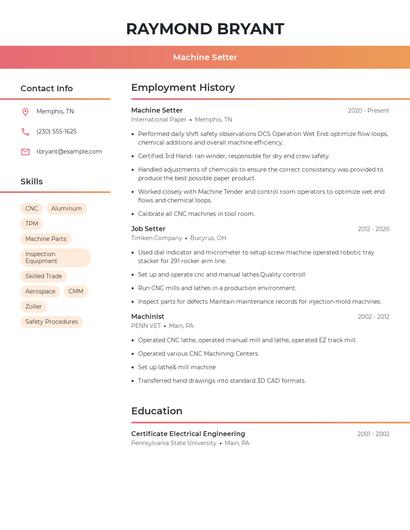
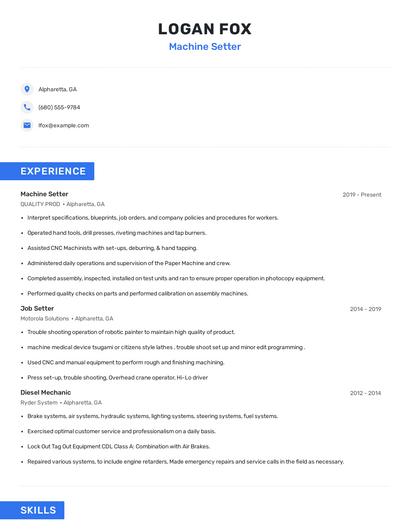
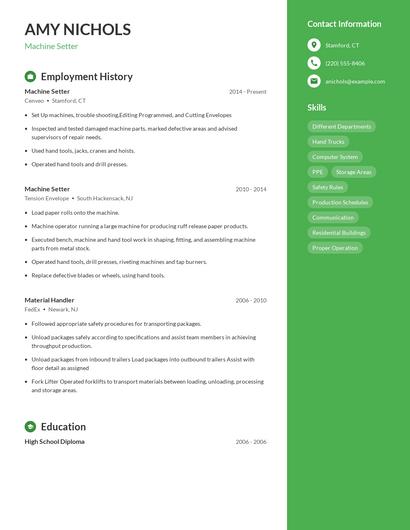
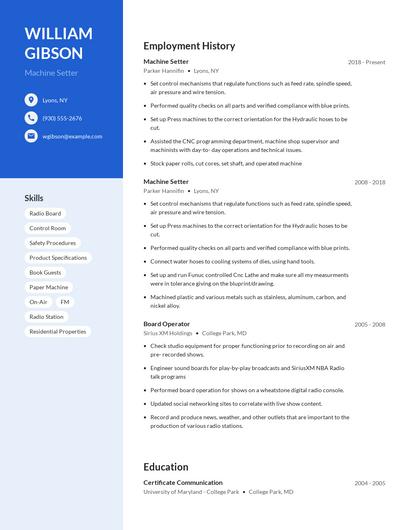
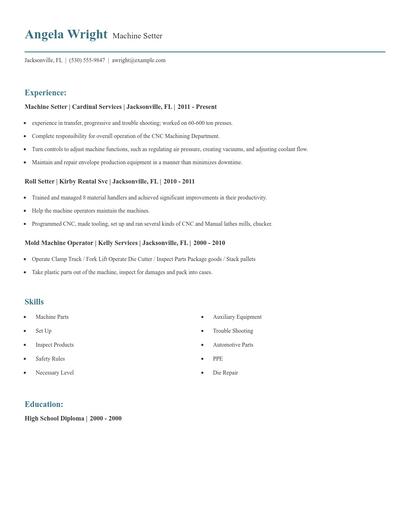
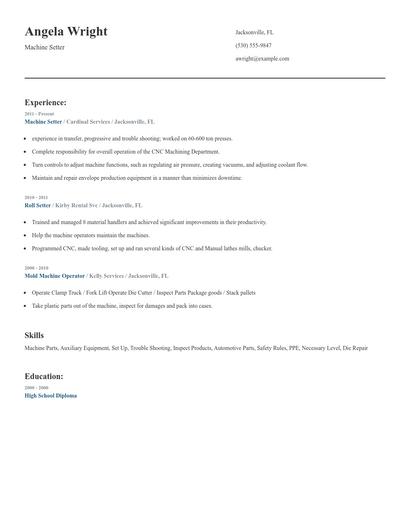
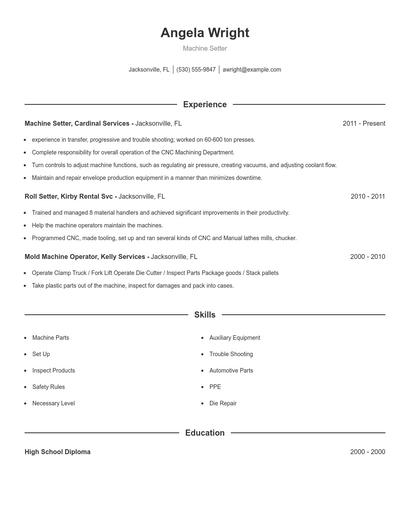
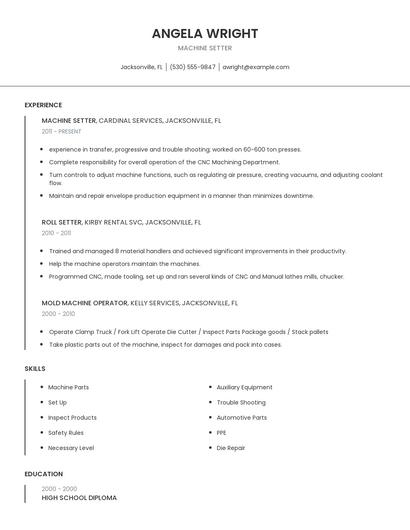
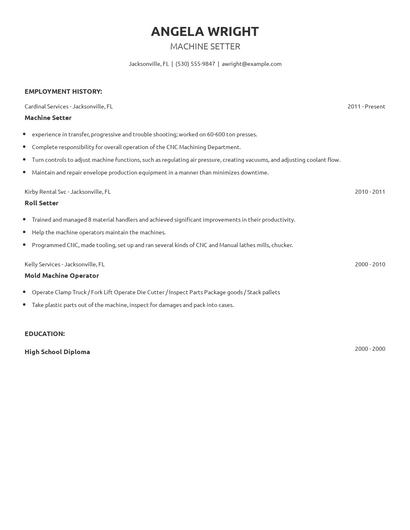
Choose from 10+ customizable machine setter resume templates
Build a professional machine setter resume in minutes. Our AI resume writing assistant will guide you through every step of the process, and you can choose from 10+ resume templates to create your machine setter resume.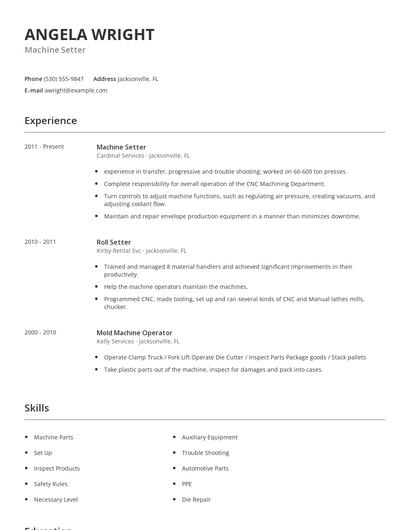
Compare different machine setters
Machine setter vs. Paper reel operator
These skill sets are where the common ground ends though. The responsibilities of a machine setter are more likely to require skills like "production schedules," "cmm," "oiling," and "cranes." On the other hand, a job as a paper reel operator requires skills like "factory environment," "customer specifications," "loto," and "hmi." As you can see, what employees do in each career varies considerably.
On average, paper reel operators reach similar levels of education than machine setters. Paper reel operators are 0.0% less likely to earn a Master's Degree and 0.0% less likely to graduate with a Doctoral Degree.Machine setter vs. Cup operator
While some skills are similar in these professions, other skills aren't so similar. For example, resumes show us that machine setter responsibilities requires skills like "production schedules," "cmm," "oiling," and "cranes." But a cup operator might use other skills in their typical duties, such as, "hmi," "paper cups," "qc," and "production quantities."
Average education levels between the two professions vary. Cup operators tend to reach higher levels of education than machine setters. In fact, they're 5.3% more likely to graduate with a Master's Degree and 0.0% less likely to earn a Doctoral Degree.Machine setter vs. Corrugator operator
The required skills of the two careers differ considerably. For example, machine setters are more likely to have skills like "production schedules," "cmm," "oiling," and "cranes." But a corrugator operator is more likely to have skills like "data entry," "quality checks," "physical plant," and "safety committee."
Corrugator operators earn the best pay in the media industry, where they command an average salary of $39,032. Machine setters earn the highest pay from the automotive industry, with an average salary of $41,838.When it comes to education, corrugator operators tend to earn similar degree levels compared to machine setters. In fact, they're 1.6% more likely to earn a Master's Degree, and 0.0% more likely to graduate with a Doctoral Degree.Machine setter vs. Corrugator
Even though a few skill sets overlap between machine setters and corrugators, there are some differences that are important to note. For one, a machine setter might have more use for skills like "production schedules," "cmm," "oiling," and "cranes." Meanwhile, some responsibilities of corrugators require skills like "safety rules," "stackers," "warehouse inventory," and "assembly line. "
Corrugators reach similar levels of education compared to machine setters, in general. The difference is that they're 2.6% more likely to earn a Master's Degree, and 0.0% less likely to graduate with a Doctoral Degree.Types of machine setter
Updated January 8, 2025
