What does a membership specialist do?
Membership specialist responsibilities
Here are examples of responsibilities from real membership specialist resumes:
- Achieve sales goals and performance requirements by differentiating brand from other athletic facilities.
- Maintain data integrity between parallel systems, including auditing and reconciling payroll and benefits interface discrepancy and edit reports.
- Provide meeting support including creating PowerPoint presentations for new business development.
Membership specialist skills and personality traits
We calculated that 34% of Membership Specialists are proficient in Marketing Campaigns, Customer Service, and Lead Generation. They’re also known for soft skills such as Communication skills, Computer skills, and Patience.
We break down the percentage of Membership Specialists that have these skills listed on their resume here:
- Marketing Campaigns, 34%
Maintain current knowledge and awareness of marketing campaigns in order to effectively communicate to members and prospective members.
- Customer Service, 30%
Executed outstanding customer service and administrative skills while collating and compiling membership information for individuals for seamless transition to obtain benefits.
- Lead Generation, 11%
Conducted internal and external marketing activities to achieve lead generation, referrals and membership sales.
- Flyers, 6%
Marketed Girl Scout events to students and parents using presentations, displays flyers, posters, and brochures.
- Membership Sales, 5%
Front desk duties such as membership sales, communication among departments, and lending equipment References and Supporting Documentation Furnished Upon Request
- Front Desk, 3%
Front desk / cashier, open and close register, sign up new members.
"marketing campaigns," "customer service," and "lead generation" are among the most common skills that membership specialists use at work. You can find even more membership specialist responsibilities below, including:
Communication skills. To carry out their duties, the most important skill for a membership specialist to have is communication skills. Their role and responsibilities require that "customer service representatives must be able to provide clear information in writing, by phone, or in person." Membership specialists often use communication skills in their day-to-day job, as shown by this real resume: "led membership dues adjustment process and communication plan. "
Patience. membership specialists are also known for patience, which are critical to their duties. You can see how this skill relates to membership specialist responsibilities, because "representatives should be patient and polite, especially when interacting with dissatisfied customers." A membership specialist resume example shows how patience is used in the workplace: "combine patience, determination, and persistence to troubleshoot utility department issues by contacting vendors daily. "
Interpersonal skills. For certain membership specialist responsibilities to be completed, the job requires competence in "interpersonal skills." The day-to-day duties of a membership specialist rely on this skill, as "representatives should be able to create positive interactions with customers." For example, this snippet was taken directly from a resume about how this skill applies to what membership specialists do: "developed lasting client relationships by applying effective communication and interpersonal skills in resolving problems and responding to customer inquiries. "
Customer-service skills. A commonly-found skill in membership specialist job descriptions, "customer-service skills" is essential to what membership specialists do. Membership specialist responsibilities rely on this skill because "representatives help companies retain customers by professionally answering questions and helping to resolve complaints." You can also see how membership specialist duties rely on customer-service skills in this resume example: "created and maintained files for all membership applications answered club phone and handled guests' questions and concerns professionally and courteously. "
Listening skills. Lastly, "listening skills" is an important element of what a membership specialist does. Membership specialist responsibilities require this skill because "representatives must listen carefully to ensure that they understand customers in order to assist them." This resume example highlights how membership specialist duties rely on this skill: "provided quality service to members and prospects (communicated in english and spanish). "
The three companies that hire the most membership specialists are:
- YMCA of Metro Chicago19 membership specialists jobs
- Ymca Of Metropolitan Atlanta19 membership specialists jobs
- HCSC4 membership specialists jobs
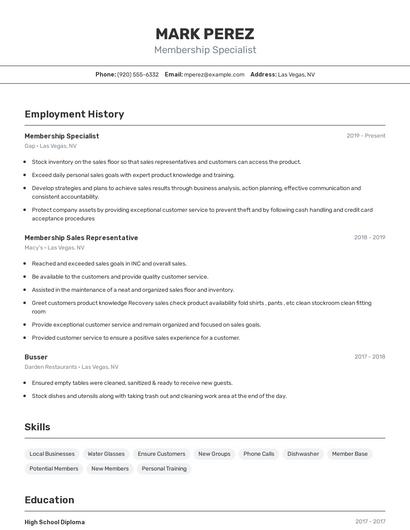
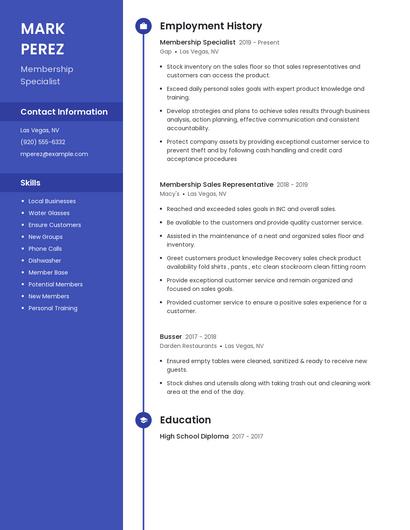
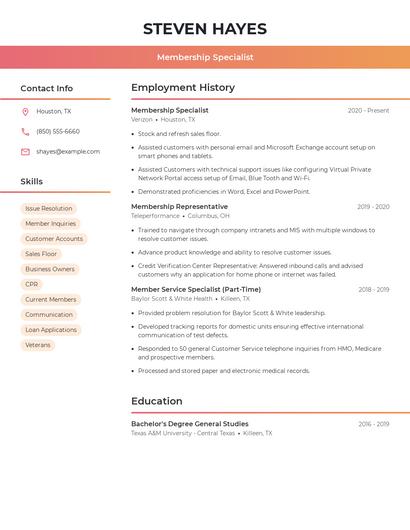
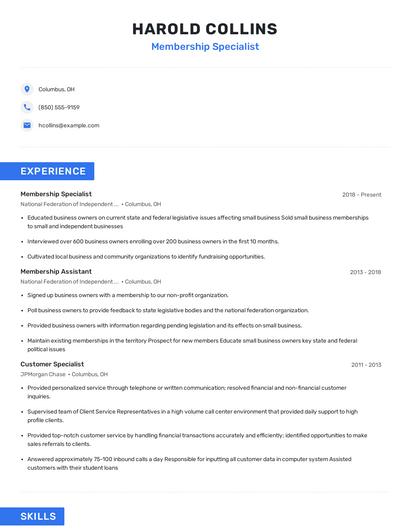
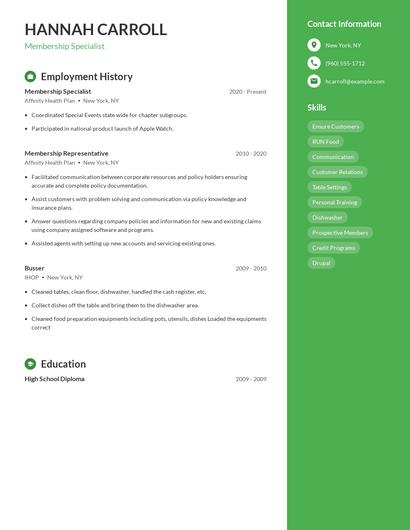
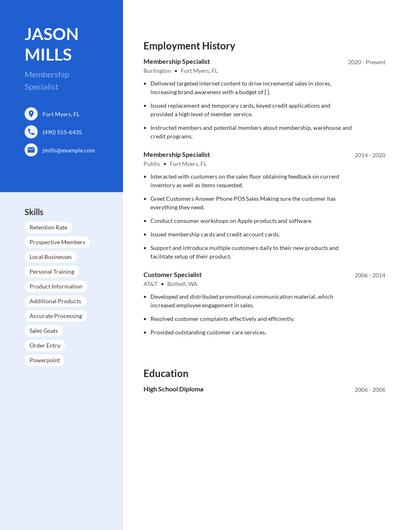
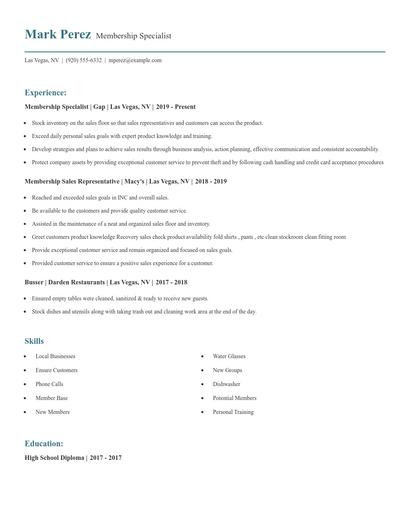
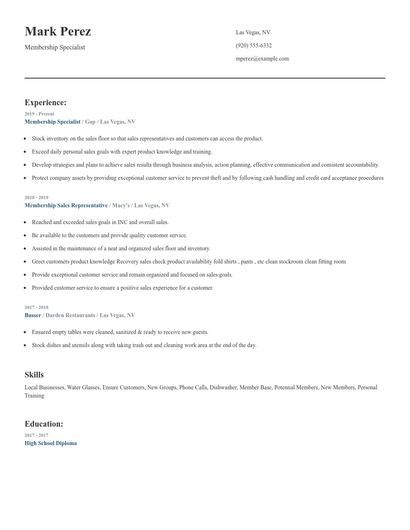
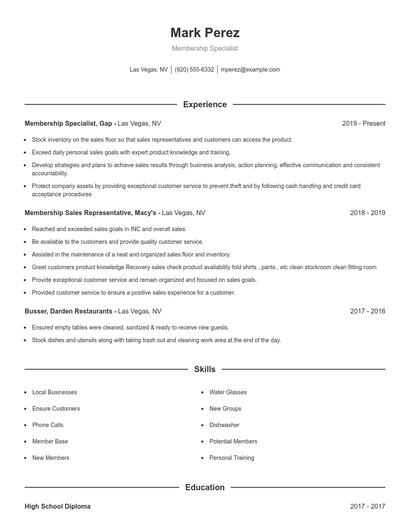
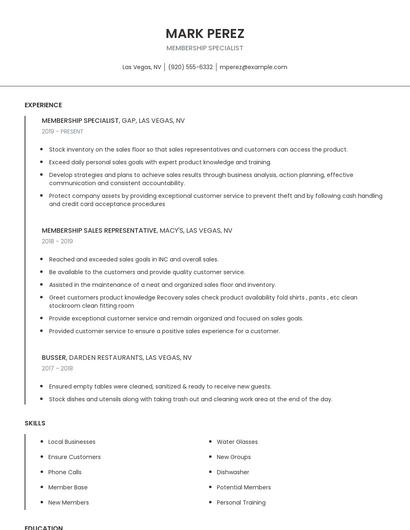
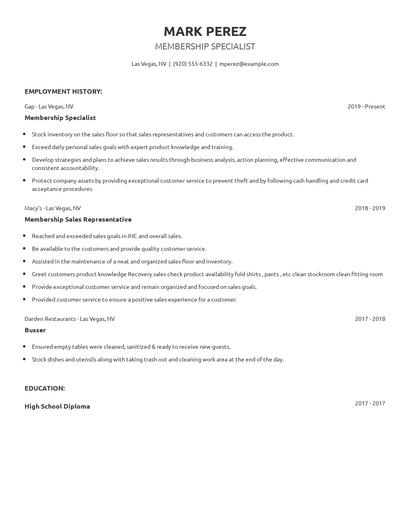
Choose from 10+ customizable membership specialist resume templates
Build a professional membership specialist resume in minutes. Our AI resume writing assistant will guide you through every step of the process, and you can choose from 10+ resume templates to create your membership specialist resume.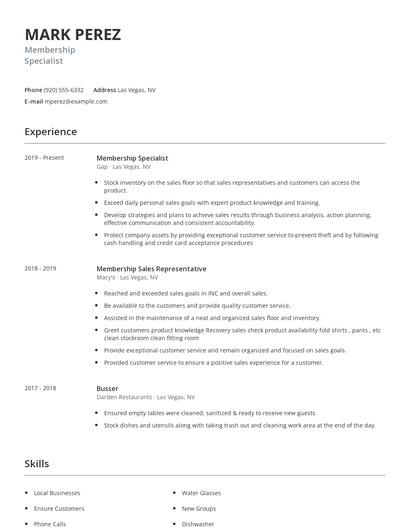
Compare different membership specialists
Membership specialist vs. Client relations specialist
A client relations specialist is primarily in charge of building positive relationships with clients by providing optimal services. Although the extent of their responsibilities depends on their company of employment, it typically includes handling customer calls and correspondence, offering products or services, discussing promotions or product specifications, answering inquiries, arranging appointments, resolving issues and concerns, and processing payments or refunds. Moreover, a client relations specialist conducts market research and analysis to identify the current trends and practices, aiming for client satisfaction.
These skill sets are where the common ground ends though. The responsibilities of a membership specialist are more likely to require skills like "marketing campaigns," "lead generation," "flyers," and "membership sales." On the other hand, a job as a client relations specialist requires skills like "client relations," "data entry," "client facing," and "inbound calls." As you can see, what employees do in each career varies considerably.
Client relations specialists earn the highest salaries when working in the real estate industry, with an average yearly salary of $49,327. On the other hand, membership specialists are paid more in the insurance industry with an average salary of $45,075.client relations specialists tend to reach similar levels of education than membership specialists. In fact, client relations specialists are 0.7% less likely to graduate with a Master's Degree and 0.6% less likely to have a Doctoral Degree.Membership specialist vs. Account services specialist
An account services specialist manages the customer accounts and ensures that it performs well and generates income and profit. The account services specialist processes and records all financial transactions and also provides auditing and quality assurance services. It is the account services specialist's job to maintain healthy communication with the client and guide them through all the processes that make the account productive. The account services specialist also needs good conversational skills with people and has a high organizational ability.
Each career also uses different skills, according to real membership specialist resumes. While membership specialist responsibilities can utilize skills like "marketing campaigns," "lead generation," "flyers," and "membership sales," account services specialists use skills like "patients," "strong customer service," "customer accounts," and "client facing."
Account services specialists may earn a lower salary than membership specialists, but account services specialists earn the most pay in the insurance industry with an average salary of $39,751. On the other hand, membership specialists receive higher pay in the insurance industry, where they earn an average salary of $45,075.account services specialists earn similar levels of education than membership specialists in general. They're 1.6% less likely to graduate with a Master's Degree and 0.6% less likely to earn a Doctoral Degree.Membership specialist vs. Customer retention specialist
A customer relations specialist is responsible for providing high-quality services for customers by responding to their inquiries and concerns and resolving complaints about the company's goods and services. Customer relations specialists update customer accounts on the database, recording their transactions accurately, and posting their payments timely. They may also sell new products and services to the clients, demonstrating features and usability, processing orders, and confirming delivery details. A customer relations specialist must have excellent communication and organizational skills to ensure customer satisfaction and maintain healthy business relationships with the customers.
There are many key differences between these two careers, including some of the skills required to perform responsibilities within each role. For example, a membership specialist is likely to be skilled in "marketing campaigns," "lead generation," "flyers," and "membership sales," while a typical customer retention specialist is skilled in "inbound calls," "customer satisfaction," "customer accounts," and "customer loyalty."
Customer retention specialists typically earn similar educational levels compared to membership specialists. Specifically, they're 3.9% less likely to graduate with a Master's Degree, and 0.7% less likely to earn a Doctoral Degree.Membership specialist vs. Customer relations specialist
Types of membership specialist
Updated January 8, 2025
