What does a mixing machine operator do?
Mixing machine operator responsibilities
Here are examples of responsibilities from real mixing machine operator resumes:
- Dump raw materials into the mixers; follow mix sequences to achieve designate temperatures.
- Possess good math skills and mechanically incline.
- Follow GMP procedures and maintain company standards.
- Lift full pallets and load to get ship to warehouse.
- Maintain a high level of sanitation and GMP's throughout the mixing department.
- Consult regularly with QA and production manager about altering mixing times and amounts of ingredients
- Record statistics on ISO documentation, and coordinate with machine technicians and electrical technicians to keep machines operating at maximum efficiency.
- Used PDI (inventory systems) and MSDS (batch tracking systems) daily on computers.
- Install resistors on prepare wafers.
- Perform repair and preventive maintenance on machinery including cleaning, oiling and adjusting.
Mixing machine operator skills and personality traits
We calculated that 17% of Mixing Machine Operators are proficient in Quality Checks, Basic Math, and Math. They’re also known for soft skills such as Detail oriented, Math skills, and Physical strength.
We break down the percentage of Mixing Machine Operators that have these skills listed on their resume here:
- Quality Checks, 17%
Performed quality checks on products and forwarded products to other areas for processing.
- Basic Math, 13%
Followed production instructions and utilized a computer and calculator to aid in basic math calculations.
- Math, 12%
Produced and maintained accurate documentation for production reports using math and computer skills.
- Product Quality, 9%
Performed product quality inspections, demonstrating a commitment to continuous improvement, in preparation for air bag distribution and shipping.
- Safety Rules, 6%
Followed safety rules with respect to nitrogen purging systems and ground clamps.
- Production Data, 6%
Record and enter production data.
Most mixing machine operators use their skills in "quality checks," "basic math," and "math" to do their jobs. You can find more detail on essential mixing machine operator responsibilities here:
Detail oriented. The most essential soft skill for a mixing machine operator to carry out their responsibilities is detail oriented. This skill is important for the role because "workers must be able to detect small changes in the quality or quantity of food products." Additionally, a mixing machine operator resume shows how their duties depend on detail oriented: "trouble shoot machine and quality checks, film change, gmp and sop oriented"
Math skills. Another essential skill to perform mixing machine operator duties is math skills. Mixing machine operators responsibilities require that "workers may need math skills in order to accurately mix specific quantities of ingredients." Mixing machine operators also use math skills in their role according to a real resume snippet: "used math skills to calculate ingredient levels for mixing cakes, pies, candy bars. "
Physical strength. This is an important skill for mixing machine operators to perform their duties. For an example of how mixing machine operator responsibilities depend on this skill, consider that "food processing equipment workers must be able to lift or move heavy boxes of ingredients, which may weigh up to 50 pounds." This excerpt from a resume also shows how vital it is to everyday roles and responsibilities of a mixing machine operator: "create invoices for non-expected inventory, physically/ manually unload trucks, operate forklift to unload/ load trucks. ".
The three companies that hire the most mixing machine operators are:
- Schwan's4 mixing machine operators jobs
- Hearthside Food Solutions3 mixing machine operators jobs
- Woodland Foods2 mixing machine operators jobs
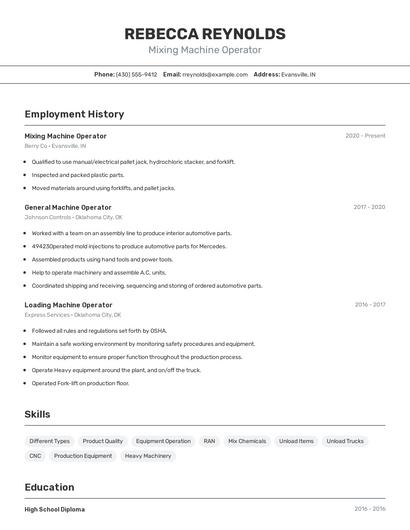
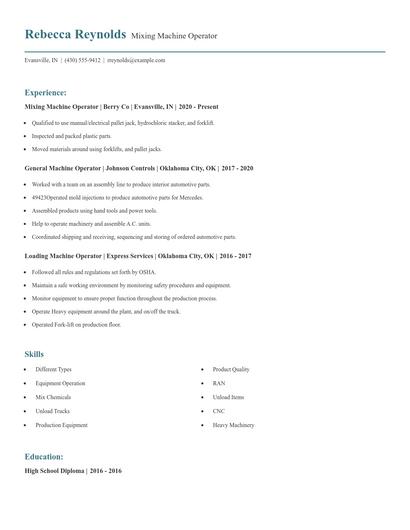
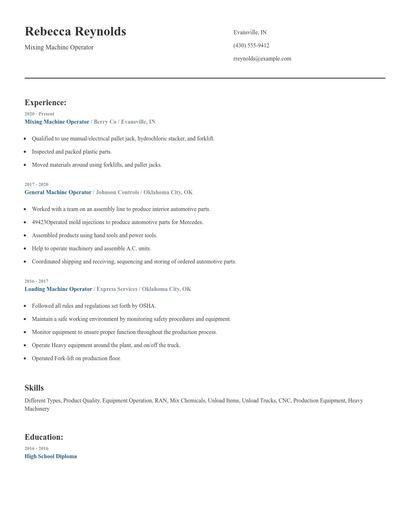
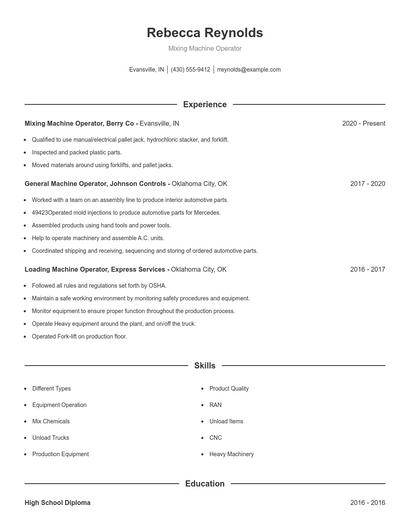
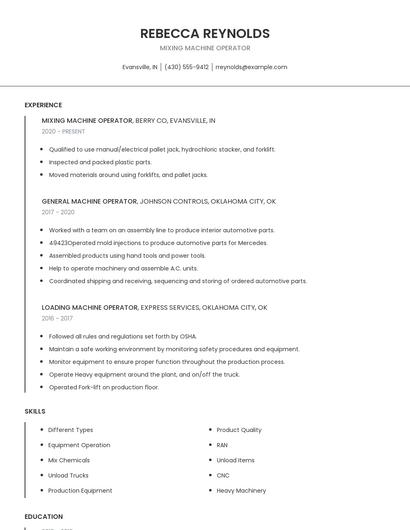
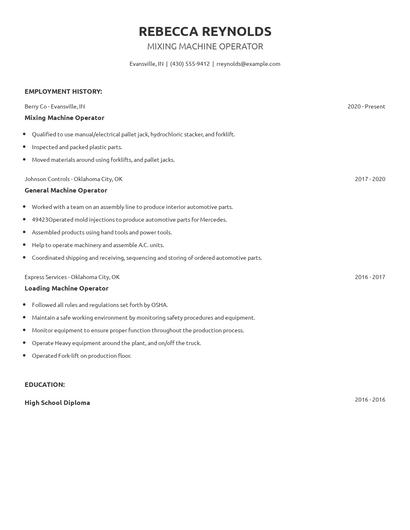
Choose from 10+ customizable mixing machine operator resume templates
Build a professional mixing machine operator resume in minutes. Our AI resume writing assistant will guide you through every step of the process, and you can choose from 10+ resume templates to create your mixing machine operator resume.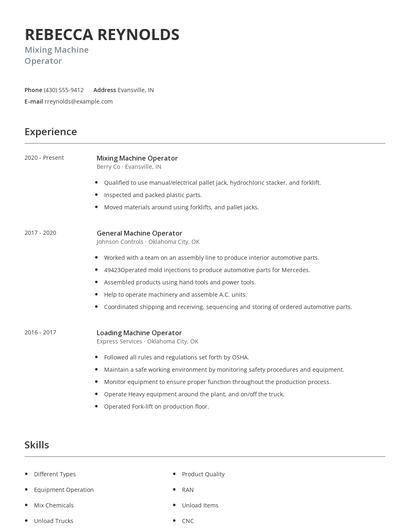


Compare different mixing machine operators
Mixing machine operator vs. Blender
While similarities exist, there are also some differences between mixing machine operators and blender. For instance, mixing machine operator responsibilities require skills such as "safety rules," "mixers," "machine operation," and "sqf." Whereas a blender is skilled in "hand tools," "dot," "lockout tagout," and "qa." This is part of what separates the two careers.
Blenders earn the highest salaries when working in the agriculture industry, with an average yearly salary of $39,608. On the other hand, mixing machine operators are paid more in the manufacturing industry with an average salary of $41,183.The education levels that blenders earn slightly differ from mixing machine operators. In particular, blenders are 1.8% more likely to graduate with a Master's Degree than a mixing machine operator. Additionally, they're 0.2% less likely to earn a Doctoral Degree.Mixing machine operator vs. Batch room technician
In addition to the difference in salary, there are some other key differences worth noting. For example, mixing machine operator responsibilities are more likely to require skills like "quality checks," "math," "product quality," and "safety rules." Meanwhile, a batch room technician has duties that require skills in areas such as "patients," "patient care," "data entry," and "cleanliness." These differences highlight just how different the day-to-day in each role looks.
On average, batch room technicians earn a higher salary than mixing machine operators. Some industries support higher salaries in each profession. Interestingly enough, batch room technicians earn the most pay in the technology industry with an average salary of $49,106. Whereas mixing machine operators have higher pay in the manufacturing industry, with an average salary of $41,183.batch room technicians earn similar levels of education than mixing machine operators in general. They're 2.0% more likely to graduate with a Master's Degree and 0.2% less likely to earn a Doctoral Degree.Mixing machine operator vs. Concrete mixer
There are many key differences between these two careers, including some of the skills required to perform responsibilities within each role. For example, a mixing machine operator is likely to be skilled in "quality checks," "basic math," "math," and "production data," while a typical concrete mixer is skilled in "dot," "asphalt," "delivery tickets," and "drive trucks."
Concrete mixers earn the best pay in the construction industry, where they command an average salary of $41,674. Mixing machine operators earn the highest pay from the manufacturing industry, with an average salary of $41,183.concrete mixers typically earn similar educational levels compared to mixing machine operators. Specifically, they're 0.7% more likely to graduate with a Master's Degree, and 0.3% more likely to earn a Doctoral Degree.Mixing machine operator vs. Chemical mixer
Even though a few skill sets overlap between mixing machine operators and chemical mixers, there are some differences that are important to note. For one, a mixing machine operator might have more use for skills like "quality checks," "basic math," "math," and "product quality." Meanwhile, some responsibilities of chemical mixers require skills like "safety standards," "osha," "material usage," and "mathematics. "
The manufacturing industry tends to pay the highest salaries for chemical mixers, with average annual pay of $40,075. Comparatively, the highest mixing machine operator annual salary comes from the manufacturing industry.The average resume of chemical mixers showed that they earn similar levels of education compared to mixing machine operators. So much so that theyacirc;euro;trade;re 1.0% more likely to earn a Master's Degree and less likely to earn a Doctoral Degree by 0.3%.Types of mixing machine operator
Updated January 8, 2025
