What does a network architect do?
A network architect is an information technology expert specializing in designing and developing network systems for a company. Their responsibilities typically include performing research and analysis to identify and understand the network needs of a company, planning and performing installations and implementation, establishing guidelines and timelines, upgrading systems, and developing strategies to enhance network operations. Moreover, a network architect must implement security policies and regulations, conduct regular maintenance checks, and perform repairs and modifications to maintain a smooth and efficient workflow.
Network architect responsibilities
Here are examples of responsibilities from real network architect resumes:
- Design, manage and troubleshoot EIGRP and BGP routing environment.
- Manage Linux base systems in private cloud with emphasis on LinuxHA, and security.
- Manage and maintain servers running various flavors of Linux including RHEL, CentOS, and Ubuntu.
- Design the OU hierarchy, manage DNS naming schemes, and create forests' for efficient domain management.
- Manage several projects including a 300 person PC move complete over one weekend with a staff of five persons.
- Excele at managing major network-wide upgrades; improve speed and predictability of multicast and order-routing data.
- Work with projects group and troubleshoot protocols to include BGP, OSPF and MPLS.
- Network protocols used include BGP, EIGRP, and OSPF, static plus floating static.
- Audit of DHCP markings in NetScout reveal hundreds of switches and routers over multiple sites with improperly apply QoS policies.
- RIP, EIGRP, OSFP, multicast routing.
- Design, implement and support VMware vSphere virtualization environment including ESXi hosts and guest operating systems.
- Remove many of the aggregated EIGRP rout links in the corporate network, replacing them with OSPF.
- Develop the detailed testing procedures to examine the QoS relate issues and their possible solutions over MPLS networks.
- Set up and troubleshoot secure wireless access points (WAP) and wireless LAN controller (WLC) for broadband internet.
- Configure Cisco switches and routers across the enterprise, monitor traffic utilization to accurately plan infrastructure growth needs within the enterprise.
Network architect skills and personality traits
We calculated that 8% of Network Architects are proficient in Architecture, BGP, and Network Infrastructure. They’re also known for soft skills such as Analytical skills, Communication skills, and Problem-solving skills.
We break down the percentage of Network Architects that have these skills listed on their resume here:
- Architecture, 8%
Led architecture and design sessions with customers; initiated technical meetings with customer engineers to further engage and identify additional opportunities.
- BGP, 4%
Designed and deployed networks using static and dynamic routing protocol (IP, RIP, EIGRP, OSPF and BGP)
- Network Infrastructure, 4%
Participate in developing architectural strategy, including technology standardization and modernization of enterprise, data center and disaster recovery network infrastructures.
- Firewall, 4%
Implement and maintain enterprise Internet connection including Cisco 3640 router and Checkpoint firewall configuration.
- Switches, 4%
Configured Cisco switches and routers across the enterprise, monitored traffic utilization to accurately plan infrastructure growth needs within the enterprise.
- Emerging Technologies, 4%
Lead high priority special projects and technology initiatives also evaluate emerging technologies against business and IT strategic needs.
Most network architects use their skills in "architecture," "bgp," and "network infrastructure" to do their jobs. You can find more detail on essential network architect responsibilities here:
Analytical skills. One of the key soft skills for a network architect to have is analytical skills. You can see how this relates to what network architects do because "administrators need to evaluate networks and systems to make sure that they perform reliably and to anticipate new requirements as customers’ needs change." Additionally, a network architect resume shows how network architects use analytical skills: "administer linux red hat servers used for network device configuration storage, network device syslog collectors, and network sniffer analyzers. "
Communication skills. Another essential skill to perform network architect duties is communication skills. Network architects responsibilities require that "administrators must describe problems and their solutions to non-it workers." Network architects also use communication skills in their role according to a real resume snippet: "initial technical lead for mpls interconnectivity design which enabled communication between up, bnsf, csx and norfolk southern. "
Problem-solving skills. network architects are also known for problem-solving skills, which are critical to their duties. You can see how this skill relates to network architect responsibilities, because "administrators must quickly resolve problems that arise with computer networks." A network architect resume example shows how problem-solving skills is used in the workplace: "resolved multiple problems with one way audio issues and routing over the at&t; and orange mpls networks. "
The three companies that hire the most network architects are:
- Pacific Northwest National Laboratory53 network architects jobs
- Accenture32 network architects jobs
- CrowdStrike12 network architects jobs
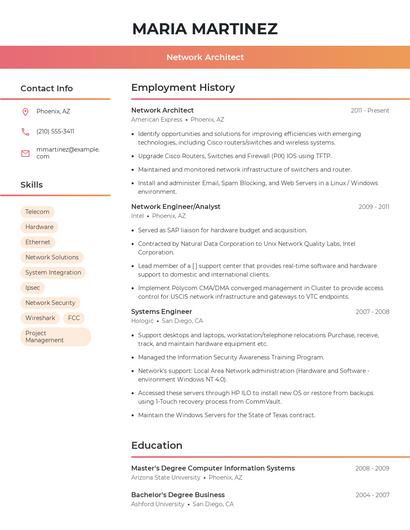
Choose from 10+ customizable network architect resume templates
Build a professional network architect resume in minutes. Our AI resume writing assistant will guide you through every step of the process, and you can choose from 10+ resume templates to create your network architect resume.










Compare different network architects
Network architect vs. Administrator
Administrators are administrative professionals who oversee the whole office or department. They manage office activities and supervise administrative functions in the office. They work the office calendar and oversee the appointment-setting process. They coordinate office events and ensure that all preparations are made and that there are no conflicting schedules. They also maintain a database of external providers of various office needs. Administrators also oversee office supplies and prepare purchase requisitions. They also manage janitorial services and other functions that are related to the maintenance of the physical office space. Administrators ensure that all fixtures and equipment in the office are functioning well and have no problems.
These skill sets are where the common ground ends though. The responsibilities of a network architect are more likely to require skills like "architecture," "bgp," "network infrastructure," and "firewall." On the other hand, a job as an administrator requires skills like "customer service," "data entry," "troubleshoot," and "payroll." As you can see, what employees do in each career varies considerably.
Administrators tend to make the most money working in the manufacturing industry, where they earn an average salary of $78,798. In contrast, network architects make the biggest average salary, $120,312, in the professional industry.The education levels that administrators earn slightly differ from network architects. In particular, administrators are 3.8% less likely to graduate with a Master's Degree than a network architect. Additionally, they're 0.3% less likely to earn a Doctoral Degree.Network architect vs. Systems administrator
Systems administrators are employees who oversee information technology infrastructures in the office. They are skilled information technology professionals who are knowledgeable about the company's network systems and other technology-related infrastructures. They are responsible for installing, configuring, or updating network systems, software, and hardware. They also monitor the different systems and troubleshoot any issues that users may encounter. Systems administrators manage the access of users, ensure the security of the network, and address any challenges that users may have. They conduct repairs and routine maintenance to ensure that the systems in place are in the best shape.
In addition to the difference in salary, there are some other key differences worth noting. For example, network architect responsibilities are more likely to require skills like "architecture," "bgp," "firewall," and "emerging technologies." Meanwhile, a systems administrator has duties that require skills in areas such as "troubleshoot," "database," "powershell," and "os." These differences highlight just how different the day-to-day in each role looks.
Systems administrators may earn a lower salary than network architects, but systems administrators earn the most pay in the technology industry with an average salary of $86,962. On the other hand, network architects receive higher pay in the professional industry, where they earn an average salary of $120,312.systems administrators earn lower levels of education than network architects in general. They're 7.2% less likely to graduate with a Master's Degree and 0.3% less likely to earn a Doctoral Degree.What technology do you think will become more important and prevalent for network architects in the next 3-5 years?
Christy Graves
Professor/Program Manager, Seminole State College of Florida
Network architect vs. Information technology administrator
An Information Technology (IT) administrator is an individual responsible for managing the day-to-day operation of an organization's IT systems and ensuring that the systems are running effectively. IT administrators must conduct consistent analyses of the computer system and install updates when needed. They are required to assess the organization's security programs and run the system for viruses and spyware. IT administrators also extend support to the organization's end-users and train them on desktop applications.
The required skills of the two careers differ considerably. For example, network architects are more likely to have skills like "architecture," "bgp," "emerging technologies," and "ospf." But a information technology administrator is more likely to have skills like "customer service," "troubleshoot," "database," and "os."
Information technology administrators earn the highest salary when working in the finance industry, where they receive an average salary of $93,678. Comparatively, network architects have the highest earning potential in the professional industry, with an average salary of $120,312.information technology administrators typically earn lower educational levels compared to network architects. Specifically, they're 8.6% less likely to graduate with a Master's Degree, and 1.1% less likely to earn a Doctoral Degree.Network architect vs. Technical systems engineer
Technical Systems Engineers are responsible for maintaining the integrity of the infrastructure or systems network. They build, maintain, and repair all the systems and network infrastructure of the organization. They troubleshoot problems and find the best possible solution to address such problems. They also ensure that those problems will be resolved and would never be encountered again. Technical Systems Engineers also help out in information technology or network infrastructure projects of other departments. They provide expertise on the systems-related aspects of the project. They help guide project teams on the feasibility and the success factors of the project.
Types of network architect
Updated January 8, 2025
