What does a network management engineer do?
Network management engineer responsibilities
Here are examples of responsibilities from real network management engineer resumes:
- Manage corporate internal and external DNS servers.
- Write UNIX shell and Perl scripts to simplify and automate administration tasks.
- Ensure business continuity by managing and monitoring all infrastructure backups, and notifying business partners of fail backup jobs.
- Deploy Cisco routers throughout the Philadelphia area for network operations and remote locations.
- Support multiple network management tools including Zenoss, SolarWinds, Sciencelogic/EM7, and Splunk
- Assist and work with equipment vendors with replacement & configuration of fail Cisco routers & Alcatel-Lucent switches.
- Perform SNMP queries and network discoveries.
- Work and troubleshoot issues with VOIP.
- Experience with Cisco command line interface using Cisco IOS.
- Build servers, install updates, and perform OS reinstalls.
- Configure SNMP community strings and RMON devices as well as DNS.
- Maintain telecommunications systems including VOIP, DVR security systems and cell phones.
- Evaluate QIP for Unix for DHCP & DNS management for major clients.
- Participate in Solarwinds software patch upgrades and create the test plan for new features.
- Verify management of application hot fixes, product enhancements and the impact to the performance of the Linux OS.
Network management engineer skills and personality traits
We calculated that 7% of Network Management Engineers are proficient in Switches, Routers, and Technical Support. They’re also known for soft skills such as Analytical skills, Communication skills, and Multitasking skills.
We break down the percentage of Network Management Engineers that have these skills listed on their resume here:
- Switches, 7%
Developed infrastructure for remote Network Management Stations - switches or routers which stored the management applications locally in compressed form.
- Routers, 5%
Implemented removal of redundant policies and addresses from internal and external routers, resulting in substantially increased network security.
- Technical Support, 5%
Provide technical support for application systems integration with database, application and Web servers.
- DOD, 4%
Managed and maintains network managements monitor for the entire enterprise on all DoD Networks SPECTRUM groups.
- Linux, 4%
Developed automated network attack scripts on Linux.
- Juniper, 4%
Provide Support for Configuring SNMP in Cisco ASR 9000 & 7609S, Extreme black diamond 10808, Juniper M120, MX960.
"switches," "routers," and "technical support" are among the most common skills that network management engineers use at work. You can find even more network management engineer responsibilities below, including:
Analytical skills. To carry out their duties, the most important skill for a network management engineer to have is analytical skills. Their role and responsibilities require that "administrators need to evaluate networks and systems to make sure that they perform reliably and to anticipate new requirements as customers’ needs change." Network management engineers often use analytical skills in their day-to-day job, as shown by this real resume: "experience in using udp datagram packets and udp datagram sockets in java. "
Communication skills. Another essential skill to perform network management engineer duties is communication skills. Network management engineers responsibilities require that "administrators must describe problems and their solutions to non-it workers." Network management engineers also use communication skills in their role according to a real resume snippet: "developed java udp based client and server to establish the communication between secureall hardware devices. "
Multitasking skills. This is an important skill for network management engineers to perform their duties. For an example of how network management engineer responsibilities depend on this skill, consider that "administrators may have to work on many problems and tasks at the same time." This excerpt from a resume also shows how vital it is to everyday roles and responsibilities of a network management engineer: "used multitasking and knowledge in unix and aol proprietary systems while working individually in an overnight setting. ".
Problem-solving skills. For certain network management engineer responsibilities to be completed, the job requires competence in "problem-solving skills." The day-to-day duties of a network management engineer rely on this skill, as "administrators must quickly resolve problems that arise with computer networks." For example, this snippet was taken directly from a resume about how this skill applies to what network management engineers do: "developed stop-gap solution of missing 'out of the box' authorization feature, using perl scripts and the application api. "
The three companies that hire the most network management engineers are:
- Spectrum3 network management engineers jobs
- Ford Motor2 network management engineers jobs
- Morgan Stanley2 network management engineers jobs
Choose from 10+ customizable network management engineer resume templates
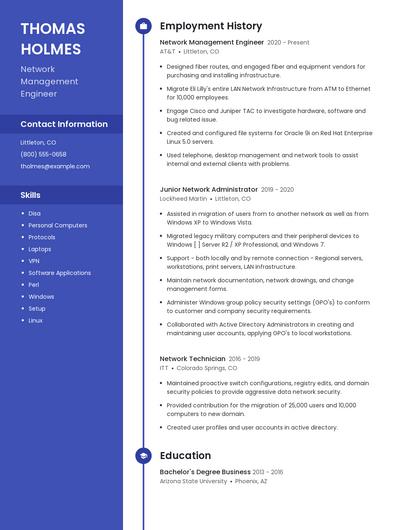
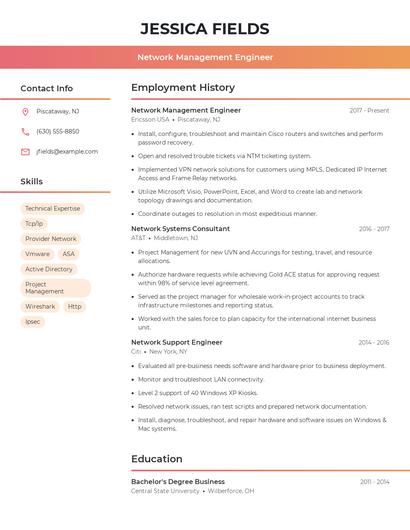
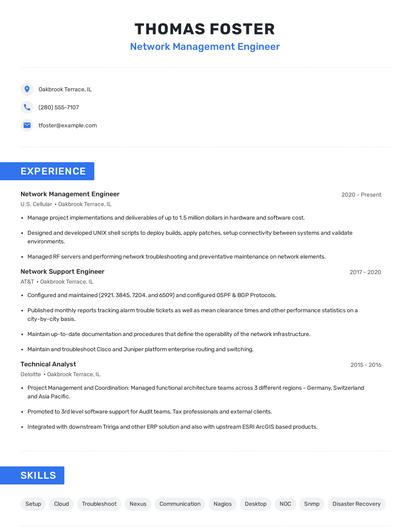
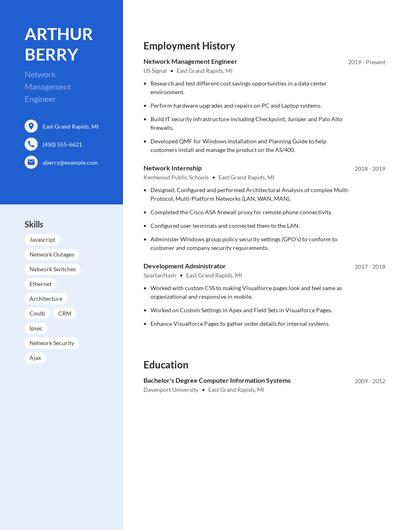
Build a professional network management engineer resume in minutes. Our AI resume writing assistant will guide you through every step of the process, and you can choose from 10+ resume templates to create your network management engineer resume.




Compare different network management engineers
Network management engineer vs. Noc technician
A NOC (Network Operations Center) technician is responsible for providing the highest customer service by resolving the customers' technical and network issues that affect the performance and stability of the systems operations. NOC technicians diagnose system failures and create support tickets for immediate troubleshooting. They also assist the system engineers in upgrading the network infrastructure and configuration to prevent system downtimes and operational delays. A NOC technician must have excellent communication and organizational skills, especially in identifying technical solutions and achieve the best customer satisfaction for system services.
There are some key differences in the responsibilities of each position. For example, network management engineer responsibilities require skills like "dod," "firewall," "sql," and "itil." Meanwhile a typical noc technician has skills in areas such as "troubleshoot," "rf," "phone calls," and "os." This difference in skills reveals the differences in what each career does.
Noc technicians earn the highest salaries when working in the professional industry, with an average yearly salary of $56,227. On the other hand, network management engineers are paid more in the finance industry with an average salary of $99,649.noc technicians tend to reach lower levels of education than network management engineers. In fact, noc technicians are 7.1% less likely to graduate with a Master's Degree and 0.3% less likely to have a Doctoral Degree.Network management engineer vs. Network operation technician
A network operation technician is responsible for providing technical assistance with computer network issues. Network operation technicians repair and troubleshoot networks and routers, identifying the source of defects by listening to the customers and determining step-by-step guidelines for resolution. They also configure servers to optimize the network's performance and recommend strategies to improve the system's infrastructure. A network operation technician must have excellent organizational and technical skills, especially in explaining the network problems to the customers and addressing preventive maintenance.
In addition to the difference in salary, there are some other key differences worth noting. For example, network management engineer responsibilities are more likely to require skills like "dod," "firewall," "itil," and "virtualization." Meanwhile, a network operation technician has duties that require skills in areas such as "troubleshoot," "rf," "provisioning," and "network problems." These differences highlight just how different the day-to-day in each role looks.
Network operation technicians earn a lower average salary than network management engineers. But network operation technicians earn the highest pay in the retail industry, with an average salary of $74,614. Additionally, network management engineers earn the highest salaries in the finance with average pay of $99,649 annually.Average education levels between the two professions vary. Network operation technicians tend to reach lower levels of education than network management engineers. In fact, they're 5.5% less likely to graduate with a Master's Degree and 0.3% less likely to earn a Doctoral Degree.What technology do you think will become more important and prevalent for network management engineers in the next 3-5 years?
Dr. Galen Duree
Head of the Department of Physics and Optical Engineering and Professor, Rose-Hulman Institute of Technology
Network management engineer vs. Network support technician
A network support technician specializes in optimizing a company's information technology (IT) networks for a smooth and efficient workflow. Their responsibilities revolve around addressing issues and concerns, troubleshooting, installing systems, executing upgrades, conducting diagnostic tests, and performing corrective measures as needed. They must also coordinate with staff in developing new IT systems, evaluate existing networks for areas needing improvement, and develop protocols while adhering to the company's policies and regulations. Furthermore, as a network support technician, it is essential to maintain regular network maintenance checks to ensure the security and safety of company data.
The required skills of the two careers differ considerably. For example, network management engineers are more likely to have skills like "dod," "juniper," "firewall," and "bgp." But a network support technician is more likely to have skills like "troubleshoot," "network support," "provides technical support," and "desk support."
Network support technicians earn the best pay in the technology industry, where they command an average salary of $48,633. Network management engineers earn the highest pay from the finance industry, with an average salary of $99,649.network support technicians typically earn lower educational levels compared to network management engineers. Specifically, they're 7.2% less likely to graduate with a Master's Degree, and 0.2% less likely to earn a Doctoral Degree.Network management engineer vs. Network support analyst
Network support analysts are professionals who provide technical support as well as maintain various network components for an organization's network system. These analysts are responsible for installing and configuring local area networks (LANs), wide area networks (WANs), internet systems, and other components of network systems. They are required to monitor the performance of networks and systems and align network use and access by using master consoles. Network support analysts must also organize and deploy security measures for the network so that they can safeguard software, hardware, and data.
Even though a few skill sets overlap between network management engineers and network support analysts, there are some differences that are important to note. For one, a network management engineer might have more use for skills like "dod," "customer service," "itil," and "disa." Meanwhile, some responsibilities of network support analysts require skills like "troubleshoot," "network support," "network security," and "vmware. "
Network support analysts enjoy the best pay in the technology industry, with an average salary of $98,644. For comparison, network management engineers earn the highest salary in the finance industry.network support analysts reach similar levels of education compared to network management engineers, in general. The difference is that they're 3.5% more likely to earn a Master's Degree, and 0.3% less likely to graduate with a Doctoral Degree.Types of network management engineer
Updated January 8, 2025
