What does a network security architect do?
Network security architect responsibilities
Here are examples of responsibilities from real network security architect resumes:
- Help manage and set up a manage cisco VOIP system for the new headquarters
- Manage client's VOIP and advise client on upcoming billing cycles.
- Lead architecture and design sessions with customers; initiate technical meetings with customer engineers to further engage and identify additional opportunities.
- Configure and setup secure sockets layers (SSL) for data encryption and client authentication.
- Conduct risk assessments to regulations in IAVA, DITSCAP, PDD-63, GISRA, and HIPAA.
- Maintain internal and external DNS and all IP address management.
- Perform quarterly security audits and maintain compliance (PCI).
- Experience in troubleshooting of DHCP and other IP conflict problems.
- Roll out QOS throughout the network to support time critical applications.
- Represent agency as the SME for department level meetings and projects.
- Build the rules for the application access across the IPSEC VPN tunnel.
- Evaluate and implement encryption of wire transfer processing within the UBOC network.
- Reference HIPAA and ISO17799 standards in order to help implement policy . )
- Configure URL filtering to enable and/or disable user traffic access to web-sites.
- Extend and enable MSEXCH's functions to SSL connectivity and forms-base web mail login.
Network security architect skills and personality traits
We calculated that 13% of Network Security Architects are proficient in Network Security, Firewall, and Security Solutions. They’re also known for soft skills such as Detail oriented, Analytical skills, and Problem-solving skills.
We break down the percentage of Network Security Architects that have these skills listed on their resume here:
- Network Security, 13%
Network Security Architect/Virtual CIO Responsible for all Network Security, Weekly/Monthly reports on Security status, yearly risk assessments.
- Firewall, 9%
Solved firewall state table synchronization problem with asymmetric routing created by multiple gateways.
- Security Solutions, 4%
Develop Industrial Automation security solutions leveraging Operational Technology (OT) and Information Technology (IT).
- Switches, 4%
Network Engineer - deployed and supported organizational-wide Local and Wide Area networks utilizing Nortel Networks Backbone routers and Layer 3 switches.
- Security Architecture, 4%
Manage and maintaining IDS/IPS solutions* Team working on NextGeneration network and security architecture* Performance and tuning for cloud solutions
- Routers, 4%
Submitted changes for Cisco PIX, Cisco IOS Routers, and Checkpoint on Nokia firewalls.
"network security," "firewall," and "security solutions" are among the most common skills that network security architects use at work. You can find even more network security architect responsibilities below, including:
Detail oriented. To carry out their duties, the most important skill for a network security architect to have is detail oriented. Their role and responsibilities require that "because cyberattacks can be difficult to detect, information security analysts must pay careful attention to computer systems and watch for minor changes in performance." Network security architects often use detail oriented in their day-to-day job, as shown by this real resume: "network security audits of newly acquired companies, including detailed topology audits and penetration testing. "
Analytical skills. Another essential skill to perform network security architect duties is analytical skills. Network security architects responsibilities require that "information security analysts must carefully study computer systems and networks and assess risks to determine how security policies and protocols can be improved." Network security architects also use analytical skills in their role according to a real resume snippet: "configured and setup secure sockets layers (ssl) for data encryption and client authentication. "
Problem-solving skills. This is an important skill for network security architects to perform their duties. For an example of how network security architect responsibilities depend on this skill, consider that "information security analysts must respond to security alerts and uncover and fix flaws in computer systems and networks." This excerpt from a resume also shows how vital it is to everyday roles and responsibilities of a network security architect: "implemented enterprise wide network infrastructure and ecommerce support solutions including, network intrusion detection, encryption and monitoring. ".
The three companies that hire the most network security architects are:
- Organon416 network security architects jobs
- Applied Materials105 network security architects jobs
- Deloitte82 network security architects jobs
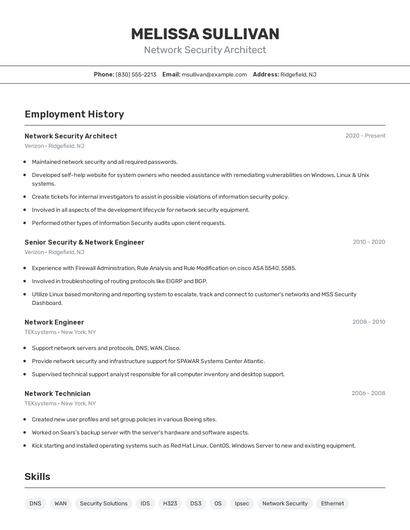
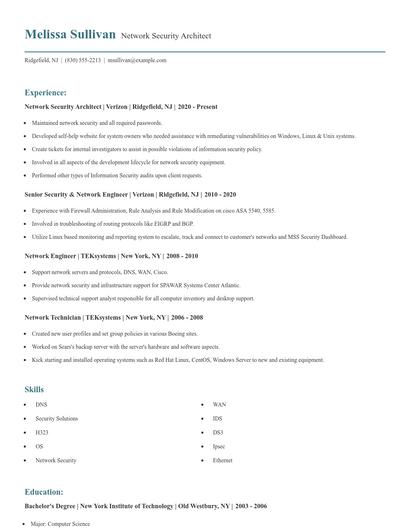
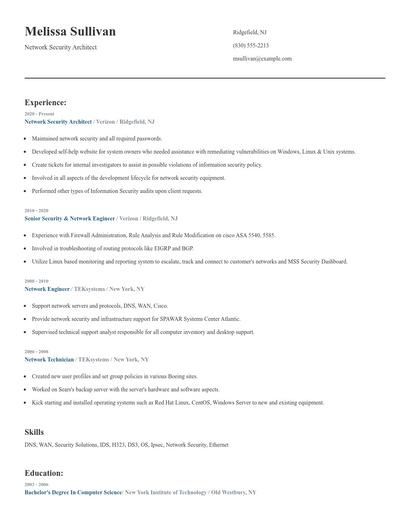
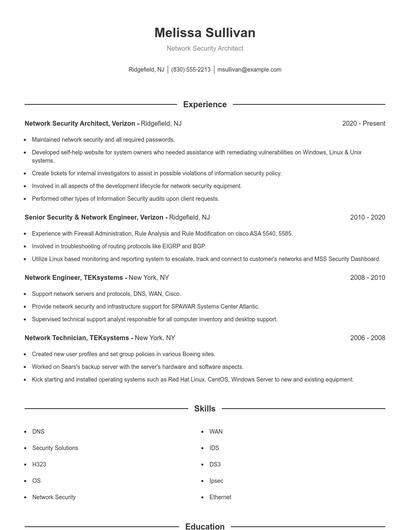
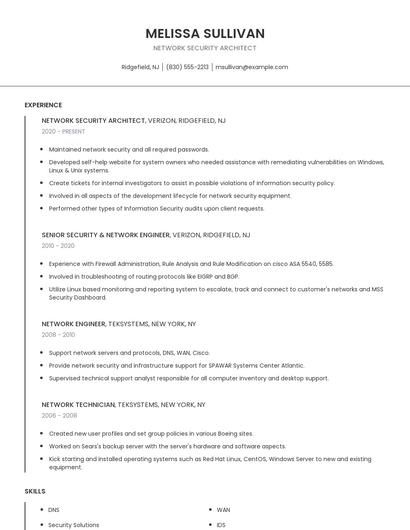
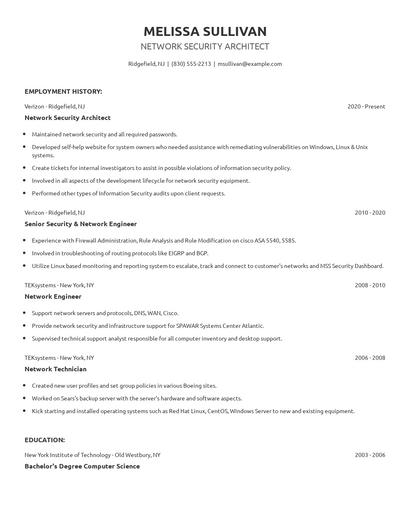
Choose from 10+ customizable network security architect resume templates
Build a professional network security architect resume in minutes. Our AI resume writing assistant will guide you through every step of the process, and you can choose from 10+ resume templates to create your network security architect resume.


Compare different network security architects
Network security architect vs. Information assurance engineer
Information assurance engineers are responsible for protecting an organization's data. They act as a team of security specialists that use their skill in securely operating and keeping data to protect the organization's most essential asset. Their main role is to guarantee the quality, security, and retrievability of the organization's information. Also, they outline security systems that make certain the integrity, confidentiality, and accessibility of data. Additionally, they secure IT infrastructure, maintain hardware and software updated, establish security standards, and monitor threats like breaches.
There are some key differences in the responsibilities of each position. For example, network security architect responsibilities require skills like "firewall," "security solutions," "security architecture," and "routers." Meanwhile a typical information assurance engineer has skills in areas such as "rmf," "dod," "iam," and "acas." This difference in skills reveals the differences in what each career does.
Information assurance engineers tend to make the most money working in the professional industry, where they earn an average salary of $97,153. In contrast, network security architects make the biggest average salary, $133,146, in the technology industry.information assurance engineers tend to reach similar levels of education than network security architects. In fact, information assurance engineers are 2.3% less likely to graduate with a Master's Degree and 1.1% more likely to have a Doctoral Degree.Network security architect vs. Senior network engineer
A senior network engineer is responsible for managing the organization's network infrastructure, handling advanced network issues, upgrading the system's design for optimization, configuring network features, and ensuring the network's highest security measures to avoid unauthorized access and suspicious activities. Senior network engineers work with network architects to implement network designs, run diagnostic tests, and create network solution reports for review and recovery reference. A senior network engineer must have excellent communication and organization skills and broad knowledge of the technology industry, programming languages, and system codes.
In addition to the difference in salary, there are some other key differences worth noting. For example, network security architect responsibilities are more likely to require skills like "network security," "firewall," "security solutions," and "security architecture." Meanwhile, a senior network engineer has duties that require skills in areas such as "troubleshoot," "eigrp," "mpls," and "load balancers." These differences highlight just how different the day-to-day in each role looks.
Senior network engineers may earn a lower salary than network security architects, but senior network engineers earn the most pay in the finance industry with an average salary of $112,997. On the other hand, network security architects receive higher pay in the technology industry, where they earn an average salary of $133,146.senior network engineers earn lower levels of education than network security architects in general. They're 7.2% less likely to graduate with a Master's Degree and 1.1% more likely to earn a Doctoral Degree.What technology do you think will become more important and prevalent for network security architects in the next 3-5 years?
Christy Graves
Professor/Program Manager, Seminole State College of Florida
Network security architect vs. Information systems security officer
An information systems security officer's role is to perform preventive measures to protect a company's data and systems from hackers or cyber-attacks. Their responsibilities revolve around assessing the existing security measures to identify any vulnerabilities or inconsistencies, recommending and implementing changes to improve security systems, and developing new strategies and programs for data protection. There are also instances when an information systems security officer must manage and maintain information in databases, train new employees, and create new security policies, all while adhering to the company's vision and mission.
The required skills of the two careers differ considerably. For example, network security architects are more likely to have skills like "network security," "firewall," "security solutions," and "security architecture." But a information systems security officer is more likely to have skills like "rmf," "dod," "isso," and "security posture."
Information systems security officers earn the highest salary when working in the professional industry, where they receive an average salary of $89,615. Comparatively, network security architects have the highest earning potential in the technology industry, with an average salary of $133,146.information systems security officers typically earn lower educational levels compared to network security architects. Specifically, they're 5.3% less likely to graduate with a Master's Degree, and 1.1% less likely to earn a Doctoral Degree.Network security architect vs. Securities consultant
A securities consultant is responsible for maintaining the safety and security of the company's premises, including enforcing protection for all the employees and company assets. Securities consultants also handle the confidentiality and stability of data network systems to prevent potential breaches and unauthorized access to information. They coordinate with the system analysts to design programs and databases as part of technical solutions to maximize productivity and increase efficiency. A securities consultant writes incident reports, recommend strategic techniques, and research threat risks that may put the company in jeopardy.
Types of network security architect
Updated January 8, 2025
