What does a network support administrator do?
Network support administrator responsibilities
Here are examples of responsibilities from real network support administrator resumes:
- Manage VoIP and Cisco phone systems and set up Cisco lab for Cisco/CCNA program.
- Manage cloud base hosting for clients including client's network DNS, office 365 and Google Apps.
- Manage OS and hardware installations and configurations.
- Support DNS and DHCP configuration for corporate and remote locations.
- Monitor VMWare virtual machine's performance and disaster recovery replication jobs to Colo.
- Perform dual functions within the company: PC and network support for internal staff and ISP support for external customer base.
- Change IP scheme, convert the network from static IP to DHCP.
- Code builds perform to Linux base systems running tomcat and java.
- Experience on LAN/WAN networking, TCP/IP, ISP's, router configuration.
- Create a VMware server for food and beverage point of sale system.
- Identify, troubleshoot, and repair hardware, software, and network system difficulties.
- Assist customers with installations of DSL modems, routers, network cards, and relate software.
- Develop the design and solution for deploying OS patches and other critical updates through GFI Languard.
- Experience with all aspects of networking from building servers/configuring operating systems to troubleshooting desktops and LAN cable issues.
- Perform LAN administration functions such as adding/deleting users, provide access rights, assign group permissions and network printer access.
Network support administrator skills and personality traits
We calculated that 9% of Network Support Administrators are proficient in Windows Server, Switches, and PC. They’re also known for soft skills such as Analytical skills, Communication skills, and Multitasking skills.
We break down the percentage of Network Support Administrators that have these skills listed on their resume here:
- Windows Server, 9%
Experienced with Windows Server 2003 Active Directory design, installation and deployment of enterprise-wide Group Policies using Active Directory components.
- Switches, 6%
Performed installation and configured Cisco switches.
- PC, 6%
Deployed Windows XP operating system on all Windows 98/2000 PC's without the use of imaging software due to budgetary constraints.
- Desktop Support, 5%
Managed the technology department including desktop support technicians.
- Technical Support, 5%
Led Technical Support Division in troubleshooting efforts and best practices maintaining workstations.
- Network Printers, 4%
Provide technical and hardware support, for laptops, workstations, servers, network printers.
Common skills that a network support administrator uses to do their job include "windows server," "switches," and "pc." You can find details on the most important network support administrator responsibilities below.
Analytical skills. To carry out their duties, the most important skill for a network support administrator to have is analytical skills. Their role and responsibilities require that "administrators need to evaluate networks and systems to make sure that they perform reliably and to anticipate new requirements as customers’ needs change." Network support administrators often use analytical skills in their day-to-day job, as shown by this real resume: "set up samba file sharing with windows system, enabling user access data on linux servers. "
Communication skills. Another soft skill that's essential for fulfilling network support administrator duties is communication skills. The role rewards competence in this skill because "administrators must describe problems and their solutions to non-it workers." According to a network support administrator resume, here's how network support administrators can utilize communication skills in their job responsibilities: "managed local area communication network (lan) within the organization. "
Multitasking skills. This is an important skill for network support administrators to perform their duties. For an example of how network support administrator responsibilities depend on this skill, consider that "administrators may have to work on many problems and tasks at the same time." This excerpt from a resume also shows how vital it is to everyday roles and responsibilities of a network support administrator: "exhibit strong communication, critical thinking, multitasking, troubleshooting, and customer service skills".
Problem-solving skills. For certain network support administrator responsibilities to be completed, the job requires competence in "problem-solving skills." The day-to-day duties of a network support administrator rely on this skill, as "administrators must quickly resolve problems that arise with computer networks." For example, this snippet was taken directly from a resume about how this skill applies to what network support administrators do: "configured, troubleshot, and resolved network access issues with switches and routers. "
The three companies that hire the most network support administrators are:
- General Dynamics5 network support administrators jobs
- Nes Holdings2 network support administrators jobs
- NANA1 network support administrators jobs
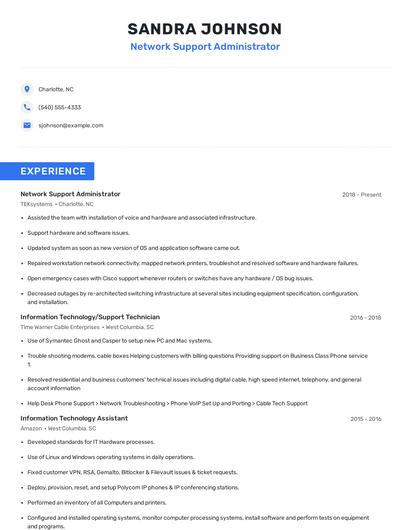
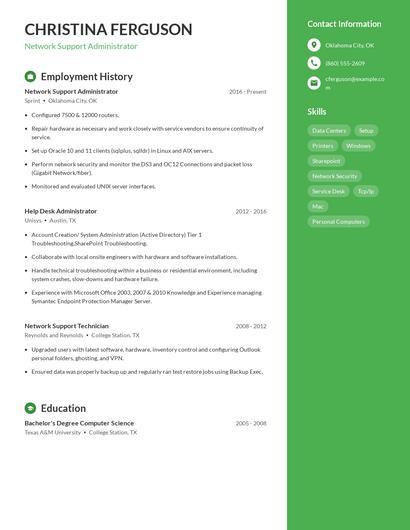
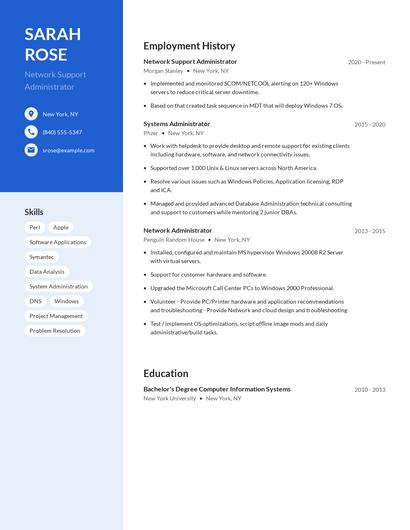
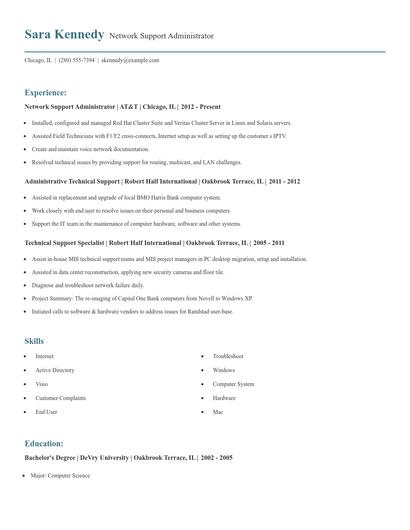
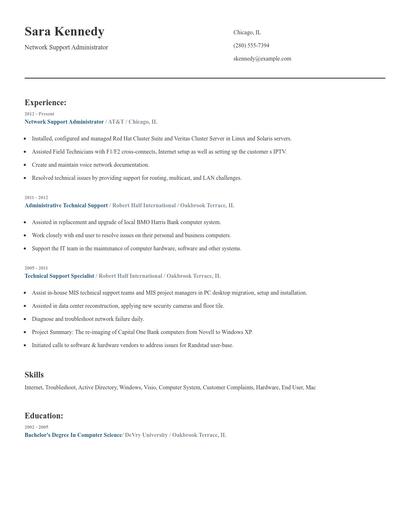
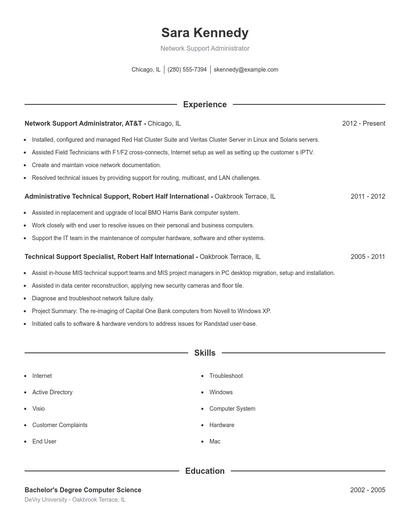
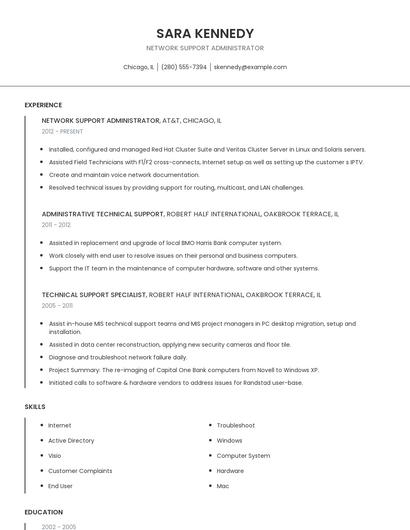
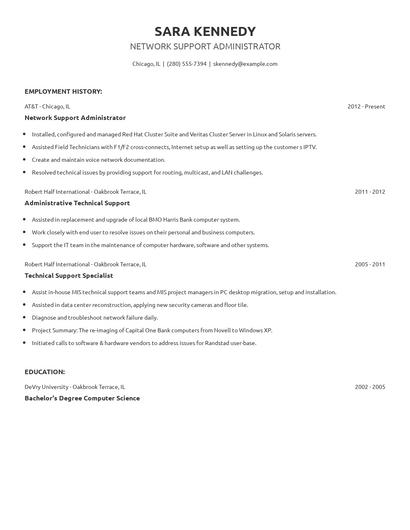
Choose from 10+ customizable network support administrator resume templates
Build a professional network support administrator resume in minutes. Our AI resume writing assistant will guide you through every step of the process, and you can choose from 10+ resume templates to create your network support administrator resume.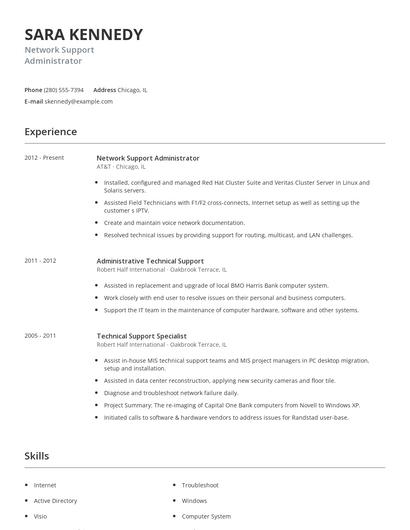
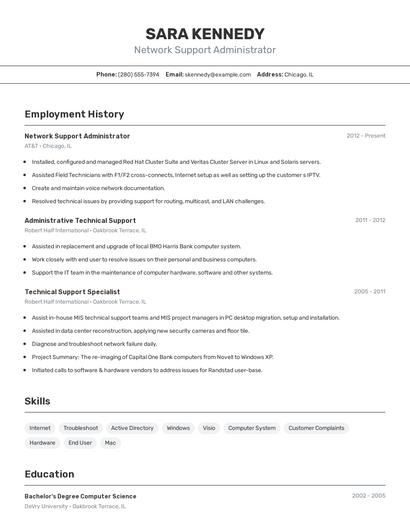
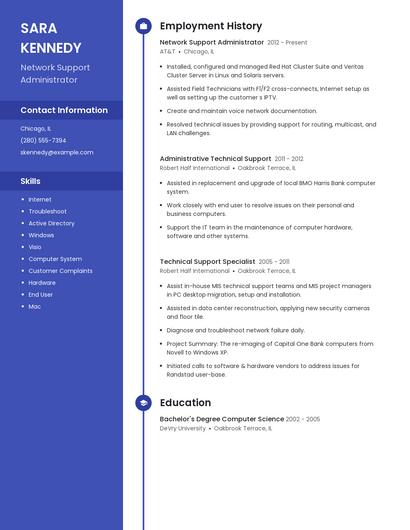
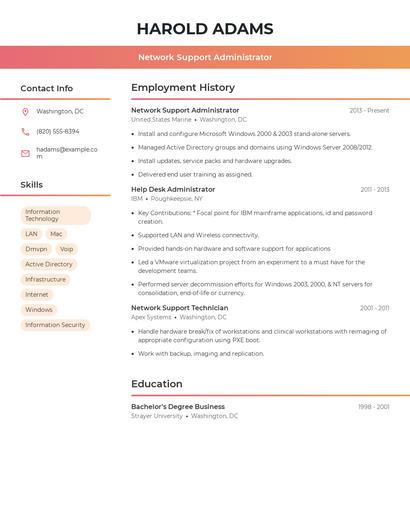
Compare different network support administrators
Network support administrator vs. Systems support
A systems support agent is responsible for resolving system applications and network issues, performing technical configuration, and upgrading systems infrastructure. A systems support representative conducts regular maintenance and diagnostic tests on the computer applications to ensure its optimal performance and efficiency to support business operations and avoid delays in deliverables. They also assist the technology team in designing backup systems and improve existing networks according to business requirements and specifications. They write resolution reports for reference to prevent the reoccurrence of system malfunction and inconsistencies.
While similarities exist, there are also some differences between network support administrators and systems support. For instance, network support administrator responsibilities require skills such as "routers," "network administration," "user support," and "network security." Whereas a systems support is skilled in "customer service," "provides technical support," "end user support," and "system support." This is part of what separates the two careers.
Systems supports tend to make the most money working in the professional industry, where they earn an average salary of $72,760. In contrast, network support administrators make the biggest average salary, $71,955, in the technology industry.The education levels that systems supports earn slightly differ from network support administrators. In particular, systems supports are 1.5% more likely to graduate with a Master's Degree than a network support administrator. Additionally, they're 0.1% more likely to earn a Doctoral Degree.Network support administrator vs. Administrative technical support
Administrative technical support maintains every technical set-up used in a company. Their primary responsibility is to inspect a company's systems, evaluate for issues, and repair any problems immediately. Administrative technical support is typically on call at the start of the day and, when they are not responding to calls, they conduct regular check-ups on all company systems. They are also responsible for creating technical reports and offering recommendations for improvements.
While some skills are similar in these professions, other skills aren't so similar. For example, resumes show us that network support administrator responsibilities requires skills like "switches," "pc," "desktop support," and "routers." But an administrative technical support might use other skills in their typical duties, such as, "customer service," "phone calls," "data entry," and "desk support."
Average education levels between the two professions vary. Administrative technical supports tend to reach similar levels of education than network support administrators. In fact, they're 0.8% more likely to graduate with a Master's Degree and 0.1% more likely to earn a Doctoral Degree.What technology do you think will become more important and prevalent for network support administrators in the next 3-5 years?
Babak Beheshti Ph.D.
Dean, Professor, New York Institute of Technology
-We will be witnessing a more widespread commercial deployment of 5G in 2020. With the implementation of the Standalone 5G devices based on the 3gpp release 16, we should be seeing the more robust mobile broadband deployment of 5G, wider availability of 5G smartphones, and a push towards an all 5G Network in select urban areas around the world.
-Significant growth in AI-based technologies, from face recognition and voice recognition to business intelligence and market predictions. As machines and deep learning algorithms get integrated into many applications, many industries will undergo substantial changes. AI systems will continue to interact with our phones; cars will interpret and analyze their surroundings and intelligently drive themselves. Online vendors will monitor our browsing habits, and Google decides what kind of search results to give us, based on who it thinks we are.
Network support administrator vs. Network engineer
A network engineer is responsible for managing a network system, monitoring its performance, and upgrading its features to optimize performance and boost efficiency. Network engineers also create new systems, designing them based on clients' specifications and business needs. They also check network defects, perform troubleshooting, improve data security systems, and install security updates. A network engineer must have excellent knowledge of the technology industry, as well as a broad understanding of system codes, programming languages, and network configurations.
Some important key differences between the two careers include a few of the skills necessary to fulfill the responsibilities of each. Some examples from network support administrator resumes include skills like "desktop support," "network printers," "routers," and "vpn," whereas a network engineer is more likely to list skills in "bgp," "ospf," "juniper," and "eigrp. "
Network engineers earn the best pay in the technology industry, where they command an average salary of $90,927. Network support administrators earn the highest pay from the technology industry, with an average salary of $71,955.network engineers typically earn similar educational levels compared to network support administrators. Specifically, they're 3.8% more likely to graduate with a Master's Degree, and 0.1% more likely to earn a Doctoral Degree.Network support administrator vs. Support analyst
The role of support analysts is to resolve problems with hardware, computer programs, and peripherals. They may focus on a particular aspect of the information technology (IT) department or give technical support to end-users. They mainly detect issues with IT equipment and software and devise solutions to resolve these issues. Also, they are responsible for answering queries from users, preparing service records, and handling escalations. Support analysts also support the company's IT operations and best practices by creating and distributing relevant IT documents.
Even though a few skill sets overlap between network support administrators and support analysts, there are some differences that are important to note. For one, a network support administrator might have more use for skills like "switches," "pc," "network printers," and "routers." Meanwhile, some responsibilities of support analysts require skills like "customer service," "application support," "patients," and "issue resolution. "
Support analysts enjoy the best pay in the finance industry, with an average salary of $93,871. For comparison, network support administrators earn the highest salary in the technology industry.In general, support analysts hold similar degree levels compared to network support administrators. Support analysts are 2.6% more likely to earn their Master's Degree and 0.3% more likely to graduate with a Doctoral Degree.Types of network support administrator
Updated January 8, 2025
