What does an office system analyst do?
Office system analysts are professionals who are responsible for designing technical solutions to solve any problems related to the activities of an office. These analysts must ensure that reports of client accounts are accurate including investment, income, and expense transactions. They are required to work with senior management and the trading desk to prepare and analyze profit and loss (P/L) reports while resolving any issues. Office system analysts must also assist in the installation and configuration of software applications such as MS Office Suite to be accessed by everyone in the office.
Office system analyst responsibilities
Here are examples of responsibilities from real office system analyst resumes:
- Design system architecture and electrical systems, develop system test plan and manage technical suppliers.
- Calculate and reconcile income payments for all securities hold in funds including fix income, bank loan and equity securities.
- Verify proper accounting treatment of all interest rate schedules in proprietary company software for fix income and bank loan securities.
- Utilize vendor data to price equities, equity swaps, equity options, corporate/government bonds, FX, index futures daily.
- Produce, negotiate and track ISDA documentation for OTC trades.
- Identify upcoming corporate events using tools such fax from custodian, Bloomberg, and DTC website.
- Establish trading reports for management base on net deposit and withdrawals, trading activity and current P/L.
- Produce desk P/L for the global business including trading revenue, funding, reserves, brokerage costs and corporate actions.
- Work with other commodities front-to-back office system integration & implementation.
- Develop and implements strategic sourcing plans for assign commodities if require.
- Provide independent trade capture/confirmation processing to ensure accurate derivative transaction input and settlement processing.
- Collaborate with cross-functional teams using SharePoint as a central location for tracking core quality documents and standard operating procedures.
- Research using proactive performance engineering techniques and recommend SAN infrastructure upgrades that save hours of enterprise email infrastructure down time.
- Process all credit derivatives trades into risk system and coordinate with sales and trading desks to assure trade accuracy.
- Used ASP.NET controls and CSS in designing front-end UIs.
Office system analyst skills and personality traits
We calculated that 13% of Office System Analysts are proficient in Derivative, Securities, and Fixed Income. They’re also known for soft skills such as Creativity, Analytical skills, and Communication skills.
We break down the percentage of Office System Analysts that have these skills listed on their resume here:
- Derivative, 13%
Provided independent trade capture/confirmation processing to ensure accurate derivative transaction input and settlement processing.
- Securities, 8%
Worked with multiple financial products such as US and international settlements, options and fixed income securities, and equity conversions.
- Fixed Income, 5%
Provided operational and regulatory support to fixed income trading desks and municipal underwriters.
- Bloomberg, 5%
Identified upcoming corporate events using tools such fax from custodian, Bloomberg, and DTC website.
- Trade Support, 5%
Provided daily reporting to management and subsequent middle office teams which allowed for a seamless transition in trade support.
- P/L, 4%
Establish trading reports for management based on net deposit and withdrawals, trading activity and current P/L.
Most office system analysts use their skills in "derivative," "securities," and "fixed income" to do their jobs. You can find more detail on essential office system analyst responsibilities here:
Creativity. To carry out their duties, the most important skill for an office system analyst to have is creativity. Their role and responsibilities require that "because analysts are tasked with finding innovative solutions to computer problems, an ability to “think outside the box” is important." Office system analysts often use creativity in their day-to-day job, as shown by this real resume: "implemented policies into the work place and was accountable for all pc software and hardware inventory and maintenance. "
Analytical skills. Another essential skill to perform office system analyst duties is analytical skills. Office system analysts responsibilities require that "analysts must interpret complex information from various sources and decide the best way to move forward on a project." Office system analysts also use analytical skills in their role according to a real resume snippet: "use toad, crystal reports and sql to extract banner sis data and import into excel and xcelsius. "
Communication skills. This is an important skill for office system analysts to perform their duties. For an example of how office system analyst responsibilities depend on this skill, consider that "analysts work as a go-between with management and the it department and must explain complex issues in a way that both will understand." This excerpt from a resume also shows how vital it is to everyday roles and responsibilities of an office system analyst: "provide client communication support including incident logging and project management duties associated with information management helpdesk responsibilities. ".
The three companies that hire the most office system analysts are:
- Silicon Valley Bank5 office system analysts jobs
- Konica Minolta5 office system analysts jobs
- Citi4 office system analysts jobs
Choose from 10+ customizable office system analyst resume templates
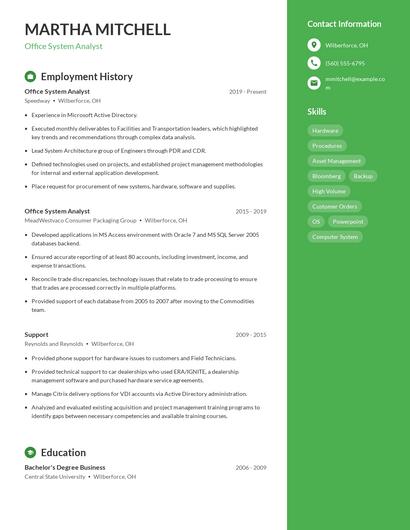
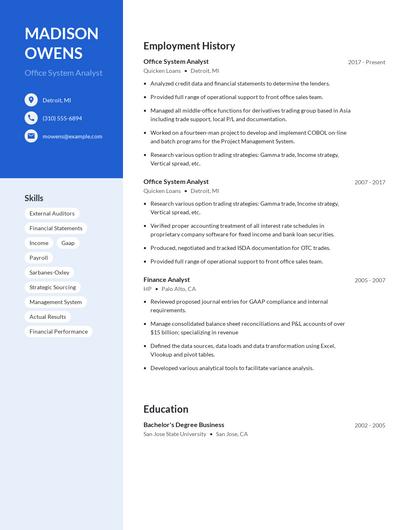
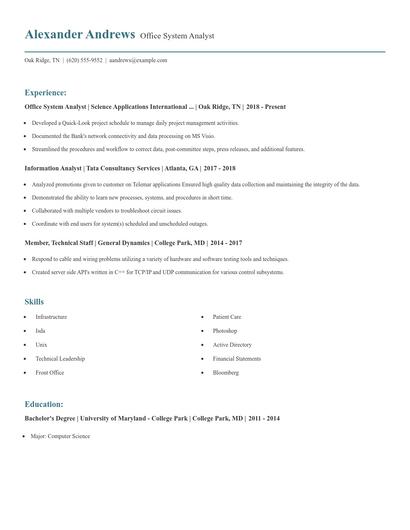
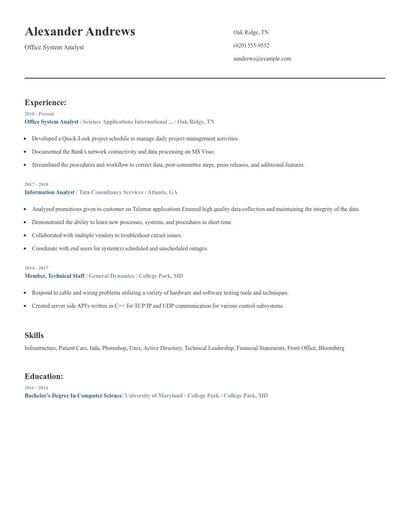
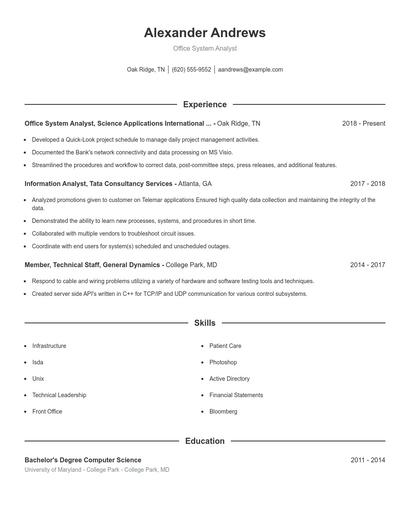
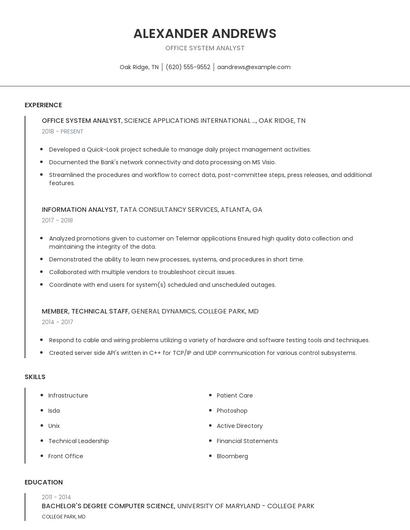
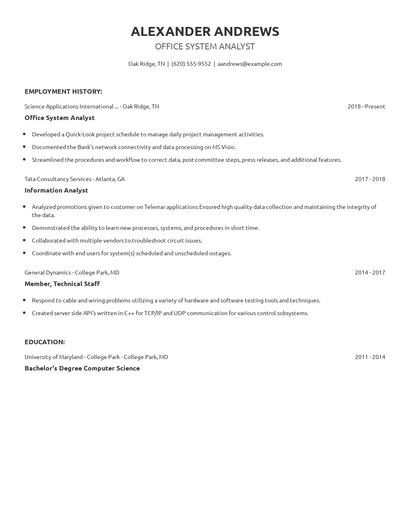
Build a professional office system analyst resume in minutes. Our AI resume writing assistant will guide you through every step of the process, and you can choose from 10+ resume templates to create your office system analyst resume.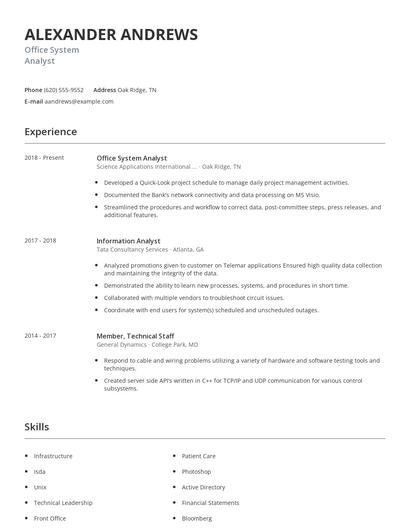
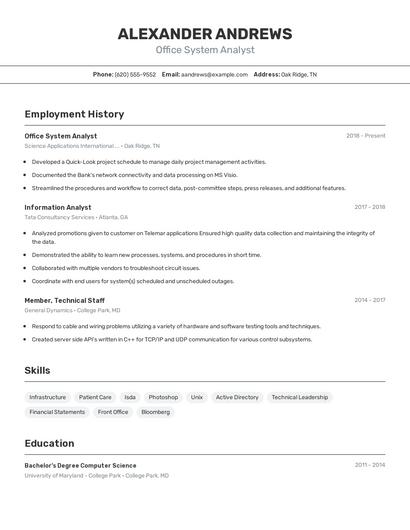
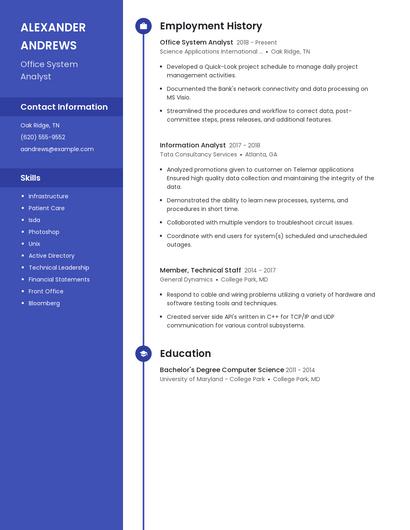
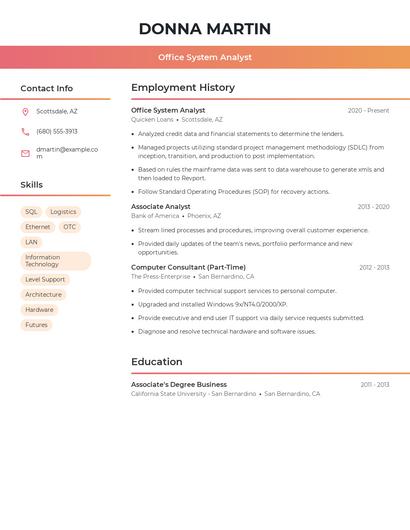

Compare different office system analysts
Office system analyst vs. Analyst lead
The duties of an analyst lead depend on one's line of work or industry of employment. Typically, their responsibilities revolve around performing research and analysis, coordinating with different departments to gather leads and data, reviewing findings, and producing reports and presentations for the stakeholders and other higher-ranking officials. Through the results, an analyst lead can provide advice, devise strategies for business optimization, spearhead the development of processes, identify strengths and weaknesses, and offer recommendations on areas in need of improvement. All of this is done while in adherence to the company's vision and mission.
These skill sets are where the common ground ends though. The responsibilities of an office system analyst are more likely to require skills like "securities," "fixed income," "bloomberg," and "trade support." On the other hand, a job as an analyst lead requires skills like "analytics," "data analysis," "project management," and "customer service." As you can see, what employees do in each career varies considerably.
Analyst leads really shine in the finance industry with an average salary of $110,488. Comparatively, office system analysts tend to make the most money in the professional industry with an average salary of $94,431.analyst leads tend to reach higher levels of education than office system analysts. In fact, analyst leads are 5.8% more likely to graduate with a Master's Degree and 0.7% less likely to have a Doctoral Degree.Office system analyst vs. Operations research analyst
Operations research analysts are responsible for assisting organizations in making better decisions. These professionals work to develop solutions that will aid businesses to operate more efficiently using advanced techniques such as data mining, optimization, and mathematical modeling. They work closely with key organizational stakeholders to stay up-to-date on short-term and long-term business goals. They also conduct research that will give them insights they need to guide decision-makers and develop solutions using predictive modeling, simulations, and statistical analysis.
In addition to the difference in salary, there are some other key differences worth noting. For example, office system analyst responsibilities are more likely to require skills like "derivative," "securities," "fixed income," and "bloomberg." Meanwhile, an operations research analyst has duties that require skills in areas such as "operations research," "dod," "python," and "statistical analysis." These differences highlight just how different the day-to-day in each role looks.
Operations research analysts may earn a lower salary than office system analysts, but operations research analysts earn the most pay in the professional industry with an average salary of $115,452. On the other hand, office system analysts receive higher pay in the professional industry, where they earn an average salary of $94,431.Average education levels between the two professions vary. Operations research analysts tend to reach higher levels of education than office system analysts. In fact, they're 9.5% more likely to graduate with a Master's Degree and 0.7% more likely to earn a Doctoral Degree.Office system analyst vs. Analyst
Analysts are employees or individual contributors with a vast experience in a particular field that help the organization address challenges. They help the organization improve processes, policies, and other operations protocol by studying the current processes in place and determining the effectiveness of those processes. They also research industry trends and data to make sound inferences and recommendations on what the company should do to improve their numbers. Analysts recommend business solutions and often help the organization roll out these solutions. They ensure that the proposed action plans are effective and produce the desired results.
There are many key differences between these two careers, including some of the skills required to perform responsibilities within each role. For example, an office system analyst is likely to be skilled in "securities," "fixed income," "trade support," and "p/l," while a typical analyst is skilled in "customer service," "troubleshoot," "data analysis," and "management system."
Analysts earn the highest salary when working in the technology industry, where they receive an average salary of $79,330. Comparatively, office system analysts have the highest earning potential in the professional industry, with an average salary of $94,431.Most analysts achieve a similar degree level compared to office system analysts. For example, they're 0.5% more likely to graduate with a Master's Degree, and 0.7% more likely to earn a Doctoral Degree.Office system analyst vs. Information analyst
Information Analysts are employees who collect data and analyze the information from the data they collected. They are usually found in companies with information technology departments. They collect network, software, or hardware performance data and analyze these data. The data that Information Analysts collect would help in identifying and anticipating problems in the system. As such, they will be able to troubleshoot and provide a sound analysis of the systems and networks. They would then be able to give recommendations to address problems, based on what they analyzed.
Types of office system analyst
Updated January 8, 2025
