What does an operational test mechanic do?
Operational test mechanic responsibilities
Here are examples of responsibilities from real operational test mechanic resumes:
- Box build sub-assembly level by solder wire into connector, lead, and fan according to MPI and visuals aid.
- Perform basic QC for components and complete system.
- Provide construction and testing of electro-mechanical sub-assemblies for high quality medical equipment build from blueprints and schematics.
- Ensure that daily automate regression testing is running and completing successfully.
Operational test mechanic skills and personality traits
We calculated that 44% of Operational Test Mechanics are proficient in R, Functional Test, and QC. They’re also known for soft skills such as Dexterity, Physical strength, and Technical skills.
We break down the percentage of Operational Test Mechanics that have these skills listed on their resume here:
- R, 44%
Controlled R MA's return at 4% or less for OPS workmanship defect and subcontract issues.
- Functional Test, 38%
Performed functional test board level to make sure that all the component are function using test procedure.
- QC, 18%
Perform basic QC for components and completed system Perform system level funtional testing after completed unit.
Common skills that an operational test mechanic uses to do their job include "r," "functional test," and "qc." You can find details on the most important operational test mechanic responsibilities below.
Physical strength. Another essential skill to perform operational test mechanic duties is physical strength. Operational test mechanics responsibilities require that "quality control inspectors may be required to lift or maneuver heavy production materials or finished products." Operational test mechanics also use physical strength in their role according to a real resume snippet: "collect physical data using multimeter or oscilloscope. "
Technical skills. operational test mechanics are also known for technical skills, which are critical to their duties. You can see how this skill relates to operational test mechanic responsibilities, because "to ensure that products and parts meet quality standards, inspectors must understand the relevant blueprints, technical documents, and manuals." An operational test mechanic resume example shows how technical skills is used in the workplace: "completed and submit technical test reporting to designated project manager and management. "
Math skills. A big part of what operational test mechanics do relies on "math skills." You can see how essential it is to operational test mechanic responsibilities because "knowledge of basic math is important for measuring, calibrating, and calculating specifications in quality control testing." Here's an example of how this skill is used from a resume that represents typical operational test mechanic tasks: "worked in the testing phase of the meshworks cad geometry morpher suite. "
Mechanical skills. Another crucial skill for an operational test mechanic to carry out their responsibilities is "mechanical skills." A big part of what operational test mechanics relies on this skill, since "quality control inspectors use tools and machinery when testing products." How this skill relates to operational test mechanic duties can be seen in an example from an operational test mechanic resume snippet: "perform to assemble electro mechanical of flow control for production. "
The three companies that hire the most operational test mechanics are:
- Kelly Services2 operational test mechanics jobs
- Estée Lauder2 operational test mechanics jobs
- Aerojet Rocketdyne1 operational test mechanics jobs
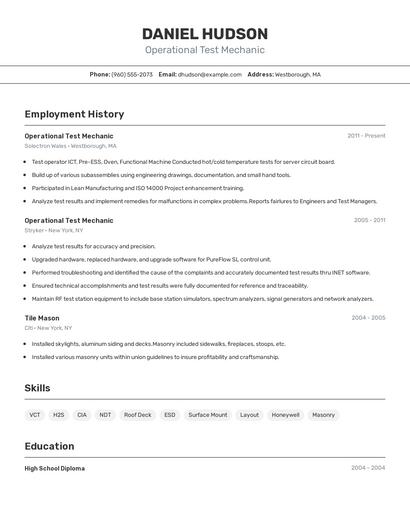
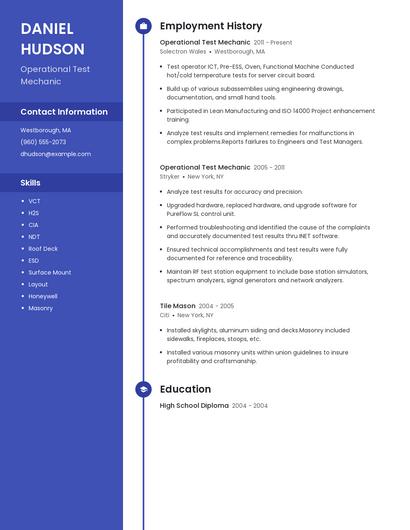
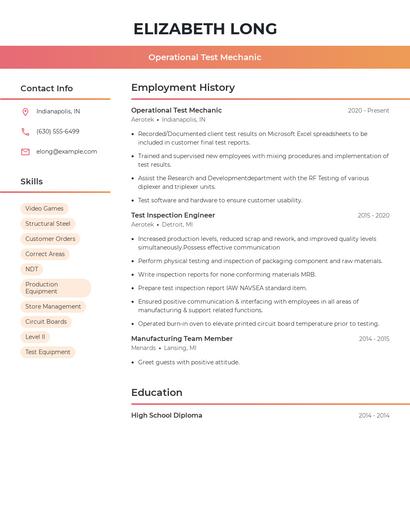
Choose from 10+ customizable operational test mechanic resume templates
Build a professional operational test mechanic resume in minutes. Our AI resume writing assistant will guide you through every step of the process, and you can choose from 10+ resume templates to create your operational test mechanic resume.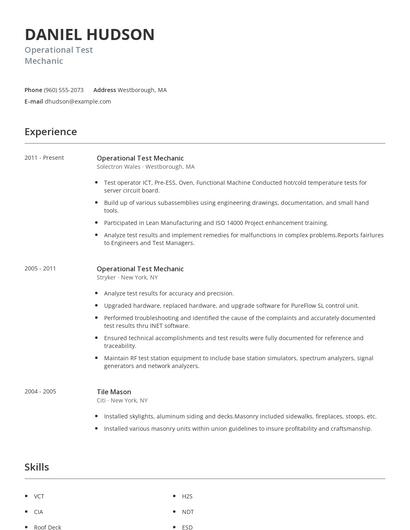
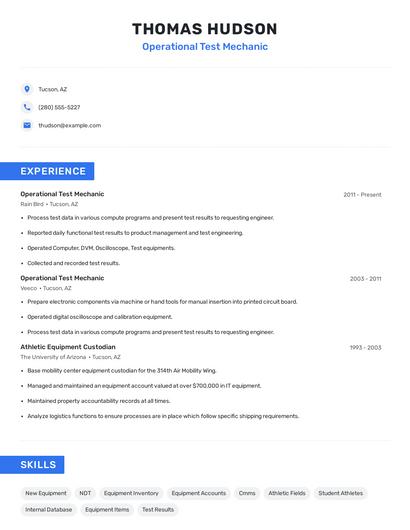
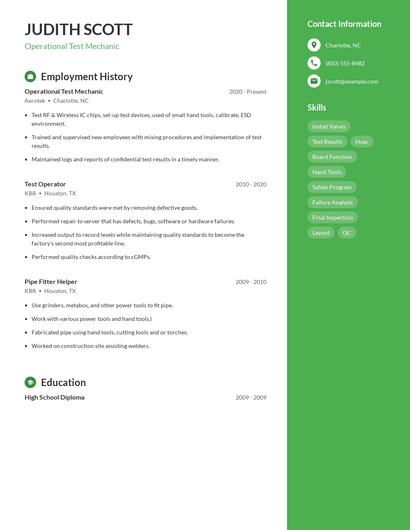
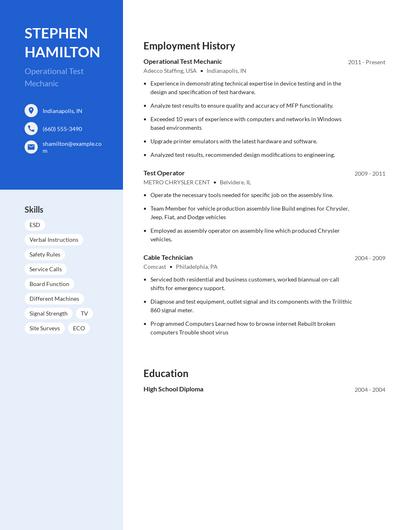
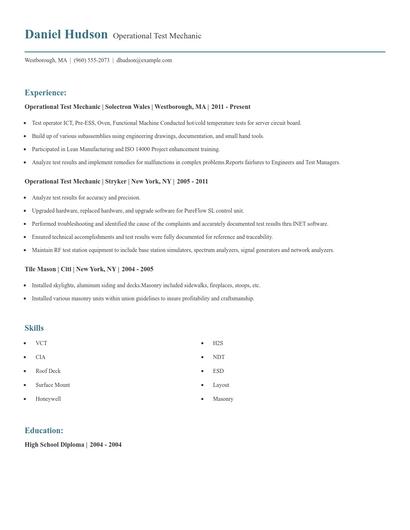
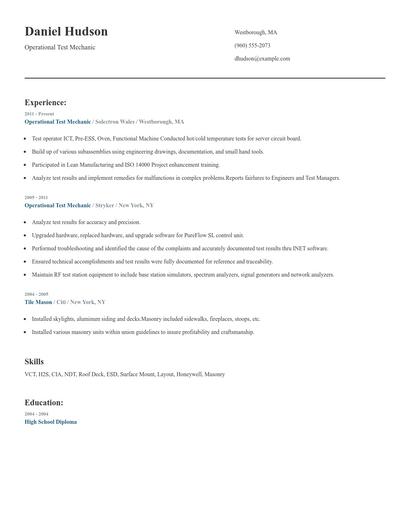
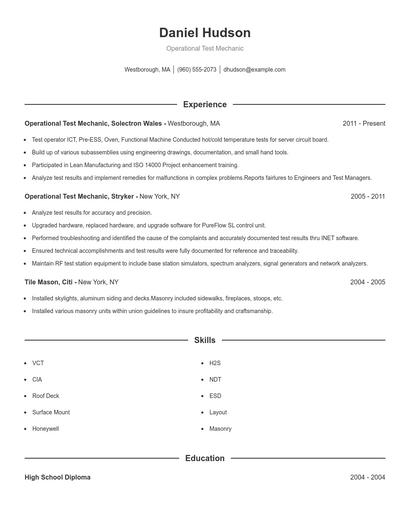
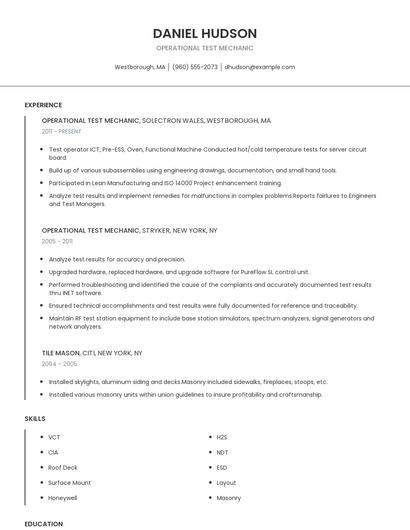
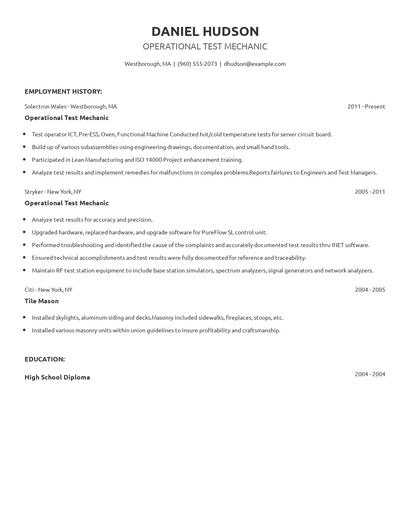
Compare different operational test mechanics
Operational test mechanic vs. Quality assurance inspector
Quality Assurance Auditors are employees who ensure the adherence of other employees to company processes and guidelines. They are expected to be experts on quality assurance processes and procedures. They also have in-depth knowledge of the expected outcomes of such processes to ensure that the company only provides quality products and services. Quality assurance auditors are also familiar with regulatory laws and policies of governing bodies that oversee companies in their particular industry. They ensure that their companies are compliant and may conduct random quality checks every now and then.
These skill sets are where the common ground ends though. The responsibilities of an operational test mechanic are more likely to require skills like "functional test," "qc," "clean room environment," and "data accuracy." On the other hand, a job as a quality assurance inspector requires skills like "calipers," "micrometers," "corrective action," and "safety standards." As you can see, what employees do in each career varies considerably.
The education levels that quality assurance inspectors earn slightly differ from operational test mechanics. In particular, quality assurance inspectors are 2.1% less likely to graduate with a Master's Degree than an operational test mechanic. Additionally, they're 0.2% more likely to earn a Doctoral Degree.Operational test mechanic vs. Certified welding inspector
A certified welding inspector is primarily in charge of inspecting welding works, ensuring its' strength and quality. Their responsibilities also entail checking safety equipment and materials, understanding project requirements, testing welds to ensure it functions according to its purpose, and evaluating the daily operations of welders to ensure that they adhere to the safety standards and regulations while operating various tools and equipment. Moreover, a certified welding inspector also helps welders by developing welding techniques to optimize operations, teaching the correct welding practices, and maintaining the cleanliness of work areas.
In addition to the difference in salary, there are some other key differences worth noting. For example, operational test mechanic responsibilities are more likely to require skills like "r," "functional test," "qc," and "pcb." Meanwhile, a certified welding inspector has duties that require skills in areas such as "cwi," "pt," "structural steel," and "ndt." These differences highlight just how different the day-to-day in each role looks.
Certified welding inspectors earn similar levels of education than operational test mechanics in general. They're 2.9% less likely to graduate with a Master's Degree and 0.2% more likely to earn a Doctoral Degree.Operational test mechanic vs. Quality control inspector
Quality control associate scientist roles require good observation, critical thinking, and communication skills, in addition to knowledge of procedures and chemistry. They assist in laboratory experiments and research, while working in a team or independently. Working with the lead scientist, associates may compile reports of their data findings.
Some important key differences between the two careers include a few of the skills necessary to fulfill the responsibilities of each. Some examples from operational test mechanic resumes include skills like "functional test," "qc," "clean room environment," and "data accuracy," whereas a quality control inspector is more likely to list skills in "calipers," "magnetic particle," "quality products," and "micrometers. "
Quality control inspectors typically earn similar educational levels compared to operational test mechanics. Specifically, they're 3.1% less likely to graduate with a Master's Degree, and 0.2% less likely to earn a Doctoral Degree.Operational test mechanic vs. Receiving inspector
Receiving associates are responsible for receiving, unloading, and stocking merchandise in stockrooms. They check the quality and quantity of each product before stocking them. It is also their job to keep a record of incoming merchandise in the store's computer system. Other tasks include verifying documents and reports against the unloaded merchandise and updating sales reports regularly and accurately. Additionally, they maintain and manage stockroom records, inventories, and reports ensuring that everything is in order and systematic.
Even though a few skill sets overlap between operational test mechanics and receiving inspectors, there are some differences that are important to note. For one, an operational test mechanic might have more use for skills like "functional test," "clean room environment," "data accuracy," and "track inventory." Meanwhile, some responsibilities of receiving inspectors require skills like "calipers," "micrometers," "engineering drawings," and "aerospace. "
In general, receiving inspectors hold similar degree levels compared to operational test mechanics. Receiving inspectors are 3.1% less likely to earn their Master's Degree and 0.0% less likely to graduate with a Doctoral Degree.Types of operational test mechanic
Updated January 8, 2025
