What does an overhead crane operator do?
Overhead crane operator responsibilities
Here are examples of responsibilities from real overhead crane operator resumes:
- Operate traveling overhead crane to lift, move, and position loads of raw steel material using a hook hoisting attachment.
- Loaded/Unload trucks safely using overhead cranes and/or mobile equipment.
- Certify crane operator and heavy equipment operator NCCCO certify TWIC certify MSHA training course
- Operate TLL to hang pipe, values and other material in racks for site construction.
- Operate hydraulic and lattice cranes, crane assembly and disassembly, oiling, rigging, and signaling.
- Operate 60 ton rough terrain , 165 ton link-belt, and 175 ton 777 Manitowoc.Forrest``ken"Haley
- Perform and log daily crane inspections, including cables, wire ropes, hooks, slings, and other crane components.
- Prepare the cranes for re-certifications by greasing all cables, checking all sheaves for lubrication check all hoses and boom sections.
- Operate cranes for refinery turnarounds and outages
- Operate 70-ton overhead crane in lifting/transporting coils of aluminum for production processing.
- Experience operating boom cranes at various locations where maneuverability is restricted and accuracy is critical.
- Perform specialized production line and quality control duties in a professional production environment specializing in plastic extrusion.
- Operate machinery such as saws, torches, and lathes in an industrial environment.
- Perform specialized production line and quality control duties in a professional production environment specializing in plastic extrusion.
Overhead crane operator skills and personality traits
We calculated that 19% of Overhead Crane Operators are proficient in Cranes, Overhead Cranes, and Determines Safety. They’re also known for soft skills such as Communication skills, Coordination, and Visual ability.
We break down the percentage of Overhead Crane Operators that have these skills listed on their resume here:
- Cranes, 19%
Achieved overhead crane, standing and sitting forklift certifications * Safely and proficiently transferred * Effectively navigated customers to appropriate merchandise
- Overhead Cranes, 9%
Loaded materials onto customer and company equipment with overhead cranes.
- Determines Safety, 9%
Operate overhead crane to lift, move, and position loads using hoisting Observe load hookup and determines safety of load.
- Steel Coils, 7%
Trained to load, unload, move, and locate steel coils in a designated storage area.
- Hoisting, 6%
Performed precision rigging and hoisting operations and obtained rigging certification through McDal Corporation.
- Tape Measure, 4%
Read tape measure for measurement of steel to be cut according to customers orders.
Common skills that an overhead crane operator uses to do their job include "cranes," "overhead cranes," and "determines safety." You can find details on the most important overhead crane operator responsibilities below.
Communication skills. The most essential soft skill for an overhead crane operator to carry out their responsibilities is communication skills. This skill is important for the role because "material moving machine operators signal and direct workers to load and unload material." Additionally, an overhead crane operator resume shows how their duties depend on communication skills: "operate 110 ton overhead crane to move and place large weldments for welding with constant communication with other operators. "
Coordination. Many overhead crane operator duties rely on coordination. "material moving machine operators must have steady hands and feet to guide and control heavy machinery precisely," so an overhead crane operator will need this skill often in their role. This resume example is just one of many ways overhead crane operator responsibilities rely on coordination: "meet productivity goals & quality standards- communicate in english, both verbal and written- good hand-eye coordination- attention to detail"
Visual ability. overhead crane operators are also known for visual ability, which are critical to their duties. You can see how this skill relates to overhead crane operator responsibilities, because "material moving machine operators must be able to see clearly where they are driving or what they are moving." An overhead crane operator resume example shows how visual ability is used in the workplace: "meter reading welding, assembly line, valve repair, hydraulic repair, and visually inspecting finished products. "
Mechanical skills. A big part of what overhead crane operators do relies on "mechanical skills." You can see how essential it is to overhead crane operator responsibilities because "material moving machine operators make minor adjustments to their machines and perform basic maintenance on them." Here's an example of how this skill is used from a resume that represents typical overhead crane operator tasks: "repaired and replaced major mechanical steel production components (utilizing overhead cranes) at nucor-yamato steel site, blytheville, ar. "
The three companies that hire the most overhead crane operators are:
- Express Employment Indy South4 overhead crane operators jobs
- Harsco2 overhead crane operators jobs
- Olympic Steel2 overhead crane operators jobs
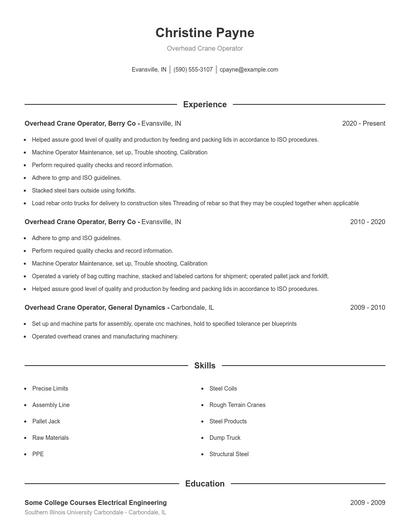
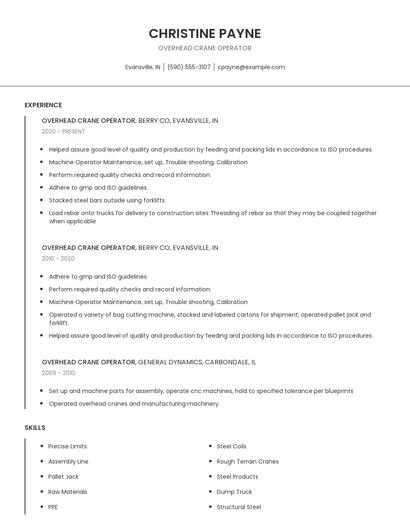
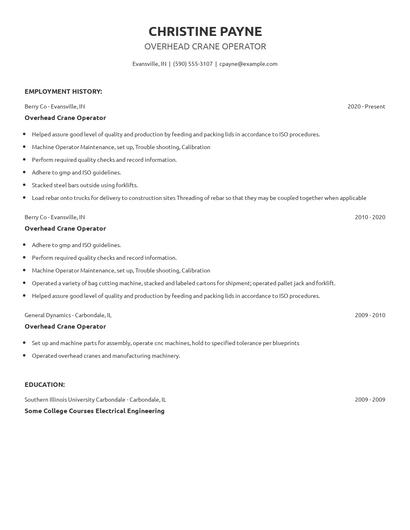
Choose from 10+ customizable overhead crane operator resume templates
Build a professional overhead crane operator resume in minutes. Our AI resume writing assistant will guide you through every step of the process, and you can choose from 10+ resume templates to create your overhead crane operator resume.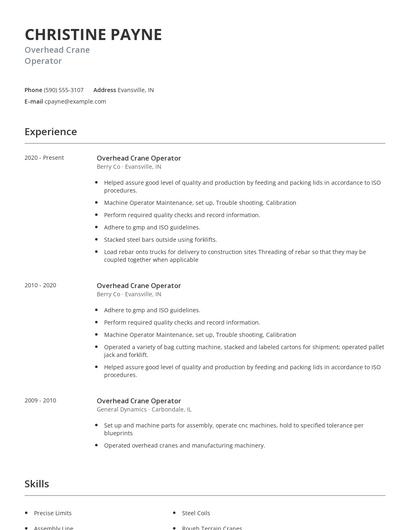
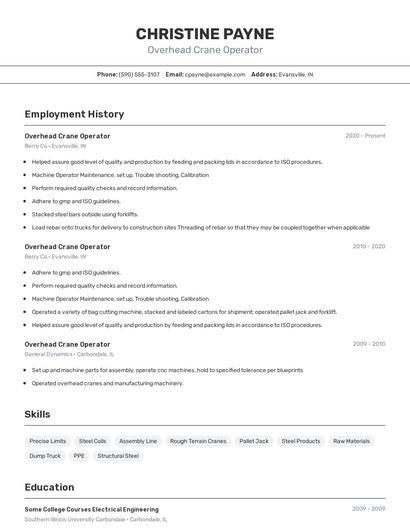


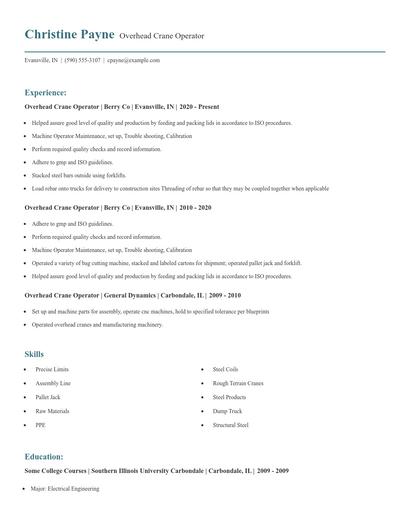
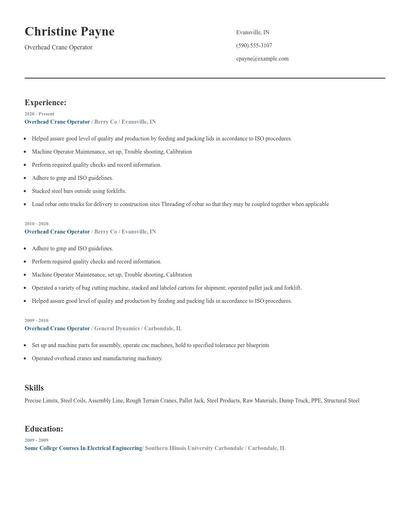
Compare different overhead crane operators
Overhead crane operator vs. Machine operator/forklift operator
A machine operator/forklift operator is responsible for operating industrial trucks to move merchandise around the warehouse facilities and other assigned areas. Machine operators/forklift operators also assist with inventory tasks by scanning orders and ensuring the correct merchandise for shipment. They manage the stability of the vehicles, ensuring its efficiency and optimization during operations, performing engine repairs for any inconsistencies to avoid delays on deliveries. A machine operator/forklift operator should strictly follow the safety protocols of the business, as well as have knowledge of the mechanical industry.
There are some key differences in the responsibilities of each position. For example, overhead crane operator responsibilities require skills like "cranes," "overhead cranes," "determines safety," and "steel coils." Meanwhile a typical machine operator/forklift operator has skills in areas such as "drive forklift," "machine operation," "electric pallet jack," and "quality checks." This difference in skills reveals the differences in what each career does.
Machine operator/forklift operators really shine in the automotive industry with an average salary of $36,711. Comparatively, overhead crane operators tend to make the most money in the hospitality industry with an average salary of $38,436.The education levels that machine operator/forklift operators earn slightly differ from overhead crane operators. In particular, machine operator/forklift operators are 0.1% less likely to graduate with a Master's Degree than an overhead crane operator. Additionally, they're 0.0% less likely to earn a Doctoral Degree.Overhead crane operator vs. Control tower operator
Mill operators are skilled employees who are responsible for operating and maintaining milling machines that grind materials such as rocks or chemicals at a milling facility. These operators must gather raw materials for production and assist with the inventory of all materials. They must operate a wide variety of equipment such as power saws, sanders, drill press, and basic hand tools while performing regular maintenance and troubleshooting on the milling machines. Mill operators must also attend safety meetings that are held weekly and monthly to ensure machine operators are following safety procedures.
While some skills are similar in these professions, other skills aren't so similar. For example, resumes show us that overhead crane operator responsibilities requires skills like "cranes," "overhead cranes," "determines safety," and "steel coils." But a control tower operator might use other skills in their typical duties, such as, "federal aviation administration," "air traffic control," "radio communications," and "airfield operations."
Average education levels between the two professions vary. Control tower operators tend to reach similar levels of education than overhead crane operators. In fact, they're 2.1% more likely to graduate with a Master's Degree and 0.0% less likely to earn a Doctoral Degree.Overhead crane operator vs. Mill operator
A lift operator is responsible for overseeing the performance of chair lifts in ski resorts and mountains, ensuring the efficiency of the machine and safety of all riders. Aside from controlling operations, they must also assist customers in getting up and off the lifts, remind them of the safety precautions, and ensure that the ride capacity is up to standard. Furthermore, lift operators must make sure that the machine is in good condition and adhere to all the safety regulations and policies at all times.
Some important key differences between the two careers include a few of the skills necessary to fulfill the responsibilities of each. Some examples from overhead crane operator resumes include skills like "cranes," "determines safety," "hoisting," and "unload trucks," whereas a mill operator is more likely to list skills in "osha," "math," "calipers," and "hand tools. "
Mill operators make a very good living in the construction industry with an average annual salary of $41,320. On the other hand, overhead crane operators are paid the highest salary in the hospitality industry, with average annual pay of $38,436.When it comes to education, mill operators tend to earn similar degree levels compared to overhead crane operators. In fact, they're 0.1% less likely to earn a Master's Degree, and 0.1% less likely to graduate with a Doctoral Degree.Overhead crane operator vs. Lift operator
Even though a few skill sets overlap between overhead crane operators and lift operators, there are some differences that are important to note. For one, an overhead crane operator might have more use for skills like "cranes," "overhead cranes," "determines safety," and "steel coils." Meanwhile, some responsibilities of lift operators require skills like "pallets," "fork-lift," "electric pallet jack," and "power saws. "
Lift operators enjoy the best pay in the automotive industry, with an average salary of $36,028. For comparison, overhead crane operators earn the highest salary in the hospitality industry.In general, lift operators hold similar degree levels compared to overhead crane operators. Lift operators are 0.1% more likely to earn their Master's Degree and 0.0% more likely to graduate with a Doctoral Degree.Types of overhead crane operator
Updated January 8, 2025
