What does a packer/loader do?
Packer/loader responsibilities
Here are examples of responsibilities from real packer/loader resumes:
- Prepare pallets by following prescribe stacking arrangement and properly tagging pallets.
- Attach burners on the top castings with clips.
Packer/loader skills and personality traits
We calculated that 21% of Packer/Loaders are proficient in Electric Pallet Jack, Safety Procedures, and Load Trucks. They’re also known for soft skills such as Customer-service skills, Hand-eye coordination, and Listening skills.
We break down the percentage of Packer/Loaders that have these skills listed on their resume here:
- Electric Pallet Jack, 21%
Operate a electric pallet jack safely and efficiently.
- Safety Procedures, 14%
Adhered to safety procedures regarding serviceability of equipment; communicated with other associates and provided internal/external customer service.
- Load Trucks, 14%
Unload trucks and pack shipment onto pallets; load rail carts with product to be placed onto train for shipment
- Inspect Containers, 13%
Examine and inspect containers, materials, and products to ensure that packing specifications are met.
- Assembly Line, 10%
Get ice cream from assembly line and packed it in boxes and loaded the boxes onto pallets.
- Label Containers, 6%
Mark and label containers, container tags, or products, using marking tools.
"electric pallet jack," "safety procedures," and "load trucks" are among the most common skills that packer/loaders use at work. You can find even more packer/loader responsibilities below, including:
Customer-service skills. To carry out their duties, the most important skill for a packer/loader to have is customer-service skills. Their role and responsibilities require that "hand laborers and material movers who work with the public, such as grocery baggers or carwash attendants, must be pleasant and courteous to customers." Packer/loaders often use customer-service skills in their day-to-day job, as shown by this real resume: "fill customer orders by packaging for direct shipping or by transferring orders to manufacturers or third-party distributors. "
Hand-eye coordination. Another soft skill that's essential for fulfilling packer/loader duties is hand-eye coordination. The role rewards competence in this skill because "most hand laborers and material movers use their arms and hands to manipulate objects or move objects into specific positions." According to a packer/loader resume, here's how packer/loaders can utilize hand-eye coordination in their job responsibilities: "ensured hand and eye coordination at all times in facility. "
Listening skills. packer/loaders are also known for listening skills, which are critical to their duties. You can see how this skill relates to packer/loader responsibilities, because "hand laborers and material movers follow instructions that a supervisor gives them." A packer/loader resume example shows how listening skills is used in the workplace: "communicated with co-packers and others from different departments about goals and safety rules. "
Physical strength. A big part of what packer/loaders do relies on "physical strength." You can see how essential it is to packer/loader responsibilities because "some hand laborers and material movers must be able to lift and carry heavy objects." Here's an example of how this skill is used from a resume that represents typical packer/loader tasks: "loaded tractor trailers with anywhere from 1200-1500 packages a night in a very fast paced and physical facility"
The three companies that hire the most packer/loaders are:
- Randstad North America, Inc.3 packer/loaders jobs
- The Timken Company2 packer/loaders jobs
- Wheaton World Wide Moving
2 packer/loaders jobs
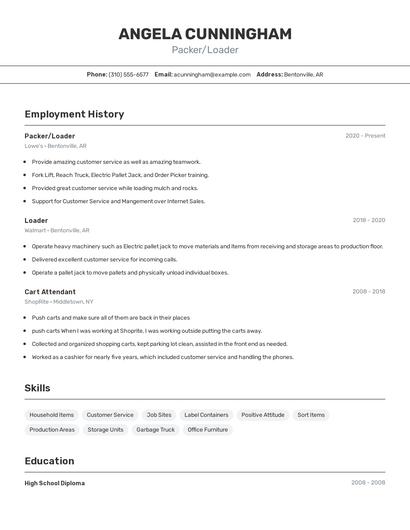
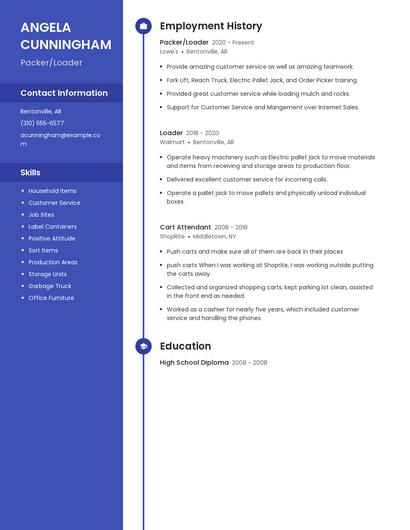
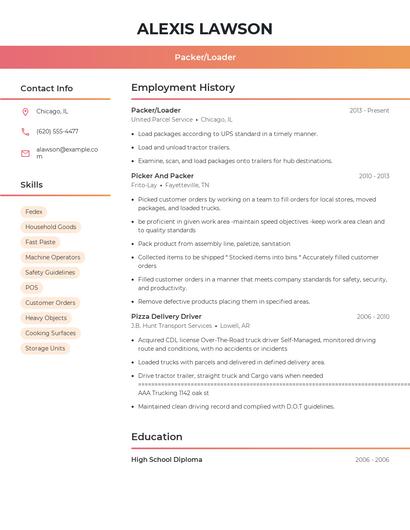
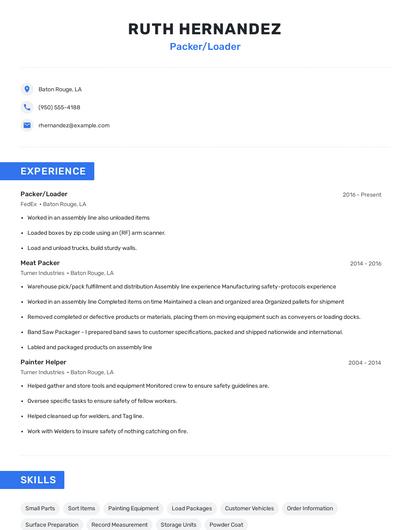
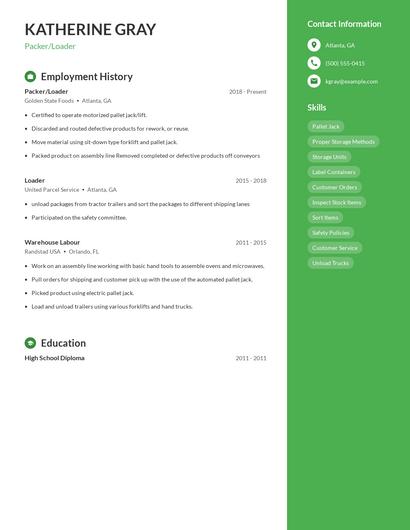
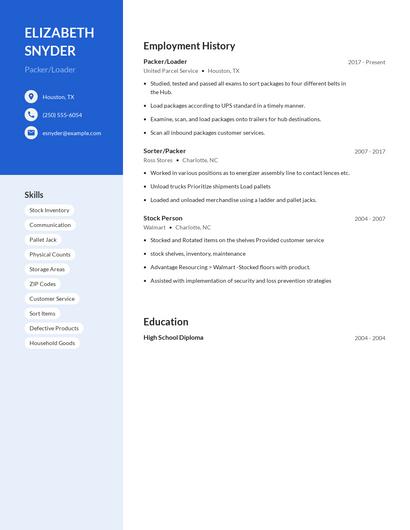
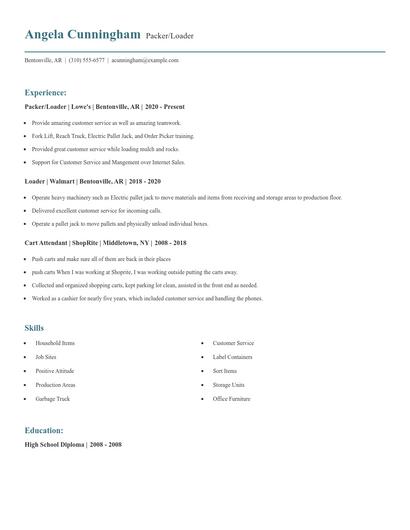
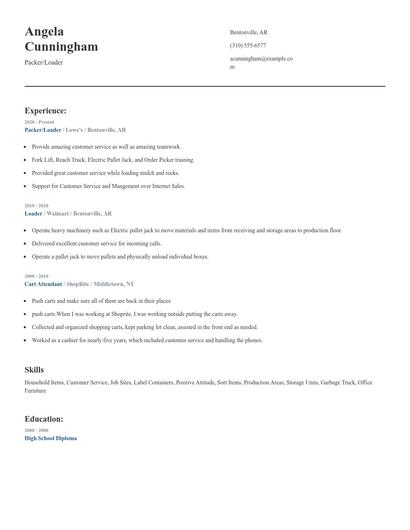
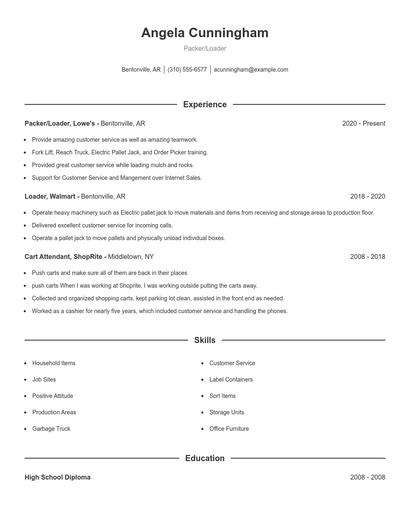
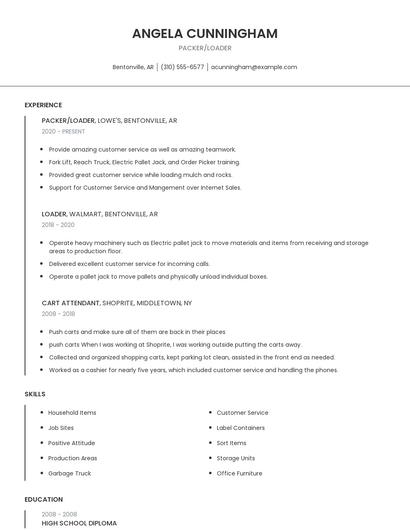
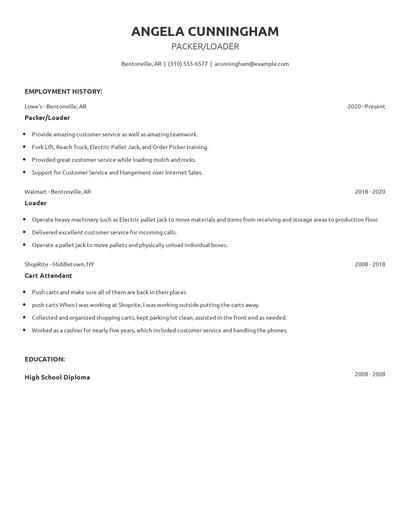
Choose from 10+ customizable packer/loader resume templates
Build a professional packer/loader resume in minutes. Our AI resume writing assistant will guide you through every step of the process, and you can choose from 10+ resume templates to create your packer/loader resume.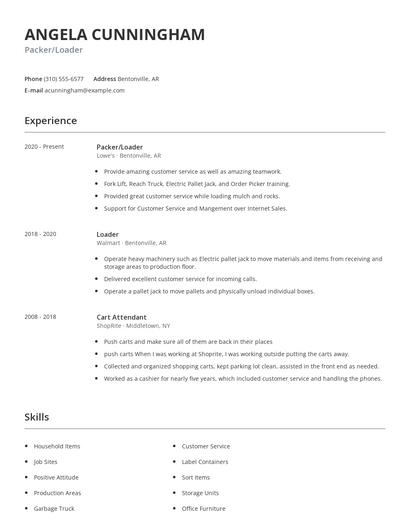
Compare different packer/loaders
Packer/loader vs. Warehouse labour
Warehouse labour workers are responsible for organizing shipment details by processing the correct quantity of orders, ensuring that the items are free from any defects and mislabeling. Warehouse labourers prepare the items for packaging efficiently, update the inventory records, and escalate production discrepancy to the management for immediate resolution. They should also strictly adhere to the production area's safety regulations, especially on loading and unloading items, and moving each package to appropriate shelves using warehouse equipment.
There are some key differences in the responsibilities of each position. For example, packer/loader responsibilities require skills like "inspect containers," "label containers," "household goods," and "seasonal position." Meanwhile a typical warehouse labour has skills in areas such as "pallets," "customer service," "basic math," and "osha." This difference in skills reveals the differences in what each career does.
Warehouse labours tend to make the most money working in the technology industry, where they earn an average salary of $33,085. In contrast, packer/loaders make the biggest average salary, $33,695, in the technology industry.On average, warehouse labours reach similar levels of education than packer/loaders. Warehouse labours are 0.2% more likely to earn a Master's Degree and 0.1% more likely to graduate with a Doctoral Degree.Packer/loader vs. Mover
Movers help people take or move things from one place to another through their physical strength. They work manually to help customers in their businesses or homes. Among the elements, they do include the preparation, loading, and unloading of items. They are also notable as material movers and hand laborers. Some movers drive a moving truck. However, they should not be burdened with any issue with a high value like jewelry and cash.
Each career also uses different skills, according to real packer/loader resumes. While packer/loader responsibilities can utilize skills like "electric pallet jack," "safety procedures," "inspect containers," and "assembly line," movers use skills like "office furniture," "customer service," "pallet jack," and "delivery vehicle."
Movers earn similar levels of education than packer/loaders in general. They're 0.3% more likely to graduate with a Master's Degree and 0.1% more likely to earn a Doctoral Degree.Packer/loader vs. Can handler
Can handlers or material handlers have various duties and responsibilities within an organization. These include maintaining production and product distribution, staging finished products, and delivering production supplies and materials. Other responsibilities include maintaining inventory, documenting supplies and materials disposition, and receiving supplies and materials from production. They receive credit-return materials by verifying the code, quantity, and lot number. Can handlers also prepare products for shipment, maintain material-handling equipment, and contribute to teamwork and effort. The skills and qualifications needed for this position include organizational skills, inventory control, and data entry skills.
Some important key differences between the two careers include a few of the skills necessary to fulfill the responsibilities of each. Some examples from packer/loader resumes include skills like "electric pallet jack," "inspect containers," "label containers," and "household goods," whereas a can handler is more likely to list skills in "customer service," "patients," "supply support," and "safety regulations. "
Can handlers earn the highest salary when working in the automotive industry, where they receive an average salary of $33,051. Comparatively, packer/loaders have the highest earning potential in the technology industry, with an average salary of $33,695.Most can handlers achieve a similar degree level compared to packer/loaders. For example, they're 1.7% more likely to graduate with a Master's Degree, and 0.1% more likely to earn a Doctoral Degree.Packer/loader vs. Warehouseman
A warehouseman or warehouse worker is the person who assists with the inventory, shipping, and receiving of items in warehouses. Warehousemen receive and process incoming materials and stocks, along with picking and filling orders from the store. They manage, organize, and retrieve supplies and others. These workers need to have skills in speed, accuracy, and prioritizing tasks on site. They should also be equipped with skills in forklift, loading, and general labor.
Types of packer/loader
Updated January 8, 2025
