What does a parent educator do?

A parent educator is an individual who specializes in tutoring parents on skills to help them raise children who are healthy and well-rounded. You will help parents learn the skills they may need to raise children who are healthy emotionally, psychologically, and physically. Parent educators can work as social workers employed by a public agency, in schools and childcare centers, or can be self-employed counselors who specialize in child care and parenting skills.
Parent educator responsibilities
Here are examples of responsibilities from real parent educator resumes:
- Provide assistance for patients navigating government and community agencies.
- Provide and assist in a variety of parenting classes, including CPR and health classes.
- Develop courses, and provide training for infant CPR and newborn care for expectant parents.
- Maintain effective verbal and written communication with clients, DCS case managers, teachers, adjustment councilors, and probation officers.
- Support parents throughout pregnancy until their children enter kindergarten.
- Advocate and encourage community coalition to support at-risk families.
- Maintain case documentation following COA guidelines and Medicaid rule.
- Verify client's eligibility for Medicaid and obtain Medicaid number.
- Facilitate supervised visits between parents and children involve with DCS.
- Prepare children for kindergarten & assist families w/ transitioning to kindergarten.
- Assist in developing curriculum and educational activities for specific direct service interventions for at-risk populations.
- Design and organize workshops for parents to provide tools in assisting students to increase literacy and mathematics achievement.
- Conduct ASQ-3 and ASQ-SE to support each child s development and detect potential delays.
- Collaborate effectively with peers/hospital staff and develop positive relationships with patients' families, ensuring a level of trust and respect.
- Assist teachers and school personnel with translation of documents for ESOL.
Parent educator skills and personality traits
We calculated that 17% of Parent Educators are proficient in Child Development, Social Work, and Community Resources. They’re also known for soft skills such as Business skills, Leadership skills, and Organizational skills.
We break down the percentage of Parent Educators that have these skills listed on their resume here:
- Child Development, 17%
Facilitated parenting education classes for a nonprofit organization in child development and effective parenting strategies to over 500 parents and caregivers.
- Social Work, 12%
State funded non-profit agency retaining highly qualified educators and social workers to perform kindergarten readiness in AZ youth.
- Community Resources, 12%
Develop with parent input, an individualized family service plan and offers referral to community resources as appropriate.
- Mental Health, 6%
Provide family support follow-up, Developmental follow-up, referral to community services, Mental Health referrals.
- Family Support, 4%
Supervised Family Support staff for a Metro Atlanta early education agency.
- Child Abuse, 4%
Mandated child abuse reporting as necessary.
Most parent educators use their skills in "child development," "social work," and "community resources" to do their jobs. You can find more detail on essential parent educator responsibilities here:
Business skills. To carry out their duties, the most important skill for a parent educator to have is business skills. Their role and responsibilities require that "preschool and childcare center directors manage childcare centers and need to be able to operate the business effectively." Parent educators often use business skills in their day-to-day job, as shown by this real resume: "served as liaison for district with professional, business and civic groups, community organizations and individuals. "
Leadership skills. Many parent educator duties rely on leadership skills. "preschool and childcare center directors need leadership skills to supervise staff and inspire diligence," so a parent educator will need this skill often in their role. This resume example is just one of many ways parent educator responsibilities rely on leadership skills: "collaborated in latino leadership program with brandeis university coordinated academic information to parents and students track students and follow-up with meetings/counselling"
Organizational skills. This is an important skill for parent educators to perform their duties. For an example of how parent educator responsibilities depend on this skill, consider that "directors need to maintain clear records about children and staff." This excerpt from a resume also shows how vital it is to everyday roles and responsibilities of a parent educator: "provide individual and group social skills training, anger management, coping skills, organizational skills and study skills. ".
Interpersonal skills. parent educator responsibilities often require "interpersonal skills." The duties that rely on this skill are shown by the fact that "preschool and childcare center directors must be able to develop relationships with parents, children, and staff." This resume example shows what parent educators do with interpersonal skills on a typical day: "utilize interpersonal relations/communication every day with client, dcs case manager, foster families, and a variety of agencies. "
Communication skills. Another crucial skill for a parent educator to carry out their responsibilities is "communication skills." A big part of what parent educators relies on this skill, since "directors inform parents and staff about the children’s progress." How this skill relates to parent educator duties can be seen in an example from a parent educator resume snippet: "model appropriate verbal interactions, communication techniques and discipline techniques with children. "
The three companies that hire the most parent educators are:
- Atlantic Health8 parent educators jobs
- A Child’s Place6 parent educators jobs
- Children's Home Society of Florida4 parent educators jobs
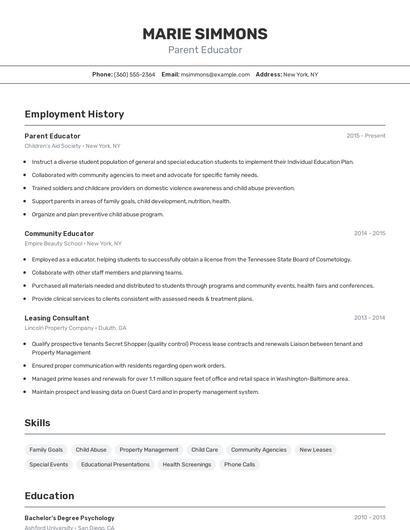
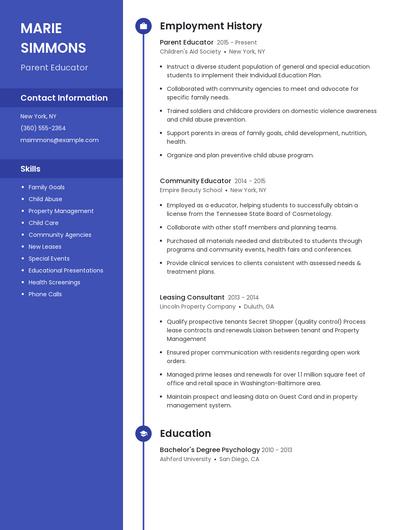
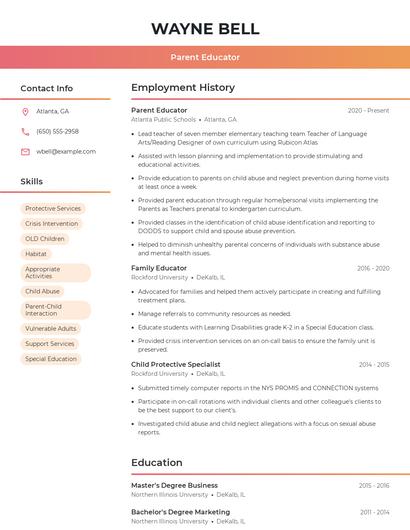
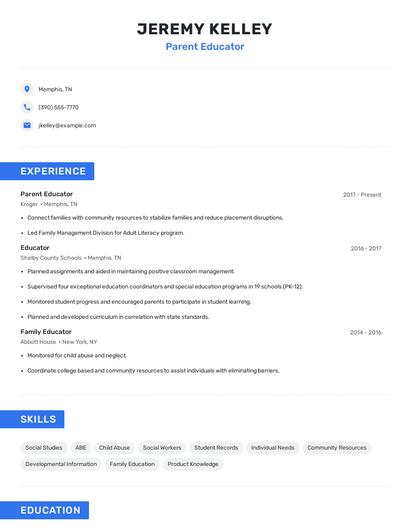
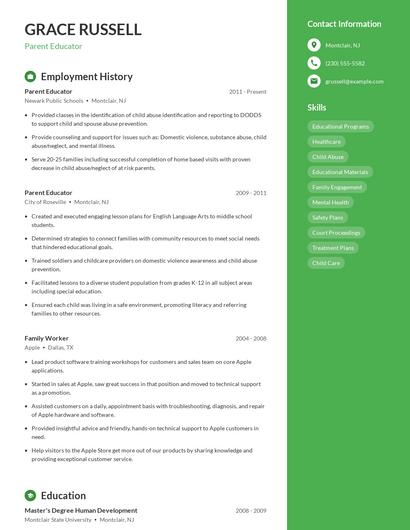
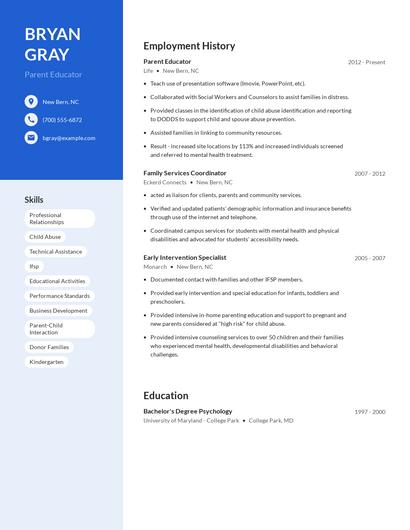
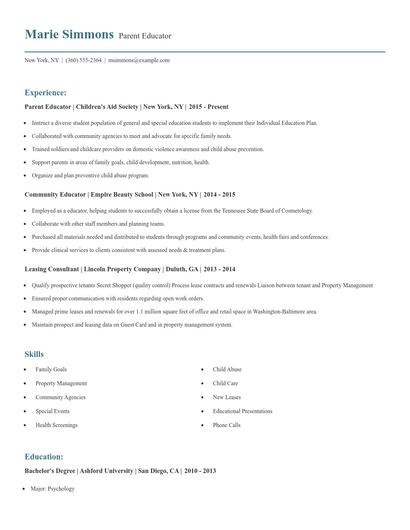
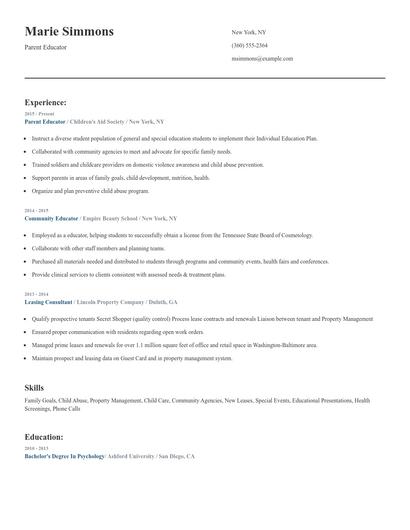
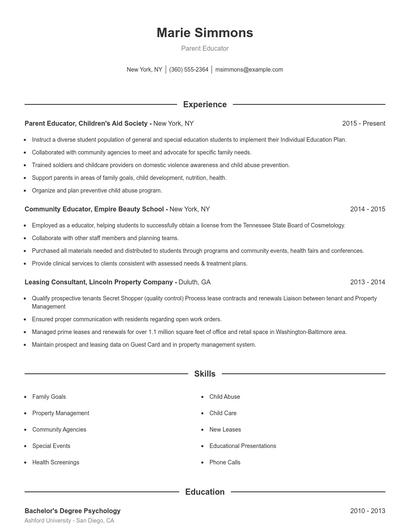
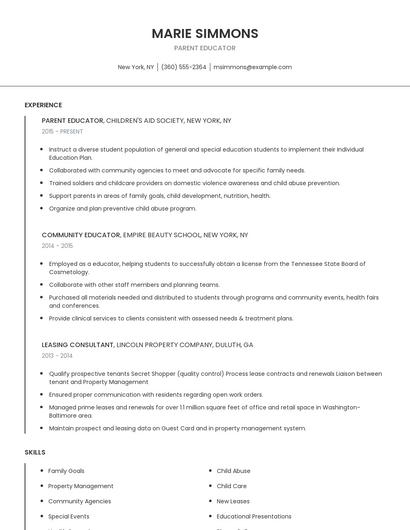
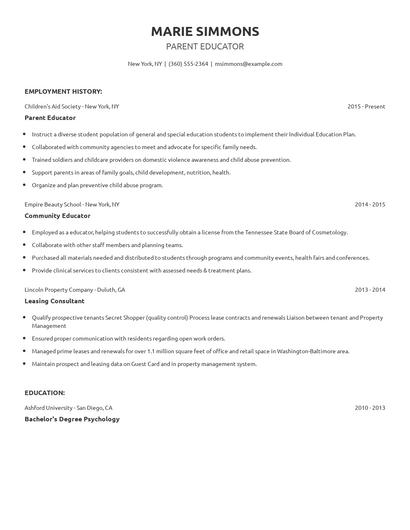
Choose from 10+ customizable parent educator resume templates
Build a professional parent educator resume in minutes. Our AI resume writing assistant will guide you through every step of the process, and you can choose from 10+ resume templates to create your parent educator resume.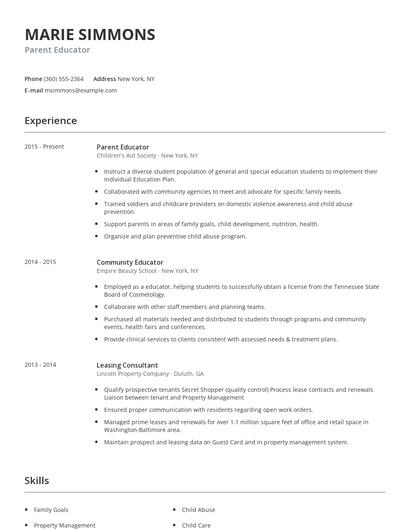
Compare different parent educators
Parent educator vs. Early childhood development manager
A family services coordinator maintains quantitative quality and qualitative quality monitoring systems and improvement systems for the program strategies to get executed with quality, fidelity, and reliability. They coach and offer supervisory guidance services to the family service team to keep the staff capacity robust and move the staff members towards mastering the core competencies. Other duties performed by family services coordinators include supporting vulnerable families, promoting family self-sufficiency, and supporting families whose children have special needs and chronic health conditions.
There are some key differences in the responsibilities of each position. For example, parent educator responsibilities require skills like "social work," "family support," "child abuse," and "kindergarten." Meanwhile a typical early childhood development manager has skills in areas such as "technical assistance," "ecd," "state standards," and "dcfs." This difference in skills reveals the differences in what each career does.
The education levels that early childhood development managers earn slightly differ from parent educators. In particular, early childhood development managers are 4.1% more likely to graduate with a Master's Degree than a parent educator. Additionally, they're 0.2% more likely to earn a Doctoral Degree.Parent educator vs. Early childhood services director
In addition to the difference in salary, there are some other key differences worth noting. For example, parent educator responsibilities are more likely to require skills like "social work," "community resources," "family support," and "child abuse." Meanwhile, an early childhood services director has duties that require skills in areas such as "professional development," "curriculum development," "pre-k," and "education programs." These differences highlight just how different the day-to-day in each role looks.
In general, early childhood services directors achieve higher levels of education than parent educators. They're 8.6% more likely to obtain a Master's Degree while being 0.2% more likely to earn a Doctoral Degree.Parent educator vs. Family services coordinator
The required skills of the two careers differ considerably. For example, parent educators are more likely to have skills like "kindergarten," "cpr," "social services," and "parent-child interaction." But a family services coordinator is more likely to have skills like "patients," "foster care," "ongoing support," and "rehabilitation."
Family services coordinators earn the highest salary when working in the government industry, where they receive an average salary of $44,036. Comparatively, parent educators have the highest earning potential in the professional industry, with an average salary of $38,320.family services coordinators typically earn similar educational levels compared to parent educators. Specifically, they're 3.6% more likely to graduate with a Master's Degree, and 0.1% more likely to earn a Doctoral Degree.Parent educator vs. Daycare manager
Types of parent educator
Updated January 8, 2025
