What does a pathologist assistant do?
A pathologist assistant is responsible for helping pathologists in conducting laboratory investigations by studying human specimens and surgical biopsies for diagnosis and identify a person's cause of death. Pathologist assistants perform autopsy functions under the supervision of the pathologist, following the strict safety protocols and regulations. They must have excellent organizational skills, especially in operating various equipment to prevent potential hazards and disease contamination. A pathologist assistant creates a comprehensive report of findings for the pathologist's review before releasing the final records.
Pathologist assistant responsibilities
Here are examples of responsibilities from real pathologist assistant resumes:
- Recognize & investigate instrument malfunctions, perform calibrations, manage QC, and maintain comprehensive written records of tests & procedures.
- Assist and perform frozen sections, teach pathology residents and pa's.
- Assist doctor when seeing patients, and document all patient information in paper chart and EMR.
- Perform blood draws, record vital signs, maintain medical records, DNA collection, EKG's, medical office duties.
- Gross examination, description, measuring and sectioning all kind of surgical specimens receive in the pathology laboratory.
- Employ all require OSHA safety procedures and devices.
- Gross description and sectioning of small and large specimens.
- Perform pharmacy and CLIA approve lab procedures, maintenance and controls.
- Document patient's information for the electronic medical record (EMR).
- Receive additional training with the CDC and ASCP in laboratory preparedness for Bio-terrorism.
- Maintain cleanliness of supply rooms and morgue, to include processing and x-ray rooms.
- Gross and dictate simple to complex specimens for the pa that is on vacation, medical leave or attending a conference.
- Maintain cleanliness of instrumentation and equipment.
- Experience in performing EKG and administering injections.
- Maintain all necessary documentation for CLIA inspections.
Pathologist assistant skills and personality traits
We calculated that 14% of Pathologist Assistants are proficient in ASCP, Patients, and PA. They’re also known for soft skills such as Analytical skills, Detail oriented, and Interpersonal skills.
We break down the percentage of Pathologist Assistants that have these skills listed on their resume here:
- ASCP, 14%
Worked at a number of locations nationally as a full-time, temporary Pathologists' Assistant, CM PA(ASCP ).
- Patients, 11%
Oversee specimen storage in grossing room and deliver hardware and other specimen to patients upon their request.
- PA, 11%
Acquired skills necessary to accurately gross complex surgical specimens under senior PA and pathologist supervision.
- Dictation, 7%
Instructed Pathology residents in Dissection and report dictation for surgical specimens and autopsy.
- Frozen Sections, 7%
Performed frozen sections Dissected surgical specimens Assisted in the implementation of the Pathology Resident Dissection Training
- Anatomic Pathology, 5%
Compiled and reported several monthly anatomic pathology quality assurance (QA) measures for submission to the institutional Quality Improvement Program.
Most pathologist assistants use their skills in "ascp," "patients," and "pa" to do their jobs. You can find more detail on essential pathologist assistant responsibilities here:
Analytical skills. One of the key soft skills for a pathologist assistant to have is analytical skills. You can see how this relates to what pathologist assistants do because "medical assistants must be able to understand and follow medical charts and diagnoses." Additionally, a pathologist assistant resume shows how pathologist assistants use analytical skills: "obtain clinical history, including scans, x-rays, laboratory data, etc. "
Detail oriented. Many pathologist assistant duties rely on detail oriented. "medical assistants need to be precise when taking vital signs or recording patient information," so a pathologist assistant will need this skill often in their role. This resume example is just one of many ways pathologist assistant responsibilities rely on detail oriented: "assist laboratory assistants in preparation of daily specimen division detailing assignment of cases and points assigned. "
Interpersonal skills. pathologist assistants are also known for interpersonal skills, which are critical to their duties. You can see how this skill relates to pathologist assistant responsibilities, because "medical assistants need to be able to discuss patient information with other medical personnel, such as physicians." A pathologist assistant resume example shows how interpersonal skills is used in the workplace: "developed extensive customer service and interpersonal skills through daily interactions with patients, office managers, and representatives. "
Technical skills. pathologist assistant responsibilities often require "technical skills." The duties that rely on this skill are shown by the fact that "medical assistants should be able to use basic clinical instruments so they can take a patient’s vital signs, such as heart rate and blood pressure." This resume example shows what pathologist assistants do with technical skills on a typical day: "gross dissection and description of surgical specimens gross medical photography technical and professional cpt coding"
The three companies that hire the most pathologist assistants are:
- Ansible by Red Hat12 pathologist assistants jobs
- HealthTrust11 pathologist assistants jobs
- Kaiser Permanente8 pathologist assistants jobs
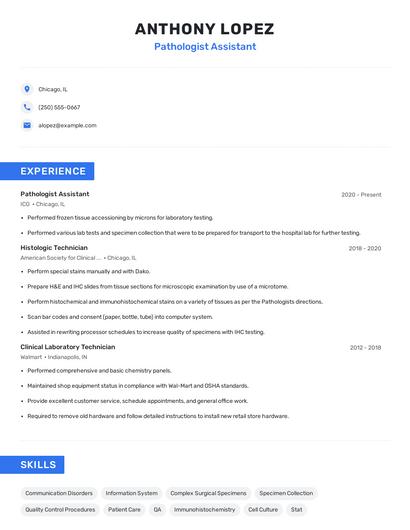
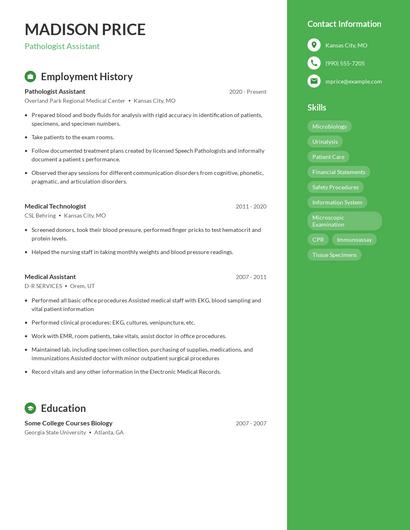
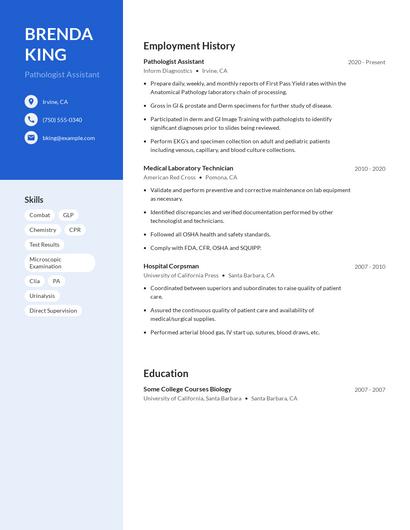
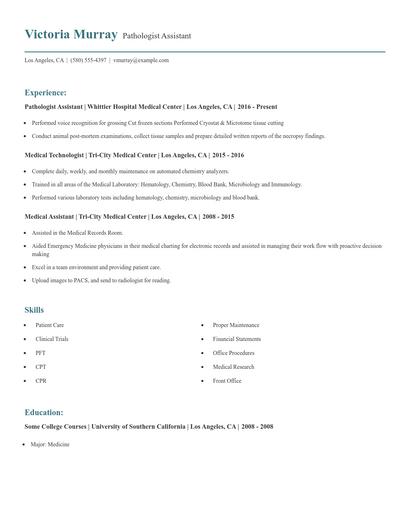
Choose from 10+ customizable pathologist assistant resume templates
Build a professional pathologist assistant resume in minutes. Our AI resume writing assistant will guide you through every step of the process, and you can choose from 10+ resume templates to create your pathologist assistant resume.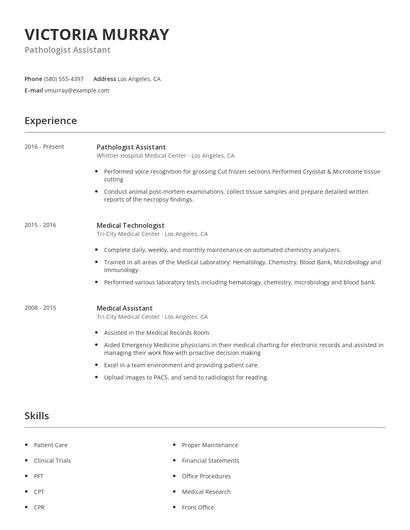
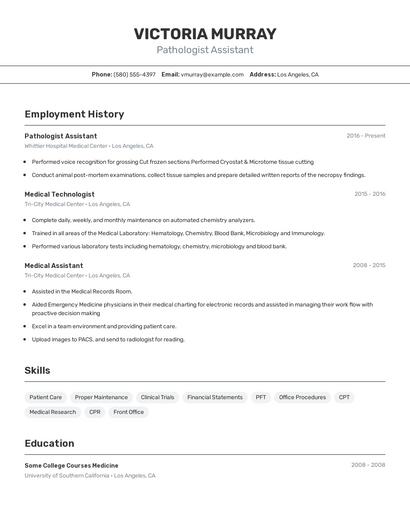
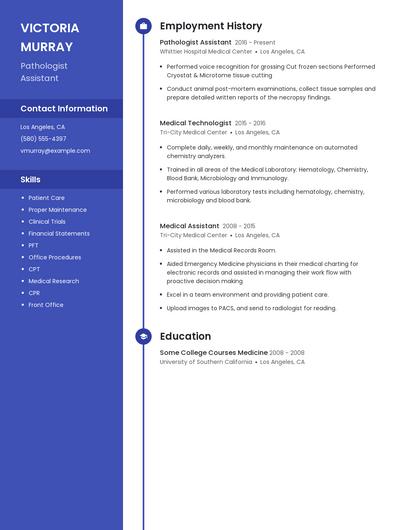
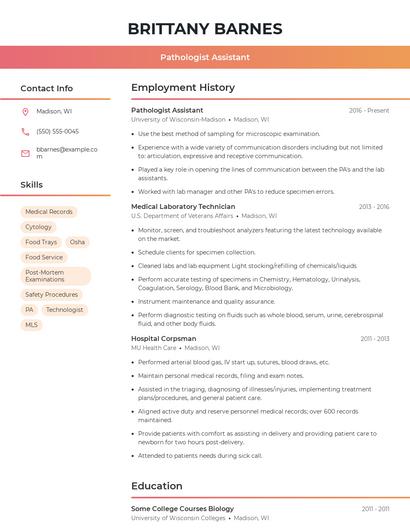
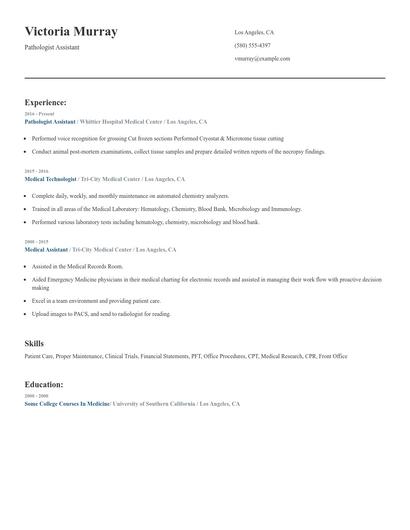
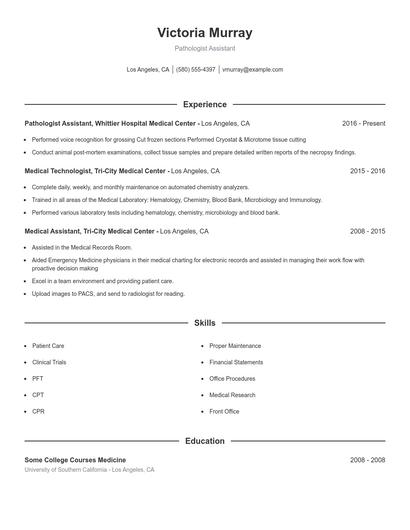
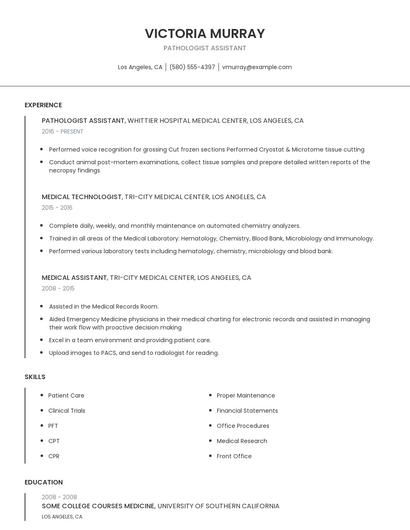
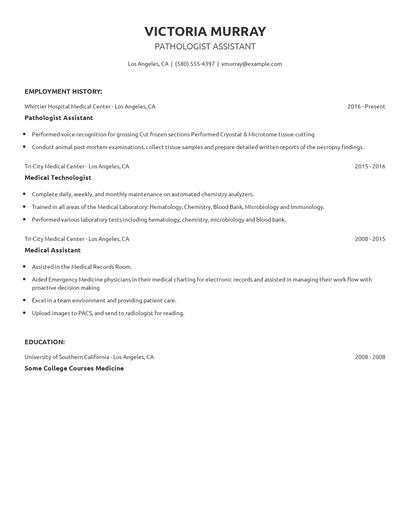
Compare different pathologist assistants
Pathologist assistant vs. Md
A Doctor of Medicine or MD is the designation of a person who completed medical education. Generally, MDs focus on the treatment of conditions in need of medication. These doctors do health assessments, prescribe medication, run diagnostic tests, treat patients, and offer health and wellness advice. Among their health specialties are in the areas of neurology, gynecology, and dermatology. They may also perform surgery when necessary. All these are made possible with their knowledge and skills in medicine.
There are some key differences in the responsibilities of each position. For example, pathologist assistant responsibilities require skills like "ascp," "pa," "dictation," and "frozen sections." Meanwhile a typical md has skills in areas such as "customer service," "surgical procedures," "surgery," and "patient care." This difference in skills reveals the differences in what each career does.
The education levels that mds earn slightly differ from pathologist assistants. In particular, mds are 2.5% less likely to graduate with a Master's Degree than a pathologist assistant. Additionally, they're 0.0% more likely to earn a Doctoral Degree.Pathologist assistant vs. Medical internship
When it comes to a medical internship, one of the primary duties is to attend to the patients' needs while under a more experienced physician's supervision. During this period, the medical interns must rotate in various fields of specialties or departments for exposure. Aside from learning and observing, there are also instances when medical interns are required to produce necessary reports and documentation, communicate with patients and families, and take part in more challenging cases.
While some skills are similar in these professions, other skills aren't so similar. For example, resumes show us that pathologist assistant responsibilities requires skills like "ascp," "pa," "dictation," and "frozen sections." But a medical internship might use other skills in their typical duties, such as, "patient care," "vital signs," "surgical procedures," and "surgery."
Average education levels between the two professions vary. Medical interns tend to reach lower levels of education than pathologist assistants. In fact, they're 6.6% less likely to graduate with a Master's Degree and 0.0% less likely to earn a Doctoral Degree.Pathologist assistant vs. Medical specialist
Medical specialists are responsible for diagnosing patients and performing medical procedures according to their areas of expertise. They coordinate with the clinical team on administering medications, conducting laboratory examinations, and monitoring admitted patients, ensuring that they receive high-quality care services from the medical staff. A medical specialist also communicates with the patients' families to respond to their medical inquiries and concerns, as well as providing them with updates on the patients' progress. A medical specialist observes the cleanliness and orderliness of the facilities at all times, including the inspection of medical tools and equipment for operations.
Some important key differences between the two careers include a few of the skills necessary to fulfill the responsibilities of each. Some examples from pathologist assistant resumes include skills like "ascp," "pa," "dictation," and "frozen sections," whereas a medical specialist is more likely to list skills in "customer service," "patient care," "utilization management," and "medical management. "
When it comes to education, medical specialists tend to earn lower degree levels compared to pathologist assistants. In fact, they're 6.0% less likely to earn a Master's Degree, and 4.0% less likely to graduate with a Doctoral Degree.Pathologist assistant vs. Office manager/medical assistant
Types of pathologist assistant
Updated January 8, 2025
