What does a personal attendant do?
Personal attendant responsibilities
Here are examples of responsibilities from real personal attendant resumes:
- Assist in ADL, grooming and cleaning work area.
- help the elderly with ADL help prepare meals drive them to doctors appointments and to do grocery shopping also do light housekeeping
- Develop and coordinate daily activities for individual with Alzheimer's disease.
- Promote continuity of care by accurately and completely communicating to other caregivers the status of patients for which care is provided.
- Provide colostomy care and administer medication for pain management in accordance with current physician recommendations.
Personal attendant skills and personality traits
We calculated that 15% of Personal Attendants are proficient in Direct Care, CPR, and Developmental Disabilities. They’re also known for soft skills such as Detail oriented, Integrity, and Interpersonal skills.
We break down the percentage of Personal Attendants that have these skills listed on their resume here:
- Direct Care, 15%
Provided direct care for adults with psychological and developmental disabilities in a supported living program.
- CPR, 10%
Received certification in medication administered and CPR.
- Developmental Disabilities, 10%
Provide practical and mental health support to adult clients with developmental disabilities in Supported Living Situations.
- Adaptive, 9%
Assist in the overall maintenance of the consumer's home and general upkeep of adaptive equipment as assigned.
- Autism, 7%
Care for clients with diagnoses such as Down Syndrome, diabetes, autism, and cerebral palsy.
- Companionship, 7%
Provided all personal hygiene care, medications, wound care, meals, companionship, accompanied to appointments.
"direct care," "cpr," and "developmental disabilities" are among the most common skills that personal attendants use at work. You can find even more personal attendant responsibilities below, including:
Detail oriented. One of the key soft skills for a personal attendant to have is detail oriented. You can see how this relates to what personal attendants do because "home health aides and personal care aides must adhere to specific rules and protocols and carefully follow instructions to help take care of clients." Additionally, a personal attendant resume shows how personal attendants use detail oriented: "assist retiree with communications, financial matters, meal preparation, pet care and domestic details. "
Integrity. Another essential skill to perform personal attendant duties is integrity. Personal attendants responsibilities require that "home health aides and personal care aides should make clients feel comfortable when they tend to personal activities, such as helping a client bathe." Personal attendants also use integrity in their role according to a real resume snippet: "adhere to all safety including food preparation, employee and customer relations to facilitate ethical and safe business practices. "
Interpersonal skills. This is an important skill for personal attendants to perform their duties. For an example of how personal attendant responsibilities depend on this skill, consider that "home health aides and personal care aides must work closely with clients." This excerpt from a resume also shows how vital it is to everyday roles and responsibilities of a personal attendant: "provide companionship and friendship to individuals so that they can maintain positive self-confidence and interpersonal skills. ".
Physical stamina. personal attendant responsibilities often require "physical stamina." The duties that rely on this skill are shown by the fact that "home health aides and personal care aides should be comfortable performing physical tasks." This resume example shows what personal attendants do with physical stamina on a typical day: "implemented complete physical care including straight catheterization and medication administration. "
The three companies that hire the most personal attendants are:
- Cerna Solutions
3 personal attendants jobs
- Canyon Ranch2 personal attendants jobs
- Easter Seals Southern California2 personal attendants jobs
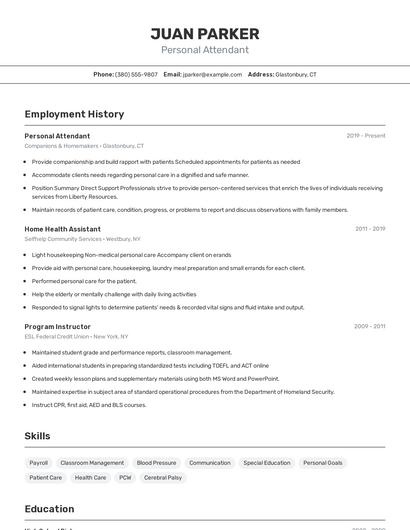
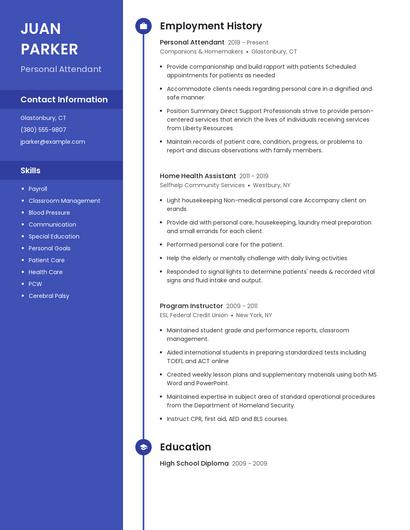
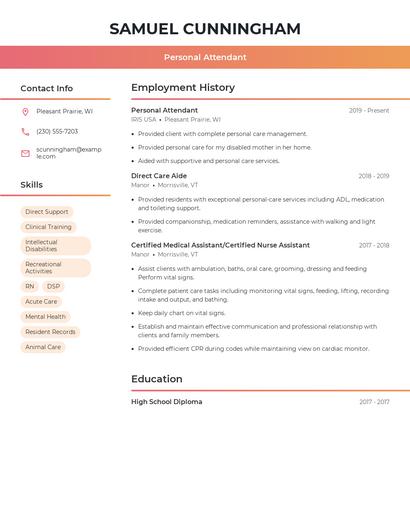
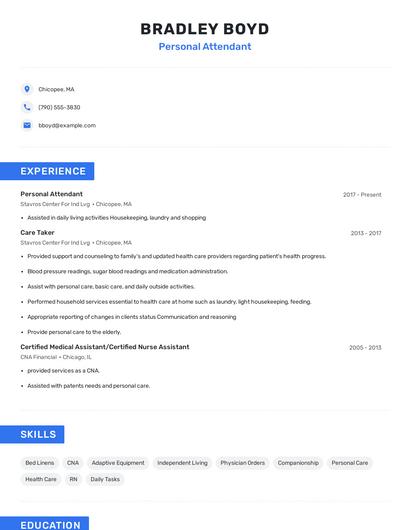
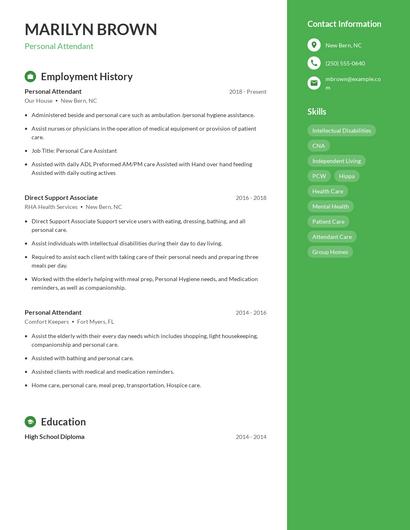
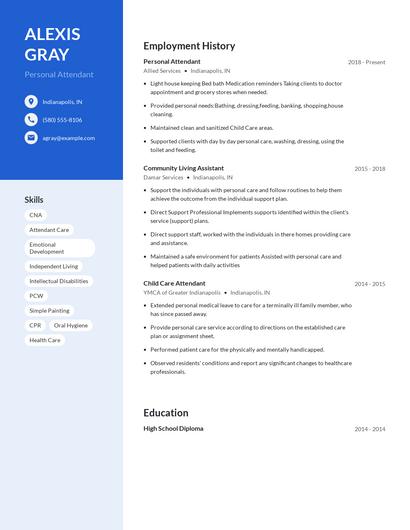
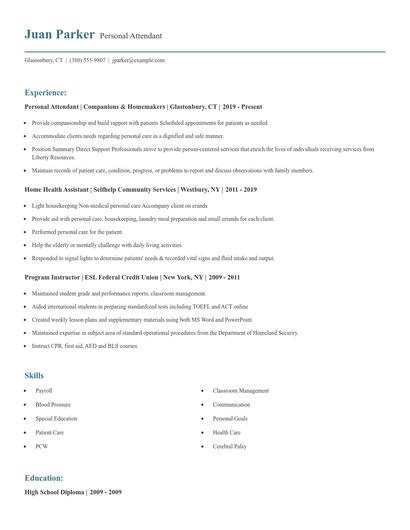
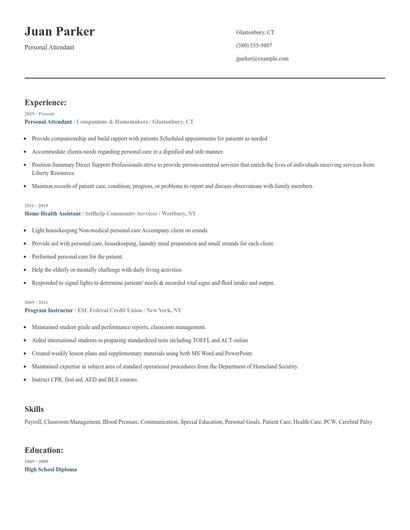
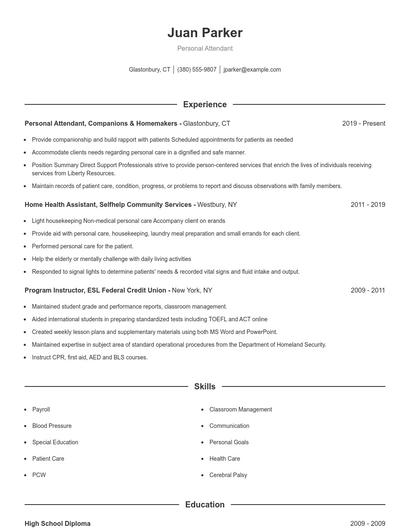
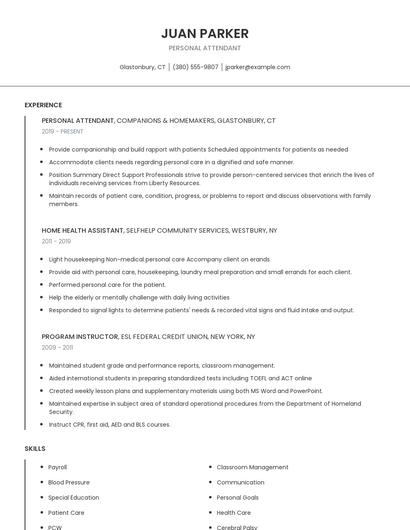
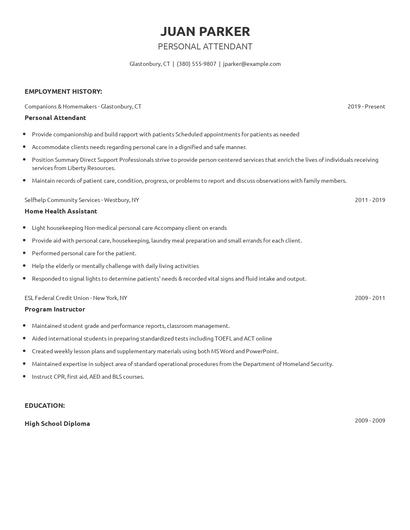
Choose from 10+ customizable personal attendant resume templates
Build a professional personal attendant resume in minutes. Our AI resume writing assistant will guide you through every step of the process, and you can choose from 10+ resume templates to create your personal attendant resume.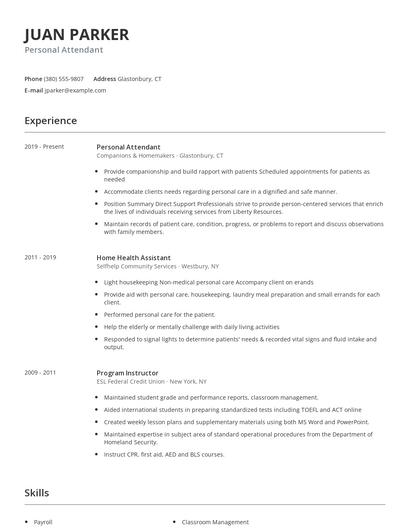
Compare different personal attendants
Personal attendant vs. Direct care staffer
A Direct Care Staffer specializes in providing personal care and supervision to the disabled or elderly. Among the responsibilities include administering medication, managing schedules, assisting in hygienic tasks, preparing meals, and doing light to moderate household chores. Furthermore, A Direct Care Staffer also helps in transportation and preparation of daily meals, running various errands, purchasing groceries and daily necessities, and as well as monitoring health conditions. It is also essential for a Daily Care Staffer to update supervisors and guardians regularly.
While similarities exist, there are also some differences between personal attendants and direct care staffer. For instance, personal attendant responsibilities require skills such as "direct care," "adaptive," "companionship," and "adaptive equipment." Whereas a direct care staffer is skilled in "mental health," "patients," "crisis intervention," and "behavioral issues." This is part of what separates the two careers.
Direct care staffers earn the highest salaries when working in the manufacturing industry, with an average yearly salary of $30,329. On the other hand, personal attendants are paid more in the hospitality industry with an average salary of $30,021.On average, direct care staffers reach similar levels of education than personal attendants. Direct care staffers are 1.7% less likely to earn a Master's Degree and 0.1% less likely to graduate with a Doctoral Degree.Personal attendant vs. Direct care worker
A Direct Care Worker's responsibility revolves around overseeing clients' welfare and health care from different ages and conditions. Most of the duties will involve assistance in basic hygienic tasks such as bathing or going to the toilet, performing light chores such as preparing healthy meals and cleaning a bedroom, and ensuring the patient's medication intake aligns with the schedule. Furthermore, it is also the duty of a Direct Care Worker to empathize and build rapport with clients to make them feel more at ease.
While some skills are similar in these professions, other skills aren't so similar. For example, resumes show us that personal attendant responsibilities requires skills like "adaptive," "autism," "adaptive equipment," and "meal preparation." But a direct care worker might use other skills in their typical duties, such as, "patients," "crisis intervention," "mental health," and "meal prep."
Direct care workers earn a higher average salary than personal attendants. But direct care workers earn the highest pay in the professional industry, with an average salary of $29,581. Additionally, personal attendants earn the highest salaries in the hospitality with average pay of $30,021 annually.direct care workers earn similar levels of education than personal attendants in general. They're 2.5% less likely to graduate with a Master's Degree and 0.1% less likely to earn a Doctoral Degree.Personal attendant vs. Live in caregiver
A live-in caregiver assists with dressing, exercise, bathing, grooming, and toileting services. These professionals offer essential food preparation services such as laundry, light housekeeping, meal preparation, shopping, and more. They offer general health care services such as administering medicine, appointment reminders, overseeing medication usage, and overseeing prescriptions usage. Moreover, they offer personal supervision services, whereby they provide general supervision and constant companionship. Also, they orient or ground individuals with dementia and Alzheimer's disease and relay the doctor's information to the family members.
There are many key differences between these two careers, including some of the skills required to perform responsibilities within each role. For example, a personal attendant is likely to be skilled in "direct care," "developmental disabilities," "adaptive," and "autism," while a typical live in caregiver is skilled in "home health," "senior care," "meal prep," and "compassion."
Live in caregivers make a very good living in the non profits industry with an average annual salary of $37,225. On the other hand, personal attendants are paid the highest salary in the hospitality industry, with average annual pay of $30,021.live in caregivers typically earn similar educational levels compared to personal attendants. Specifically, they're 2.4% less likely to graduate with a Master's Degree, and 0.1% less likely to earn a Doctoral Degree.Personal attendant vs. Group home worker
A group home worker is an employee who assists with different types of patients staying in group homes to help them develop life skills until they are ready to live independently. Group home workers must assist different types of patients, such as adults diagnosed with mental illness, seniors with disabilities, or young residents who cannot live with their families due to behavioral issues. They must monitor the behavior of residents, especially those with a troubled past.
Types of personal attendant
Updated January 8, 2025
