What does a petroleum inspector do?
Petroleum Inspectors are responsible for examining petroleum shipments to ensure they meet contract specifications. Their duties include examining samples during petroleum tank transfer for water or discoloration, withdrawing samples from the petroleum tank, and conducting laboratory analysis on bottled, stored samples. They also use calibration tables to quantify consignments and sounding shore tanks using steel tape. Petroleum inspectors may conduct calibration on meters and tanks. Petroleum inspectors ensure that shipments passing through adhere to performance and safety regulations.
Petroleum inspector responsibilities
Here are examples of responsibilities from real petroleum inspector resumes:
- Manage testing of chemicals, including: benzene, diesel, gasoline, crude oil, ethanol, and acetic acid.
- Inspect and test measures brakes being produce use ruler calipers and micrometers
- Sample petroleum/petrochemical products for API lab analysis.
- Check ware for visual defects with gauges at prescribe intervals.
- Record GPS location points for up-stream documentation and record retention.
- Research the internet to find MSDS sheets that are updated and current.
- Calibrate machine gauges and make sure they stay up to safety standard.
- Inspect all incoming parts, PC boards, assemblies and chemicals for company.
- Sample will be drawn from delivery shore tank and ISO tank after loading for analysis and retention.
- Check and record all chemicals that are being used by the workers so that the proper MSDS sheets can be find.
- Walk down engineering drawings and locate CUI susceptible locations and coordinate with NDE crews to further inspections done to assess damage.
- calculate and interpolate quantities using advance math calculations.
- Develop and recommend NDE solutions for equipment examination.
- Collect asphalt truck tickets during roadway paving operations.
- Record results in accordance with the FAA regulations, modification status/configuration
Petroleum inspector skills and personality traits
We calculated that 17% of Petroleum Inspectors are proficient in Regular Communication, API, and Ladders. They’re also known for soft skills such as Dexterity, Math skills, and Mechanical skills.
We break down the percentage of Petroleum Inspectors that have these skills listed on their resume here:
- Regular Communication, 17%
Maintain regular communication with office staff about job status, issues, and concerns.
- API, 17%
Sampled, measured, and took temperatures of Shore tanks and vessel tanks utilizing API procedures and complied with M.S.D.S.
- Ladders, 15%
Work in confined spaces, climbing storage tanks, ladders, and stairs Run samples at Exxon Mobil at-line when required
- Math, 12%
calculate and interpolate quantities using advanced math calculations.
- Client Procedures, 9%
Maintain knowledge and adhere to the latest industry and client procedures and standards as provided by SGS.
- TWIC, 5%
Have a current and up to date TWIC ID card allowing access to all international ports.
Common skills that a petroleum inspector uses to do their job include "regular communication," "api," and "ladders." You can find details on the most important petroleum inspector responsibilities below.
Math skills. Another soft skill that's essential for fulfilling petroleum inspector duties is math skills. The role rewards competence in this skill because "knowledge of basic math is important for measuring, calibrating, and calculating specifications in quality control testing." According to a petroleum inspector resume, here's how petroleum inspectors can utilize math skills in their job responsibilities: "calculated all transfers using algebraic formulas, inspected transport vessels and provided proper paperwork according to dot standards. "
Mechanical skills. petroleum inspectors are also known for mechanical skills, which are critical to their duties. You can see how this skill relates to petroleum inspector responsibilities, because "quality control inspectors use tools and machinery when testing products." A petroleum inspector resume example shows how mechanical skills is used in the workplace: "performed external/internal visual inspections on piping and pressure vessels to ensure the safety and mechanical integrity of the equipment. "
Physical strength. A big part of what petroleum inspectors do relies on "physical strength." You can see how essential it is to petroleum inspector responsibilities because "quality control inspectors may be required to lift or maneuver heavy production materials or finished products." Here's an example of how this skill is used from a resume that represents typical petroleum inspector tasks: "performed special inspections on masonry, structural steel, high strength bolting, reinforced and post tensioned concrete. "
Technical skills. Another crucial skill for a petroleum inspector to carry out their responsibilities is "technical skills." A big part of what petroleum inspectors relies on this skill, since "to ensure that products and parts meet quality standards, inspectors must understand the relevant blueprints, technical documents, and manuals." How this skill relates to petroleum inspector duties can be seen in an example from a petroleum inspector resume snippet: "provided technical assistance and problem resolution for customers, which included diagnosis of customer's computer system. "
The three companies that hire the most petroleum inspectors are:
- SGS19 petroleum inspectors jobs
- CAMIN CARGO CONTROL13 petroleum inspectors jobs
- Intertek8 petroleum inspectors jobs
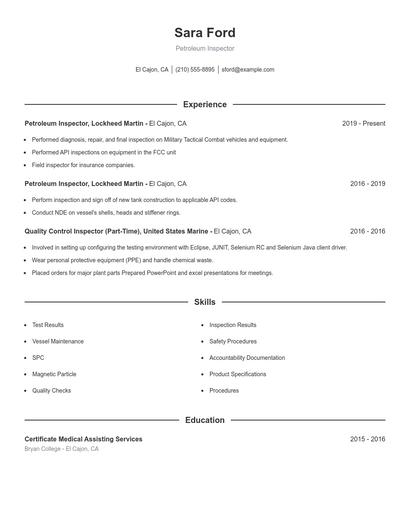
Choose from 10+ customizable petroleum inspector resume templates
Build a professional petroleum inspector resume in minutes. Our AI resume writing assistant will guide you through every step of the process, and you can choose from 10+ resume templates to create your petroleum inspector resume.




Compare different petroleum inspectors
Petroleum inspector vs. Catcher
Quality Assurance Auditors are employees who ensure the adherence of other employees to company processes and guidelines. They are expected to be experts on quality assurance processes and procedures. They also have in-depth knowledge of the expected outcomes of such processes to ensure that the company only provides quality products and services. Quality assurance auditors are also familiar with regulatory laws and policies of governing bodies that oversee companies in their particular industry. They ensure that their companies are compliant and may conduct random quality checks every now and then.
There are some key differences in the responsibilities of each position. For example, petroleum inspector responsibilities require skills like "regular communication," "api," "ladders," and "excellent interpersonal." Meanwhile a typical catcher has skills in areas such as "quality checks," "assembly line," "tape measure," and "safety committee." This difference in skills reveals the differences in what each career does.
Catchers tend to make the most money working in the automotive industry, where they earn an average salary of $34,416. In contrast, petroleum inspectors make the biggest average salary, $62,781, in the technology industry.catchers tend to reach similar levels of education than petroleum inspectors. In fact, catchers are 0.9% less likely to graduate with a Master's Degree and 0.2% more likely to have a Doctoral Degree.Petroleum inspector vs. Quality assurance inspector
An inspector general is responsible for doing audit reports and inspections to ensure that no possible fraud, misconduct, corruption, or power abuse in the government or private sector occurs. Their role is to monitor and inspect the agencies' effectiveness, assess possible mismanagement of a company, and improve the economy. Also, they usually conduct and review audit reports or investigations to ensure an agency's compliance to the policies and guidelines.
In addition to the difference in salary, there are some other key differences worth noting. For example, petroleum inspector responsibilities are more likely to require skills like "regular communication," "ladders," "excellent interpersonal," and "client procedures." Meanwhile, a quality assurance inspector has duties that require skills in areas such as "calipers," "micrometers," "corrective action," and "safety standards." These differences highlight just how different the day-to-day in each role looks.
Quality assurance inspectors may earn a lower salary than petroleum inspectors, but quality assurance inspectors earn the most pay in the government industry with an average salary of $48,138. On the other hand, petroleum inspectors receive higher pay in the technology industry, where they earn an average salary of $62,781.quality assurance inspectors earn similar levels of education than petroleum inspectors in general. They're 2.2% more likely to graduate with a Master's Degree and 0.2% more likely to earn a Doctoral Degree.Petroleum inspector vs. Inspector general
The job of a test operator is to test the functionality of electronic components, assemblies, units, parts, and systems in a manner consistent with standard procedures. As a test operator, you will perform a variety of duties that include working with engineers to ensure accurate procedures are being followed, perform different mechanical assembly operations, and inspecting products for the correct orientation and placement. Additionally, you will assemble electronics in their boxes and notify the quality/test engineer if the test yields below the acceptable levels.
There are many key differences between these two careers, including some of the skills required to perform responsibilities within each role. For example, a petroleum inspector is likely to be skilled in "regular communication," "api," "ladders," and "excellent interpersonal," while a typical inspector general is skilled in "ig," "oig," "dod," and "corrective action."
Inspectors general earn the highest salary when working in the government industry, where they receive an average salary of $59,592. Comparatively, petroleum inspectors have the highest earning potential in the technology industry, with an average salary of $62,781.Most inspectors general achieve a higher degree level compared to petroleum inspectors. For example, they're 14.6% more likely to graduate with a Master's Degree, and 3.5% more likely to earn a Doctoral Degree.Petroleum inspector vs. Test operator
Even though a few skill sets overlap between petroleum inspectors and test operators, there are some differences that are important to note. For one, a petroleum inspector might have more use for skills like "regular communication," "api," "ladders," and "excellent interpersonal." Meanwhile, some responsibilities of test operators require skills like "test equipment," "hand tools," "test procedures," and "test results. "
The technology industry tends to pay the highest salaries for test operators, with average annual pay of $44,634. Comparatively, the highest petroleum inspector annual salary comes from the technology industry.The average resume of test operators showed that they earn similar levels of education compared to petroleum inspectors. So much so that theyacirc;euro;trade;re 0.4% more likely to earn a Master's Degree and less likely to earn a Doctoral Degree by 0.0%.Types of petroleum inspector
Updated January 8, 2025
