What does a pit operator do?
Pit operator responsibilities
Here are examples of responsibilities from real pit operator resumes:
- Perform specialized production line and quality control duties in a professional production environment specializing in plastic extrusion.
- Perform specialized production line and quality control duties in a professional production environment specializing in plastic extrusion.
Pit operator skills and personality traits
We calculated that 17% of Pit Operators are proficient in Pallets, Safety Policies, and RF Scanner. They’re also known for soft skills such as Alertness, Communication skills, and Coordination.
We break down the percentage of Pit Operators that have these skills listed on their resume here:
- Pallets, 17%
Perform all tasks timely, deliver and stage pallets in designated location in Order Assembly awaiting shipment to customers.
- Safety Policies, 13%
Performed compliance audits to ensure associates complete procedures according to established quality guidelines and safety policies, coaching associates when needed.
- RF Scanner, 12%
Unload inbound shipments safely and move product to storage locations using RF scanner.
- Load Trucks, 10%
Drive forklift to load trucks, receive items from racking, and unload bales.
- Safety Committee, 8%
Participated on the safety committee for the 2nd shift loaders.
- Powered Industrial Trucks, 6%
Operated PIT's (Powered Industrial Trucks) to safely retrieve customer orders from item locations.
Common skills that a pit operator uses to do their job include "pallets," "safety policies," and "rf scanner." You can find details on the most important pit operator responsibilities below.
Communication skills. Another soft skill that's essential for fulfilling pit operator duties is communication skills. The role rewards competence in this skill because "material moving machine operators signal and direct workers to load and unload material." According to a pit operator resume, here's how pit operators can utilize communication skills in their job responsibilities: "help with machine operation and forklift driving accomplishments trained new employees skills used good communication skills"
Coordination. This is an important skill for pit operators to perform their duties. For an example of how pit operator responsibilities depend on this skill, consider that "material moving machine operators must have steady hands and feet to guide and control heavy machinery precisely." This excerpt from a resume also shows how vital it is to everyday roles and responsibilities of a pit operator: "warehouse coordination inventory controls feed assembly line".
Mechanical skills. pit operator responsibilities often require "mechanical skills." The duties that rely on this skill are shown by the fact that "material moving machine operators make minor adjustments to their machines and perform basic maintenance on them." This resume example shows what pit operators do with mechanical skills on a typical day: "scored highest record for facility skills used time management, quality check, mechanical knowledge"
Visual ability. Another crucial skill for a pit operator to carry out their responsibilities is "visual ability." A big part of what pit operators relies on this skill, since "material moving machine operators must be able to see clearly where they are driving or what they are moving." How this skill relates to pit operator duties can be seen in an example from a pit operator resume snippet: "helped bring some ideas learned at gm to costco, including visual management and some of gm safety standards/procedures. "
The three companies that hire the most pit operators are:
- Cargill13 pit operators jobs
- Geodis Wilson USA Inc4 pit operators jobs
- OHL USA3 pit operators jobs
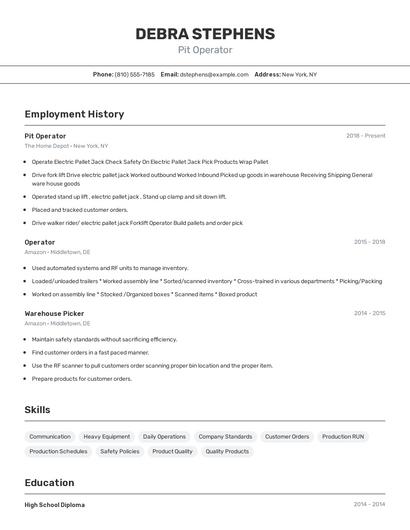
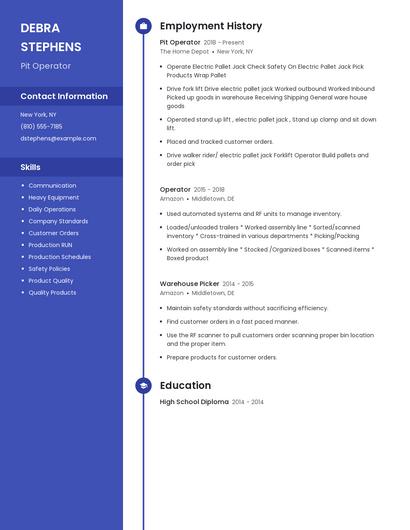
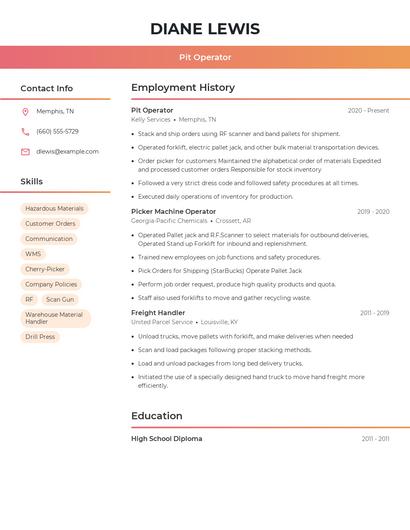
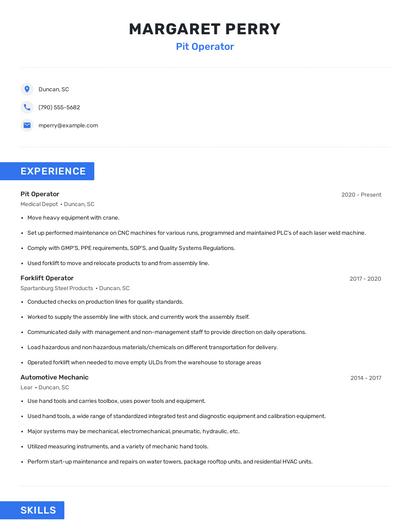
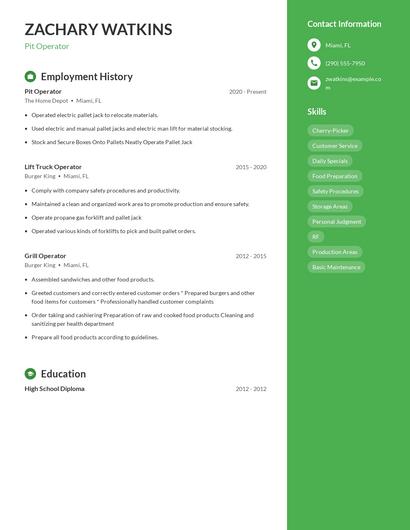
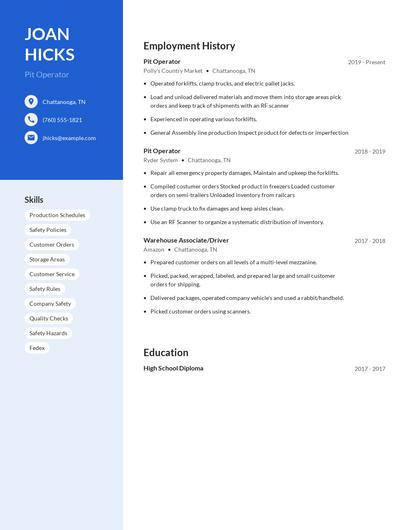
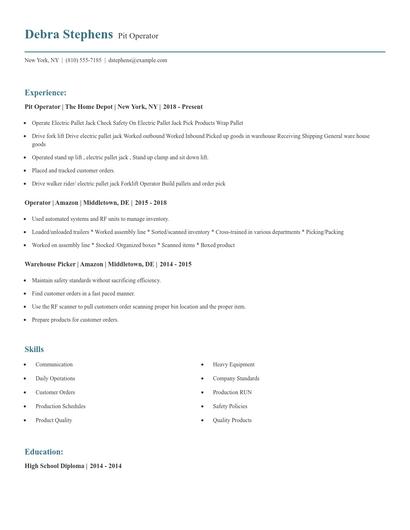
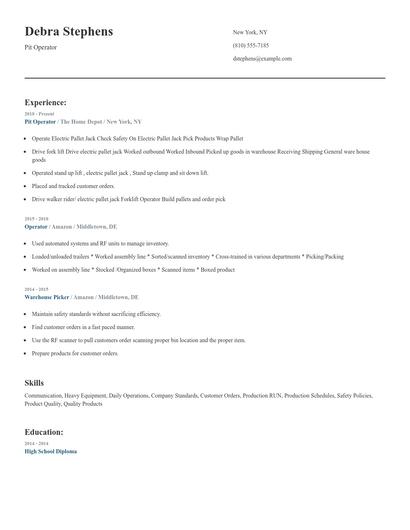
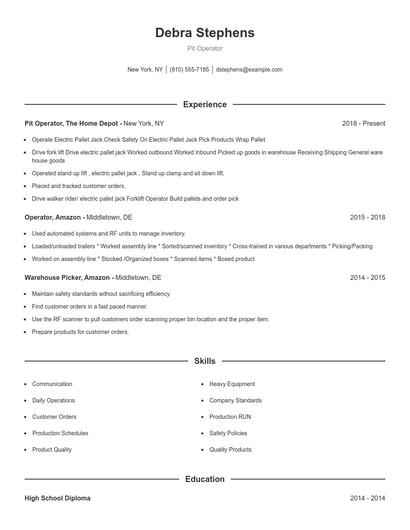
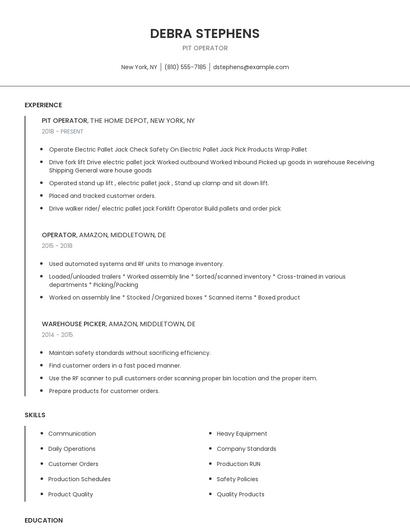
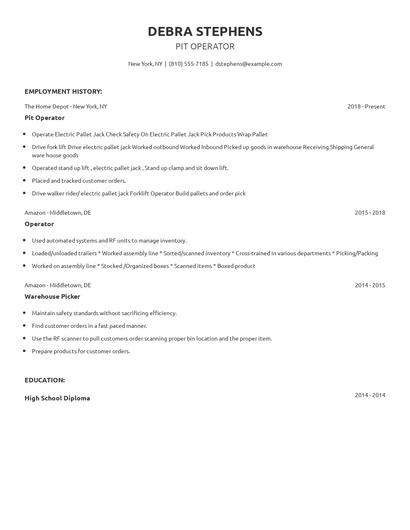
Choose from 10+ customizable pit operator resume templates
Build a professional pit operator resume in minutes. Our AI resume writing assistant will guide you through every step of the process, and you can choose from 10+ resume templates to create your pit operator resume.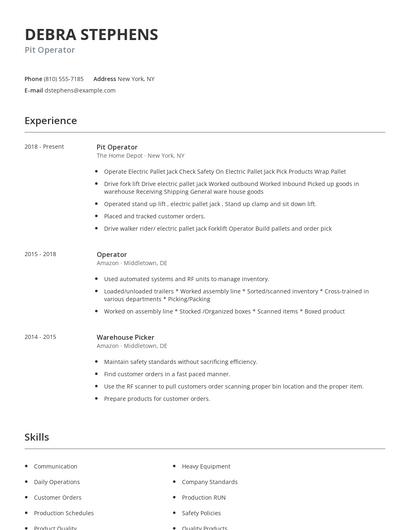
Compare different pit operators
Pit operator vs. Forklift
The primary job of a forklift operator is to operate and manage forklifts used for moving, locating, relocating, stacking, and counting merchandise in various settings, such as construction sites and warehouses. As a forklift operator, you will unload shipments properly and safely, and stack and store them in their designated areas. In addition, you will need to report any quality variances and assist in physical inventories. Other duties that you may perform include ensuring that stock rotation is done properly, inspecting and performing preventative maintenance of forklift and other equipment, and ensuring that inventory security and control are maintained.
These skill sets are where the common ground ends though. The responsibilities of a pit operator are more likely to require skills like "safety policies," "gmp," "safety committee," and "powered industrial trucks." On the other hand, a job as a forklift requires skills like "basic math," "shipping receiving," "math," and "warehouse environment." As you can see, what employees do in each career varies considerably.
Forklifts tend to make the most money working in the transportation industry, where they earn an average salary of $34,824. In contrast, pit operators make the biggest average salary, $38,919, in the finance industry.The education levels that forklifts earn slightly differ from pit operators. In particular, forklifts are 0.5% less likely to graduate with a Master's Degree than a pit operator. Additionally, they're 0.1% more likely to earn a Doctoral Degree.Pit operator vs. Machine operator/forklift operator
A machine operator/forklift operator is responsible for operating industrial trucks to move merchandise around the warehouse facilities and other assigned areas. Machine operators/forklift operators also assist with inventory tasks by scanning orders and ensuring the correct merchandise for shipment. They manage the stability of the vehicles, ensuring its efficiency and optimization during operations, performing engine repairs for any inconsistencies to avoid delays on deliveries. A machine operator/forklift operator should strictly follow the safety protocols of the business, as well as have knowledge of the mechanical industry.
While some skills are similar in these professions, other skills aren't so similar. For example, resumes show us that pit operator responsibilities requires skills like "pallets," "safety policies," "rf scanner," and "gmp." But a machine operator/forklift operator might use other skills in their typical duties, such as, "safety standards," "drive forklift," "machine operation," and "cnc."
Machine operator/forklift operators may earn a lower salary than pit operators, but machine operator/forklift operators earn the most pay in the automotive industry with an average salary of $36,711. On the other hand, pit operators receive higher pay in the finance industry, where they earn an average salary of $38,919.Average education levels between the two professions vary. Machine operator/forklift operators tend to reach similar levels of education than pit operators. In fact, they're 0.6% less likely to graduate with a Master's Degree and 0.1% less likely to earn a Doctoral Degree.Pit operator vs. Material handler/forklift operator
A material handler and forklift operator is responsible for transporting and storing various kinds of goods, even including fragile or hazardous shipments. The duties and location will vary depending on the line of work or industry involved. However, most of the tasks will require efficiency in operating machinery, communication skills, and great attention to detail. Furthermore, a material handler and forklift operator must monitor products and keep an accurate record of overall activities, transport materials within allotted time and schedule, and maintain communication and coordination with co-workers and supervisors.
The required skills of the two careers differ considerably. For example, pit operators are more likely to have skills like "safety policies," "gmp," "safety committee," and "haccp." But a material handler/forklift operator is more likely to have skills like "safety procedures," "electric pallet jack," "forklift operation," and "production lines."
Material handler/forklift operators make a very good living in the automotive industry with an average annual salary of $37,909. On the other hand, pit operators are paid the highest salary in the finance industry, with average annual pay of $38,919.When it comes to education, material handler/forklift operators tend to earn similar degree levels compared to pit operators. In fact, they're 0.6% less likely to earn a Master's Degree, and 0.5% less likely to graduate with a Doctoral Degree.Pit operator vs. Mechanical spreader operator
A mechanical spreader operators manage and operate all equipment in various industries where they perform their jobs. The operators work as general mechanics in building HVAC, general building maintenance, and pump station operations. They test electro-mechanical subsystems for operational reliability and circuit integrity. Their job includes promoting quality assurance and performance improvement programs within the organization. Also, they perform an energy audit to improve the efficiency of HVAC energy.
Types of pit operator
Updated January 8, 2025
