What does a pizza maker do?

As the name entails, pizza makers are the individuals who prepare pizza at restaurants and stores that include pizza in their menus. Besides preparing pizza, they also help with other kitchen operations such as packaging food items, cooking different menus, and maintaining the kitchen and kitchen equipment. Pizza makers are also responsible for training other staff members on how to prepare pizza. There are several requirements needed to become a pizza maker: basic cooking knowledge, having a relevant food certification or license, and the ability to operate kitchen equipment.
Pizza maker responsibilities
Here are examples of responsibilities from real pizza maker resumes:
- Manage closing duties, including restocking items and reconciliation of the cash drawer and POS system.
- Manage cleanliness and readiness of cooking equipment.
- Operate and clean stoves, grills, fryers, and microwaves.
- Deliver pizza; utilize GPS mapping system
- Handle cash transactions using math and utilize basic problem-solving skills.
- Apply quick and accurate math computations when handling monetary transactions.
- Utilize GPS or maps to deliver food to the correct address.
- Handle cash, do inventory and ordering, prep kitchen, run register and make schedules.
- Help make pizza, prep items, run front register, answer phones, take orders, cash handling.
- Maintain cleanliness and sanitation of the restaurant including all tables, floors, windows, beverage station, restrooms, etc.
- Prepare menu items and maintain restaurant cleanliness
- Prepare pizzas stock supplies wash dishes occasionally
- Deliver smoothies with proper ingredient measurements and an enthusiastic attitude throughout entire process consistently.
- Leverage teamwork to fully utilize kitchen staff to generate remarkable food and service to ensure customer satisfaction.
- Slice and pit fruit for garnishing drinks.
Pizza maker skills and personality traits
We calculated that 24% of Pizza Makers are proficient in Kitchen Equipment, Customer Service, and Customer Orders. They’re also known for soft skills such as Comprehension, Sense of taste and smell, and Dexterity.
We break down the percentage of Pizza Makers that have these skills listed on their resume here:
- Kitchen Equipment, 24%
Assist with operating all kitchen equipment, maintaining the kitchen, cooking other restaurant menu items and packaging food items.
- Customer Service, 16%
Maintained exceptional customer service, handled cash through register operation, and worked independently when opening store.
- Customer Orders, 8%
Received customer orders, accepted payments and ensured products were adequate stocked/prepared.
- Safety Standards, 8%
Maintained cleanliness of store and restrooms according to health and safety standards.
- Food Products, 6%
Ensured that all food products on line was rotated, dated, and placed in storing containers after every shift.
- Food Preparation, 5%
Maintained organized and sanitary food preparation area to meet all food safety requirements.
Most pizza makers use their skills in "kitchen equipment," "customer service," and "customer orders" to do their jobs. You can find more detail on essential pizza maker responsibilities here:
Sense of taste and smell. Another soft skill that's essential for fulfilling pizza maker duties is sense of taste and smell. The role rewards competence in this skill because "cooks must have a keen sense of taste and smell to prepare meals that customers enjoy." According to a pizza maker resume, here's how pizza makers can utilize sense of taste and smell in their job responsibilities: "take food and drink orders over the phone and receive payment from customers using a cash register. "
Dexterity. pizza makers are also known for dexterity, which are critical to their duties. You can see how this skill relates to pizza maker responsibilities, because "cooks should have excellent hand–eye coordination." A pizza maker resume example shows how dexterity is used in the workplace: "lifted stock items, clean up duties, light phone calls, and provided excellent customer service to all clients. "
The three companies that hire the most pizza makers are:
- Domino's Pizza400 pizza makers jobs
- AmRest LLC
85 pizza makers jobs
- Bertucci's50 pizza makers jobs
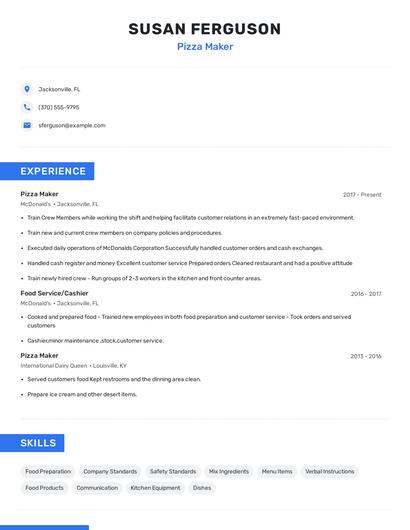
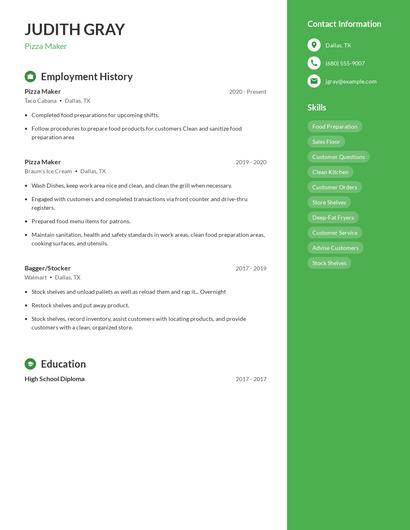
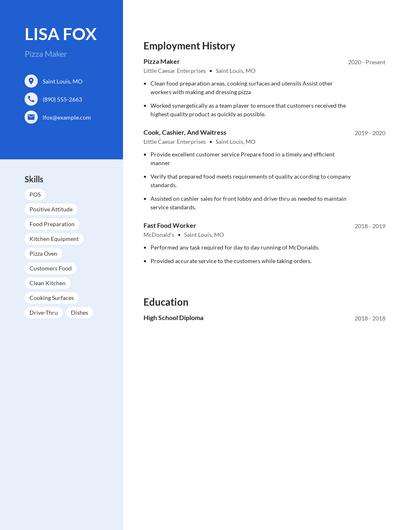
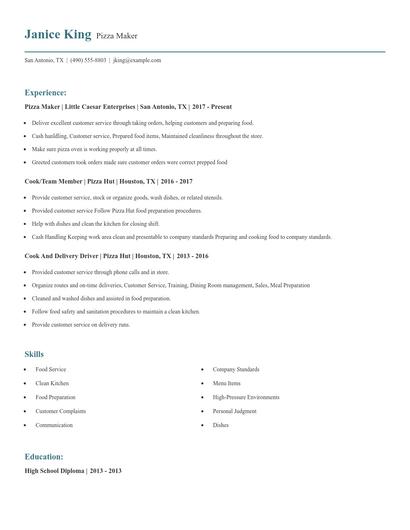
Choose from 10+ customizable pizza maker resume templates
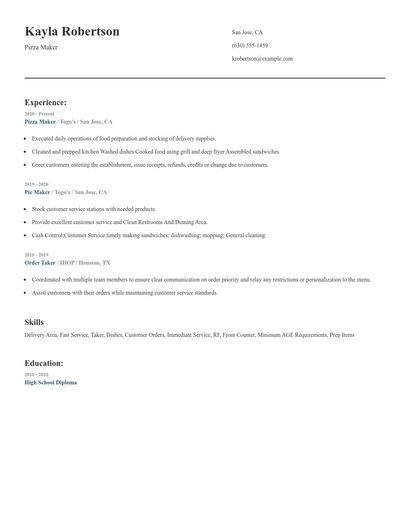
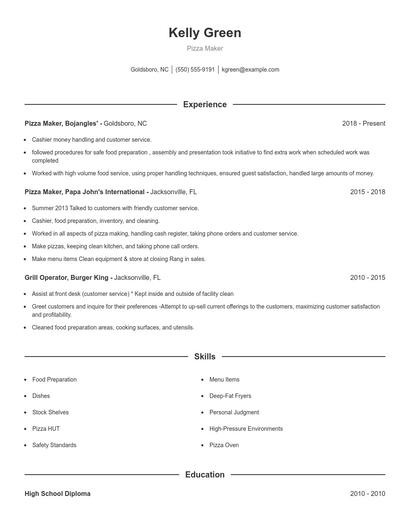
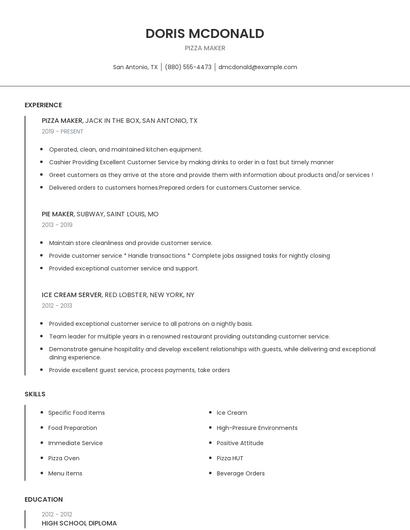
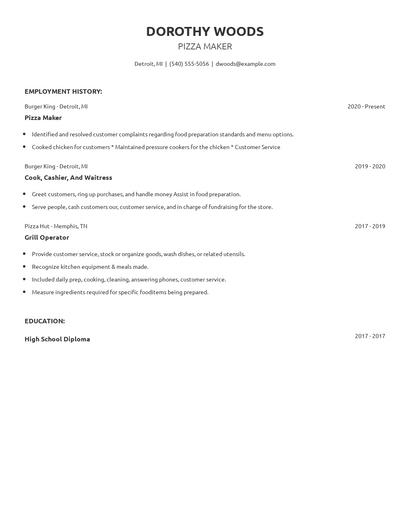
Build a professional pizza maker resume in minutes. Our AI resume writing assistant will guide you through every step of the process, and you can choose from 10+ resume templates to create your pizza maker resume.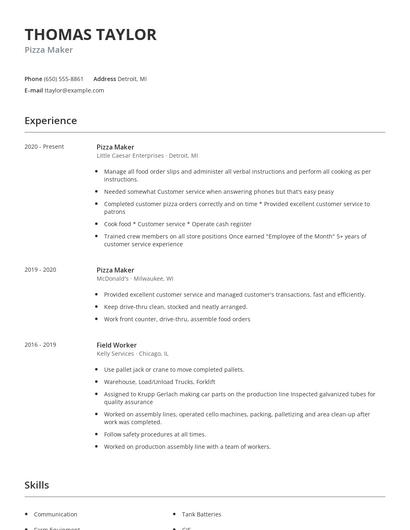
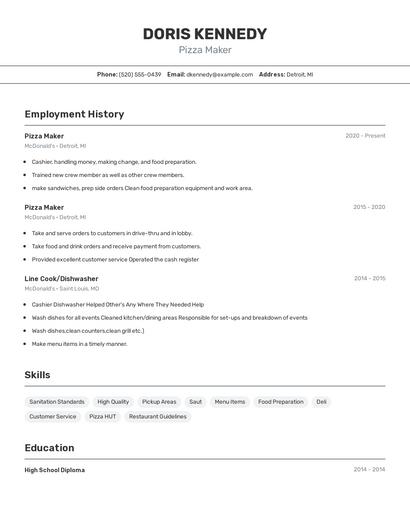
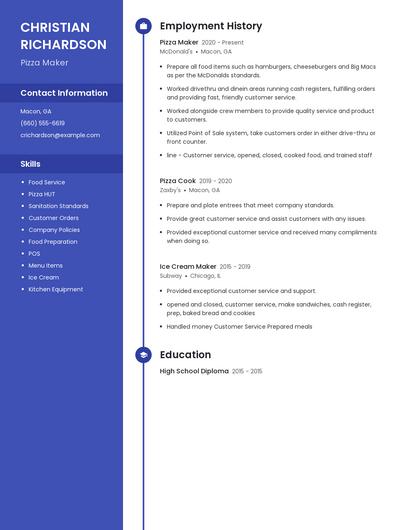
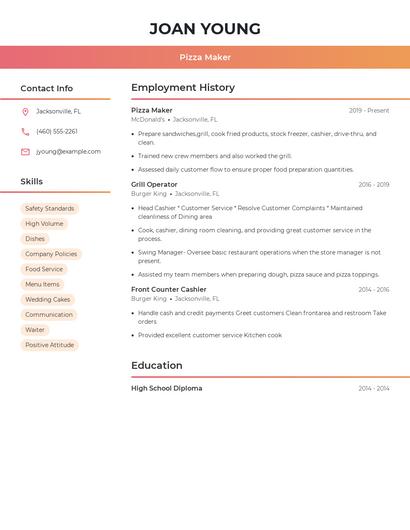
Compare different pizza makers
Pizza maker vs. Cook
Cooks are responsible for preparing meals for guests or employers. They must be knowledgeable about the different recipes and ingredients needed. They are also responsible for managing the inventory and ensuring that the pantry is well-stocked. They prepare meals from scratch, cutting ingredients, measuring them, and following recipes. Cooks should be creative, especially when ingredients are lacking, and they must find alternatives that will not compromise the food taste. They should be precise, imaginative, and patient. Cooks should also have good time management skills and decision-making skills.
These skill sets are where the common ground ends though. The responsibilities of a pizza maker are more likely to require skills like "delivery orders," "food safety," "pos," and "phone orders." On the other hand, a job as a cook requires skills like "food handling," "food service," "cleanliness," and "basic math." As you can see, what employees do in each career varies considerably.
Cooks earn the highest salaries when working in the government industry, with an average yearly salary of $34,114. On the other hand, pizza makers are paid more in the technology industry with an average salary of $29,588.The education levels that cooks earn slightly differ from pizza makers. In particular, cooks are 0.4% more likely to graduate with a Master's Degree than a pizza maker. Additionally, they're 0.1% more likely to earn a Doctoral Degree.Pizza maker vs. Fry cook
Generally, a fry cook works in a kitchen specializing in fried foods and operating the deep fryer. Fry cooks or chefs cook food by submerging in boiling oil. They prepare food to be fried, work with frying pans, and watch over deep fryers. The skills they need to establish include food preparation, dexterity, physical stamina, and comprehension. They are also expected to be understanding and patient, noting that these qualities help impress the customers.
Each career also uses different skills, according to real pizza maker resumes. While pizza maker responsibilities can utilize skills like "delivery orders," "food safety," "pos," and "phone orders," fry cooks use skills like "deep-fat fryers," "fine dining," "quality standards," and "food quality."
Fry cooks may earn a higher salary than pizza makers, but fry cooks earn the most pay in the hospitality industry with an average salary of $25,919. On the other hand, pizza makers receive higher pay in the technology industry, where they earn an average salary of $29,588.Average education levels between the two professions vary. Fry cooks tend to reach similar levels of education than pizza makers. In fact, they're 0.0% less likely to graduate with a Master's Degree and 0.1% more likely to earn a Doctoral Degree.Pizza maker vs. Kitchen cook
A kitchen cook prepares food for customers. Kitchen cooks help devise new menu items and methods of cooking. Their duties are to prepare food before the arrival of guests, manage employees in the kitchen, and season food according to recipe needs. They assist other cooks during the food assembly process, estimate food consumption, and organize preparation. They keep records and accounts of food purchases, prepare any necessary sauce before the meal service begins, and so on. As kitchen cooks, they must excel in organizational skills, verbal communication, culinary arts, and kitchen equipment. They should be equipped with knowledge of international cuisines, butchering, and basic computational skills.
There are many key differences between these two careers, including some of the skills required to perform responsibilities within each role. For example, a pizza maker is likely to be skilled in "delivery orders," "food safety," "pos," and "phone orders," while a typical kitchen cook is skilled in "dishes," "food handling," "cleanliness," and "math."
Kitchen cooks make a very good living in the retail industry with an average annual salary of $32,362. On the other hand, pizza makers are paid the highest salary in the technology industry, with average annual pay of $29,588.kitchen cooks typically earn similar educational levels compared to pizza makers. Specifically, they're 1.1% more likely to graduate with a Master's Degree, and 0.0% more likely to earn a Doctoral Degree.Pizza maker vs. Cook/server
Cooks/servers are employees who take on the dual role of being a cook and a server in the restaurant. They are usually trained cooks who are in charge of preparing meals for the guests. They prepare ingredients, cook them according to the recipe, and serve them to guests. They are responsible for ensuring that the food is prepared and served to guests within the promised time. They are in charge of managing the pantry, ensuring that the stock is fresh, and checking whether the stock is low. They are expected to have culinary skills, precision, and time management skills.
Types of pizza maker
Updated January 8, 2025
