
Automatically apply for jobs with Zippia
Upload your resume to get started.
Police communications dispatcher skills for your resume and career
15 police communications dispatcher skills for your resume and career
1. Computer Aided Dispatch
- Documented, translated and entered call content into a proprietary database using computer aided dispatch.
- Received calls and operated a variety of communications equipment, including telephone, two- way radio and Computer Aided Dispatch system.
2. CAD
- Used knowledge and expertise in the CAD environment to provide shadow training for new employees, resulting in reduced training time.
- Document all security and police calls using CAD software.
3. Good Judgment
- Position required constant contact with the public in stressful situations that require good judgment, considerable tact, and calmness
- Worked under pressure, exercised good judgment and made sound and timely decisions in emergency and non-emergency situations.
4. Two-Way Radio
- Operated two-way radio to provide lifeline support for officers in the field.
- Operate two-way radio equipment for direct communication with law enforcement officers, including emergency transmissions; respond with voice clarity.
5. Computer System
- Operated a variety of communications equipment including radio consoles, telephones and computer systems.
- Relayed relevant information obtained from various computer systems.
6. Public Safety Agencies
- Communicated effectively to neighboring local public safety agencies via live broadcast of two-way digital high frequency radio.
- Interacted with callers requesting emergency response or service from public safety agencies.
Choose from 10+ customizable police communications dispatcher resume templates
Build a professional police communications dispatcher resume in minutes. Our AI resume writing assistant will guide you through every step of the process, and you can choose from 10+ resume templates to create your police communications dispatcher resume.7. Emergency Situations
- Maintain a professional demeanor and provide satisfactory customer service in emergency situations while juggling multiple phone lines.
- Determined appropriate course of action under crisis or emergency situations.
8. Criminal Justice
- Certified in operating and monitoring National and State criminal justice systems.
- Maintain Criminal Justice Information System and Emergency Medical Dispatch certification.
9. Non-Emergency Calls
Non-emergency calls are calls that do not require immediate attention or intervention. They are simply a request for police, fire or rescue service that does not present a life or death situation. In this case, the local non-emergency number should be used if immediate dispatch of the police is not required.
- Monitored direct emergency alarms and answered non-emergency calls for assistance.
- Answered emergency and non-emergency calls; dispatched officers.
10. Background Checks
- Enter all police incidents into database and run drivers license, plates, and criminal background checks as needed.
- Conducted background checks on the California Law Enforcement Telecommunications System.
11. Inputs
- Input data into an automated personnel database and record keeping system.
12. EMS
Emergency Medical Services, also known as EMS, is an emergency medical response system that provides stabilization and urgent preclinical and on-site treatment for serious illness and injury, as well as the transportation of patients who are unable to transport themselves to a definite health care center. The main objective of EMS is to provide emergency medical treatment to those who need urgent medical attention and to properly treat the patient's condition and transport them to a suitable health center or medical facility.
- Dispatch emergency and other call requiring law enforcement and or fire/or EMS response according to priority and availability.
- Operated radio transmitter and receiver to dispatch EMS personnel to life or property-threatening emergency and non-emergency situations.
13. Telephone Calls
Telephone calls are a communication means through which a caller is connected to the called party. The call is done through a telecommunications device called a telephone. The caller can use a landline, mobile phone, or satellite phone to make the call.
- Received telephone calls and obtaining information using structured protocols.
- Prepared and maintained accurate logs of all radio transmissions, telephone calls and other records and files.
14. NCIC
- Provide crucial NCIC computerized data to units in the field.
- Conducted NCIC checks for Patrol Officers.
15. Law Enforcement Agencies
- Coordinate with other law enforcement agencies to facilitate the capture of fleeingsuspects or handle traffic related situations.
- Provided telephone service for the intra-systems calls within the various departments including outside law enforcement agencies.
5 Police Communications Dispatcher resume examples
Build a professional police communications dispatcher resume in minutes. Browse through our resume examples to identify the best way to word your resume. Then choose from 5+ resume templates to create your police communications dispatcher resume.

What skills help Police Communications Dispatchers find jobs?
Tell us what job you are looking for, we’ll show you what skills employers want.
List of police communications dispatcher skills to add to your resume
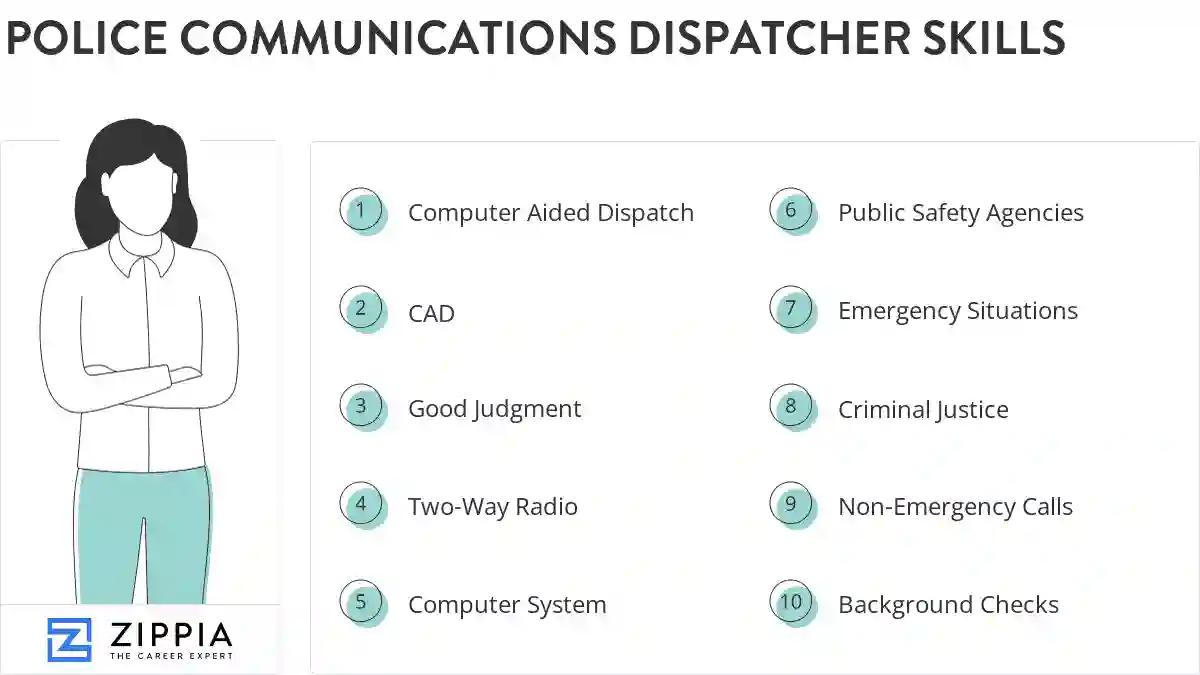
The most important skills for a police communications dispatcher resume and required skills for a police communications dispatcher to have include:
- Computer Aided Dispatch
- CAD
- Good Judgment
- Two-Way Radio
- Computer System
- Public Safety Agencies
- Emergency Situations
- Criminal Justice
- Non-Emergency Calls
- Background Checks
- Inputs
- EMS
- Telephone Calls
- NCIC
- Law Enforcement Agencies
- Patrol
- Radio Systems
- TDD
- Vehicle Registration
- Warrant Checks
- Multi-Channel Radio Console
- Incident Reports
- Radio Communications
- Non-Emergency Police
- CCTV
- Radio Calls
- Relative Priorities
- Criminal History
- Emergency Response
- Officer Safety
- Fire Service
- Data Systems
- Police Assistance
Updated January 8, 2025
