
Automatically apply for jobs with Zippia
Upload your resume to get started.
Principal process engineer skills for your resume and career
15 principal process engineer skills for your resume and career
1. Process Engineering
Process engineering is the agreement and use of the essential standards and laws of nature that permit us to change crude material and energy into items that are valuable to society, at a mechanical level.
- Prepared a process execution plan including organizing, determining priorities, and delegating process engineering tasks on project and proposal.
- Developed interconnecting pipe rack process engineering flow schemes, interface tables, metallurgical design diagrams and utility flow diagrams.
2. Continuous Improvement
Continuous improvement is an ongoing process of improvement of products, services, and processes with the help of innovative ideas. It is an organized approach that helps an organization to find its weaknesses and improve them.
- Conducted daily reviews of manufacturing data.> Improved process through structured Continuous Improvement or capital projects.> Developed and maintained SPC system
- Provide direct engineering support to manufacturing and maintenance for a variety of continuous improvement projects and applications.
3. Engineering Design
Engineering design is defined as the method that engineers use to recognize and solve problems. It is an extensive and flexible approach to problem-solving and provides the necessary information needed regarding every step of the process. An engineering design is a collaborative effort of the team to identify problems underlying a process and find out ways to solve them.
- Conducted conceptual, detailed engineering designs and studies for new facilities, revamps and expansions.
- Lead the process efforts of engineering design for projects, proposals and studies.
4. RF
- Developed CMOS process technology and high voltage device on SOI, demonstrating world leading RF PA performance/ruggedness on CMOS platform.
- Multi-disciplined engineering expertise includes mechanical, RF electrical, materials and process development.
5. Process Control
Process control is a method pertaining to continuous production processes that uses the aid of ICS (Industrial Control Systems) for production. This method enables production to be done with a level of consistency and safety in an economically friendly manner that is impossible to achieve solely through manual control.
- Design and implementation of the new Automated Process Control Systems to meet Manufacturing Department requirements, safety and reliability standards.
- Designed and implemented an Automated Length Change System with integrated statistical process control capability.
6. Process Improvement
- Team leader for root cause analysis investigations, troubleshooting and process improvements.
- Led process improvements for Common and Federated Software Departments.
Choose from 10+ customizable principal process engineer resume templates
Build a professional principal process engineer resume in minutes. Our AI resume writing assistant will guide you through every step of the process, and you can choose from 10+ resume templates to create your principal process engineer resume.7. Principal Process
- Job Title: Principal Process Engineer/Supervisor Role: Directly report to engineering department manager.
- Worked as a Principal Process Engineer at Parsons Energy & Chemical Company in Houston.
8. Technical Support
Technical support or tech support are the services provided by any hardware or software company to users. They help in solving the technical difficulties the customers face with their products or services. Moreover, the tech support employees maintain, manage, and repair the IT faults. They are also responsible for resolving the network problems, installing and configuring hardware and software.
- Created and managed a technical support group of 3 engineers dedicated to clinical manufacturing.
- Provide technical support for the Rochester pharmaceutical manufacturing operation.
9. Sigma
In Greek alphabets, sigma is the 18th letter that means "to sum up". In statistics, the lower case symbol of sigma is the unit of measurement for standard deviation which is used to assess the variability in a given set of data. While the upper case symbol is for summation notation means to add up all the given numbers in the data set.
- Led numerous Six Sigma projects resulting in improved process capability and $3M cost savings.
- Utilized Six Sigma, Lean, and Apollo Root Cause analysis tools.
10. Data Analysis
- Performed data analysis to identify and improve key sources of process variation.
- Achieved greater than 50% alignment time reduction by integrating data analysis and parametric correlation for process optimization and product upgrades.
11. Process Equipment
Process equipment refers to the machinery used in processing and refining industries. This equipment is responsible for a single job in the refinement process, which can vary from maintaining the flow of a chemical, controlling chemical reactions, or even storing chemicals. Process equipment can also be broken down into two categories, which are fixed and rotating equipment, depending on the movement required from the equipment.
- Interfaced with Work Control and Operations to complete improvements and maintenance on process equipment.
- Generated a process equipment list needed for the project.
12. Lean Manufacturing
- process to further implement lean manufacturing techniques in preparation for a DOD contract which ultimately didn't materialize.
- Participated in MRB decisions, lean manufacturing improvements (5-S), and CCB to evaluate ECOs.
13. Process Design
Process design is the act of creating a result-driven process that will lead to the achievement of an organization's goals, visions, and objectives. At its core, process design is the defines the processes and strategies that an organization can implement into achieving its lofty aims and objectives. It's usually presented in form of an infographic labeling each stage and with arrows showing the hierarchy of the steps.
- Performed process design calculations, developed engineering requisitions, evaluated proposals.
- Coordinated the development and modification of Process Design Manual.
14. SPC
SPC stands for "statistical process control," a method that uses statistical tools and charts to analyze a process or procedure over time. This could reveal an error in production or an internal system by highlighting data points outside the expected results. These anomalies, likely caused by outside sources, can then be studied and remedied.
- Implemented and maintained SPC charts and analyzed data using JMP, Klarity-ACE and YMS.
- Conduct internal audits to achieve zero non-compliance Developed quality metrics for defect SPC and designed automated reports to summarize SPC trends.
15. JMP
- Mask optimization and layout utilizing L-Edit software Statistical analysis utilizing JMP software.
- Assisted other manufacturing process engineers with data manipulation and SPC development using SAS JMP statistical software.
5 Principal Process Engineer resume examples
Build a professional principal process engineer resume in minutes. Browse through our resume examples to identify the best way to word your resume. Then choose from 5+ resume templates to create your principal process engineer resume.

What skills help Principal Process Engineers find jobs?
Tell us what job you are looking for, we’ll show you what skills employers want.
What skills stand out on principal process engineer resumes?
Dr. Maria Benavides Ph.D.
Associate Professor, Chemistry Program Coordinator, Assistant Chair, University of Houston - Downtown
What principal process engineer skills would you recommend for someone trying to advance their career?
Dr. Galen Duree
Head of the Department of Physics and Optical Engineering and Professor, Rose-Hulman Institute of Technology
General reading about technologies or reading available articles about subjects the graduate is interested in will help generate questions they can ask potential graduate schools. This time would also be a chance to improve areas where the graduate may feel weak while an undergraduate. Many online resources can help them brush up on week background topics. Do not worry about transfer credits because that is usually not helpful in graduate school, but improve knowledge and experience in areas where the graduate feels weak. If the graduate has identified a graduate school and program to study in, the graduate school might have some recommendations about what to review. All of this will help improve success in graduate school.
If the next step is a job with a company or lab, taking courses to improve communication will help. Many technically competent or even technically brilliant people struggle with effective communication. Techniques about writing reports, making oral presentations, or communicating technical information will help improve success. The gap year also provides time to investigate technologies that the graduate wants to be involved in and the companies or labs in those areas.
Once the graduate has identified areas of interest and companies or labs that the graduate might want to work for, they can be contacted to either answer questions or point the graduate in a direction for further investigation.
In either case, a gap year can provide a chance to refine the graduate's choice for the next steps and help them prepare other skills overlooked during the undergraduate years.
What type of skills will young principal process engineers need?
John Ring
Director Engineering Outreach, Elon University
What soft skills should all principal process engineers possess?
William Cross Ph.D.
Professor, South Dakota School of Mines and Technology
What hard/technical skills are most important for principal process engineers?
Dr. Heidrun Schmitzer
Professor and Chair, Xavier University
List of principal process engineer skills to add to your resume
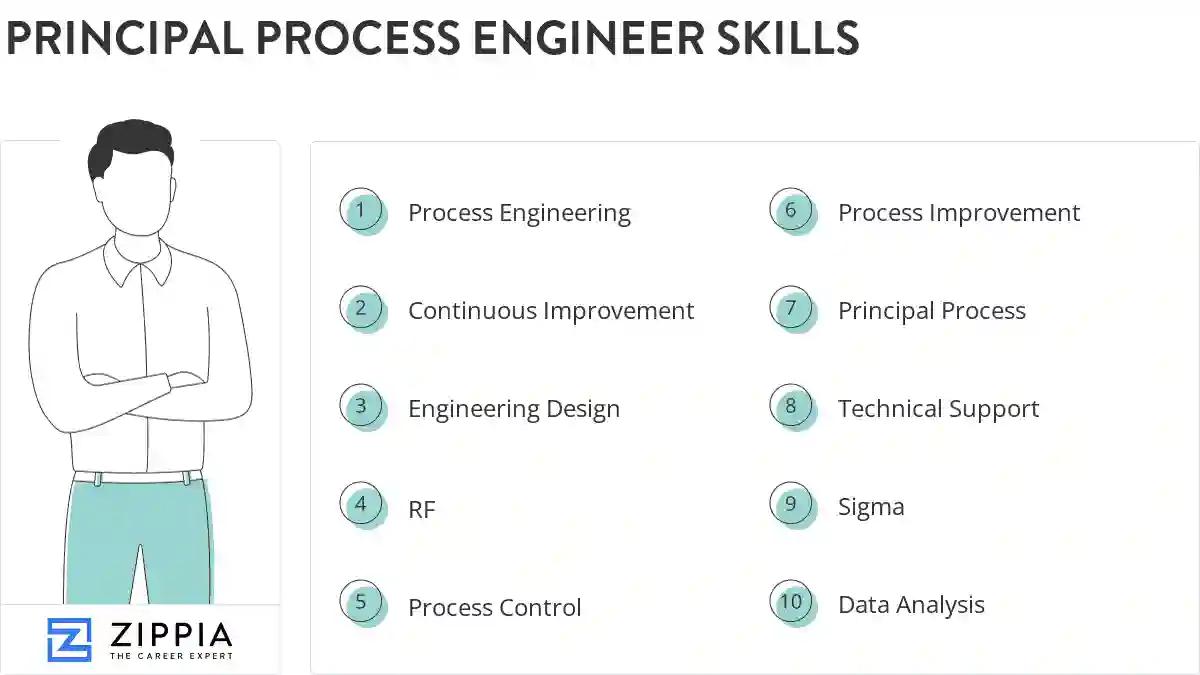
The most important skills for a principal process engineer resume and required skills for a principal process engineer to have include:
- Process Engineering
- Continuous Improvement
- Engineering Design
- RF
- Process Control
- Process Improvement
- Principal Process
- Technical Support
- Sigma
- Data Analysis
- Process Equipment
- Lean Manufacturing
- Process Design
- SPC
- JMP
- Failure Analysis
- GRASS
- Process Flow
- Process Simulation
- Lean Six Sigma
- Prototyping
- IDS
- Refinery
- API
- P Id
- Engineering Support
- CMOS
- EPC
- Extraction
- DOE
- FDA
- R
- FMEA
- HYSYS
- PFD
- HAZOP
- Manufacturing Support
- Cost Reduction
- Aspen Plus
- Debugging
- LNG
- Equipment Specifications
- Design Basis
- Material Balances
- Etching
Updated January 8, 2025
