
Automatically apply for jobs with Zippia
Upload your resume to get started.
Problem manager skills for your resume and career
15 problem manager skills for your resume and career
1. Infrastructure
Infrastructure includes the organizational and physical structures needed to run an area or a society smoothly. It is a group of basic facilities required for any society or firm to run sustainably and efficiently. The infrastructural system is a high investing area and helps majorly in flourishing the economy and prosperity of a country. It is an underlying system needed for ensuring the safety and comfort of the public and to run a country smoothly. All the tasks needed to be performed for a flourishing economy and a happy and healthy public are included in infrastructure.
- Coordinated and implemented Problem Management processes and quality following the Information Technology Infrastructure Library (ITIL) guidelines.
- Facilitated meetings with application and infrastructure support and service teams to find solutions for recurring incidents.
2. RCA
- Standardized categorization of incidents between RCA process and MI process for cleaner analysis.
- Created and authored over 130 Root Cause Analysis (RCA) reports to CGI Business Unit Partners and Senior GIS Management.
3. Identify Trends
Identify Trends refers to the act of analyzing recent history and determining how the history connects. This is commonly seen in social media, where trends may be different challenges completed to raise awareness for an organization or disease, or it may be a purchasing trend to determine what product will most likely sell next.
- Track Open and Aged Incidents daily and identify trends.
4. Trend Analysis
Trend Analysis is the process of studying large chunks of data to predict a future outcome. Experts use trend analysis to identify if performing any task can be hazardous in the health and safety industry. The process could also determine the benefits and downsides of action in any work industry. If a process has been fruitful in the past, the company can follow it to increase success chances.
- Performed trend analysis for proactive Problem Management.
- Delivered trend analysis, passive and proactive management of technical problems, and coordinating technical resources to resolve problems.
5. Proactive Problem
- Managed Proactive Problem Management for trending and analysis in order to reduce non actionable incident and event volume in customer environments.
- Conducted proactive problem management through incident trending, problem identification, root cause analysis and solution implementation.
6. Process Improvement
- Guided the implementation of a large scale, enterprise-wide system implementation and business process improvement initiative.
- Have developed and implemented numerous process improvements advancing proactive / reactive Problem Management policies and practices.
7. Customer Satisfaction
- Continued to seek opportunities to increase customer satisfaction and deepen client relationships.
- Perform customer satisfaction analysis, reporting, and actions for improving satisfaction.
8. ITSM
- Developed online ITSM training using the ServiceNow Knowledge Management module.
- Worked with Enterprise ITSM teams on designing and implementing a new enterprise system or record, BMC Remedy.
9. Corrective Action
- Performed Root Cause Analysis and facilitated solutions for Corrective Action.
- Developed effectiveness checks to ensure implemented corrective actions are sustained.
10. Problem Management
- Participated in regular problem management meetings with Application, Business, and Development areas to monitor progress of error resolution tasks.
- Lead problem management discussions; manage process responsibilities through final resolution among internal teams, service providers and third party contractors.
11. Service Improvement
- Designed and implemented service improvement and tracking programs.
- Drive and lead SIP (Service Improvement Plan) process for needed services.
12. KPIs
- Attended senior management meetings to provide program updates and metrics on KPIs.
- Generate monthly KPIs and reports.
13. Level Agreements
- Utilized SNMP to configured monitoring systems to monitor metrics based upon service level agreements.
- Gather, compile and report metric information related to service levels, system performance and contract service level agreements.
14. Remedy
- Gathered and reviewed standard operating procedures, system requirements and interviewed the new Remedy Users.
- Ensured Remedy Alert Notification and escalations are handled and routed immediately.
15. Critical Incidents
- Led critical incident conference calls to ensure all teams responsible for resolution of system issues were working together efficiently and effectively.
- Created and presented executive summaries and updates for major problems which arose from critical incidents.

What skills help Problem Managers find jobs?
Tell us what job you are looking for, we’ll show you what skills employers want.
What skills stand out on problem manager resumes?
Ehsan Sheybani Ph.D.
Professor, University of South Florida
List of problem manager skills to add to your resume
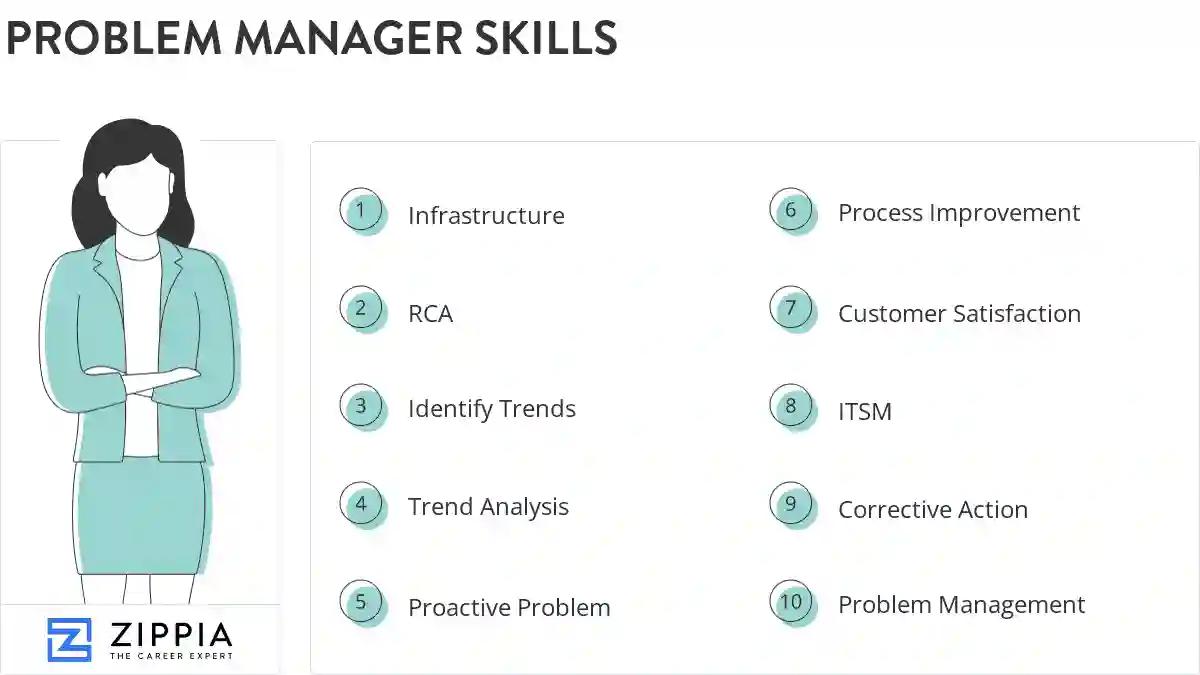
The most important skills for a problem manager resume and required skills for a problem manager to have include:
- Infrastructure
- RCA
- Identify Trends
- Trend Analysis
- Proactive Problem
- Process Improvement
- Customer Satisfaction
- ITSM
- Corrective Action
- Problem Management
- Service Improvement
- KPIs
- Level Agreements
- Remedy
- Critical Incidents
- Problem Resolution
- Known Errors
- SLA
- Incident Management
- Configuration Management
- Technical Issues
- Production Environment
- Technical Support
- Incident Resolution
- Problem Tickets
- Subject Matter Experts
- ITIL
- Management Activities
- SharePoint
- Executive Management
- Sigma
- Knowledge Database
- MTTR
- Incident Reports
- Level Support
- SME
- Service Level Management
- Cab
- End User Experience
- Virtualization
- Advisory Boards
- Service Availability
- CMDB
- Windows
- Mainframe
Updated January 8, 2025
