What does a process engineer, applications engineer do?
Process engineer, applications engineer responsibilities
Here are examples of responsibilities from real process engineer, applications engineer resumes:
- Lead and assist maintenance in resolving equipment malfunctions, troubleshoot process problems, and organize and implement preventative maintenance procedures.
- Develop a method to get AutoCad isometric drawings relevant to relief valve transferred electronically to the relief valve sizing package.
- Systemize the Deviation/CAPA and train on investigations utilizing DMAIC.
Process engineer, applications engineer skills and personality traits
We calculated that 14% of Process Engineer, Applications Engineers are proficient in R, Process Engineering, and Lean Manufacturing. They’re also known for soft skills such as Creativity, Listening skills, and Math skills.
We break down the percentage of Process Engineer, Applications Engineers that have these skills listed on their resume here:
- R, 14%
Generated and maintained X-bar R and CPK charts for all critical operations
- Process Engineering, 11%
Maintained selected database contents for Process Engineering and Manufacturing data support.
- Lean Manufacturing, 11%
Lean Manufacturing: Saved 3 people by implementing lean and cellular cell configuration of crank line.
- CAD, 8%
Reviewed CAD drawings of new products for design for manufacturing issues.
- Minitab, 8%
Produced control charts for statistical purposes using MiniTab.
- ISO, 8%
Measure and control quality in production process by establishing, implementing and maintaining quality management system.ISO 9001:2015 internal Auditor
Common skills that a process engineer, applications engineer uses to do their job include "r," "process engineering," and "lean manufacturing." You can find details on the most important process engineer, applications engineer responsibilities below.
Creativity. One of the key soft skills for a process engineer, applications engineer to have is creativity. You can see how this relates to what process engineer, applications engineers do because "industrial engineers use creativity and ingenuity to design new production processes in many kinds of settings in order to reduce the use of material resources, time, or labor while accomplishing the same goal." Additionally, a process engineer, applications engineer resume shows how process engineer, applications engineers use creativity: "delivered shipping cost reductions, inventory space & management, and storage capacity increase. "
Listening skills. Another soft skill that's essential for fulfilling process engineer, applications engineer duties is listening skills. The role rewards competence in this skill because "these engineers often operate in teams, but they also must solicit feedback from customers, vendors, and production staff." According to a process engineer, applications engineer resume, here's how process engineer, applications engineers can utilize listening skills in their job responsibilities: "communicated with field operators and technicians to as-built existing facilities, validate plc behavior, support sops, and conduct phas. "
Math skills. Another skill that relates to the job responsibilities of process engineer, applications engineers is math skills. This skill is critical to many everyday process engineer, applications engineer duties, as "industrial engineers use the principles of calculus, trigonometry, and other advanced topics in mathematics for analysis, design, and troubleshooting in their work." This example from a resume shows how this skill is used: "master basic and advanced lean, six sigma and/or quality tools and statistics. "
Problem-solving skills. A big part of what process engineer, applications engineers do relies on "problem-solving skills." You can see how essential it is to process engineer, applications engineer responsibilities because "in designing facilities for manufacturing and processes for providing services, these engineers deal with several issues at once, from workers’ safety to quality assurance." Here's an example of how this skill is used from a resume that represents typical process engineer, applications engineer tasks: "developed software design documents to ensure effective resolution of customer problems. "
Speaking skills. Another common skill required for process engineer, applications engineer responsibilities is "speaking skills." This skill comes up in the duties of process engineer, applications engineers all the time, as "industrial engineers sometimes have to explain their instructions to production staff or technicians before they can make written instructions available." An excerpt from a real process engineer, applications engineer resume shows how this skill is central to what a process engineer, applications engineer does: "delivered parts kits, scheduled builds, addressed process issues, ordered paste stencils. "
Writing skills. Lastly, "writing skills" is an important element of what a process engineer, applications engineer does. Process engineer, applications engineer responsibilities require this skill because "industrial engineers must prepare documentation for other engineers or scientists, or for future reference." This resume example highlights how process engineer, applications engineer duties rely on this skill: "contract position) responsibilities and accomplishments writing iq / oq / pq qualifications and execution of same. "
The three companies that hire the most process engineer, applications engineers are:
- Texas Instruments3 process engineer, applications engineers jobs
- Parker Hannifin2 process engineer, applications engineers jobs
- Henkel1 process engineer, applications engineers jobs
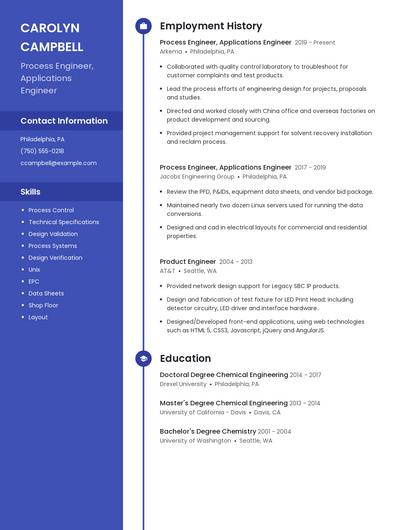
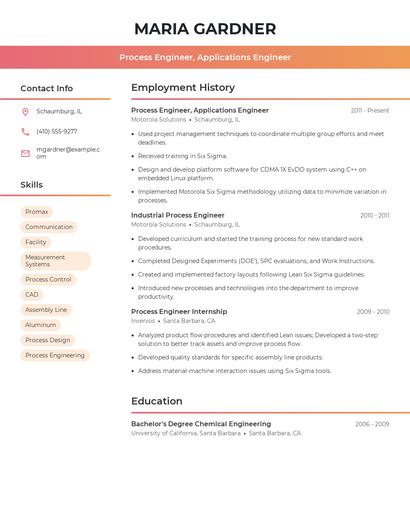
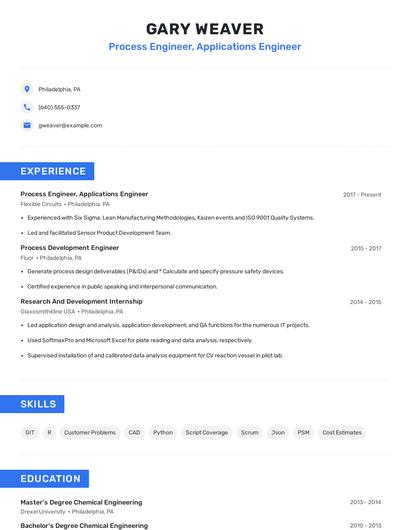
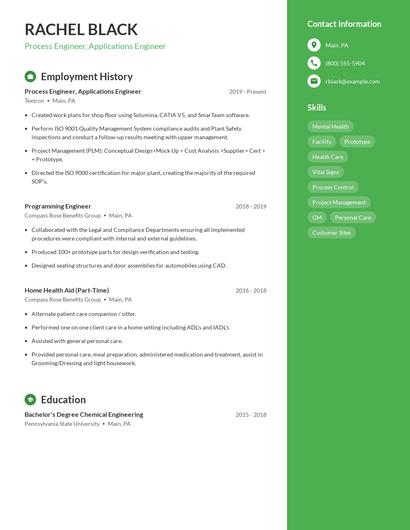
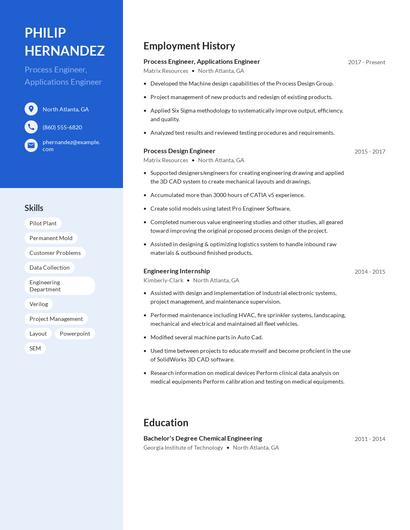
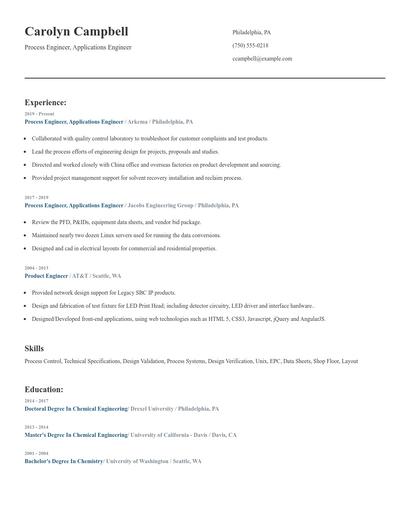
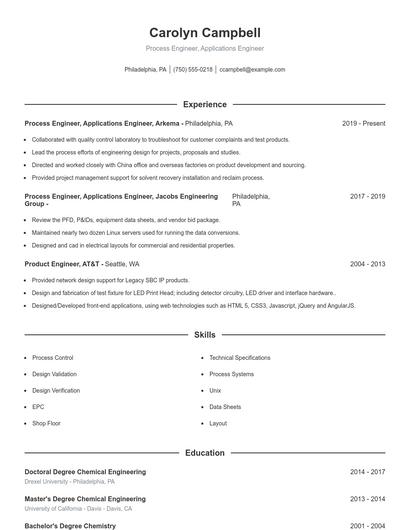
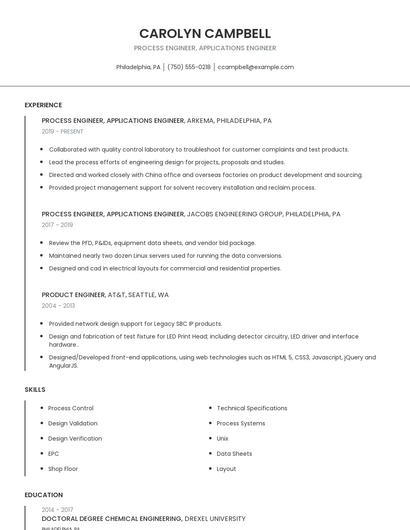
Choose from 10+ customizable process engineer, applications engineer resume templates
Build a professional process engineer, applications engineer resume in minutes. Our AI resume writing assistant will guide you through every step of the process, and you can choose from 10+ resume templates to create your process engineer, applications engineer resume.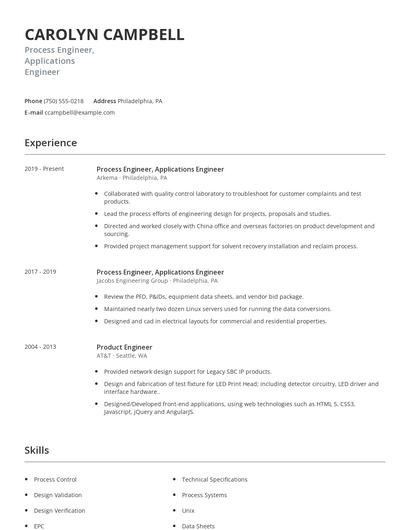



Compare different process engineer, applications engineers
Process engineer, applications engineer vs. Senior quality engineer
A Senior Quality Engineer ensures that a company's goods meet the quality standards required. They may work in various industries, such as the automobile, textile, clothing, food, and electronics industries.
These skill sets are where the common ground ends though. The responsibilities of a process engineer, applications engineer are more likely to require skills like "process engineering," "cad," "minitab," and "customer problems." On the other hand, a job as a senior quality engineer requires skills like "continuous improvement," "corrective action," "product quality," and "sigma." As you can see, what employees do in each career varies considerably.
Senior quality engineers earn the highest salaries when working in the professional industry, with an average yearly salary of $100,740. On the other hand, process engineer, applications engineers are paid more in the technology industry with an average salary of $98,318.On average, senior quality engineers reach similar levels of education than process engineer, applications engineers. Senior quality engineers are 2.8% more likely to earn a Master's Degree and 3.3% less likely to graduate with a Doctoral Degree.Process engineer, applications engineer vs. Quality engineer
A quality engineer's responsibilities include ensuring that the manufacturing processes are efficient and accurate, documenting findings that would raise concerns, conducting quality tests while observing parameters, and implementing changes as necessary to meet the highest quality standards. Quality engineers need to have excellent problem-solving and observation skills to detect any irregularities and possible malfunctions. They also must be able to communicate effectively with the clients for feedbacks and corrective adjustments, address complaints, and immediately resolve any inconsistencies made.
While some skills are similar in these professions, other skills aren't so similar. For example, resumes show us that process engineer, applications engineer responsibilities requires skills like "process engineering," "cad," "customer problems," and "p id." But a quality engineer might use other skills in their typical duties, such as, "corrective action," "continuous improvement," "quality standards," and "sigma."
Quality engineers earn a lower average salary than process engineer, applications engineers. But quality engineers earn the highest pay in the technology industry, with an average salary of $84,890. Additionally, process engineer, applications engineers earn the highest salaries in the technology with average pay of $98,318 annually.quality engineers earn similar levels of education than process engineer, applications engineers in general. They're 0.5% more likely to graduate with a Master's Degree and 3.3% less likely to earn a Doctoral Degree.Process engineer, applications engineer vs. Engineer
Engineers are highly trained professionals who determine the feasibility of various projects, usually related to the construction industry. They are considered experts in mathematics and science, two disciplines that they need to use in designing and coming up with plans for projects. They should also be well-versed in different construction or industrial materials, and they ensure that appropriate materials are used for the project. They also ensure that the projects meet the requirements of the groups that hired them. They create spaces that would both address the needs of the end-users and the industry standards. They also ensure that the projects they make would stand the test of time.
The required skills of the two careers differ considerably. For example, process engineer, applications engineers are more likely to have skills like "process engineering," "lean manufacturing," "minitab," and "customer problems." But a engineer is more likely to have skills like "python," "cloud," "c++," and "c #."
Engineers earn the best pay in the automotive industry, where they command an average salary of $97,672. Process engineer, applications engineers earn the highest pay from the technology industry, with an average salary of $98,318.engineers typically earn similar educational levels compared to process engineer, applications engineers. Specifically, they're 0.5% more likely to graduate with a Master's Degree, and 2.8% more likely to earn a Doctoral Degree.Process engineer, applications engineer vs. Industrial engineer
An industrial engineer specializes in devising various systems to improve the workflow and the workforce in a manufacturing setting. One of their primary responsibilities is to understand all of the procedures in a manufacturing plant and develop strategies to resolve issues or improve production operations, such as designing a cost-efficient machine or system that will enhance the quality of goods and boost the productivity of workers. Moreover, it is also essential to adhere to all the company's policies and safety regulations to maintain a safe and productive work environment for all employees.
Types of process engineer, applications engineer
Updated January 8, 2025
