What does a process/product engineer do?
A Process/Product Engineer usually works at manufacturing facilities where they are in charge of designing and developing products and procedures. Working alongside development teams, a process/product engineer conducts extensive research and analysis, conceptualizes plans, develops prototypes and schematics, and establishes test structures to evaluate and ensure the quality and efficiency of products and procedures. They may also assess existing practices, identifying their strengths and weaknesses to optimize operations. Moreover, they set guidelines and specifications, overseeing staff's performance while implementing safety standards and policies for a smooth and efficient workflow.
Process/product engineer responsibilities
Here are examples of responsibilities from real process/product engineer resumes:
- Lead development and implementation of ISO 9001/9002 and lean manufacturing assembly for new and existing products.
- Lead and assist maintenance in resolving equipment malfunctions, troubleshoot process problems, and organize and implement preventative maintenance procedures.
- Fulfill role of ISO 9000 -2000 internal auditor supporting the quality system.
- Ensure that all FMEA documentation and work instructions are up to date.
- Own MEMS pressure sensor products, working on yield improvement and FMEA.
- Develop a method to get AutoCad isometric drawings relevant to relief valve transferred electronically to the relief valve sizing package.
- Participate in configuration and implementation of new ERP system, establishing new business processes base on new system capabilities.
Process/product engineer skills and personality traits
We calculated that 14% of Process/Product Engineers are proficient in Product Quality, R, and Process Engineering. They’re also known for soft skills such as Speaking skills, Writing skills, and Creativity.
We break down the percentage of Process/Product Engineers that have these skills listed on their resume here:
- Product Quality, 14%
Participated in evaluating and defining product quality and approving new products.
- R, 6%
Applied statistical methods to manufacturing disciplines including X-bar and R charts, process capability studies and problem identification/solving activities.
- Process Engineering, 6%
Contributed process engineering knowledge to all phases of a FMEA risk assessment for a manufacturing process at an international manufacturing location.
- Technical Support, 5%
Provided technical support in conducting packaging tests for continuous material flow improvement.
- Sigma, 4%
Developed a key supplier to 5 Sigma defect rate over 6 months (from a 0.4 sigma baseline).
- Engineering Support, 3%
Provided engineering support for products moving from development to manufacturing.
Most process/product engineers use their skills in "product quality," "r," and "process engineering" to do their jobs. You can find more detail on essential process/product engineer responsibilities here:
Speaking skills. One of the key soft skills for a process/product engineer to have is speaking skills. You can see how this relates to what process/product engineers do because "industrial engineers sometimes have to explain their instructions to production staff or technicians before they can make written instructions available." Additionally, a process/product engineer resume shows how process/product engineers use speaking skills: "represented process engineering discipline as a member of a cross-functional team transferring motorola fab processes to foundry factories. "
Writing skills. Another essential skill to perform process/product engineer duties is writing skills. Process/product engineers responsibilities require that "industrial engineers must prepare documentation for other engineers or scientists, or for future reference." Process/product engineers also use writing skills in their role according to a real resume snippet: "experienced in writing protocols, reports and conducting tests for gage r and r of measurement equipment. "
Creativity. This is an important skill for process/product engineers to perform their duties. For an example of how process/product engineer responsibilities depend on this skill, consider that "industrial engineers use creativity and ingenuity to design new production processes in many kinds of settings in order to reduce the use of material resources, time, or labor while accomplishing the same goal." This excerpt from a resume also shows how vital it is to everyday roles and responsibilities of a process/product engineer: "saved $46,000 in inventory cost reduction projects. ".
Listening skills. For certain process/product engineer responsibilities to be completed, the job requires competence in "listening skills." The day-to-day duties of a process/product engineer rely on this skill, as "these engineers often operate in teams, but they also must solicit feedback from customers, vendors, and production staff." For example, this snippet was taken directly from a resume about how this skill applies to what process/product engineers do: "communicated with equipment suppliers to successfully troubleshoot and repair malfunctioning equipment, reducing scrap parts and poor yields. "
Math skills. Another common skill required for process/product engineer responsibilities is "math skills." This skill comes up in the duties of process/product engineers all the time, as "industrial engineers use the principles of calculus, trigonometry, and other advanced topics in mathematics for analysis, design, and troubleshooting in their work." An excerpt from a real process/product engineer resume shows how this skill is central to what a process/product engineer does: "performed risk assessment on autoclave to determine any quantitative threats to product quality. "
Problem-solving skills. Lastly, "problem-solving skills" is an important element of what a process/product engineer does. Process/product engineer responsibilities require this skill because "in designing facilities for manufacturing and processes for providing services, these engineers deal with several issues at once, from workers’ safety to quality assurance." This resume example highlights how process/product engineer duties rely on this skill: "resolved production and quality issues, developed sops, implemented visual management, one-piece flow and 5s. "
The three companies that hire the most process/product engineers are:
- Fred Hutch4 process/product engineers jobs
- Kimberly-Clark3 process/product engineers jobs
- Air Products2 process/product engineers jobs
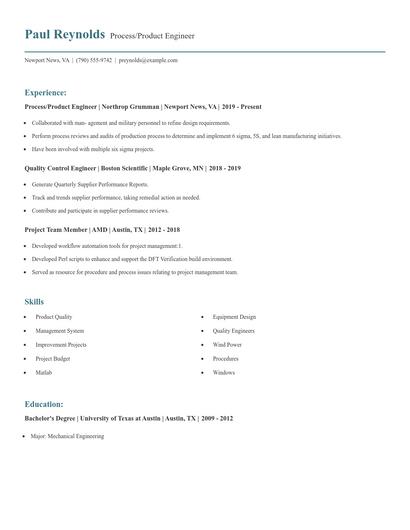
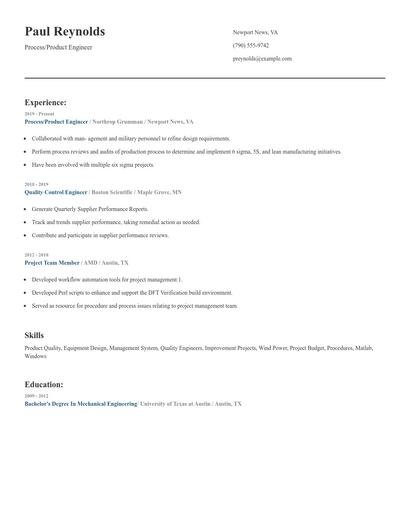
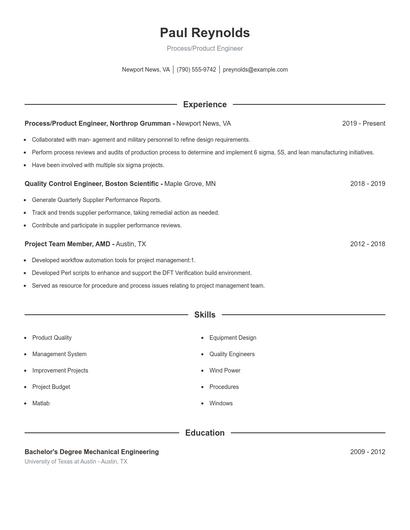
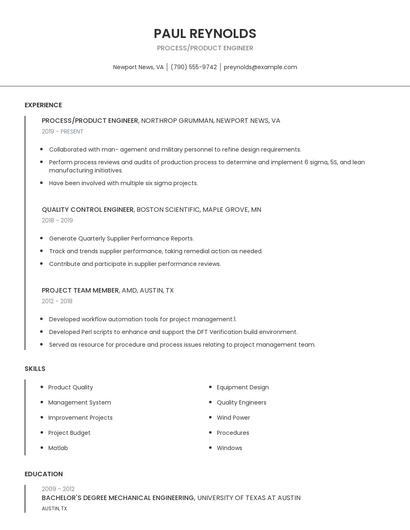
Choose from 10+ customizable process/product engineer resume templates
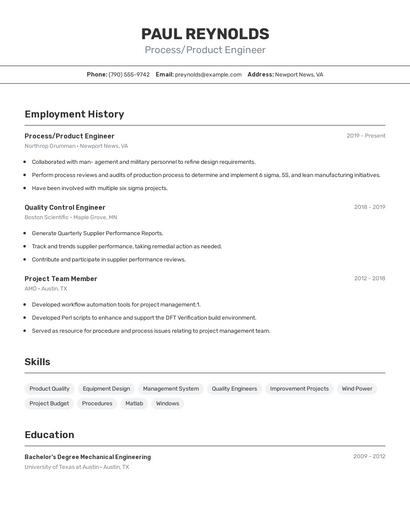
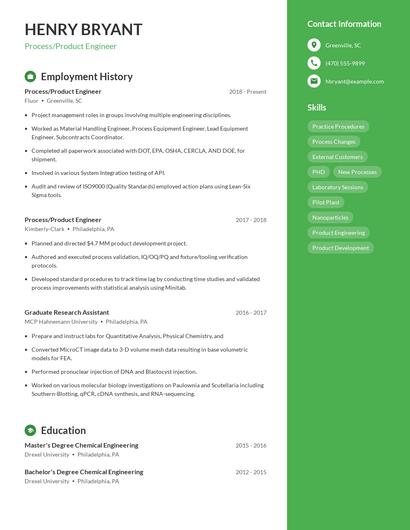
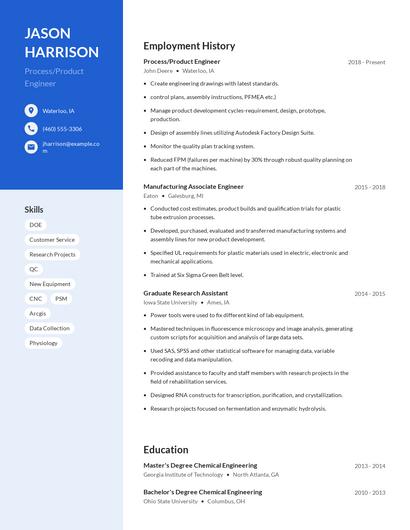
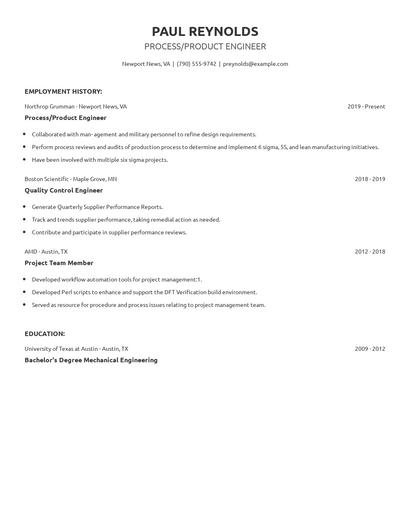
Build a professional process/product engineer resume in minutes. Our AI resume writing assistant will guide you through every step of the process, and you can choose from 10+ resume templates to create your process/product engineer resume.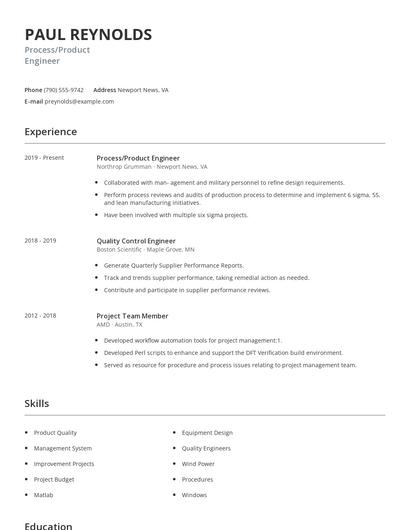


Compare different process/product engineers
Process/product engineer vs. Manufacturing engineering internship
A manufacturing engineering intern is responsible for assisting the manufacturing engineers on the plant's daily operations, analyzing the manufacturing process and procedures, and recommending strategic solutions to maximize productivity and minimize costs. Manufacturing engineering interns shadow the production staff, inspect the tools and equipment of the manufacturing, analyze the quality control documentation, and perform related administrative tasks to familiarize themselves with the plant structure. A manufacturing engineering intern must have excellent communication and organization skills, as well as the ability to adapt quickly to a fast-paced environment.
There are some key differences in the responsibilities of each position. For example, process/product engineer responsibilities require skills like "process engineering," "product line," "process documentation," and "practice procedures." Meanwhile a typical manufacturing engineering internship has skills in areas such as "lean manufacturing," "solidworks," "assembly line," and "pallets." This difference in skills reveals the differences in what each career does.
Manufacturing engineering interns tend to make the most money working in the technology industry, where they earn an average salary of $49,245. In contrast, process/product engineers make the biggest average salary, $105,237, in the retail industry.manufacturing engineering interns tend to reach similar levels of education than process/product engineers. In fact, manufacturing engineering interns are 0.4% less likely to graduate with a Master's Degree and 0.2% more likely to have a Doctoral Degree.Process/product engineer vs. Planning engineer
A planning engineer is in charge of developing plans and systems to organize and schedule project procedures, ensuring efficiency and timeliness. Their responsibilities revolve around learning and understanding the extent of all operations, setting schedules and objectives, liaising with external parties such as vendors or distributors, and maintaining an active communication line with other departments. Furthermore, a planning engineer must monitor the progress of the workflow and the performance of the workforce, all while implementing the company's policies and regulations.
Each career also uses different skills, according to real process/product engineer resumes. While process/product engineer responsibilities can utilize skills like "product quality," "process engineering," "sigma," and "product line," planning engineers use skills like "project management," "infrastructure," "transmission planning," and "nerc."
Planning engineers earn a lower average salary than process/product engineers. But planning engineers earn the highest pay in the energy industry, with an average salary of $86,256. Additionally, process/product engineers earn the highest salaries in the retail with average pay of $105,237 annually.Average education levels between the two professions vary. Planning engineers tend to reach similar levels of education than process/product engineers. In fact, they're 4.6% more likely to graduate with a Master's Degree and 0.2% more likely to earn a Doctoral Degree.What technology do you think will become more important and prevalent for process/product engineers in the next 3-5 years?
Jerry Leth
VP/General Manager, MANA
Process/product engineer vs. Senior manufacturing engineer
A Senior Manufacturing Engineer works in a company's production operations and is responsible for developing and improving manufacturing processes. They analyze and propose solutions to engineering problems.
There are many key differences between these two careers, including some of the skills required to perform responsibilities within each role. For example, a process/product engineer is likely to be skilled in "process engineering," "data analysis," "statistical analysis," and "practice procedures," while a typical senior manufacturing engineer is skilled in "lean manufacturing," "project management," "lean six sigma," and "solidworks."
Senior manufacturing engineers earn the highest salary when working in the automotive industry, where they receive an average salary of $97,567. Comparatively, process/product engineers have the highest earning potential in the retail industry, with an average salary of $105,237.When it comes to education, senior manufacturing engineers tend to earn similar degree levels compared to process/product engineers. In fact, they're 1.7% more likely to earn a Master's Degree, and 0.0% more likely to graduate with a Doctoral Degree.Process/product engineer vs. Engineer
Engineers are highly trained professionals who determine the feasibility of various projects, usually related to the construction industry. They are considered experts in mathematics and science, two disciplines that they need to use in designing and coming up with plans for projects. They should also be well-versed in different construction or industrial materials, and they ensure that appropriate materials are used for the project. They also ensure that the projects meet the requirements of the groups that hired them. They create spaces that would both address the needs of the end-users and the industry standards. They also ensure that the projects they make would stand the test of time.
Even though a few skill sets overlap between process/product engineers and engineers, there are some differences that are important to note. For one, a process/product engineer might have more use for skills like "product quality," "process engineering," "sigma," and "engineering support." Meanwhile, some responsibilities of engineers require skills like "python," "cloud," "c++," and "c #. "
Engineers enjoy the best pay in the automotive industry, with an average salary of $97,672. For comparison, process/product engineers earn the highest salary in the retail industry.engineers reach similar levels of education compared to process/product engineers, in general. The difference is that they're 1.7% more likely to earn a Master's Degree, and 1.0% more likely to graduate with a Doctoral Degree.Types of process/product engineer
Updated January 8, 2025
