
Automatically apply for jobs with Zippia
Upload your resume to get started.
Procurement supervisor skills for your resume and career
15 procurement supervisor skills for your resume and career
1. Logistics
Logistics is a complete organization and implementation of a problem. Logistics are often considered in a complex business operation, as some works need detailed plannings. Logistics are also used in military action.
- Conducted technical logistics equipment audits, improved equipment performance and output.
- Coordinated all logistics between third-party fulfillment and transportation vendors.
2. Purchase Orders
- Initiate part requisition and place purchase orders with approved vendors to ensure timely delivery of components to support requirements.
- Generated Purchase Orders/Subcontracts utilizing RFQ system based on requirements forwarded by internal and external customers.
3. Continuous Improvement
Continuous improvement is an ongoing process of improvement of products, services, and processes with the help of innovative ideas. It is an organized approach that helps an organization to find its weaknesses and improve them.
- Developed and monitored operational metrics and service levels for Procurement, with a focus on continuous improvement.
- Evaluate and execute continuous improvement projects.
4. Strategic Sourcing
- Led strategic sourcing event for armored transport services, resulting in $932k savings with optimized service matrix and standardized contracts.
- Planned and coordinated the use of strategic sourcing in 60-70% of products purchased from manufacturers and Tier 1 suppliers.
5. ERP
Enterprise Resource Planning (ERP) is computer software used by major corporations and organizations for conducting their management and accounting tasks efficiently. ERP systems bind different business processes with each other allowing smoother flow of data between them resulting in swift project assessment and completion.
- Participated in the implementation and launch of the company's new ERP system (SAP).
- Ensured that Engineering Change Orders were properly reflected in the ERP system.
6. Commodities
- Supported an affiliate business development team that traded and marketed commodities and related transportation services to various customers.
- Partnered with global supplier base to ensure uninterrupted supply of multiple commodities with annual spend of $500 million.
Choose from 10+ customizable procurement supervisor resume templates
Build a professional procurement supervisor resume in minutes. Our AI resume writing assistant will guide you through every step of the process, and you can choose from 10+ resume templates to create your procurement supervisor resume.7. Cost Savings
- Identify cost savings opportunities through order aggregation and consolidating needs with nearby internal company production facilities.
- Generated numerous cost savings initiatives, cycle time and process improvements within the PH internal and external supply chain.
8. Cost Reduction
- Researched and implemented all customer focused material purchasing resulting in improved quality and annualized cost reductions in excess of $200K.
- Implemented a customer-focused direct material purchasing module resulting in improved quality and annualized cost reductions in excess of $1.5 million.
9. MRP
MRP is an abbreviation of Material Requirements Planning and refers to the control system which is implemented in the planning and management of the activities related to manufacturing. Through MRP, manufacturers can easily schedule the production and it can also be used for inventory. MRP systems are mostly software-based but the process can also be carried out manually.
- Key Projects and Achievements: * Monitored physical inventory, supply chain, and logistical operations using JIT and MRP methodologies.
- Manage a team of buyers to successfully procure material per MRP requirements.
10. Cost Analysis
Cost analysis, also known as cost-benefit analysis, refers to analyzing how a company's money is used, whether this is expenses of the company itself or the cost of the current production method. This method also takes the number of products sold into consideration to determine whether the manufacturing process is benefiting or harming the company's profits.
- Prepared and documented price/cost analysis in support of supplier negotiations.
- Evaluate vendor proposals utilizing price and/or cost analysis.
11. RFQ
A request for quotation (RFQ) is a document that a corporation submits to one or more potential suppliers obtaining quotations for a service or product. Typically, an RFQ seeks a detailed list of prices for something that is measurable like hardware and it involves more than the price per item. RFQ, call for bids and invitation for bid generally mean the same thing.
- Supported Commodity Managers to develop and implement commodity strategies by creating RFQ packages, tracking savings, and managing pricing implementation.
- Managed subcontracts activity including RFQ analysis, major negotiations and construction of complex subcontracting orders and milestones.
12. Procurement Process
Procurement Process refers to a method for determining what materials and products are best for a company. Many factors go into making these decisions, such as listing potential vendors and the prices of various goods or services. This process is used in several companies to assist with any activities that must be outsourced without costing the company much in cashflow.
- Led team to successfully integrate Procurement processes for multiple divisions creating standardization company wide.
- Supervised 9 purchasing agents in their execution of internal procurement processes.
13. Direct Reports
- Managed 8 direct reports responsible for various categories of spend in a matrix organization.
- Mentored 7 direct reports and ensured their objectives and metrics were met.
14. Process Improvement
- Identify opportunities for process improvements/best practices.
- Developed and presented process improvements to the Sales Director, Sales Vice President, and Branch Manager which were ultimately implemented.
15. Inventory Management
- Set up and managed multiple warehouse locations, ensuring sound Inventory Management principles were instituted and adhered to throughout the department.
- Inventory Management Managed $27M inventory consisting of 130.000 items while increasing inventory turns on an ongoing basis.
5 Procurement Supervisor resume examples
Build a professional procurement supervisor resume in minutes. Browse through our resume examples to identify the best way to word your resume. Then choose from 5+ resume templates to create your procurement supervisor resume.

What skills help Procurement Supervisors find jobs?
Tell us what job you are looking for, we’ll show you what skills employers want.
What type of skills will young procurement supervisors need?
Terry McKee
IT & Procurement Director, Knoxville Community Development Corporation
List of procurement supervisor skills to add to your resume
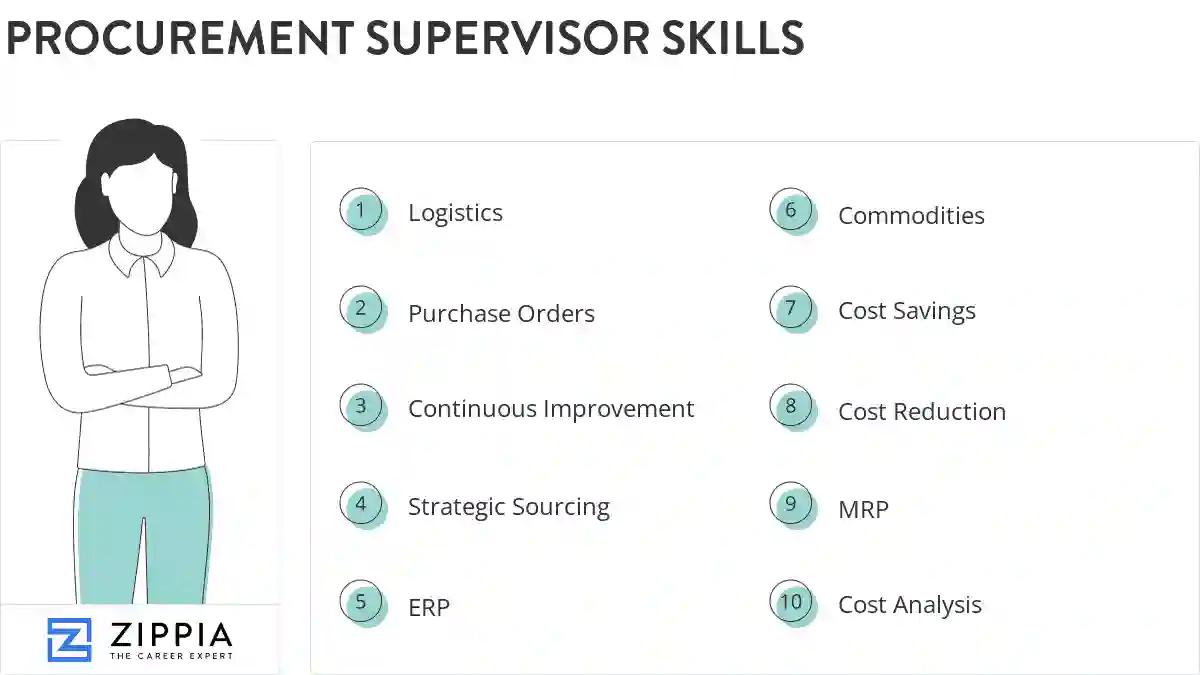
The most important skills for a procurement supervisor resume and required skills for a procurement supervisor to have include:
- Logistics
- Purchase Orders
- Continuous Improvement
- Strategic Sourcing
- ERP
- Commodities
- Cost Savings
- Cost Reduction
- MRP
- Cost Analysis
- RFQ
- Procurement Process
- Direct Reports
- Process Improvement
- Inventory Management
- Procurement Policies
- Inventory Control
- RFP
- KPIs
- Performance Reviews
- MRO
- R
- Federal Acquisition
- Contract Administration
- Price Analysis
- POS
- Spend Analysis
- Delivery Schedules
- Global Sourcing
- RFI
- SOX
- Management System
- Vendor Negotiations
- ISO
- Gross Profit
- Capital Equipment
- Contract Negotiations
- BOM
- HR
- Price Negotiation
- DOD
- DCMA
Updated January 8, 2025
