What does a product/project engineer do?
Product/project engineer responsibilities
Here are examples of responsibilities from real product/project engineer resumes:
- Manage the manufacturing of defense and aerospace electro-mechanical print circuit boards from prototype to production level.
- Convert part and assembly drawings from AutoCad to Solidworks.
- Review, audit and create ISO 9000 area procedures, flow charts, test procedures and forms.
- Award special recognition from NIBCO's chairman of the board for efforts in gaining ISO certification quickly and smoothly.
- Utilize Solidworks for design, AutoCad for legacy document maintenance.
- Design and develop aircraft seal devices through engineering analysis, prototyping, risk assessment and appropriate qualification testing with customer expectation.
- Design and develop aircraft seal devices through engineering analysis, prototyping, risk assessment and appropriate qualification testing with customer expectation.
Product/project engineer skills and personality traits
We calculated that 10% of Product/Project Engineers are proficient in Project Management, CAD, and Solidworks. They’re also known for soft skills such as Mechanical skills, Listening skills, and Creativity.
We break down the percentage of Product/Project Engineers that have these skills listed on their resume here:
- Project Management, 10%
Lead multiple projects simultaneously through project management techniques of planning objectives and utilizing proper resources to successful and on time completion.
- CAD, 9%
Designed compressor's electrical, pneumatic, process and instrumentation drawings on CAD for all markets and most major manufacturers.
- Solidworks, 7%
Created Company SolidWorks Part Library.
- Aerospace, 7%
Major Aerospace customers include Pratt & Whitney of Canada and GEAE.
- Product Development, 6%
Perform necessary analysis to complete Investment Requests for additional resources in support of current product development.
- Technical Support, 5%
Provide technical support to manufacturing, production group.
Common skills that a product/project engineer uses to do their job include "project management," "cad," and "solidworks." You can find details on the most important product/project engineer responsibilities below.
Mechanical skills. To carry out their duties, the most important skill for a product/project engineer to have is mechanical skills. Their role and responsibilities require that "mechanical skills allow engineers to apply basic engineering concepts and mechanical processes to the design of new devices and systems." Product/project engineers often use mechanical skills in their day-to-day job, as shown by this real resume: "managed the manufacturing of defense and aerospace electro-mechanical printed circuit boards from prototype to production level. "
Listening skills. Another soft skill that's essential for fulfilling product/project engineer duties is listening skills. The role rewards competence in this skill because "mechanical engineers often work on projects with others, such as architects and computer scientists." According to a product/project engineer resume, here's how product/project engineers can utilize listening skills in their job responsibilities: "communicated with oversees suppliers by issuing corrective actions to improve or correct manufacturing processes. "
Creativity. This is an important skill for product/project engineers to perform their duties. For an example of how product/project engineer responsibilities depend on this skill, consider that "mechanical engineers design and build complex pieces of equipment and machinery." This excerpt from a resume also shows how vital it is to everyday roles and responsibilities of a product/project engineer: "created boms, monitored inventory levels, and reduced parts and labor costs using syspro erp software. ".
Math skills. A big part of what product/project engineers do relies on "math skills." You can see how essential it is to product/project engineer responsibilities because "mechanical engineers use the principles of calculus, statistics, and other advanced subjects in math for analysis, design, and troubleshooting in their work." Here's an example of how this skill is used from a resume that represents typical product/project engineer tasks: "designed concepts and provided math models for tool creation and prototyping. "
Problem-solving skills. A commonly-found skill in product/project engineer job descriptions, "problem-solving skills" is essential to what product/project engineers do. Product/project engineer responsibilities rely on this skill because "mechanical engineers need good problem-solving skills to take scientific principles and discoveries and use them to design and build useful products." You can also see how product/project engineer duties rely on problem-solving skills in this resume example: "identify, initiate and implement continuous improvement solutions for optimization, cost reductions and yield and process enhancements across product lines. "
The three companies that hire the most product/project engineers are:
- Construction Specialties83 product/project engineers jobs
- Aerojet Rocketdyne3 product/project engineers jobs
- Polaris2 product/project engineers jobs
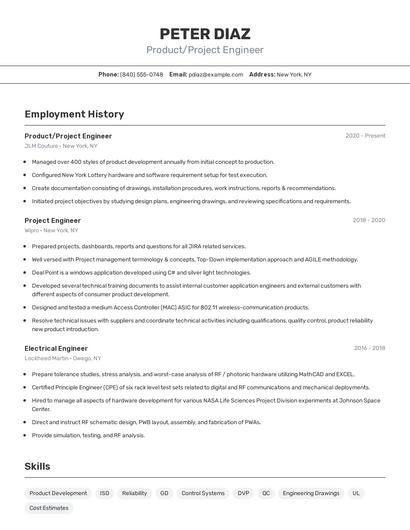
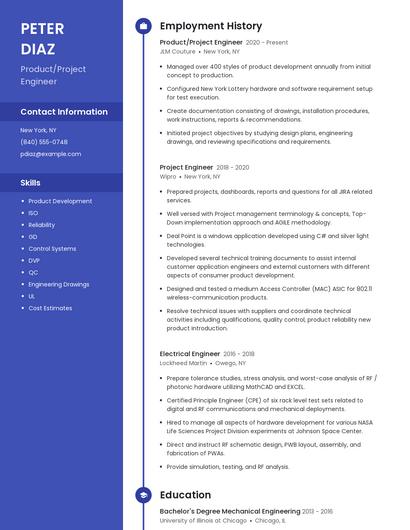
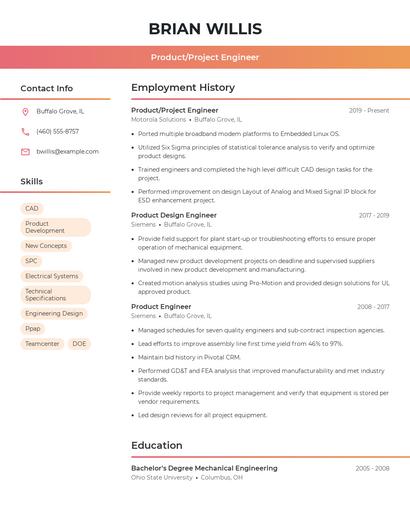
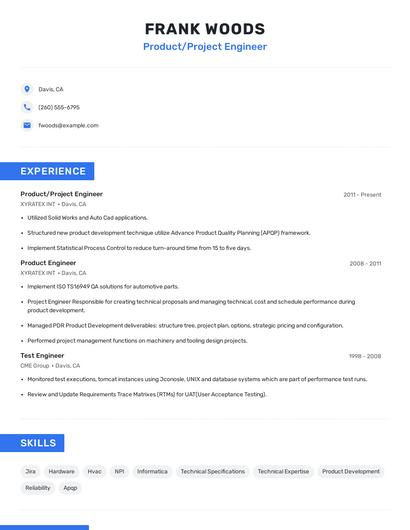
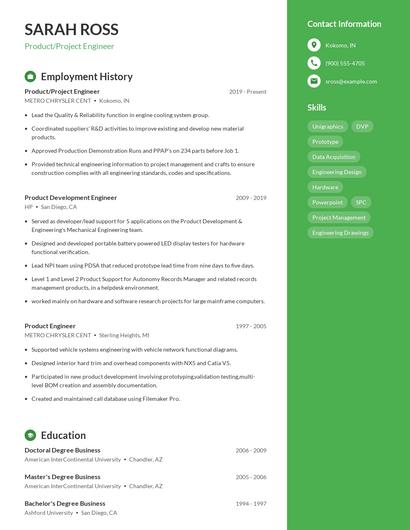
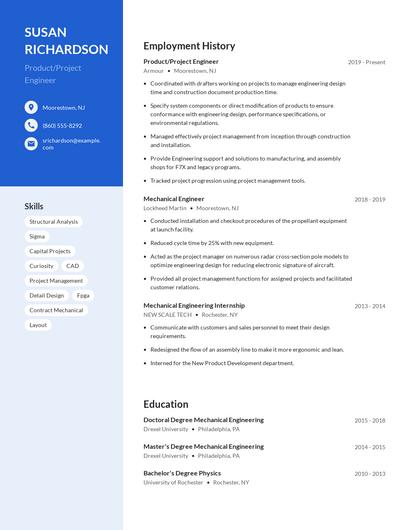
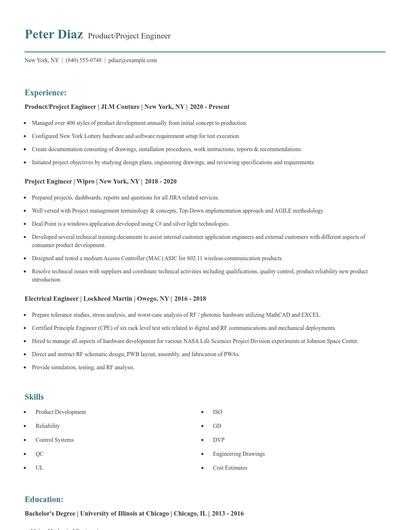
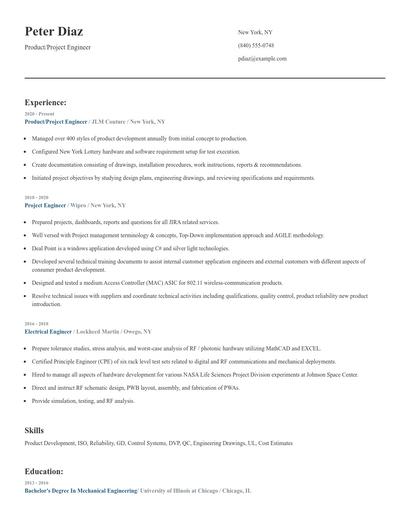
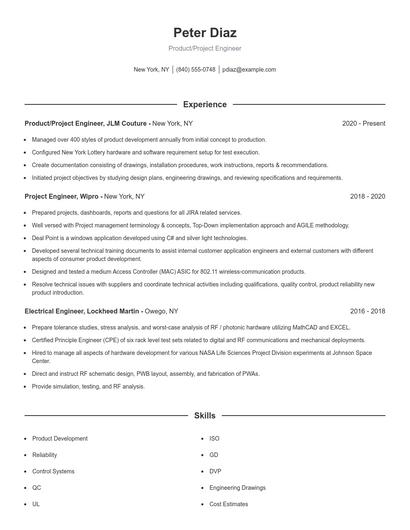
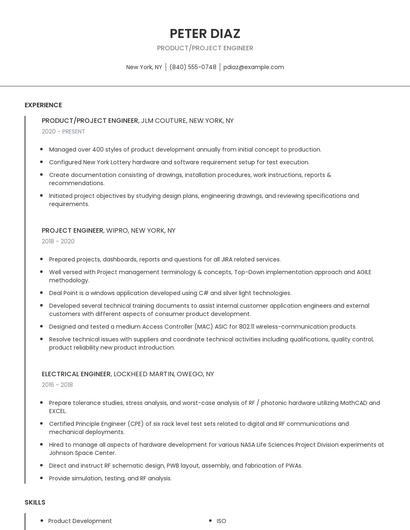
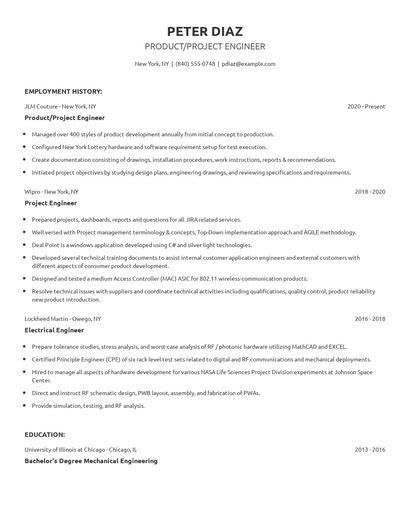
Choose from 10+ customizable product/project engineer resume templates
Build a professional product/project engineer resume in minutes. Our AI resume writing assistant will guide you through every step of the process, and you can choose from 10+ resume templates to create your product/project engineer resume.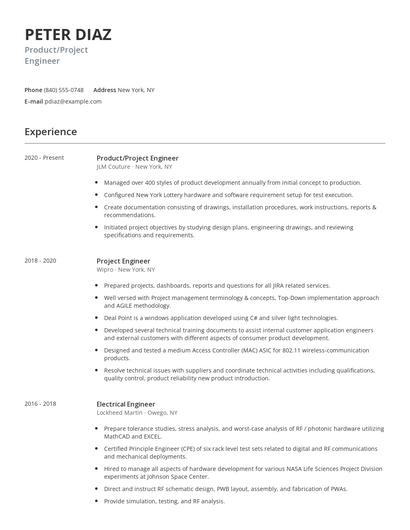
Compare different product/project engineers
Product/project engineer vs. Team lead engineer
A team leads engineer is in charge of spearheading and overseeing the efforts of an engineering team, ensuring efficiency and smooth workflow. Although the duties may depend on one's industry of employment, it typically includes designing and developing systems according to project requirements, setting objectives and construction guidelines, delegating tasks, managing budgets and schedules, and monitoring the workflow, performing corrective measures as needed. Furthermore, as a team leads engineer, it is essential to encourage the workforce to reach goals, all while enforcing the company's safety standards and regulations.
There are some key differences in the responsibilities of each position. For example, product/project engineer responsibilities require skills like "aerospace," "product line," "product design," and "technical specifications." Meanwhile a typical team lead engineer has skills in areas such as "python," "architecture," "java," and "c++." This difference in skills reveals the differences in what each career does.
Team lead engineers really shine in the technology industry with an average salary of $117,918. Comparatively, product/project engineers tend to make the most money in the energy industry with an average salary of $94,048.On average, team lead engineers reach similar levels of education than product/project engineers. Team lead engineers are 1.5% more likely to earn a Master's Degree and 0.5% more likely to graduate with a Doctoral Degree.Product/project engineer vs. Co-operations engineer
A Co-Operations Engineer ensures that operations-related activities are performed in compliance with company standards and regulations. They optimize the overall efficiency of business.
Each career also uses different skills, according to real product/project engineer resumes. While product/project engineer responsibilities can utilize skills like "aerospace," "product line," "product design," and "customer satisfaction," co-operations engineers use skills like "python," "c++," "powerpoint," and "continuous improvement."
Co-operations engineers earn a lower average salary than product/project engineers. But co-operations engineers earn the highest pay in the energy industry, with an average salary of $51,087. Additionally, product/project engineers earn the highest salaries in the energy with average pay of $94,048 annually.co-operations engineers earn lower levels of education than product/project engineers in general. They're 5.4% less likely to graduate with a Master's Degree and 0.5% less likely to earn a Doctoral Degree.What technology do you think will become more important and prevalent for product/project engineers in the next 3-5 years?
Dr. Richard Onyancha
Associate Professor of Mechanical Engineering and Department Head, Rose-Hulman Institute of Technology
Product/project engineer vs. Engineer
Engineers are highly trained professionals who determine the feasibility of various projects, usually related to the construction industry. They are considered experts in mathematics and science, two disciplines that they need to use in designing and coming up with plans for projects. They should also be well-versed in different construction or industrial materials, and they ensure that appropriate materials are used for the project. They also ensure that the projects meet the requirements of the groups that hired them. They create spaces that would both address the needs of the end-users and the industry standards. They also ensure that the projects they make would stand the test of time.
The required skills of the two careers differ considerably. For example, product/project engineers are more likely to have skills like "aerospace," "product development," "product line," and "product design." But a engineer is more likely to have skills like "python," "cloud," "c++," and "c #."
Engineers make a very good living in the automotive industry with an average annual salary of $97,672. On the other hand, product/project engineers are paid the highest salary in the energy industry, with average annual pay of $94,048.When it comes to education, engineers tend to earn similar degree levels compared to product/project engineers. In fact, they're 0.5% less likely to earn a Master's Degree, and 0.7% less likely to graduate with a Doctoral Degree.Product/project engineer vs. Design engineer
A design engineer is responsible for creating systems and applications based on their expertise. Design engineers work through client specifications based on business needs. A design engineer also provides recommendations on improving existing systems to boost its performance and increase efficiency. Design engineers must have an excellent command of computer systems, programming codes, and technical data to ensure the system's stability and high-quality processes. A design engineer should also have strong analytical and time-management skills to perform tasks and meet deadlines.
Even though a few skill sets overlap between product/project engineers and design engineers, there are some differences that are important to note. For one, a product/project engineer might have more use for skills like "cad," "solidworks," "aerospace," and "customer satisfaction." Meanwhile, some responsibilities of design engineers require skills like "c++," "work ethic," "engineering design," and "auto cad. "
In general, design engineers earn the most working in the technology industry, with an average salary of $86,213. The highest-paying industry for a product/project engineer is the energy industry.The average resume of design engineers showed that they earn similar levels of education compared to product/project engineers. So much so that theyacirc;euro;trade;re 1.6% less likely to earn a Master's Degree and more likely to earn a Doctoral Degree by 0.2%.Types of product/project engineer
Updated January 8, 2025
