Explore jobs
Find specific jobs
Explore careers
Explore professions
Best companies
Explore companies
Job outlook for product specialists/sales specialists in the United States
Product specialist/sales specialist job growth summary. After extensive research, interviews, and analysis, Zippia's data science team found that:
The projected product specialist/sales specialist job growth rate is 19% from 2018-2028.
About 150,300 new jobs for product specialists/sales specialists are projected over the next decade.
Product specialist/sales specialist salaries have increased 5% for product specialists/sales specialists in the last 5 years.
There are over 73,847 product specialists/sales specialists currently employed in the United States.
There are 163,634 active product specialist/sales specialist job openings in the US.
The average product specialist/sales specialist salary is $76,743.
Are product specialist/sales specialist jobs in demand?
Product specialist/sales specialist job and salary trends over time
Product specialist/sales specialist jobs over time
Product specialist/sales specialist job growth rate over time
| Year | # of jobs | % of population |
|---|---|---|
| 2021 | 73,847 | 0.02% |
| 2020 | 74,238 | 0.02% |
| 2019 | 76,644 | 0.02% |
| 2018 | 75,670 | 0.02% |
| 2017 | 76,140 | 0.02% |
Average product specialist/sales specialist salary over time
Product specialist/sales specialist salary by year
| Year | Avg. salary | Hourly rate | % Change |
|---|---|---|---|
| 2026 | $76,743 | $36.90 | +3.2% |
| 2025 | $74,388 | $35.76 | +1.1% |
| 2024 | $73,606 | $35.39 | --0.2% |
| 2023 | $73,735 | $35.45 | +1.1% |
| 2022 | $72,953 | $35.07 | +0.7% |
Product specialist/sales specialist jobs by state
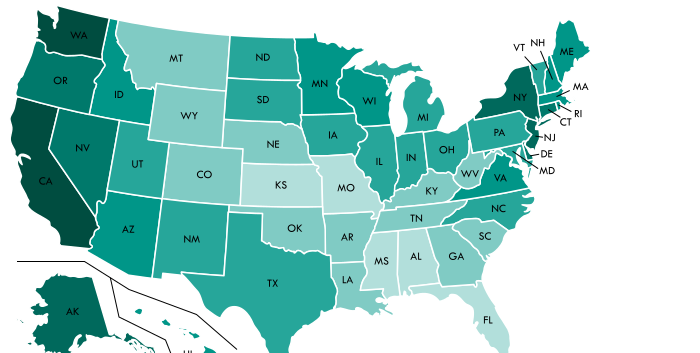
Most common states for product specialists/sales specialists
| Rank | State | Population | # of jobs | Employment/ 1000ppl |
|---|---|---|---|---|
| 1 | District of Columbia | 693,972 | 310 | 45% |
| 2 | North Dakota | 755,393 | 291 | 39% |
| 3 | Vermont | 623,657 | 216 | 35% |
| 4 | Nebraska | 1,920,076 | 640 | 33% |
| 5 | Wyoming | 579,315 | 193 | 33% |
| 6 | Colorado | 5,607,154 | 1,732 | 31% |
| 7 | Iowa | 3,145,711 | 960 | 31% |
| 8 | South Dakota | 869,666 | 271 | 31% |
| 9 | Alaska | 739,795 | 228 | 31% |
| 10 | Maryland | 6,052,177 | 1,738 | 29% |
| 11 | Maine | 1,335,907 | 385 | 29% |
| 12 | Delaware | 961,939 | 276 | 29% |
| 13 | Pennsylvania | 12,805,537 | 3,569 | 28% |
| 14 | Georgia | 10,429,379 | 2,947 | 28% |
| 15 | Massachusetts | 6,859,819 | 1,897 | 28% |
| 16 | Wisconsin | 5,795,483 | 1,640 | 28% |
| 17 | Kansas | 2,913,123 | 795 | 27% |
| 18 | Montana | 1,050,493 | 288 | 27% |
| 19 | Arizona | 7,016,270 | 1,858 | 26% |
| 20 | Rhode Island | 1,059,639 | 263 | 25% |
Most common cities for product specialists/sales specialists
| Rank | City | # of jobs | Employment/ 1000ppl | Avg. salary |
|---|---|---|---|---|
| 1 | American Fork | 2 | 7% | $67,254 |
| 2 | Brunswick | 1 | 3% | $66,787 |
| 3 | Falmouth | 1 | 3% | $83,771 |
| 4 | Tampa | 4 | 1% | $45,532 |
| 5 | Pittsburgh | 2 | 1% | $66,413 |
| 6 | Richmond | 2 | 1% | $75,940 |
| 7 | Ann Arbor | 1 | 1% | $68,950 |
| 8 | Buena Park | 1 | 1% | $114,901 |
| 9 | San Francisco | 3 | 0% | $136,504 |
| 10 | New York | 2 | 0% | $103,847 |
| 11 | Anaheim | 1 | 0% | $114,491 |
| 12 | Baltimore | 1 | 0% | $69,225 |
| 13 | Baton Rouge | 1 | 0% | $48,894 |
| 14 | Boston | 1 | 0% | $82,513 |
| 15 | Chicago | 1 | 0% | $70,948 |
| 16 | Dallas | 1 | 0% | $61,043 |
Product Specialist/Sales Specialist job outlook: Expert opinions
Our panel of product specialist/sales specialist experts
Weber State University
University of Maryland - College Park
University of Southern Mississippi
University of Alabama at Birmingham
University of South Florida
Southern Illinois University Edwardsville
University of Maryland - College Park

University of Nevada, Reno
Southeast Missouri State University

Southern Connecticut State University

Millikin University
Aurora University

Adelphi University
Hiniker
Tarleton State University
Gardner-Webb University
Ryan McKeehan
Weber State University
General Sales, Merchandising And Related Marketing Operations
What general advice would you give to a Product Specialist/Sales Specialist?
Ryan McKeehan: I advise seeking experiences over money when you are beginning your career. Often, new graduates will take the job that offers the most compensation. Choosing employment that provides the best opportunities to develop different skill sets will pay dividends in the long run. Leadership and problem-solving depend heavily on the experiences one can draw upon.
What Product Specialist/Sales Specialist skills would you recommend for someone trying to advance their career?
Ryan McKeehan: At the start of one’s career, there are numerous ways to maximize one’s salary potential. One way is to change jobs every few years. The traditional stigma around job hopping has diminished, and each job change can bring new opportunities for salary upgrades and skill acquisition. By demonstrating a willingness to work hard and continuously upgrade skills, one can develop rare and valuable expertise that will be in high demand, opening doors to better opportunities and higher earnings.
What will help Product Specialists/Sales Specialists increase their earning potential?
Ryan McKeehan: With the rapid advancement of AI and other technologies, the role of salespeople is evolving. In this changing landscape, superior soft skills will be in high demand. The ability to communicate effectively, provide exceptional customer service, and sell ethically will be more crucial than ever. By honing these skills, one can stay ahead in the job market.
What Product Specialist/Sales Specialist skills would you recommend for someone trying to advance their career?
Dr. Kathleen Kelly: Maximizing your salary potential requires research, flexibility, and being your best advocate.
What general advice would you give to a Product Specialist/Sales Specialist?
Kevin Buckley: The biggest factor in earning potential is performance - salespeople get paid based on their ability to hit and exceed quotas through revenue generation. With a sales career, you have a lot of control over earnings. My advice is to be metrics-driven and have a plan to intentionally grow your sales skills through training, mentors, and personal development. Build a reputation for consistent over-achievement. It's also important to do research and understand typical compensation benchmarks. Some may offer higher base pay, while others offer more earnings leverage through aggressive commission/bonus structures.
What Product Specialist/Sales Specialist skills would you recommend for someone trying to advance their career?
Kevin Buckley: Adaptability - The sales environment is evolving rapidly with changes in buyer expectations, technologies, and go-to-market strategies. Successful salespeople will need to be highly adaptable, comfortable with change, and able to quickly adjust their approach as needed. Those stuck in outdated methods will struggle. Digital Selling - The ability to effectively sell through digital channels and virtual interactions is now table stakes. Mastering skills like virtual presentations, video marketing, social selling, and leveraging sales technology tools will separate the top performers. Buyers expect a seamless, digitally-enabled experience. Business Acumen - More than ever, salespeople need the ability to position their products/services as strategic solutions that tangibly impact the client's key objectives, financial metrics, and business outcomes. Knowing how to speak the language of business strategy is crucial for consultative selling.
What will help Product Specialists/Sales Specialists increase their earning potential?
Kevin Buckley: My top advice is to be a continuous learner, both about your company/products and about the sales profession itself. Sales is a skill that requires ongoing development through practice, coaching, and studying new techniques. Don't rest on what you learned in school - seek out mentors, training opportunities, and ways to keep enhancing your sales capabilities. I would also advise resilience and to view every 'no' as a step closer to 'yes.' Sales has its share of rejection. Have a positive attitude, persist through obstacles, and be a student of why buyers say no so that you can improve.
What general advice would you give to a Product Specialist/Sales Specialist?
Dr. John Hansen: Regarding the third question, the only real way to maximize your salary in sales is to perform well against the success metrics in place in your role. Sales is, for the most part, an outcome-based profession, meaning that pay increases (or decreases) based on outcomes attained. Whatever the success metrics are in the position one is currently in, they will maximize their income to the extent that they perform well in relation to these success metrics.
What Product Specialist/Sales Specialist skills would you recommend for someone trying to advance their career?
Dr. John Hansen: As to the first question, I would suggest any new graduate beginning in sales understand themselves to better understand what type of role they will best fit to. There has been a growing increase in assessment tests in sales to ensure that sales people are being placed in roles they will flourish in. For example, some sales people are more oriented towards finding new customers, while others are more oriented towards managing existing relationships. To the extent that new salespeople can better understand what role they will fit best to, and then secure that role, they are more likely to be successful. Beyond that, there is no substitute for hard work - particularly as one begins their career.
What will help Product Specialists/Sales Specialists increase their earning potential?
Dr. John Hansen: In terms of the second question, consultative selling has become critically important and will become even more important moving forward in the future. Gone are the days of salespeople simply being able to show up and pitch products while negotiating price. Today, instead, salespeople must be able to craft solutions in response to their customer’s problems. They must truly be consultative in their approach, guiding their customers through the purchasing process. To the extent that they can do this, they will be more successful in their careers.
Jay Civitillo
University of South Florida
Business/Commerce
What Product Specialist/Sales Specialist skills would you recommend for someone trying to advance their career?
Jay Civitillo: Good evening, Attached are my responses. I look forward to reviewing the draft. Have a great weekend!
E. Duff Wrobbel Ph.D.
ChairSouthern Illinois University Edwardsville
Communication And Media Studies
What Product Specialist/Sales Specialist skills would you recommend for someone trying to advance their career?
E. Duff Wrobbel Ph.D.: All things social media are important, and so writing skills still matter.
What will help Product Specialists/Sales Specialists increase their earning potential?
E. Duff Wrobbel Ph.D.: With this major, probably the best salaries are from sales jobs, which many people shy away from because they think only of hustling used cars, but sales can be very good work.
What general advice would you give to a Product Specialist/Sales Specialist?
Derrek Schartz: Be agile and able to adapt. Sales has changed more of the last 20 years than over the previous 100. It's not your father's sales career. Over the last several decades the role of sales in most organizations has changed dramatically.
What Product Specialist/Sales Specialist skills would you recommend for someone trying to advance their career?
Derrek Schartz: To maximize your total income in sales one must always be learning and growing. Improving their knowledge, skills, and abilities particularly in light of the disruptions beginng to occur, such as AI, digitization, and others.
What will help Product Specialists/Sales Specialists increase their earning potential?
Derrek Schartz: The future of sales will require a change to the knowledge, skills, and abilities of salespeople (KSAs). Knowledge is a very important part of what a salesperson needs to be effective.
What general advice would you give to a Product Specialist/Sales Specialist?
Hank Boyd: Demonstrated proficiency in sales represents a feather in your cap. For many
CEOs, they started their illustrious career in sales. Nowadays, it is a common
launchpad for scores of successful business executives in consumer package goods.
Why is this so? Savvy companies know that it is paramount that new hires
quickly learn who the real target consumers are. Spending time on the front lines will
enhance your later contributions to the firm. For example, after obtaining my MBA from
Berkeley, I had the good fortune to land a sales position at Merck. I served as a Hospital
Representative specializing in broad spectrum antibiotics. My territory consisted of
Stanford University Medical Center, Palo Alto VA Medical Center, and the Santa Clara
Valley Medical Center.
After 18 months of working diligently in territory, I was offered a promotion to
work inside at Merck's headquarters in Rahway, New Jersey. Once I truly knew the
needs and concerns of my clients - general surgeons, urologists, gastroenterologists,
urologists, and infectious disease specialists - Merck was confident I could craft
relevant literature pieces and design compelling ad campaigns to reach target
physicians.
Mastery of general sales is a highly coveted asset. Once you conquer a given
product domain, the artform of sales is entirely transferrable. Case in point, it is not
unusual for you to begin in pharmaceuticals and then effortlessly segue into medical
equipment sales after a couple of years.
Jim McClenahan
Director of Career and Corporate OutreachUniversity of Nevada, Reno
College of Business
What soft skills should all Product Specialists/Sales Specialists possess?
Jim McClenahan: As I said, soft skills are desired more than ever. Angela Duckworth describes Grit as "Perseverance, effort, and skill." We can teach the skill; the other two have to come with the new hire. Empathy is important as someone grows in their career-you can't be an effective leader and not have empathy in your skillset.
Scott Thorne Ph.D.
InstructorSoutheast Missouri State University
Department of Marketing
What skills will help Product Specialists/Sales Specialists earn the most?
Scott Thorne Ph.D.: In today's market, a strong grounding in social media as well as the soft skills of leadership, teamwork, and taking the initiative. Also, I always point out to students that, in marketing, there are more millionaires in the field of selling than any other, so skill in both B2B and B2C sales is vital.
What skills stand out on Product Specialist/Sales Specialist resumes?
Scott Thorne Ph.D.: In general, most employers in the marketing field today are looking for the following: Leadership, working with others, internships, working with the internet and social media platforms, statistical analysis.
Charles Gamble
Adjunct ProfessorSouthern Connecticut State University
Marketing Department
What skills stand out on Product Specialist/Sales Specialist resumes?
Charles Gamble: The core value of any marketing effort is measured by its ability to promote or sell the business's products/services. To that end, some of the most valued marketing skills are those that can drive revenue. A few skills that stand out are:
-Project/Campaign Management - Most of the work that a marketer does is project-based. Having strong project/campaign management skills can help you increase the velocity at which projects are completed. With all of the various projects that a marketing team takes on, this is critical for your time management and the rest of the marketing team.
-Paid Search/SEO - You can't win business if your prospective customers don't know you exist. The most common way to gain market exposure is online and online engagement is often broken down into primary categories:
-Paid - Google Ad Words, display advertising, retargeting, etc.
-Organic - Driven by SEO and other tactics.
-Marketing Automation - A marketing automation platform (or MAP) helps you coordinate, manage, execute and measure all of your marketing campaigns.
-Data Analysis and Reporting - What's measured can be improved. A strong foundation in analyzing and reporting trends/performance can be a force multiplier for a marketing department.
What soft skills should all Product Specialists/Sales Specialists possess?
Charles Gamble: Be a good communicator (internally and externally). Marketing is all about effective communication. Most of the roles in marketing are basically managing the various channels through which the communications are disseminated (Events, PR, Paid Search, Web, Social Media, etc.). If you can communicate effectively, you will be a strong asset to the team, and your skills will be easily transferable to multiple roles within the marketing organization. This will provide you security in your current role and a path for career advancement. Three things help to make you a more effective marketing communicator:
-Empathy - Have deep empathy for your prospective customer and the challenges that they are facing. Understand their industry, language, motivation, what their day is like, why they do what they do, who their customers are, etc.
-Product Knowledge - Have a deep understanding of the product or service that you are marketing. Understanding how the functionality of a product or a solution can solve a prospective customers pain point
-Macro Mindset - Think about how content layers together to create a hierarchy or matrix. Understanding how a content theme can be expanded or contracted can help you see the "big picture" and offer more granular detail on a particular topic.
What skills will help Product Specialists/Sales Specialists earn the most?
Charles Gamble: -Lead Generation - Customers are the lifeblood of the business. Having the ability to generate leads will make you a valuable team member.
-Writing - Positioning, value proposition, messaging, and effective written communication are foundational to promoting or selling a product or service
-Data Analysis - Almost everything in marketing can be measured now. Data analytics can help to measure, improve and report on the performance of all marketing activities.
-Scalability - Always look to make a greater impact and operate on a larger scale.
-Leadership - As a marketer, you have the opportunity to work with almost every department in the business. Look how you can empower your team, as well as other departments, to be successful.
Dr. Carrie Trimble
Associate Professor of MarketingMillikin University
Tabor School of Business
What skills stand out on Product Specialist/Sales Specialist resumes?
Dr. Carrie Trimble: Marketing applicants must demonstrate that they understand the nature of an employer's business and how marketing can help the employer achieve its objectives.
That means key skills include:
-customer problem-solving--how can the business help?
-communication--can I share relatable and actionable information with clients?
-and data analytics skills--can I measure the impact of the marketing efforts & use that insight to inform our future efforts?
Nothing about the pandemic has changed that, but now you must add the ability to work independently and remotely as well.
What skills will help Product Specialists/Sales Specialists earn the most?
Dr. Carrie Trimble: Pandemic or no, marketing applicants who can show that they've improved an employer's bottom line--often in sales-related positions-- will always be the quickest hired and paid the best because it's easier for employers to see those candidates as revenue-generating.
Jacqueline Babb
Assistant Professor of Digital Marketing, Director of Graduate StudiesAurora University
Marketing Department
What technical skills for a Product Specialist/Sales Specialist stand out to employers?
Jacqueline Babb: Technical skills paired with strong communication, flexibility in thought, diversity, and creative problem solving are a winning combination for job candidates. Candidates with a strong acumen in data analysis and storytelling are marketable right now.
How would you rate the starting salaries for Product Specialists/Sales Specialists, as well as the prospects for salary advancement?
Zachary Johnson Ph.D.: COVID has disrupted everything, at least for the time being. And the salaries that I'm seeing from employers range widely -- anywhere from the low $40s to tropical $100s. Overall, estimates suggest that marketing jobs are expected to increase somewhere between 5-10% within the next ten years. Still, the next few years are likely to be unpredictable until the pandemic subsides. One of the best places to compare mid-level salaries -- which should be the medium to the long-term goal -- is O*Net, a website developed by the U.S. government. Each page provides the Department of Labor's analysis of a job category based on wages, skills, and other areas to help a graduate assess potential career paths.
What technology do you think will become more important and prevalent for Product Specialists/Sales Specialists in the next 3-5 years?
Ella Andreasen: Virtual Reality seems to be growing. I believe social media marketing will continue to grow and shape in different forms. I feel we'll be able to learn more and more targeted information about people to make particular ads. People don't want to feel like they are being "sold to" so tools that help the product seems more personable would be popular.
Are there any particularly good places in the United States for Product Specialists/Sales Specialists to find work opportunities?
Dr. Joseph Schuessler: Certainly! Much like finance, many suitable positions for finance majors are also ideal for business economics majors. In our region, the Federal Reserve Bank of Dallas routinely recruits our majors. Traditional positions in the financial sector, such as investment and market analysts, stockbrokers, bank managers, etc. are all attracted to motivated business economics majors.
Shonna Snyder Ph.D., CHES
Associate ProfessorGardner-Webb University
Health, Sport, and Physical Education Department
Will there be an enduring impact of the coronavirus pandemic on Product Specialists/Sales Specialists?
Shonna Snyder Ph.D., CHES: I believe, it is going to be harder for confident graduates to find jobs for a while, but for those in the healthcare setting, it will be easier to find employment immediately upon graduating.