What does a production inspector do?
Production inspector responsibilities
Here are examples of responsibilities from real production inspector resumes:
- Read blueprints, used calipers and rulers for measuring.
- Follow strict FDA regulations with regard to GPM standards and safety.
- Perform periodic reviews of the batch record throughout the production operation to ensure GMP compliance.
- Copper tube units and inspect units.accomplishmentshelp troubleshoot units.Skills Usedbrazzing and troubleshooting
- Perform visual external corrosion and internal erosion inspection utilizing NDT techniques on process piping and equipment during refinery turnarounds.
- Promote and maintain a positive working relationship within MRB and other support organizations.
- Certify to run plastics extruders, plastics expanders and high tech all-in-one expand/cut to length machines.
Production inspector skills and personality traits
We calculated that 10% of Production Inspectors are proficient in Production Equipment, Safety Procedures, and Customer Satisfaction. They’re also known for soft skills such as Dexterity, Math skills, and Mechanical skills.
We break down the percentage of Production Inspectors that have these skills listed on their resume here:
- Production Equipment, 10%
Performed preventative maintenance and electronic/mechanical repairs to semi-automated and automated production equipment.
- Safety Procedures, 8%
Maintained general housekeeping and adhere to safety procedures.
- Customer Satisfaction, 8%
Inspect finished products throughout the process to insure quality assurance and customer satisfaction.
- Calipers, 8%
Inspected and measured surgical steel medical devices for critical dimensions, checking tolerance using micrometers and calipers reading from blueprint designs.
- Quality Standards, 7%
Performed quality inspections of manufactured exercise equipment to ensure the achievement of company quality standards.
- Circuit Boards, 6%
Inspected electronic circuit boards, soldered and press fit parts onto boards, and coordinated with engineers to correct or minimize problems
Common skills that a production inspector uses to do their job include "production equipment," "safety procedures," and "customer satisfaction." You can find details on the most important production inspector responsibilities below.
Math skills. Another soft skill that's essential for fulfilling production inspector duties is math skills. The role rewards competence in this skill because "knowledge of basic math is important for measuring, calibrating, and calculating specifications in quality control testing." According to a production inspector resume, here's how production inspectors can utilize math skills in their job responsibilities: "supervised the design and production of the nation math teacher's edition and all math ancillaries. "
Mechanical skills. This is an important skill for production inspectors to perform their duties. For an example of how production inspector responsibilities depend on this skill, consider that "quality control inspectors use tools and machinery when testing products." This excerpt from a resume also shows how vital it is to everyday roles and responsibilities of a production inspector: "helped assemble heating and cooling systems using mechanical hand tools (ex: screwdriver). ".
Physical strength. production inspector responsibilities often require "physical strength." The duties that rely on this skill are shown by the fact that "quality control inspectors may be required to lift or maneuver heavy production materials or finished products." This resume example shows what production inspectors do with physical strength on a typical day: "performed a wide variety of physically challenging tasks while working on a team that served 2 production lines. "
Technical skills. Another crucial skill for a production inspector to carry out their responsibilities is "technical skills." A big part of what production inspectors relies on this skill, since "to ensure that products and parts meet quality standards, inspectors must understand the relevant blueprints, technical documents, and manuals." How this skill relates to production inspector duties can be seen in an example from a production inspector resume snippet: "inventory control of equipment, parts and technical support. "
The three companies that hire the most production inspectors are:
- Kimco Staffing Services Inc16 production inspectors jobs
- Benchmark Electronics11 production inspectors jobs
- Catalent Pharma Solutions4 production inspectors jobs
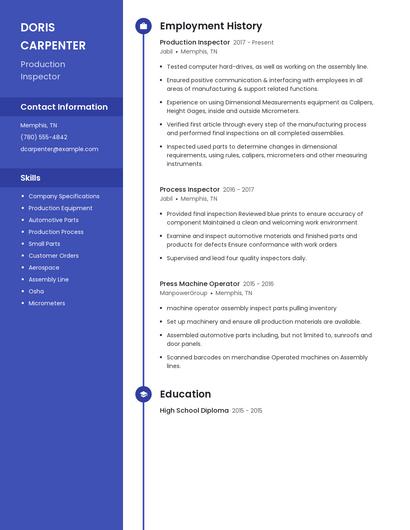
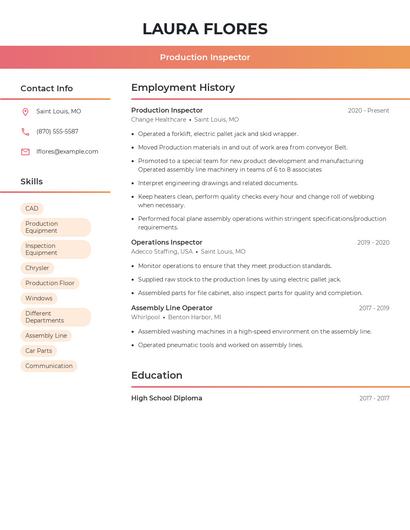
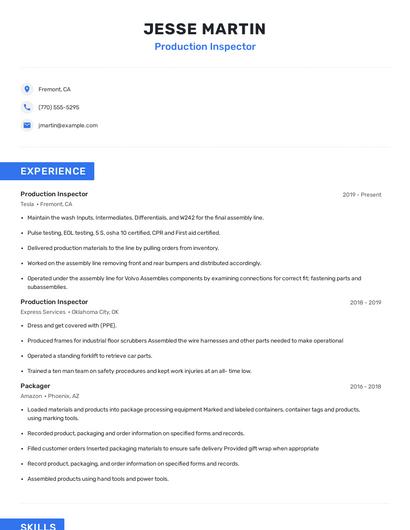
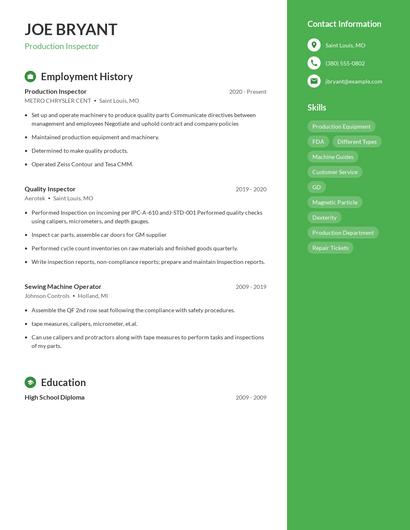
Choose from 10+ customizable production inspector resume templates
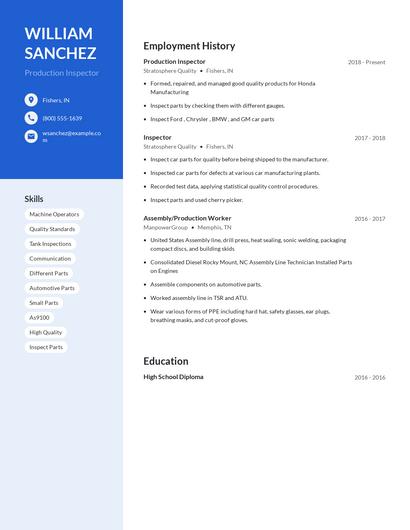
Build a professional production inspector resume in minutes. Our AI resume writing assistant will guide you through every step of the process, and you can choose from 10+ resume templates to create your production inspector resume.



Compare different production inspectors
Production inspector vs. Test operator
The job of a test operator is to test the functionality of electronic components, assemblies, units, parts, and systems in a manner consistent with standard procedures. As a test operator, you will perform a variety of duties that include working with engineers to ensure accurate procedures are being followed, perform different mechanical assembly operations, and inspecting products for the correct orientation and placement. Additionally, you will assemble electronics in their boxes and notify the quality/test engineer if the test yields below the acceptable levels.
These skill sets are where the common ground ends though. The responsibilities of a production inspector are more likely to require skills like "customer satisfaction," "calipers," "troubleshoot," and "osha." On the other hand, a job as a test operator requires skills like "hand tools," "test procedures," "test results," and "safety rules." As you can see, what employees do in each career varies considerably.
Test operators tend to make the most money working in the technology industry, where they earn an average salary of $44,634. In contrast, production inspectors make the biggest average salary, $37,078, in the automotive industry.On average, test operators reach similar levels of education than production inspectors. Test operators are 0.1% less likely to earn a Master's Degree and 0.0% less likely to graduate with a Doctoral Degree.Production inspector vs. Inspector general
An inspector general is responsible for doing audit reports and inspections to ensure that no possible fraud, misconduct, corruption, or power abuse in the government or private sector occurs. Their role is to monitor and inspect the agencies' effectiveness, assess possible mismanagement of a company, and improve the economy. Also, they usually conduct and review audit reports or investigations to ensure an agency's compliance to the policies and guidelines.
While some skills are similar in these professions, other skills aren't so similar. For example, resumes show us that production inspector responsibilities requires skills like "production equipment," "safety procedures," "customer satisfaction," and "calipers." But an inspector general might use other skills in their typical duties, such as, "ig," "oig," "dod," and "corrective action."
Inspectors general earn a higher average salary than production inspectors. But inspectors general earn the highest pay in the government industry, with an average salary of $59,592. Additionally, production inspectors earn the highest salaries in the automotive with average pay of $37,078 annually.Average education levels between the two professions vary. Inspectors general tend to reach higher levels of education than production inspectors. In fact, they're 14.2% more likely to graduate with a Master's Degree and 0.0% more likely to earn a Doctoral Degree.Production inspector vs. Quality assurance inspector
Quality Assurance Auditors are employees who ensure the adherence of other employees to company processes and guidelines. They are expected to be experts on quality assurance processes and procedures. They also have in-depth knowledge of the expected outcomes of such processes to ensure that the company only provides quality products and services. Quality assurance auditors are also familiar with regulatory laws and policies of governing bodies that oversee companies in their particular industry. They ensure that their companies are compliant and may conduct random quality checks every now and then.
There are many key differences between these two careers, including some of the skills required to perform responsibilities within each role. For example, a production inspector is likely to be skilled in "production equipment," "customer satisfaction," "troubleshoot," and "osha," while a typical quality assurance inspector is skilled in "micrometers," "corrective action," "inspection reports," and "basic math."
Quality assurance inspectors earn the best pay in the government industry, where they command an average salary of $48,138. Production inspectors earn the highest pay from the automotive industry, with an average salary of $37,078.quality assurance inspectors typically earn similar educational levels compared to production inspectors. Specifically, they're 1.7% more likely to graduate with a Master's Degree, and 0.2% more likely to earn a Doctoral Degree.Production inspector vs. Quality control inspector
Quality control associate scientist roles require good observation, critical thinking, and communication skills, in addition to knowledge of procedures and chemistry. They assist in laboratory experiments and research, while working in a team or independently. Working with the lead scientist, associates may compile reports of their data findings.
Types of production inspector
Updated January 8, 2025
