
Automatically apply for jobs with Zippia
Upload your resume to get started.
Program facilitator skills for your resume and career

15 program facilitator skills for your resume and career
1. Program Curriculum
- Collaborated with a team in developing program curriculum and provide training for teachers seeking to pursue National Board Certification.
- Provided input into program curriculum and assisted in planning activities.
2. Substance Abuse
- Utilized the Seeking Safety curriculum; a dual-diagnosed psycho-educational model addressing both PTSD and substance abuse.
- Facilitated Addictions Awareness Program as an educational group for DUI and other substance abuse related offenders.
3. CPR
Cardiopulmonary resuscitation or CPR is a medical procedure that involves chest compression to help a patient breathe. This artificial ventilation helps in keeping the brain function in place and regulates blood throughout the body. CPR is a lifesaving procedure that is used in emergencies.
- Maintain up to date certification with Red Cross CPR and WSI (Water Safety Instruction) protocol.
- Completed skill training for Red Cross CPR, Program Aide and facilitator, Survival and Babysitting.Habitat for Humanity ; Acknowledge Ministries.
4. Group Discussions
- Lead many camp activities and facilitate educational group discussions with campers.
- Empowered participants to make changes in the world through classroom instruction, hands-on activities, simulation exercises and group discussions.
5. Youth Development
Youth Development is a gradual process that is designed to equip a young person, teenager, or adolescent with the necessary skills and mindset to grow into a mature and successful adult. This involves initiating activities that will help the youth advance mentally, socially, psychologically and grow in cognitive reasoning. The activities may include community service, mentoring programs, physical training, skill training, and many other innovative ways the youth development expert can come up with to achieve the goal.
- Coordinated various youth development programs and monitored the outcome measurement.
- Utilize gender responsive programming, positive youth development, and strengths-based approaches for best practices and desired outcomes.
6. Mental Health
Mental health is the state of wellbeing in which an individual can cope with the regular stresses and tensions of life, and can work productively without having any emotional or psychological breakdown. Mental health is essential for a person of any age and helps them make the right decisions in their life.
- Provided social-emotional care and partnered with Mental Health Counselor with individual students and cohorts.
- Develop and present mental health lectures for community organizations.
Choose from 10+ customizable program facilitator resume templates
Build a professional program facilitator resume in minutes. Our AI resume writing assistant will guide you through every step of the process, and you can choose from 10+ resume templates to create your program facilitator resume.7. Behavioral Strategies
- Carry out behavioral strategies, including crisis intervention, in accordance with student's EIP, BIP, and APTS.
- Carry out behavioral strategies, including crisis intervention, while ensuring staff and student safety.
8. Professional Development
Professional development means to have the essential training certification or education with the purpose of earning and having a successful career. Every job requires a different set of skills. However, new skills may be needed in the future. Professional development, in this regard, helps people to develop and polish the skills and become efficient workers.
- Facilitated professional development workshops on effective teaching strategies using the system for teacher and student advancement rubric.
- Provide leadership and guidance in the effective and efficient allocation of professional development to promote student mastery.
9. Group Facilitation
- Group Facilitation for ADVANCE, Women Choosing Non-Violence, and Fatherhood Programs.
- Group facilitation for youth and adults Individual counseling.
10. Crisis Intervention
- Provided case management, crisis intervention and individual counseling.
- Facilitated crisis intervention to ensure client safety and well-being.
11. Conflict Resolution
Conflict resolution is an often necessary skill in business, employed for processes such as contract negotiations, legal matters, and even personal, emotional situations and conflicts. It is the ability to find and create an appropriate and peaceful solution to some sort of dilemma or argument in which two or more parties are involved. The resolution itself must benefit and satisfy all parties and this is what makes it so difficult to reach a peaceful point sometimes.
- Mediated problem solving and conflict resolution involving verbal and physical contact.
- Provided conflict resolution between families and individuals during the programs.
12. Mathematics
- Provide individual and group tutoring in areas including but not limited to; reading, writing, mathematics and study skills.
- Provided one-on-one tutoring for MESA students with diverse background who have needs in Chemistry, Mathematics, and Physics.
13. Community Outreach
- Developed community outreach opportunities geared toward resource development.
- Participate in Community Outreach events.
14. Community Events
Community events are the events scheduled within the community.
- Facilitated programs, provided tutoring, mentoring, and life skills, facilitated teamwork, organized administrative information and community events.
- Provided agency information at community events.
15. Role Model
A role model is a person with desirable qualities who inspires other people to emulate their example.
- Create leadership and role modeling to help group members understand and respect the rights, differences, and similarities of others.
- Educated youth on topics such as resisting peer pressure, planning for the future, and being a good role model.
5 Program Facilitator resume examples
Build a professional program facilitator resume in minutes. Browse through our resume examples to identify the best way to word your resume. Then choose from 5+ resume templates to create your program facilitator resume.

What skills help Program Facilitators find jobs?
Tell us what job you are looking for, we’ll show you what skills employers want.
What program facilitator skills would you recommend for someone trying to advance their career?
Jordan Levy Ph.D.
Associate Professor of Anthropology, Pacific Lutheran University
What type of skills will young program facilitators need?
Jamelyn Tobery-Nystrom
Coordinator of M.Ed. Special Education, Frostburg State University
List of program facilitator skills to add to your resume
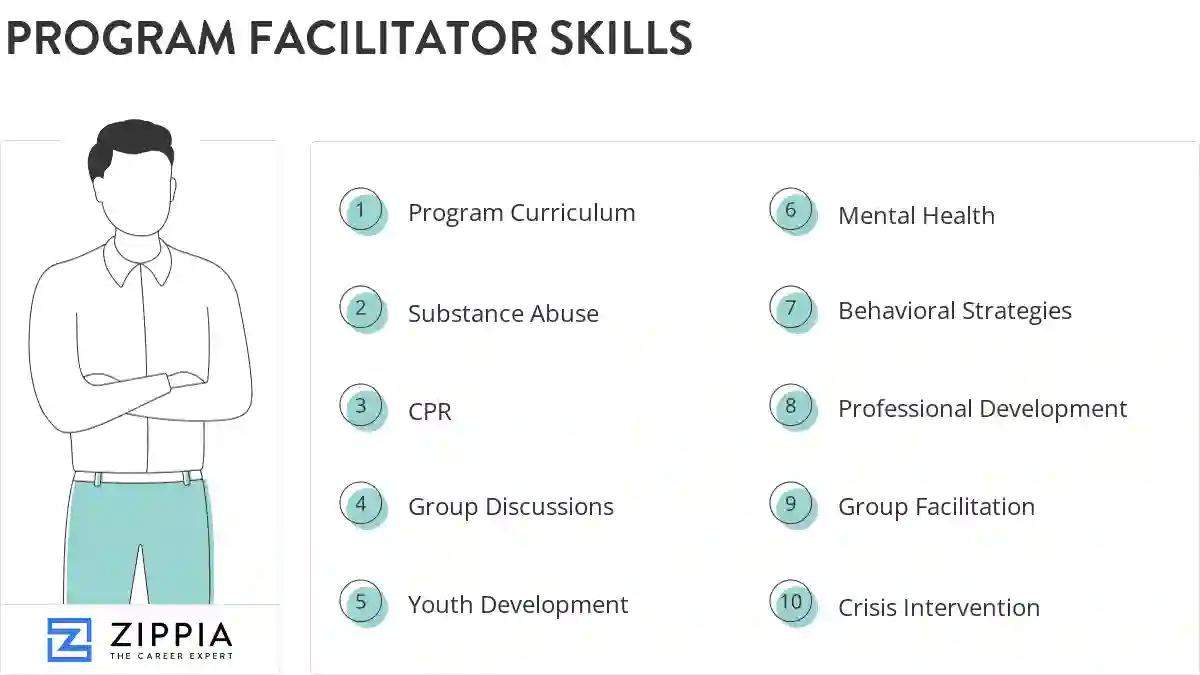
The most important skills for a program facilitator resume and required skills for a program facilitator to have include:
- Program Curriculum
- Substance Abuse
- CPR
- Group Discussions
- Youth Development
- Mental Health
- Behavioral Strategies
- Professional Development
- Group Facilitation
- Crisis Intervention
- Conflict Resolution
- Mathematics
- Community Outreach
- Community Events
- Role Model
- Public Schools
- Girl Scouts
- Educational Programs
- Program Development
- Community Resources
- Community Services
- Mental Illness
- Group Sessions
- School Programming
- Developmental Disabilities
- Domestic Violence
- Administrative Tasks
- Community Organizations
- Training Sessions
- Classroom Management
- at-Risk Youth
- Led Training
- Data Collection
- IEP
- Guest Speakers
- School Administration
- Elementary Schools
- Anger Management
- Intervention Plan
- Community Agencies
- Group Therapy
- Academic Support
- Education Plan
- HIV
- Leadership
- Summer Program
- PowerPoint
- Volunteer Recruitment
Updated January 8, 2025
