
Automatically apply for jobs with Zippia
Upload your resume to get started.
Project manager/senior project engineer skills for your resume and career
15 project manager/senior project engineer skills for your resume and career
1. Project Management
- Project management for estimation, design and construction of process, manufacturing and environmental projects for Japanese Design/Build company.
- Developed, initiated and implemented monthly forecasts into the IECS Project Management by partnering with Capacity Management and Planning.
2. Project Scope
- Defined project scope thought presentations and facilitating numerous requirements gathering sessions with users.
- Developed the project scope and established scope management procedures.
3. Autocad
- Developed documentation related to design and proper configuration of system components with AutoCAD.
- Designed possible building concept of expansion using AutoCAD including plans, sections and elevations and renderings.
4. Business Development
Business development is the ideas or initiatives that work to make business work better. Selling, advertising, product development, supply chain management, and vendor management are only a few of the divisions involved with it. There is still a lot of networking, negotiating, forming alliances, and trying to save money. The goals set for business development guide and coordinate with all of these various operations and sectors.
- Boosted bottom-line profits by performing all facets of consulting and business development and coordinating between owner and sub-consultants.
- Involved in business development activities including marketing and preparation of project understanding statements (PUS).
5. SR Project
- Maintained document control for all MSR projects from 2003 2013.
6. Cost Estimates
- Developed engineering cost estimates and schedules using Microsoft Project.
- Developed investigation reports with accurate cost estimates.
Choose from 10+ customizable project manager/senior project engineer resume templates
Build a professional project manager/senior project engineer resume in minutes. Our AI resume writing assistant will guide you through every step of the process, and you can choose from 10+ resume templates to create your project manager/senior project engineer resume.7. Capital Projects
A capital project is a long-term project carried out by professional teams to build, improve, maintain or develop a huge project that will help improve the asset of a city. This project involves a significant and constant flow of investments. A capital project can be new construction, the purchase of land or property, leasing a property, the renovation of an existing building, or the purchase of new equipment.
- Support all plant operations, initiate new capital projects, establish annual capital budget, capital expenditure requests and justifications.
- Fueled revenue growth by successfully coordinating 4 major capital projects and efficiently executing them concurrently during a single plant shutdown.
8. R
R is a free software environment and a language used by programmers for statistical computing. The R programming language is famously used for data analysis by data scientists.
- Translated interpolation and validation rainfall models from R to Java for application development.
- Double Statistical Sampling plan and six sigma analysis: Utilized R to produce a double statistical sampling plan for quality acceptance.
9. Design Engineering
- Performed system analysis to design engineering solutions and plan, schedule and execute hardware and system upgrades and implementations.
- Synchronized expectations and capabilities of design engineering and production teams by initiating better communication procedures.
10. Risk Management
Risk management is the method of recognizing, evaluating, and managing risks to an organization's resources and profits. Financial insecurity, regulatory liability, strategic management mistakes, incidents, and natural hazards are just some of the challenges or dangers that could arise. For digitalized businesses, IT security vulnerabilities and data-related threats, as well as risk management techniques to mitigate them, have become top priorities.
- Developed the first comprehensive Risk Management & Project Plans detailing stage-gate methodology including periodic human factors/usability testing.
- Coordinate and manage across functionally plant's risk management programs and ensure that the mitigation controls are implemented and updated accordingly.
11. Microsoft Project
- Utilized Microsoft Project for scheduling and evaluating litigation claims.
- Project Scheduling using Microsoft Project.
12. Process Improvement
- Facilitated JAD sessions with stakeholders to capture requirements and identify opportunities for process improvement; identified and managed project risks.
- Support Research and Development to increase performance and reliability via process improvement and utilization of new technology.
13. Construction Management
- Managed construction services under general contractor or construction management agreements.
- Provided on-site construction management of electrical and mechanical trades.
14. CAD
- Released and published engineering CAD drawings, finite element, technical service bulletins, and maintenance/operation manuals.
- Maintained and updated facility CAD drawings of workstation and office re-configurations.
15. Construction Projects
A construction project is an organized process of constructing, redeveloping, renovating, or otherwise improving a building, or structure. The project phase begins usually as a broad criterion that is then made with the help of a brief, feasibility analysis, funding, and planning. The majority of construction projects are one-time jobs.
- Coordinated all work being performed on engineering and construction projects with engineering project managers and petrochemical/refining clients.
- Prepared and updated construction budgets and schedules for commercial and single family residential construction projects.
5 Project Manager/Senior Project Engineer resume examples
Build a professional project manager/senior project engineer resume in minutes. Browse through our resume examples to identify the best way to word your resume. Then choose from 5+ resume templates to create your project manager/senior project engineer resume.

What skills help Project Managers/Senior Project Engineer find jobs?
Tell us what job you are looking for, we’ll show you what skills employers want.
What skills stand out on project manager/senior project engineer resumes?
M. Stephen Enders Ph.D.
Professor & Department Head, Colorado School of Mines
Additionally: Presentation skills - written and oral. Management skills - CSM mining engineers have 3 to 4 courses focusing on management (mine operations, safety, construction and project mgt.), plus opportunities to work as crew fore(wo)men at the Edgar mine, where they get to lead small teams of junior classmates and assume responsibility for safety and job completion.
What soft skills should all project manager/senior project engineers possess?
Dr. John Ballato
J. E. Sirrine Endowed Chair and Professor, Clemson University
What hard/technical skills are most important for project manager/senior project engineers?
Dr. John Ballato
J. E. Sirrine Endowed Chair and Professor, Clemson University
What project manager/senior project engineer skills would you recommend for someone trying to advance their career?
Nicole Jones Young Ph.D.
Assistant Professor of Organizational Behavior, Franklin and Marshall College
For students who opt not enter the workforce immediately upon graduation, I would recommend that they utilize this time in a strategic fashion, primarily expanding their network, increasing their skills related to data analytics/analysis, and reading or researching within the broader business field as well as their particular field of interest. Expanding your network is always beneficial because of the value employers place on referrals. If students do not know where to start, I would recommend they join their applicable professional organization and begin attending events (virtual events can still help build relationships).
While specific job duties may differ, the ability to understand and utilize data is in high demand in virtually every job role. Having comfort with data-both quantitative and qualitative--can be a highly beneficial skill that many in the job market may not have to offer.
I also recommend continued reading and researching, as whenever you do enter the workforce you want to know what is going on. I am never surprised, but always disappointed when I ask my students if they heard the latest job numbers or if they saw a recent news article. It is hard to articulate your value to an organization's problems if you are unaware of what they are. Stay current.
Interestingly, I would not recommend that someone enroll in a graduate program simply to take up time. If you just love school, have a clear focus, or had already planned to enroll in graduate school prior to COVID, then proceed. However, if you are unsure about your interests or future career goals, enrolling in a graduate program may be a large investment of time and money that may not result in securing a job of interest upon completion.
What type of skills will young project manager/senior project engineers need?
Robert Mcnab Ph.D.
Professor of Economics, Old Dominion University
What technical skills for a project manager/senior project engineer stand out to employers?
Martin Pietrucha Ph.D.
Program Coordinator and Professor, Pennsylvania State University
List of project manager/senior project engineer skills to add to your resume
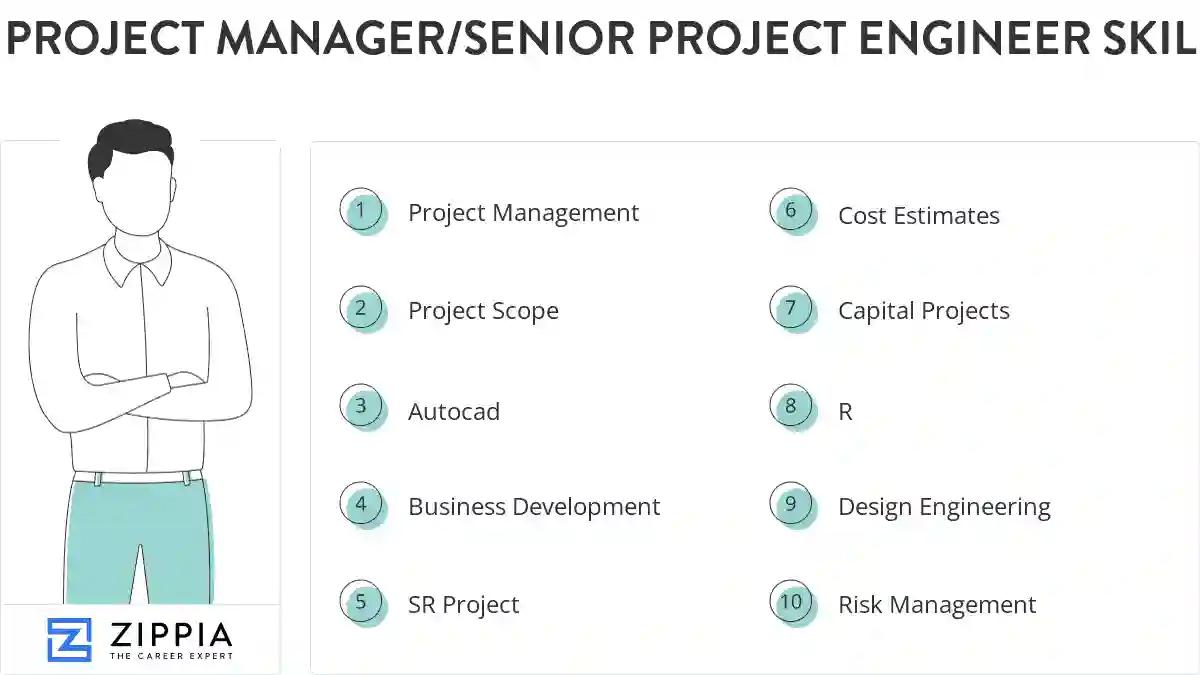
The most important skills for a project manager/senior project engineer resume and required skills for a project manager/senior project engineer to have include:
- Project Management
- Project Scope
- Autocad
- Business Development
- SR Project
- Cost Estimates
- Capital Projects
- R
- Design Engineering
- Risk Management
- Microsoft Project
- Process Improvement
- Construction Management
- CAD
- Construction Projects
- Technical Support
- Technical Specifications
- Project Budget
- Control Systems
- Emerging Technologies
- MEP
- HVAC
- Sigma
- Engineering Support
- Design Reviews
- Budget Management
- PLC
- Product Design
- Geotechnical
- Shop Drawings
- ISO
- Direct Reports
- System Design
- Agile Project Management
- PMO
- Retaining Walls
- RFQ
- Manage Cross
- FDA
- Cost Savings
- Cost Control
- DOD
- RF
- SQL
- RFP
- DFMEA
- Earned Value Management
- Retrofit
Updated January 8, 2025
