What does a protective services social worker do?
A Protective Services Social Worker provides counseling, rehabilitation, or placement services for children and adults who are disabled. They also help individuals or families deal with domestic violence, traumatic events, or terminal illnesses.
Protective services social worker responsibilities
Here are examples of responsibilities from real protective services social worker resumes:
- Manage a caseload TANF clients, assess clients eligibility to receive benefits, assist with placement of clients in various programs.
- Coordinate admissions of active duty service members and veterans to the inpatient rehabilitation/medical unit after suffering a new spinal cord injury.
- Perform related adoptions and supervisory visits for state adoptions.
Protective services social worker skills and personality traits
We calculated that 15% of Protective Services Social Workers are proficient in Social Work, Protective Services, and Crisis Intervention. They’re also known for soft skills such as Emotional skills, Communication skills, and Interpersonal skills.
We break down the percentage of Protective Services Social Workers that have these skills listed on their resume here:
- Social Work, 15%
Provided direct social work services with the goal of eliminating dangerous situations, improving consumer functioning, and avoiding institutionalization.
- Protective Services, 7%
Provided Protective Services to elderly and/or disabled citizens who were abused, neglected and financially exploited citizens.
- Crisis Intervention, 7%
Interviewed and assessed alleged perpetrators and victims of child abuse and neglect; conducted needs analysis and provided crisis intervention.
- Community Resources, 6%
Coordinated community resources, training, and assisted families and individuals in enrolling in developmental and support programs.
- Social Services, 6%
Performed office and field work required in providing continuing preventive and rehabilitative social services to clients and their families.
- Foster Care, 5%
Participated in interdisciplinary team meetings to ensure safety of children in foster care and home placements.
Common skills that a protective services social worker uses to do their job include "social work," "protective services," and "crisis intervention." You can find details on the most important protective services social worker responsibilities below.
Communication skills. Another essential skill to perform protective services social worker duties is communication skills. Protective services social workers responsibilities require that "clients talk to social workers about challenges in their lives." Protective services social workers also use communication skills in their role according to a real resume snippet: "foster communication with law enforcement agencies, school districts, medical centers, and other mandated reporters s needed. "
Interpersonal skills. This is an important skill for protective services social workers to perform their duties. For an example of how protective services social worker responsibilities depend on this skill, consider that "social workers must be able to work with different groups of people." This excerpt from a resume also shows how vital it is to everyday roles and responsibilities of a protective services social worker: "demonstrate excellent interpersonal and counseling skills. ".
Organizational skills. A big part of what protective services social workers do relies on "organizational skills." You can see how essential it is to protective services social worker responsibilities because "social workers must help and manage multiple clients, often assisting with their paperwork or documenting their treatment." Here's an example of how this skill is used from a resume that represents typical protective services social worker tasks: "developed and composed written policies addressing sensitive organizational issues such as suicide, domestic violence in the work place and bullying. "
Problem-solving skills. Another crucial skill for a protective services social worker to carry out their responsibilities is "problem-solving skills." A big part of what protective services social workers relies on this skill, since "social workers must analyze their clients’ complex situations and develop practical solutions." How this skill relates to protective services social worker duties can be seen in an example from a protective services social worker resume snippet: "attended cps court related hearings, and utilized problem-solving and organization skills to assist with at risk case management. "
Compassion. While "compassion" is last on this skills list, don't underestimate its importance to protective services social worker responsibilities. Much of what a protective services social worker does relies on this skill, seeing as "social workers often work with people who are in stressful and difficult situations." Here is a resume example of how this skill is used in the everyday duties of protective services social workers: "showed compassion and a caring attitude during times when they become overwhelmed with anxiety or other environmental stressors. "
The three companies that hire the most protective services social workers are:
- Springwell1 protective services social workers jobs
- Johnston Companies1 protective services social workers jobs
- New Bridge Medical Center1 protective services social workers jobs
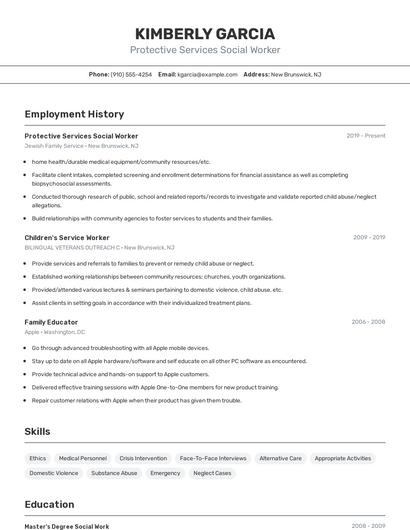
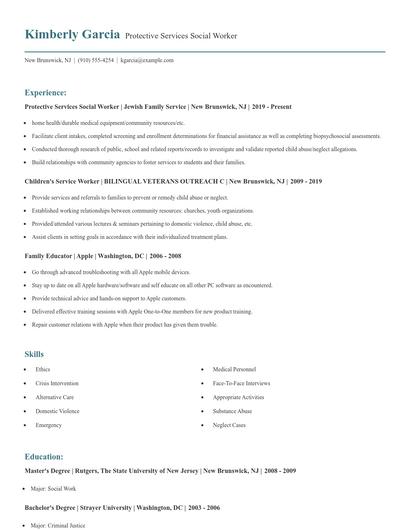
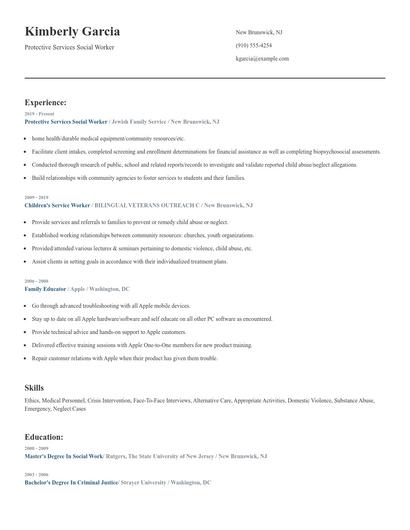
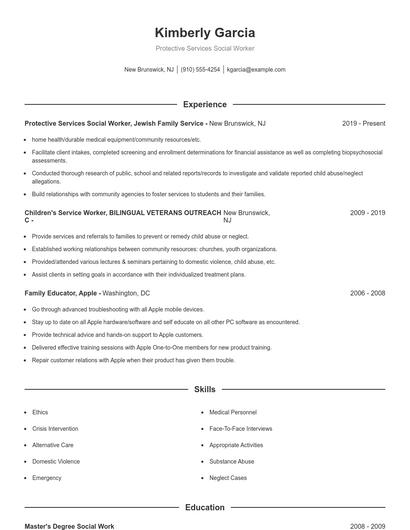
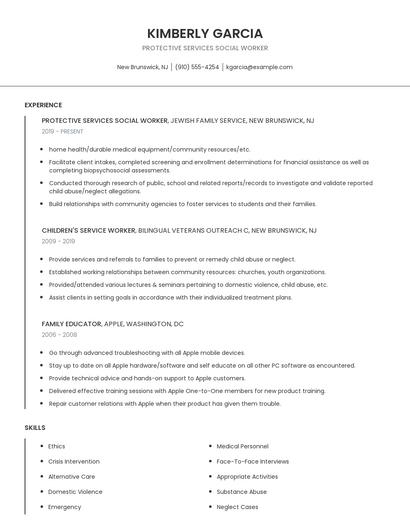
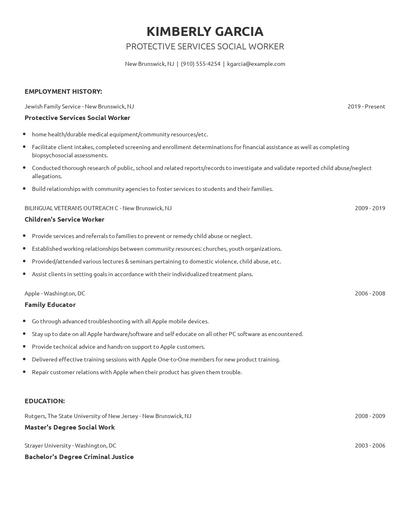
Choose from 10+ customizable protective services social worker resume templates
Build a professional protective services social worker resume in minutes. Our AI resume writing assistant will guide you through every step of the process, and you can choose from 10+ resume templates to create your protective services social worker resume.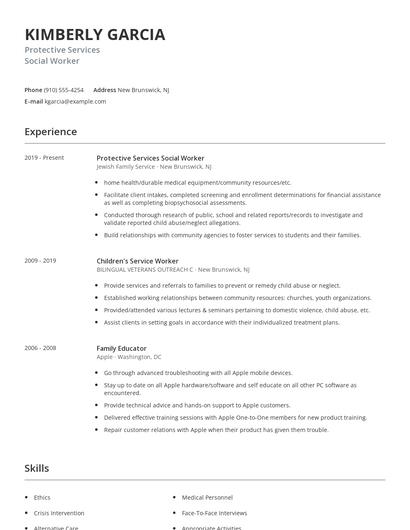


Compare different protective services social workers
Protective services social worker vs. Family therapist
A Family Therapist works with couples and families to help ameliorate marital and family issues. They can work in hospitals, treatment programs, government agencies, health organizations, and private practices.
These skill sets are where the common ground ends though. The responsibilities of a protective services social worker are more likely to require skills like "protective services," "in-home," "child welfare," and "vulnerable adults." On the other hand, a job as a family therapist requires skills like "patients," "rehabilitation," "mental health issues," and "group therapy." As you can see, what employees do in each career varies considerably.
Family therapists earn the highest salaries when working in the health care industry, with an average yearly salary of $50,267. On the other hand, protective services social workers are paid more in the hospitality industry with an average salary of $53,241.family therapists tend to reach higher levels of education than protective services social workers. In fact, family therapists are 26.5% more likely to graduate with a Master's Degree and 1.1% more likely to have a Doctoral Degree.Protective services social worker vs. Child welfare specialist
Child welfare specialists are professionals who are responsible for protecting children and youngsters from harm by visiting their homes and other residential facilities to investigate their living conditions. These specialists are required to determine the suitability of the homes and resources of foster and adoptive parents for child placement. They must serve as child advocates by attending court proceedings to provide inclusive court proceedings. Child welfare specialists must also work closely with local enforcement to ensure the safety of children.
Each career also uses different skills, according to real protective services social worker resumes. While protective services social worker responsibilities can utilize skills like "family assessments," "in-home," "mental health professionals," and "vulnerable adults," child welfare specialists use skills like "child safety," "adoptive parents," "law enforcement entities," and "dcfs."
Child welfare specialists earn a lower average salary than protective services social workers. But child welfare specialists earn the highest pay in the technology industry, with an average salary of $48,390. Additionally, protective services social workers earn the highest salaries in the hospitality with average pay of $53,241 annually.Average education levels between the two professions vary. Child welfare specialists tend to reach similar levels of education than protective services social workers. In fact, they're 2.7% less likely to graduate with a Master's Degree and 1.1% more likely to earn a Doctoral Degree.What technology do you think will become more important and prevalent for protective services social workers in the next 3-5 years?
Virginia Schwindt
MSW Field Director/Associate Professor, Union University
Protective services social worker vs. Family specialist
A Family Specialist performs social work for families in need. They are focused on helping individuals and families to improve their lives.
Some important key differences between the two careers include a few of the skills necessary to fulfill the responsibilities of each. Some examples from protective services social worker resumes include skills like "protective services," "in-home," "child welfare," and "mental health professionals," whereas a family specialist is more likely to list skills in "substance abuse," "child abuse," "child development," and "family support. "
Family specialists make a very good living in the technology industry with an average annual salary of $55,461. On the other hand, protective services social workers are paid the highest salary in the hospitality industry, with average annual pay of $53,241.Most family specialists achieve a similar degree level compared to protective services social workers. For example, they're 2.8% less likely to graduate with a Master's Degree, and 0.2% less likely to earn a Doctoral Degree.Protective services social worker vs. Family support specialist
A family support specialist is an individual who provides counseling and rehabilitation services to families who are facing crises so that their lives can be improved. Family support specialists conduct interviews with members of a family to determine areas that need support such as anti-social behavior, bullying, or domestic violence. They collaborate with healthcare and social professionals to evaluate caseload needs. In cases of relevant child protection, family support specialists are also required to attend court sessions.
Even though a few skill sets overlap between protective services social workers and family support specialists, there are some differences that are important to note. For one, a protective services social worker might have more use for skills like "protective services," "social services," "family assessments," and "in-home." Meanwhile, some responsibilities of family support specialists require skills like "child abuse," "patients," "child development," and "family services. "
The professional industry tends to pay the highest salaries for family support specialists, with average annual pay of $38,192. Comparatively, the highest protective services social worker annual salary comes from the hospitality industry.The average resume of family support specialists showed that they earn lower levels of education compared to protective services social workers. So much so that theyacirc;euro;trade;re 7.7% less likely to earn a Master's Degree and less likely to earn a Doctoral Degree by 0.2%.Types of protective services social worker
Updated January 8, 2025
