What does a quality engineer/process engineer do?
Quality testers are professionals who are responsible for running various tests on manufactured products or software to ensure that they meet all standards and guidelines as well as ready to be marketed to consumers. These testers must participate in review meetings with project managers and developers during the project planning and implementation of various quality assurance (QA) methodologies. They must communicate test results with other team members to identify issues. Quality testers must also work with business users to define business requirements and analyze the possible technical solutions.
Quality engineer/process engineer responsibilities
Here are examples of responsibilities from real quality engineer/process engineer resumes:
- Lead and assist maintenance in resolving equipment malfunctions, troubleshoot process problems, and organize and implement preventative maintenance procedures.
- Develop optimal DFMEA approach to increase effectiveness of the tool while reducing cost.
- Design, implement and upgrade internal auditing system to demonstrate conformance to ISO and QS standards and the internal QMS.
- Involve in writing SQL queries to generate tables from the database to test reports and do verification and validation of reports.
- Supervise QA laboratory during managerial transition periods.
- Participate in domestic and international new supplier audits using ISO standards.
- Apply statistical methods to estimate future manufacturing requirements and SPC tracking & failure analysis.
- Conduct quality analysis for the manufacturing, field service and quality departments according to FDA requirements.
- Lead documentation and execution efforts for the injection molding remediation team responsible for the development and execution of IQ/OQ/PQ validations.
- Lead and assist maintenance in resolving equipment malfunctions, troubleshoot process problems, and organize and implement preventative maintenance procedures.
- Work directly with API 653 and 510 inspectors as well as fellow CWI.
- Establish pyrometry processes including training as well as conducting NADCAP pre-audits and facilitating NADCAP audits.
- Design and maintain the special process qualification system through the Nadcap accreditation process to validate internal and customer special process requirements.
Quality engineer/process engineer skills and personality traits
We calculated that 7% of Quality Engineer/Process Engineers are proficient in Continuous Improvement, Corrective Action, and Product Quality. They’re also known for soft skills such as Creativity, Listening skills, and Math skills.
We break down the percentage of Quality Engineer/Process Engineers that have these skills listed on their resume here:
- Continuous Improvement, 7%
Led Continuous Improvement Teams in Lean Manufacturing and Six Sigma principle-based efforts in eliminating quality problems and in improving efficiency.
- Corrective Action, 7%
Provide material review dispositions for non-conforming material or procedures, identifying non-conformance trends and evaluating the effectiveness of corrective actions taken.
- Product Quality, 5%
Identified potential product quality trends.
- Sigma, 5%
Required statistical analysis and meeting minimum quality requirements per the Six Sigma Quality system.
- ISO, 4%
Measure and control quality in production process by establishing, implementing and maintaining quality management system.ISO 9001:2015 internal Auditor
- Process Improvement, 4%
Performed statistical analysis on multivariate quality control data and derived insights in order to provide recommendations for continuous process improvement.
Common skills that a quality engineer/process engineer uses to do their job include "continuous improvement," "corrective action," and "product quality." You can find details on the most important quality engineer/process engineer responsibilities below.
Creativity. One of the key soft skills for a quality engineer/process engineer to have is creativity. You can see how this relates to what quality engineer/process engineers do because "industrial engineers use creativity and ingenuity to design new production processes in many kinds of settings in order to reduce the use of material resources, time, or labor while accomplishing the same goal." Additionally, a quality engineer/process engineer resume shows how quality engineer/process engineers use creativity: "controlled inventory levels on erp and worked with plant manufacturing operations and logistics teams, suppliers, and demand planning department. "
Listening skills. Another essential skill to perform quality engineer/process engineer duties is listening skills. Quality engineer/process engineers responsibilities require that "these engineers often operate in teams, but they also must solicit feedback from customers, vendors, and production staff." Quality engineer/process engineers also use listening skills in their role according to a real resume snippet: "communicated to company suppliers need for corrective action and determined suitability of completed actions. "
Math skills. Another skill that relates to the job responsibilities of quality engineer/process engineers is math skills. This skill is critical to many everyday quality engineer/process engineer duties, as "industrial engineers use the principles of calculus, trigonometry, and other advanced topics in mathematics for analysis, design, and troubleshooting in their work." This example from a resume shows how this skill is used: "performed process capability studies to evaluate cpk's and kappa statistics using minitab. "
Problem-solving skills. A big part of what quality engineer/process engineers do relies on "problem-solving skills." You can see how essential it is to quality engineer/process engineer responsibilities because "in designing facilities for manufacturing and processes for providing services, these engineers deal with several issues at once, from workers’ safety to quality assurance." Here's an example of how this skill is used from a resume that represents typical quality engineer/process engineer tasks: "develop and sustain process control, support problem resolution and promote continuous improvement. "
Speaking skills. Another crucial skill for a quality engineer/process engineer to carry out their responsibilities is "speaking skills." A big part of what quality engineer/process engineers relies on this skill, since "industrial engineers sometimes have to explain their instructions to production staff or technicians before they can make written instructions available." How this skill relates to quality engineer/process engineer duties can be seen in an example from a quality engineer/process engineer resume snippet: "interfaced with customers on corrective action plans using the 5p format and presented corrective action reports to customers. "
Writing skills. Lastly, "writing skills" is an important element of what a quality engineer/process engineer does. Quality engineer/process engineer responsibilities require this skill because "industrial engineers must prepare documentation for other engineers or scientists, or for future reference." This resume example highlights how quality engineer/process engineer duties rely on this skill: "experienced in writing pfmea 5whys and 8ds. "
See the full list of quality engineer/process engineer skills
The three companies that hire the most quality engineer/process engineers are:
- Stoughton Trailers40 quality engineer/process engineers jobs
- John Deere4 quality engineer/process engineers jobs
- General Electric4 quality engineer/process engineers jobs
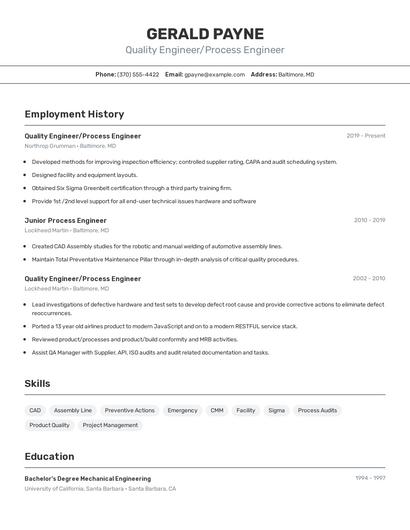
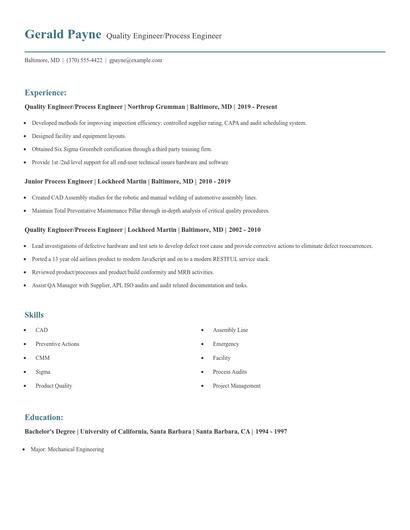
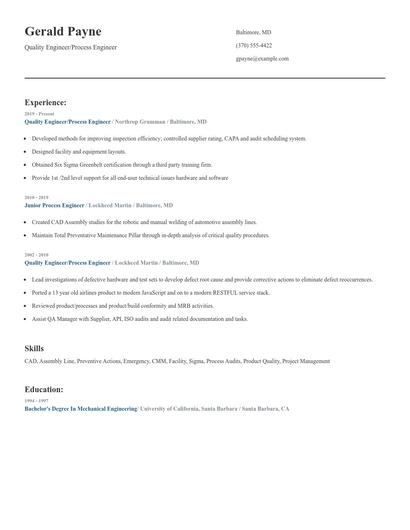
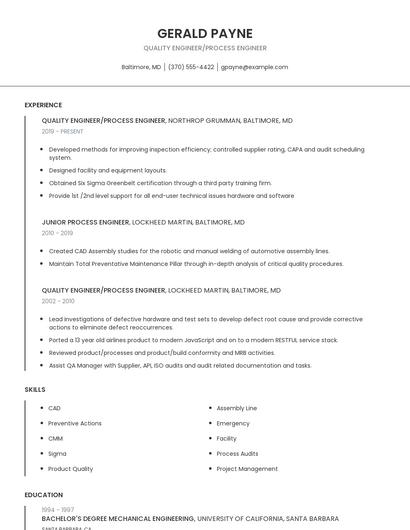
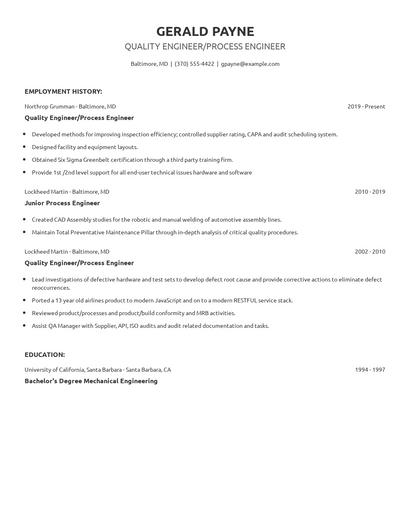
Choose from 10+ customizable quality engineer/process engineer resume templates
Build a professional quality engineer/process engineer resume in minutes. Our AI resume writing assistant will guide you through every step of the process, and you can choose from 10+ resume templates to create your quality engineer/process engineer resume.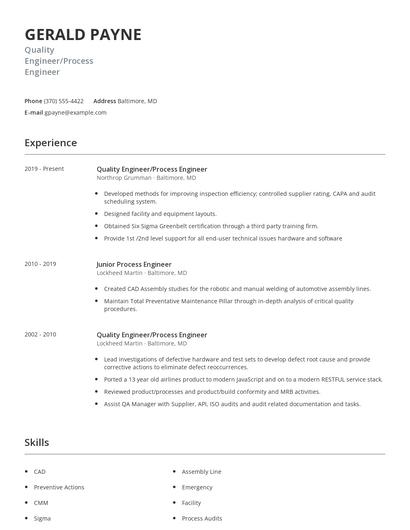



Compare different quality engineer/process engineers
Quality engineer/process engineer vs. Process improvement engineer
A process improvement engineer specializes in conducting research and analysis to develop new strategies and ideas to improve the processes in a manufacturing plant or a similar setting. They prioritize efficiency and profitability. Most of the time, engineers participate in a series of meetings where they coordinate with fellow engineers to determine opportunities for product growth and development. Moreover, a process improvement engineer is also responsible for crafting new policies and regulations, upgrading systems, and developing new practices to ensure product quality and customer satisfaction.
These skill sets are where the common ground ends though. The responsibilities of a quality engineer/process engineer are more likely to require skills like "quality procedures," "quality system," "process engineering," and "supplier quality." On the other hand, a job as a process improvement engineer requires skills like "project management," "healthcare," "performance improvement," and "patients." As you can see, what employees do in each career varies considerably.
Process improvement engineers really shine in the technology industry with an average salary of $89,829. Comparatively, quality engineer/process engineers tend to make the most money in the hospitality industry with an average salary of $77,879.On average, process improvement engineers reach similar levels of education than quality engineer/process engineers. Process improvement engineers are 4.3% more likely to earn a Master's Degree and 0.7% more likely to graduate with a Doctoral Degree.Quality engineer/process engineer vs. Project lead engineer
Project lead engineers are engineering professionals who are responsible for leading other professionals in completing a particular project. These engineers must develop a project management framework to be implemented throughout the organization based on the inputs from internal stakeholders and team members. They are required to train junior team members so that they can provide proper technical support functions. Project lead engineers must also prepare and review cost estimates for a variety of projects during bidding, construction, and post-construction phases.
Each career also uses different skills, according to real quality engineer/process engineer resumes. While quality engineer/process engineer responsibilities can utilize skills like "continuous improvement," "corrective action," "lean manufacturing," and "quality standards," project lead engineers use skills like "project management," "renewable energy," "project execution," and "engineering design."
Project lead engineers earn a higher average salary than quality engineer/process engineers. But project lead engineers earn the highest pay in the automotive industry, with an average salary of $121,074. Additionally, quality engineer/process engineers earn the highest salaries in the hospitality with average pay of $77,879 annually.Average education levels between the two professions vary. Project lead engineers tend to reach similar levels of education than quality engineer/process engineers. In fact, they're 3.2% more likely to graduate with a Master's Degree and 0.7% more likely to earn a Doctoral Degree.What technology do you think will become more important and prevalent for quality engineer/process engineers in the next 3-5 years?
Jerry Leth
VP/General Manager, MANA
Quality engineer/process engineer vs. Product support engineer
A product support engineer is responsible for resolving technical issues of end-users regarding the products and services offered by the company. Product support engineers conduct troubleshooting operations for system failures and write resolution reports for reference. They also support the product analysts in improving the product's features and processes to prevent the reoccurrence of defects and maintain optimal performance. A product support engineer designs automation procedures and runs multiple diagnostic tests to ensure high-quality outputs and avoid operational delays.
The required skills of the two careers differ considerably. For example, quality engineer/process engineers are more likely to have skills like "continuous improvement," "fmea," "lean manufacturing," and "quality standards." But a product support engineer is more likely to have skills like "product support," "troubleshoot," "customer service," and "customer support."
Product support engineers earn the best pay in the technology industry, where they command an average salary of $98,326. Quality engineer/process engineers earn the highest pay from the hospitality industry, with an average salary of $77,879.product support engineers typically earn similar educational levels compared to quality engineer/process engineers. Specifically, they're 3.0% less likely to graduate with a Master's Degree, and 0.1% less likely to earn a Doctoral Degree.Quality engineer/process engineer vs. Engineer
Engineers are highly trained professionals who determine the feasibility of various projects, usually related to the construction industry. They are considered experts in mathematics and science, two disciplines that they need to use in designing and coming up with plans for projects. They should also be well-versed in different construction or industrial materials, and they ensure that appropriate materials are used for the project. They also ensure that the projects meet the requirements of the groups that hired them. They create spaces that would both address the needs of the end-users and the industry standards. They also ensure that the projects they make would stand the test of time.
Even though a few skill sets overlap between quality engineer/process engineers and engineers, there are some differences that are important to note. For one, a quality engineer/process engineer might have more use for skills like "continuous improvement," "corrective action," "product quality," and "sigma." Meanwhile, some responsibilities of engineers require skills like "python," "cloud," "c++," and "c #. "
The automotive industry tends to pay the highest salaries for engineers, with average annual pay of $97,672. Comparatively, the highest quality engineer/process engineer annual salary comes from the hospitality industry.In general, engineers hold similar degree levels compared to quality engineer/process engineers. Engineers are 0.1% more likely to earn their Master's Degree and 0.8% more likely to graduate with a Doctoral Degree.Types of quality engineer/process engineer
Updated January 8, 2025
