What does a rate analyst do?
A rate analyst is responsible for conducting data and statistical analysis to evaluate the accurate service rates and charges for various commercial and industrial purposes. Rate analysts review the current market performance to generate rate reports and discuss service costs through comprehensive graphs and illustrations. They also analyze consumer demands and consider the factors that may affect the constant changes in charges. A rate analyst must have excellent communication and analytical skills, especially in ensuring that rate decisions comply with the regulatory guidelines and federal requirements.
Rate analyst responsibilities
Here are examples of responsibilities from real rate analyst resumes:
- Manage rate case vendor RFP development and selection process, including selection criteria, scoring and evaluation.
- Manage project team meetings using SharePoint calendars.
- Analyze energy-restructuring initiatives, rate design and retail electricity tariffs.
- Monitor rating surveillance process for existing rate securitizations back by residential mortgage loans, asset-backed securities and other structure finance assets.
- Debug rating procedures and algorithms in SQL when rating issues arises.
- Create SAS reports on HMO experience for claims monitoring and pricing decisions.
- Create SAS programs to generate statistics and reports for various department and offices.
- Streamline rating process by automating quarterly rate updates using SQL DTS (SSIS) packages.
- Involve in the development of rating assumptions, methodologies, and criteria of outstanding RMBS securities.
- Analyze tariffs and contracts to rate freight invoices present by the carrier to save clients cost of their freight charges.
- Analyze office administration support for analysts supporting DOD projects to identify efficiency opportunities to prototype and write report of analysis findings.
- Create status reports/spreadsheets to meet terms set by Medicare for financial performance as well implement required changes for cost reports.
- Perform CIP analysis and ensure accurate costs, accumulate depreciation and depreciation expense to the responsible business unit monthly.
Rate analyst skills and personality traits
We calculated that 9% of Rate Analysts are proficient in PowerPoint, Tariffs, and Financial Models. They’re also known for soft skills such as Computer skills, Detail oriented, and Math skills.
We break down the percentage of Rate Analysts that have these skills listed on their resume here:
- PowerPoint, 9%
Collaborated with random levels of management and field representatives to gather feedback and share actual statistics via PowerPoint presentations.
- Tariffs, 8%
Prepared and filed tariffs during electric industry restructuring in Regulatory Relations Dept.
- Financial Models, 7%
Incorporated purchased water system into financial models, forecasting, and data bases.
- Strong Analytical, 7%
Demonstrated strong analytical and business problem solving skills; able to understand complex business system functionality and develop strategies.
- Rate Design, 7%
Analyzed revenue and return impacts under different rate designs and negotiated customer contracts.
- Financial Analysis, 5%
Performed financial analysis including ratio analysis, NPV, IRR, financial modeling and sensitivity analysis.
Common skills that a rate analyst uses to do their job include "powerpoint," "tariffs," and "financial models." You can find details on the most important rate analyst responsibilities below.
Computer skills. To carry out their duties, the most important skill for a rate analyst to have is computer skills. Their role and responsibilities require that "financial analysts must be adept at using software to analyze financial data and trends, create portfolios, and make forecasts." Rate analysts often use computer skills in their day-to-day job, as shown by this real resume: "managed the publication of all motor freight tariffs and computer data input for rating and billing. "
Detail oriented. Another essential skill to perform rate analyst duties is detail oriented. Rate analysts responsibilities require that "financial analysts must pay attention when reviewing a possible investment, as even small issues may have large implications for its health." Rate analysts also use detail oriented in their role according to a real resume snippet: "developed detailed financial models for projecting future cash flows, leverage and debt protection metrics. "
Math skills. rate analysts are also known for math skills, which are critical to their duties. You can see how this skill relates to rate analyst responsibilities, because "financial analysts use mathematics to estimate the value of financial securities." A rate analyst resume example shows how math skills is used in the workplace: "created sas programs to generate statistics and reports for various department and offices. "
Analytical skills. For certain rate analyst responsibilities to be completed, the job requires competence in "analytical skills." The day-to-day duties of a rate analyst rely on this skill, as "financial analysts must evaluate a range of information in finding profitable investments." For example, this snippet was taken directly from a resume about how this skill applies to what rate analysts do: "research, analysis, development, and implementation of rate structures and prices. "
Communication skills. Another common skill required for rate analyst responsibilities is "communication skills." This skill comes up in the duties of rate analysts all the time, as "financial analysts must be able to clearly explain their recommendations to clients." An excerpt from a real rate analyst resume shows how this skill is central to what a rate analyst does: "express written and oral communications, strong customer service skills present and excellent time management skills. "
The three companies that hire the most rate analysts are:
- Exelon6 rate analysts jobs
- Deringer-Ney Inc.6 rate analysts jobs
- Eversource Energy4 rate analysts jobs
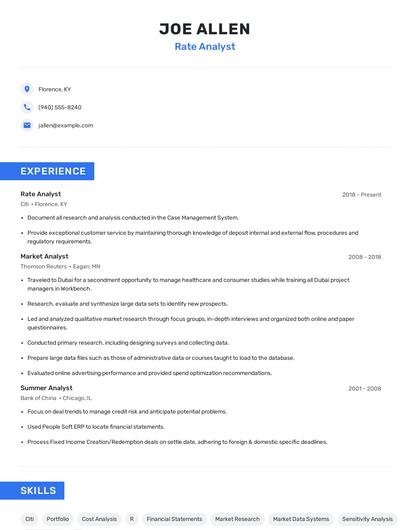
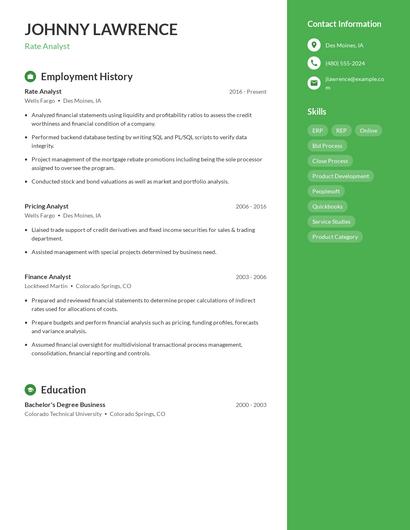
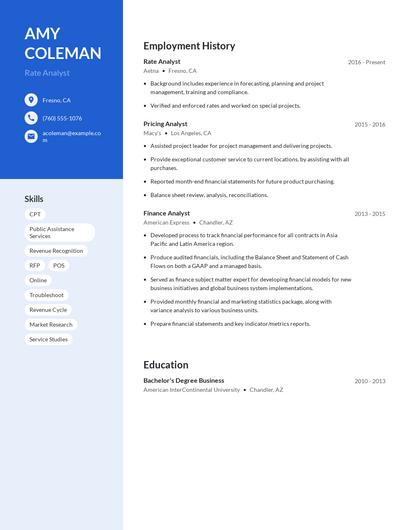
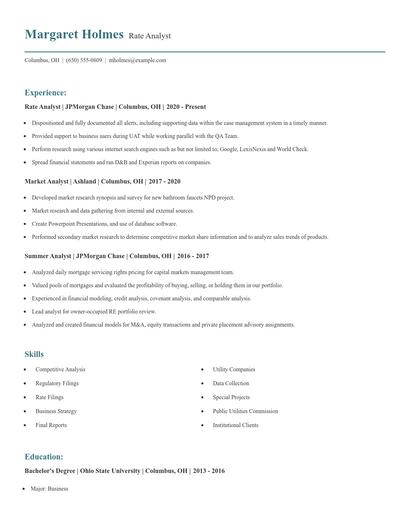
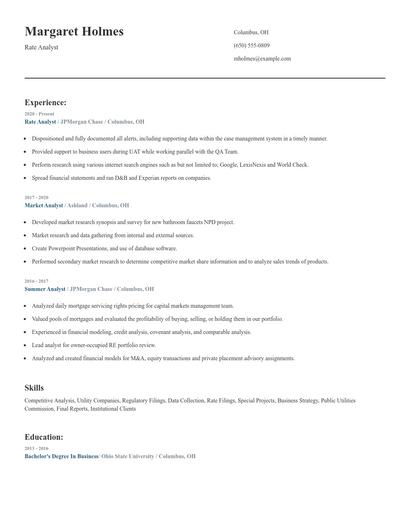
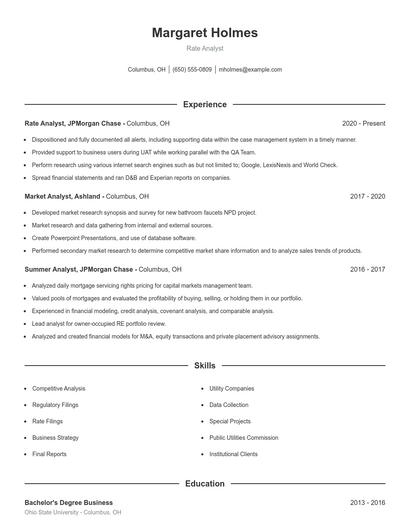
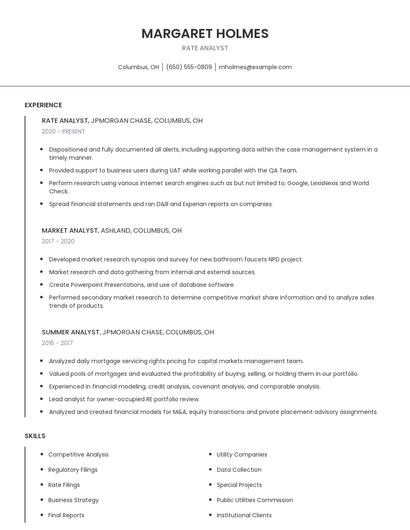
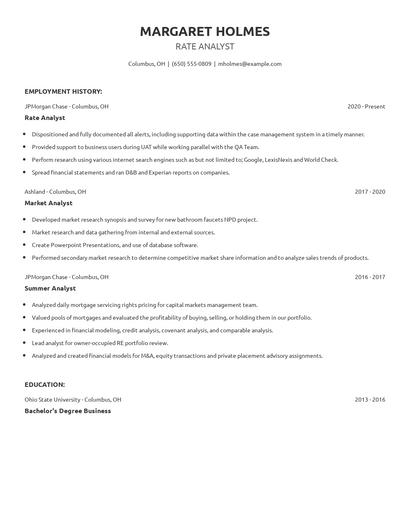
Choose from 10+ customizable rate analyst resume templates
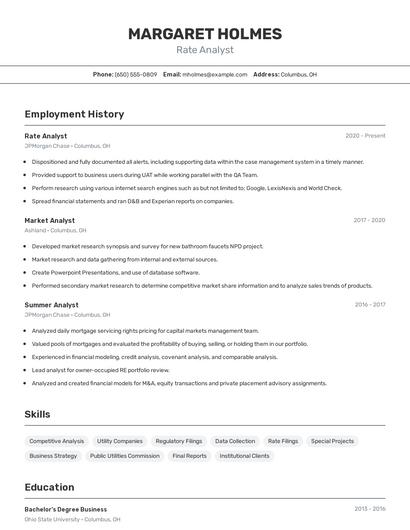
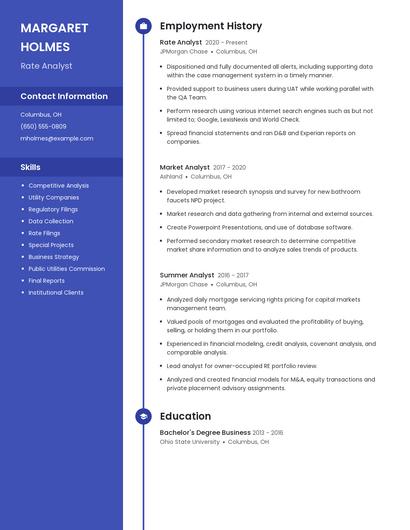
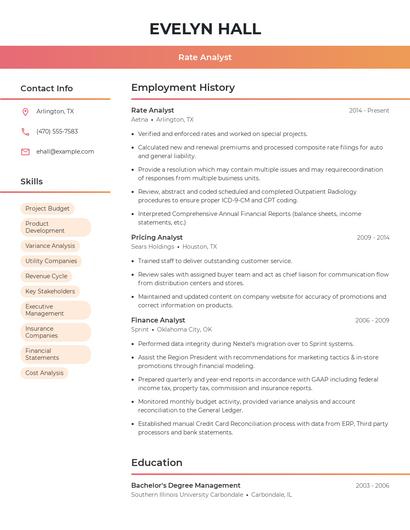
Build a professional rate analyst resume in minutes. Our AI resume writing assistant will guide you through every step of the process, and you can choose from 10+ resume templates to create your rate analyst resume.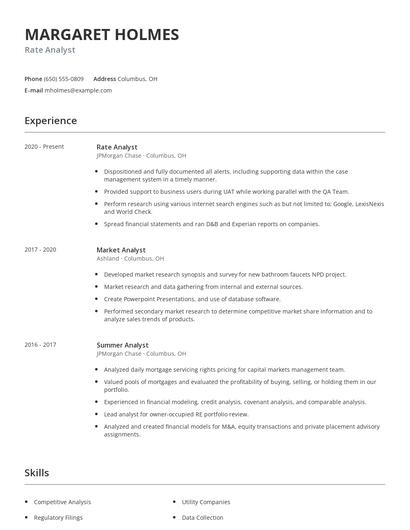
Compare different rate analysts
Rate analyst vs. Financial analyst internship
A financial analyst intern is responsible for supporting an organization with financial activities and tasks. Typical duties and responsibilities may include creating and analyzing financial reports, preparing financial statements, and helping with audits. You may be asked to perform some administrative tasks while observing the various aspects of portfolio management, accounting, and financial reporting. As a financial analyst intern, you are expected to conduct competitive analysis and market research and help prepare reports and recommendations on due diligence. You are also expected to join in on meetings and calls with company prospects.
These skill sets are where the common ground ends though. The responsibilities of a rate analyst are more likely to require skills like "powerpoint," "tariffs," "strong analytical," and "rate design." On the other hand, a job as a financial analyst internship requires skills like "r," "financial statement analysis," "due diligence," and "pivot tables." As you can see, what employees do in each career varies considerably.
The education levels that financial analyst interns earn slightly differ from rate analysts. In particular, financial analyst interns are 5.6% more likely to graduate with a Master's Degree than a rate analyst. Additionally, they're 0.3% less likely to earn a Doctoral Degree.Rate analyst vs. Analyst internship
An analyst internship is a student program where an intern is assigned to assist analyst professionals by analyzing business goals, objectives, and needs. Analyst interns assist in the planning and designing of business processes and suggest recommendations for improvement. They conduct research and analysis to support business operations and resolve issues using systems and data. They also help estimate the costs and benefits of multiple business actions and help the business organization launch new initiatives.
In addition to the difference in salary, there are some other key differences worth noting. For example, rate analyst responsibilities are more likely to require skills like "powerpoint," "tariffs," "rate design," and "regulatory filings." Meanwhile, an analyst internship has duties that require skills in areas such as "management system," "python," "data entry," and "r." These differences highlight just how different the day-to-day in each role looks.
On average, analyst interns earn a lower salary than rate analysts. Some industries support higher salaries in each profession. Interestingly enough, analyst interns earn the most pay in the professional industry with an average salary of $41,723. Whereas rate analysts have higher pay in the health care industry, with an average salary of $79,933.Average education levels between the two professions vary. Analyst interns tend to reach higher levels of education than rate analysts. In fact, they're 6.0% more likely to graduate with a Master's Degree and 0.3% more likely to earn a Doctoral Degree.What technology do you think will become more important and prevalent for rate analysts in the next 3-5 years?
Miguel Vicens
Associate Dean of School of Business, Associate Professor of Finance, Western New Mexico University
Rate analyst vs. Investment banking analyst
An Investment Banking Analyst reviews and analyzes data for investment banking portfolios. They work with individuals and businesses to suggest potential investments for their clients.
The required skills of the two careers differ considerably. For example, rate analysts are more likely to have skills like "tariffs," "strong analytical," "rate design," and "regulatory filings." But a investment banking analyst is more likely to have skills like "discounted cash flow," "healthcare," "capital markets," and "private equity."
Investment banking analysts earn the highest salary when working in the finance industry, where they receive an average salary of $89,090. Comparatively, rate analysts have the highest earning potential in the health care industry, with an average salary of $79,933.Most investment banking analysts achieve a similar degree level compared to rate analysts. For example, they're 2.4% more likely to graduate with a Master's Degree, and 0.0% more likely to earn a Doctoral Degree.Rate analyst vs. Business process analyst
The business process analysts are responsible for producing, managing, and enhancing business processes to improve business performance using data. They gather, analyze, and transcribe information about internal processes to obtain a comprehensive picture of the company's internal workings. Their responsibilities include developing strategies, identifying the needs of the user, and communicating compound data in a comprehensible way. Also, they identify, implement, and assess business metrics that are essential to the end-users. Additionally, they may act as consultants to project teams providing them with recommendations for product or service improvement.
Even though a few skill sets overlap between rate analysts and business process analysts, there are some differences that are important to note. For one, a rate analyst might have more use for skills like "powerpoint," "tariffs," "financial models," and "rate design." Meanwhile, some responsibilities of business process analysts require skills like "project management," "subject matter experts," "customer service," and "continuous improvement. "
Business process analysts enjoy the best pay in the manufacturing industry, with an average salary of $92,966. For comparison, rate analysts earn the highest salary in the health care industry.The average resume of business process analysts showed that they earn higher levels of education compared to rate analysts. So much so that theyacirc;euro;trade;re 7.4% more likely to earn a Master's Degree and less likely to earn a Doctoral Degree by 0.3%.Types of rate analyst
Updated January 8, 2025
