What does a rate clerk do?
Rate clerk responsibilities
Here are examples of responsibilities from real rate clerk resumes:
- Manage comprehensive truckload and LTL logistical information for customers and trucking carriers.
- Enter new daily updates into AS400 database for various companies.
- Verify and compare information from BOL, and orders against the actual shipment.
- Work with AP of testing, assisting with CRCT preparations and student accommodations.
- Communicate, with internal and external customers, ISO procedures, and CMMI compliance of routing and proper form nomenclature.
- Maintain cleanliness of the company warehouse, operate warehouse machinery and organize the warehouse to ensure proper product placement.
- Update shipments when routing is received and updates (PKMS).
- Secure revenue for the island of Antigua by collecting tariffs on import & export goods & services.
Rate clerk skills and personality traits
We calculated that 47% of Rate Clerks are proficient in Customer Service, Freight Bills, and Rate Quotes. They’re also known for soft skills such as Organizational skills, Communication skills, and Math skills.
We break down the percentage of Rate Clerks that have these skills listed on their resume here:
- Customer Service, 47%
Monitored customer service and sales representatives for quality, assisted other departmental personnel with administrative duties.
- Freight Bills, 17%
Apply charges to freight bills according to proper tariff and discount applications.
- Rate Quotes, 7%
Processed rate quotes by fax and phone for customers shipping merchandise requiring protective services.
- Computer System, 6%
Maintained primary rating schedule and entered all increases in computer system on an ongoing basis.
- Billing Data, 6%
Verify accuracy of billing data and revise errors, using specialized construction accounting software.
- AS400, 5%
Registered orders through AS400 Systems.
Common skills that a rate clerk uses to do their job include "customer service," "freight bills," and "rate quotes." You can find details on the most important rate clerk responsibilities below.
Organizational skills. The most essential soft skill for a rate clerk to carry out their responsibilities is organizational skills. This skill is important for the role because "financial clerks must be able to arrange files so they can find them quickly and efficiently." Additionally, a rate clerk resume shows how their duties depend on organizational skills: "prepare confidential reports, powerpoint presentations, correspondence, organizational charts and other documents as required. "
Communication skills. Another soft skill that's essential for fulfilling rate clerk duties is communication skills. The role rewards competence in this skill because "financial clerks should be able to explain policies and procedures to colleagues and customers." According to a rate clerk resume, here's how rate clerks can utilize communication skills in their job responsibilities: "operate basic office equipment, customer service, communication, critical thinking, publication, planning etc. "
Math skills. Another skill that relates to the job responsibilities of rate clerks is math skills. This skill is critical to many everyday rate clerk duties, as "the job duties of financial clerks includes calculating charges and updating financial records." This example from a resume shows how this skill is used: "collected time-sheets and re-checked math. "
The three companies that hire the most rate clerks are:
- Wells Fargo1 rate clerks jobs
- Southeastern Freight Lines1 rate clerks jobs
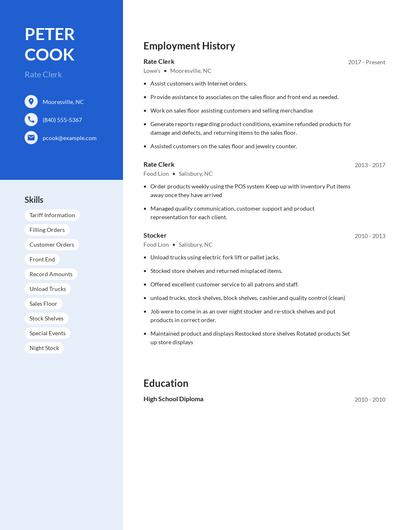
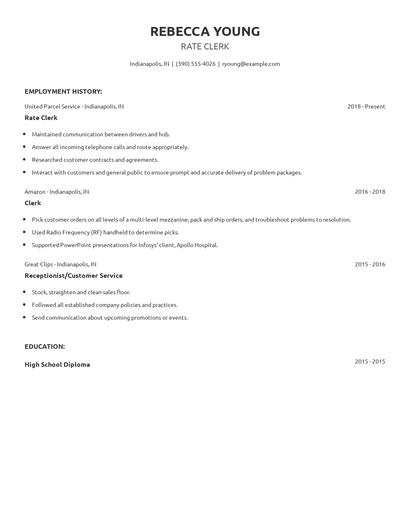
Choose from 10+ customizable rate clerk resume templates
Build a professional rate clerk resume in minutes. Our AI resume writing assistant will guide you through every step of the process, and you can choose from 10+ resume templates to create your rate clerk resume.




Compare different rate clerks
Rate clerk vs. Medical billing, receptionist
A medical billing receptionist serves as the main point of contact in a hospital. Their responsibilities revolve around greeting patients and attending to their needs, gathering and maintaining records, and checking-in patients. They also have administrative support tasks such as answering calls and responding to inquiries, arranging appointments and schedules, producing reports, keeping documentation, and handling billing processes, including insurance. Moreover, a medical billing receptionist must be alert and proactive as the conditions in a hospital can be very unpredictable.
There are some key differences in the responsibilities of each position. For example, rate clerk responsibilities require skills like "computer data entry," "freight bills," "rate quotes," and "billing data." Meanwhile a typical medical billing, receptionist has skills in areas such as "patients," "medical billing," "data entry," and "medicaid." This difference in skills reveals the differences in what each career does.
Medical billings, receptionist tend to make the most money working in the technology industry, where they earn an average salary of $35,394. In contrast, rate clerks make the biggest average salary, $41,264, in the insurance industry.On average, medical billings, receptionist reach similar levels of education than rate clerks. Medical billings, receptionist are 2.4% more likely to earn a Master's Degree and 0.3% more likely to graduate with a Doctoral Degree.Rate clerk vs. Senior billing specialist
A senior billing specialist processes and manages the billing systems of their company. They are in charge of processing necessary payments to clients and business partners and generating and providing invoices. They keep a record of all payment information. They also manage payment due dates and remind clients of the payment deadlines.
In addition to the difference in salary, there are some other key differences worth noting. For example, rate clerk responsibilities are more likely to require skills like "computer data entry," "freight bills," "rate quotes," and "computer system." Meanwhile, a senior billing specialist has duties that require skills in areas such as "patients," "billing issues," "billing system," and "data entry." These differences highlight just how different the day-to-day in each role looks.
Senior billing specialists earn a higher average salary than rate clerks. But senior billing specialists earn the highest pay in the technology industry, with an average salary of $64,965. Additionally, rate clerks earn the highest salaries in the insurance with average pay of $41,264 annually.Average education levels between the two professions vary. Senior billing specialists tend to reach higher levels of education than rate clerks. In fact, they're 6.7% more likely to graduate with a Master's Degree and 0.3% more likely to earn a Doctoral Degree.Rate clerk vs. Senior billing analyst
Billing specialists are accounting or finance employees who are responsible for sending out billing invoices to clients. They calculate charges that their clients have incurred. They then write bills, ensure that all details are correct, and send these out to clients. They also manage payment due dates and ensure that clients are duly reminded of such deadlines. Billing specialists also manage client accounts and ensure that they are paying on time. They help identify clients who have outstanding payables and send out collection notices to them. At times, billing specialists also manage the receipt of payments to manage account records better.
Some important key differences between the two careers include a few of the skills necessary to fulfill the responsibilities of each. Some examples from rate clerk resumes include skills like "customer service," "computer data entry," "freight bills," and "rate quotes," whereas a senior billing analyst is more likely to list skills in "reconciliations," "sql," "financial reports," and "billing issues. "
Senior billing analysts make a very good living in the finance industry with an average annual salary of $72,026. On the other hand, rate clerks are paid the highest salary in the insurance industry, with average annual pay of $41,264.Most senior billing analysts achieve a higher degree level compared to rate clerks. For example, they're 7.4% more likely to graduate with a Master's Degree, and 0.3% more likely to earn a Doctoral Degree.Rate clerk vs. Billing specialist
Even though a few skill sets overlap between rate clerks and billing specialists, there are some differences that are important to note. For one, a rate clerk might have more use for skills like "computer data entry," "freight bills," "rate quotes," and "os." Meanwhile, some responsibilities of billing specialists require skills like "patients," "data entry," "medical billing," and "medicaid. "
In general, billing specialists earn the most working in the manufacturing industry, with an average salary of $37,417. The highest-paying industry for a rate clerk is the insurance industry.The average resume of billing specialists showed that they earn similar levels of education compared to rate clerks. So much so that theyacirc;euro;trade;re 3.0% more likely to earn a Master's Degree and more likely to earn a Doctoral Degree by 0.2%.Types of rate clerk
Updated January 8, 2025
