What does a riser do?
Riser responsibilities
Here are examples of responsibilities from real riser resumes:
- Gain knowledge of TTR, SCR and flexible risers.
- Help develop system configurations and specifications for the production and drilling TTR system.
- Addressed CVA comments for the extreme event analysis, fatigue analysis, and interference analysis for Helix/Phoenix/GE WellStream.
- Design and analyze steel catenary risers (SCR) for use on various offshore host facilities with FEA model.
- Conduct dimensional and visual inspections procedures on CMM machines to ensure geometrical characteristics of the product are in specification.
- Assign responsibilities include ISO 9001-2000 management representative and lead internal auditor.
Riser skills and personality traits
We break down the percentage of Risers that have these skills listed on their resume here:
- API, 55%
Perform API internal/external inspections and generate reports with repair recommendations.
- Gas Meters, 45%
Located and checked gas meters throughout the valley to ensure the meters were safe and not corroded.
Math skills. Another soft skill that's essential for fulfilling riser duties is math skills. The role rewards competence in this skill because "knowledge of basic math is important for measuring, calibrating, and calculating specifications in quality control testing." According to a riser resume, here's how risers can utilize math skills in their job responsibilities: "machine operator- lap grinder, polish jack ndt inspector mathematical bearing match special process operator- black oxide"
Mechanical skills. risers are also known for mechanical skills, which are critical to their duties. You can see how this skill relates to riser responsibilities, because "quality control inspectors use tools and machinery when testing products." A riser resume example shows how mechanical skills is used in the workplace: "job duties included all aspects of ndt, cwi, api and mechanical inspections. "
Physical strength. For certain riser responsibilities to be completed, the job requires competence in "physical strength." The day-to-day duties of a riser rely on this skill, as "quality control inspectors may be required to lift or maneuver heavy production materials or finished products." For example, this snippet was taken directly from a resume about how this skill applies to what risers do: "achieved aci certification in field testing, concrete strength and aggregate testing. "
Technical skills. Another crucial skill for a riser to carry out their responsibilities is "technical skills." A big part of what risers relies on this skill, since "to ensure that products and parts meet quality standards, inspectors must understand the relevant blueprints, technical documents, and manuals." How this skill relates to riser duties can be seen in an example from a riser resume snippet: "completed technical evaluation of the vendor's bids for the production ttr components. "
The three companies that hire the most risers are:
- McDonald's43 risers jobs
- CARE2 risers jobs
- Schlumberger1 risers jobs
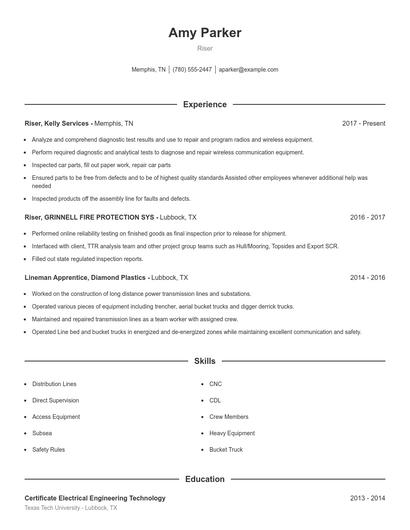
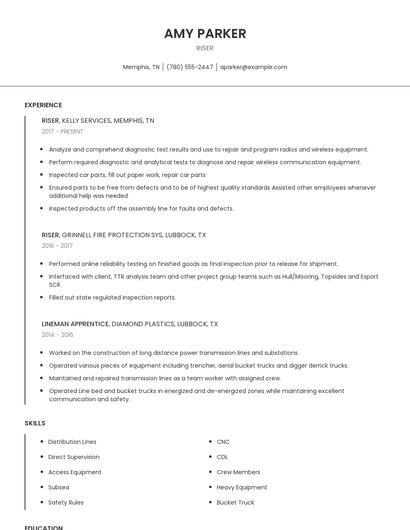
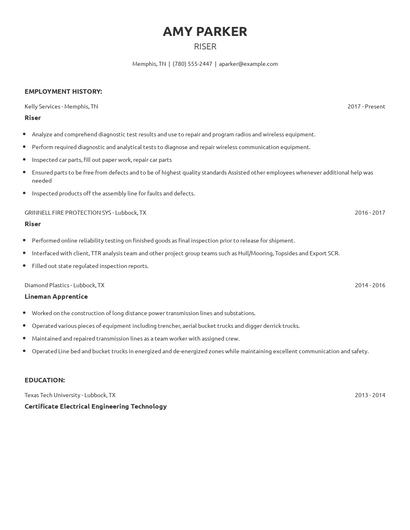
Choose from 10+ customizable riser resume templates
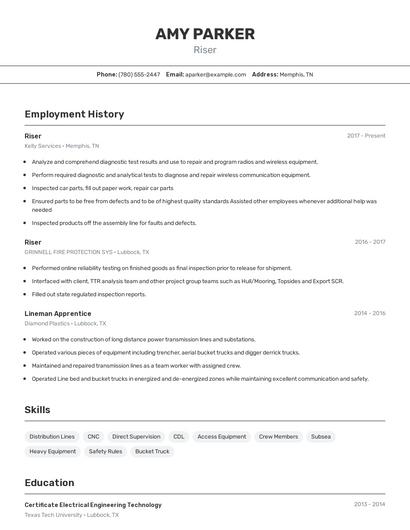
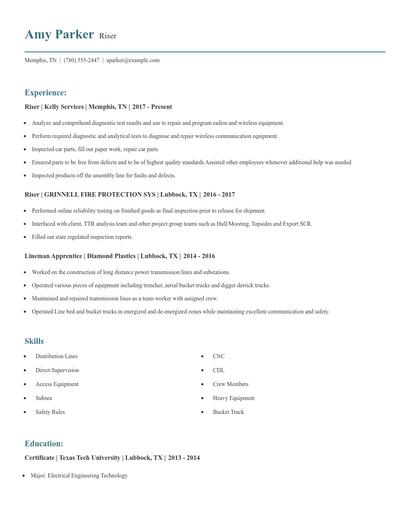
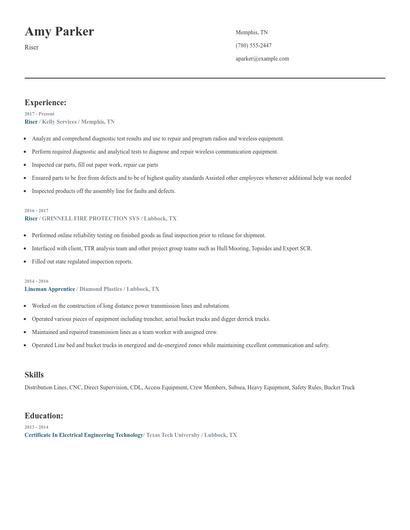
Build a professional riser resume in minutes. Our AI resume writing assistant will guide you through every step of the process, and you can choose from 10+ resume templates to create your riser resume.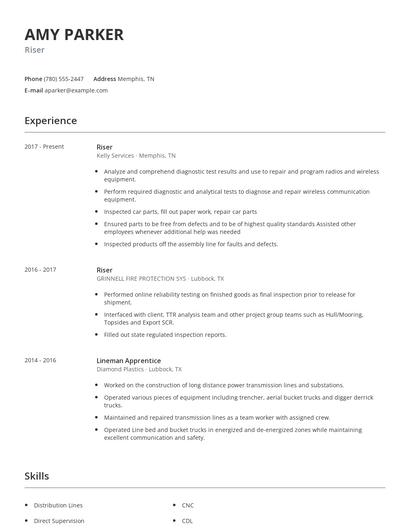


Compare different risers
Riser vs. Production employee
In a manufacturing setting, a production employee is in charge of assembling and processing products, ensuring efficiency and timelines. Their responsibilities include adhering to guidelines and blueprints, monitoring the products for any defects or inconsistencies, operating machines and equipment, keeping an eye on the assembly line, and maintaining the cleanliness of work areas. Furthermore, as a production employee, it is essential to maintain an active communication line with co-workers, coordinating every step of the way, and alerting managers should there be any problems.
While similarities exist, there are also some differences between risers and production employee. For instance, riser responsibilities require skills such as "api," "gas meters," "design codes," and "subsea engineering." Whereas a production employee is skilled in "production floor," "quality standards," "safety standards," and "work ethic." This is part of what separates the two careers.
The education levels that production employees earn slightly differ from risers. In particular, production employees are 4.5% less likely to graduate with a Master's Degree than a riser. Additionally, they're 9.2% less likely to earn a Doctoral Degree.Riser vs. Bucket operator
A bucket operator is primarily in charge of operating bucket trucks, ensuring safety and efficiency for a smooth and successful workflow. Although a bucket operator has different responsibilities depending on their industry or place of employment, it usually includes planning and coordinating operations according to project requirements, setting guidelines, and delegating duties among staff. They can also perform tasks such as pouring and collecting materials, keeping records, and maintaining the cleanliness of areas. Moreover, in some companies, they supervise staff operations while enforcing the company's safety standards and regulations.
Each career also uses different skills, according to real riser resumes. While riser responsibilities can utilize skills like "api," "gas meters," "design codes," and "subsea engineering," bucket operators use skills like "etc," "hand tools," "ladders," and "power saws."
Average education levels between the two professions vary. Bucket operators tend to reach lower levels of education than risers. In fact, they're 5.6% less likely to graduate with a Master's Degree and 9.2% less likely to earn a Doctoral Degree.Riser vs. Production utility worker
Professional utility workers have skills in customer service, safety procedures, and safety standards. Those in this career work to maintain a perpetually clean work area, comply with safety standards, inspect finished projects, repair and replace any broken equipment. A professional utility worker will also locate parts and tools to help improve workflows.
There are many key differences between these two careers, including some of the skills required to perform responsibilities within each role. For example, a riser is likely to be skilled in "api," "gas meters," "design codes," and "subsea engineering," while a typical production utility worker is skilled in "production process," "pallets," "safety rules," and "basic math."
Production utility workers typically earn lower educational levels compared to risers. Specifically, they're 5.7% less likely to graduate with a Master's Degree, and 9.4% less likely to earn a Doctoral Degree.Riser vs. Production line operator
Production line operators must have strong reading skills and a knowledge base for loading and unloading, quality control, and starting and stopping of production lines. Those who choose this career will be expected to assist in assembling and manufacturing machines, foodstuffs, and products. Production line operators most often work in a factory setting for a manufacturer.
Even though a few skill sets overlap between risers and production line operators, there are some differences that are important to note. For one, a riser might have more use for skills like "api," "gas meters," "design codes," and "subsea engineering." Meanwhile, some responsibilities of production line operators require skills like "basic math," "math," "quality standards," and "safety guidelines. "
The average resume of production line operators showed that they earn lower levels of education compared to risers. So much so that theyacirc;euro;trade;re 5.1% less likely to earn a Master's Degree and less likely to earn a Doctoral Degree by 9.0%.Types of riser
Updated January 8, 2025
