
Automatically apply for jobs with Zippia
Upload your resume to get started.
Security administrator skills for your resume and career

15 security administrator skills for your resume and career
1. Customer Service
Customer service is the process of offering assistance to all the current and potential customers -- answering questions, fixing problems, and providing excellent service. The main goal of customer service is to build a strong relationship with the customers so that they keep coming back for more business.
- Led various migration and integration of new security devices into the existing network which dramatically improved operational efficiency and customer service.
- Provided substantial support as a Security Administrator through demonstrating outstanding customer service while ensuring that mission-critical functions are met each day.
2. Troubleshoot
Troubleshooting is the process of analyzing and fixing any kind of problem in a system or a machine. Troubleshooting is the detailed yet quick search in the system for the main source of an issue and solving it.
- Communicate with Local Security Administrator to troubleshoot application access issues.
- Coordinated with other agencies in order to track employee's security clearances and troubleshoot any problems that arose in the process.
3. Security Procedures
A security procedure is a verification protocol used to check if an electronic signature, record, or performance belongs to that specific person. It is a set of necessary procedures that need to be performed to maintain security. These procedures are step-by-step guidelines on how to implement, enable, or enforce security.
- Liaised with management to provide recommendations regarding enhancements to physical and technical security procedures.
- Maintained and implemented all Security Administrative and Physical Security/Computer Security Procedures for classified processing.
4. Data Entry
Data entry means entering data into a company's system with the help of a keyboard. A person responsible for entering data may also be asked to verify the authenticity of the data being entered. A person doing data entry must pay great attention to tiny details.
- Manage requests simultaneously for different Medicare regions via data center and electronic data entry personnel.
- Utilized proprietary software; performed data entry and managed databases of customers.
5. Security Policies
- Developed and implemented Security policies and procedures supporting these assessments for the organization and monitored their viability in these dynamic environments.
- Prepared disaster recovery plan and monitored compliance with information security policies and procedures in the various units of the organization.
6. SCI
SCI stands for "sensitive compartmented information." This program maintains confidential information, often in a military or government capacity, regarding anything from analytical processing, collection methods and systems, and targeting measures. Considering the confidentiality of the information, only qualified individuals are given SCI access.
- Prepare and provide SCI visit certification policy and procedure training to the various administrative support staff forums at the laboratory
- Coordinated and monitored internal and external customers SCI security activities, ensuring compliance with DARPA security policy/procedures.
Choose from 10+ customizable security administrator resume templates
Build a professional security administrator resume in minutes. Our AI resume writing assistant will guide you through every step of the process, and you can choose from 10+ resume templates to create your security administrator resume.7. DOD
Definition of Done (DoD) is a set of deliverables that are needed to devise software. These deliverables are valuable to the system and can be exemplified by writing code, coding comments, unit testing, integration testing, design documents, release notes, and so on.
- Verified and validated hardware is fully compliant with DoD security requirements and specifications.
- Provided senior-level administrative support to senior staff on DoD classified programs.
8. HR
HR stands for human resources and is used to describe the set of people who work for a company or an organization. HR responsibilities revolve around updating employee records and carrying out management processes like planning, recruitment, evaluation, and selection processes. HR is a key contributor to any company or organization's growth as they are in charge of hiring the right employees, processing payrolls, conducting disciplinary actions, etc.
- Collaborate with upper management and HR to ensure programmers and developers have appropriate application security access.
- Ensured that HR technology usage and administration is compliant with corporate policies and regulatory requirements.
9. Security Systems
A security system refers to any device that can perform security operations such as surveillance, access control, alarm, or intrusion control in a facility or area through a system of components and multifunctional devices designed to protect people and the property against a variety of hazards including crime, arson, accidents, espionage, sabotage, subversion, and attack. A security system also detects several other threats, including smoke, carbon monoxide poisoning, and water damage.
- Provided Global System Administration for mainframe systems and preformed internal audits of security systems to support Bank Readiness Initiatives.
- Developed a risk analysis matrix, contingency and recovery plan for the physical security systems and network infrastructure.
10. Linux
Linux is a Unix-like operating system. Just like Windows, Mac OS, and IOS, Linux is an operating system used by millions across the globe. Android itself is powered by the Linux operating system. Linux manages all the hardware resources that are associated with your computer. The software is famous because of the protection it grants from viruses, malware, and crashes. The Linux operating system is entirely free and is an open-source software meaning it can be altered by those equipped with the knowledge to code.
- Performed vulnerability and networking scanning assessments on all Linux and Windows instance in AWS develop environment to minimize vulnerabilities.
- Upgrade of Connect:Direct software from 4.0 to 4.1 Secure+, and configuration on 8 HA servers, running Linux.
11. JPAS
- Monitored and managed employee security clearance investigation processes using JPAS and Visit Invitation and Request Letters.
- Updated personnel security clearance information utilizing JPAS and SIMS as required.
12. PowerPoint
- Developed various security awareness presentations in support of organizational security educational program using MS PowerPoint.
- Developed innovative PowerPoint presentation used by the Security Office, for new Security Badge System, and exchange of security badges.
13. IDS
An IDS (intrusion detection system) stands for a software application or device that monitors a network to identify policy violations or malicious activities.
- Performed security administration maintenance of client user ids with supported applications and technologies.
- Suggested IDS solution to automate auditing of network vulnerabilities and intrusions.
14. SQL
- Developed and implemented statistical reporting for several investors using SQL studio.
- Run queries, both in PeopleSoft and in SQL, to extract data requested by audit and for projects.
15. Unix
UNIX is a computer operating system that was first created in the 1960s and has been constantly updated since then. The operating system refers to the set of programs that enable a machine to function. It is a multi-user, multi-tasking device that works on computers, laptops, and servers. UNIX systems also have a graphical user interface (GUI), similar to Microsoft Windows, that makes it simple to use.
- Represented the UNIX platforms during final negotiations for contract-required security settings.
- Supported Security initiatives/administration on HGVC system including Windows NT and Unix.
5 Security Administrator resume examples
Build a professional security administrator resume in minutes. Browse through our resume examples to identify the best way to word your resume. Then choose from 5+ resume templates to create your security administrator resume.

What skills help Security Administrators find jobs?
Tell us what job you are looking for, we’ll show you what skills employers want.
What skills stand out on security administrator resumes?
Mark Van Holt
Global Security Manager, Gulfstream Aerospace
What type of skills will young security administrators need?
Joé Lloyd
Senior Director, AVIXA
List of security administrator skills to add to your resume
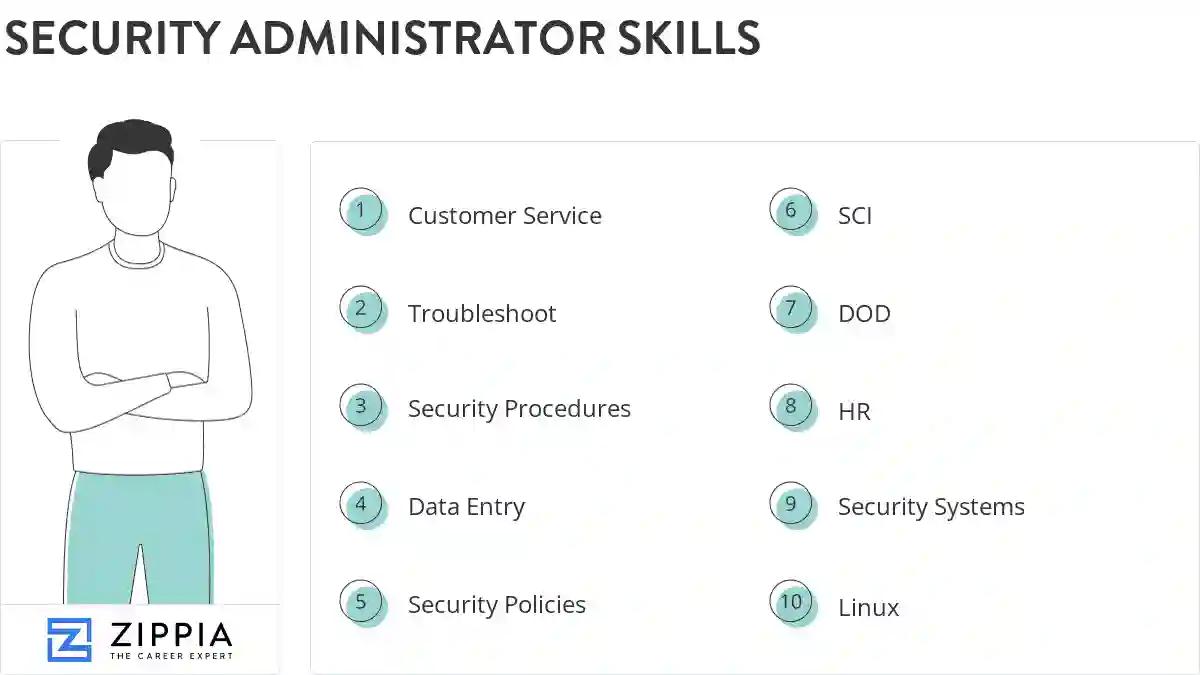
The most important skills for a security administrator resume and required skills for a security administrator to have include:
- Customer Service
- Troubleshoot
- Security Procedures
- Data Entry
- Security Policies
- SCI
- DOD
- HR
- Security Systems
- Linux
- JPAS
- PowerPoint
- IDS
- SQL
- Unix
- Data Loss Prevention
- Security Issues
- Technical Support
- National Security
- Provisioning
- DSS
- Physical Security
- Lotus Notes
- SharePoint
- Security Briefings
- HIPAA
- Security Clearance
- User Accounts
- SIMS
- NISPOM
- SOX
- McAfee
- LDAP
- VPN
- DNS
- Law Enforcement
- Mobile Device Management
- FSO
- Mainframe
- PCI
- LAN
- Security Violations
- Adjudication System
- Windows XP
- Key Management
- VMware
- COMSEC
- PeopleSoft
Updated January 8, 2025
